
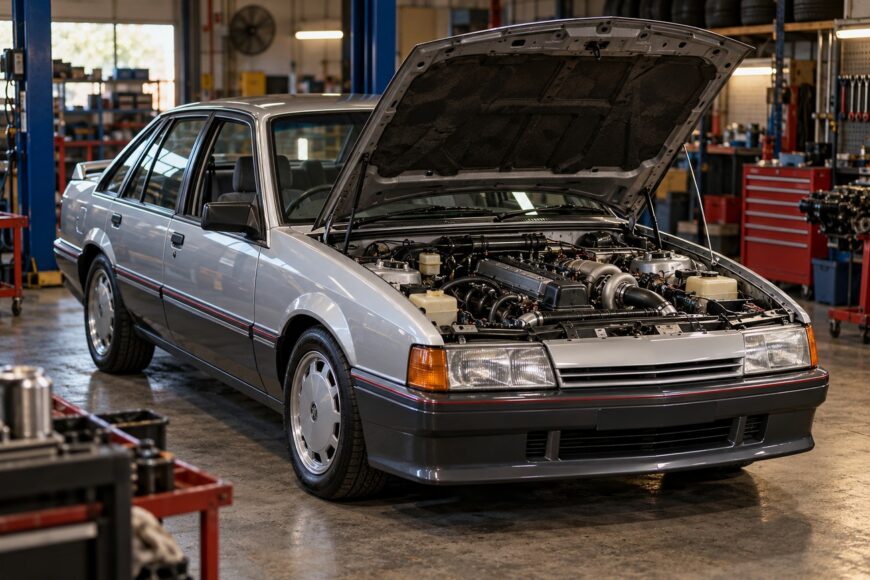
The Holden VL Commodore Turbo is Nissan-powered, but it is not simply a Skyline engine transplanted unchanged into a Holden body. Its Nissan RB30ET was installed through a Holden–Nissan agreement and adapted for the Australian VL application, which makes the car more interesting technically and more complicated to authenticate today.
The appeal is easy to understand: a 2962 cm³ turbocharged straight-six, rear-wheel drive, factory manual availability, and a strong reputation for usable torque. The ownership risks are less glamorous. Age, overheating, worn turbo hardware, modified wiring, tired hoses, and inconsistent power claims now matter more than the Turbo badge. A surviving car needs to be assessed as an old performance vehicle, not treated as a rolling factory specification sheet.
- Why the VL Turbo Is Not Just a Skyline with a Holden Badge
- RB30ET Hardware and the Factory Specification
- How the VL Turbo Delivered Its Performance
- Cooling, Turbocharger, and Age-Related Failure Points
- What to Check Before Buying a VL Commodore Turbo
- Modification Myths and Sensible RB30ET Ownership
- Frequently asked questions
- How much is a VL Turbo worth?
- How much horsepower does a VL Turbo have?
- How can you tell whether a VL Turbo is an original factory car?
- What is the correct firing order for the RB30ET?
Why the VL Turbo Is Not Just a Skyline with a Holden Badge
VL Commodore Turbo production began in August 1986, after Holden entered an arrangement with Nissan to use the RB30 engine family in the Australian Commodore. The turbocharged version was designated RB30ET and gave Holden a suitable performance engine during a period when local engine development and emissions requirements made an in-house solution less practical.
That arrangement explains the car’s identity. The VL received the Nissan engine, but the installation involved Holden-specific intake hardware, engine management, wiring, ancillary equipment, and calibration. A standard R31 Skyline engine bay may contain familiar parts, yet familiarity alone does not make every component interchangeable or prove that a replacement engine matches the original VL specification.
The factory power figure applied across different VL body variants equipped with the turbo engine. It was not restricted to one special body style, even though certain versions have become more visible in collector and enthusiast circles. A sedan, wagon, or other factory turbo application still needs to be judged by its documentation and physical configuration rather than by assumptions based on the badge.
Modern modified cars make the distinction harder. Many surviving examples combine Holden parts, R31 Skyline components, aftermarket electronics, and replacement turbo hardware. A car can be mechanically competent and enjoyable while still being different from a factory-correct VL Turbo. That difference affects diagnosis, parts selection, originality, and the cost of restoring the car later.
RB30ET Hardware and the Factory Specification
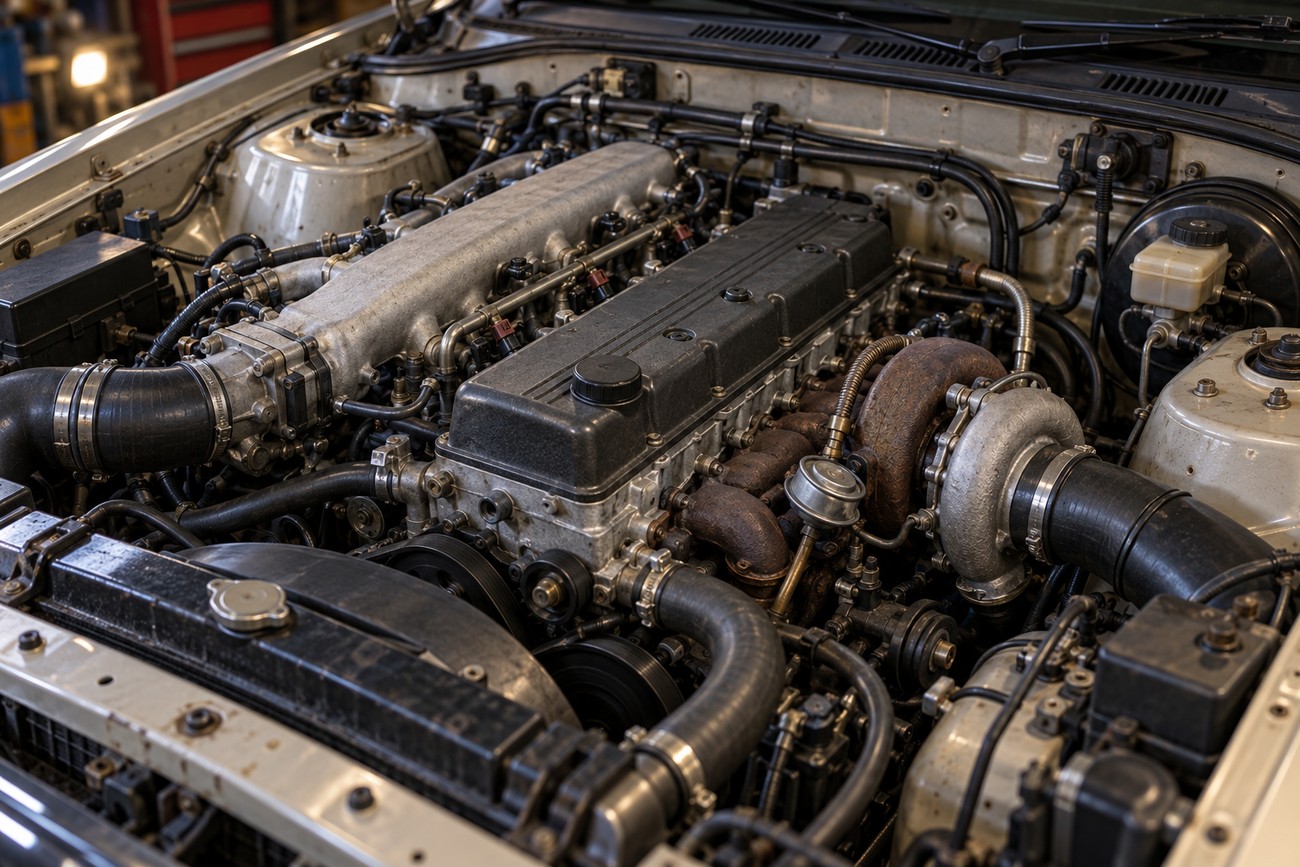
The RB30ET is a 2962 cm³ inline-six with a cast-iron block and aluminum cylinder head. Factory output was 150 kW at 5600 rpm and 296 N·m at 3200 rpm. Those figures describe the intended factory engine in correct condition, including its fuel, ignition, cooling, and boost systems.
Its compression ratio was 7.8:1, reflecting the requirements of a turbocharged engine using the period’s control systems and fuel. The turbo version used different pistons, camshaft, intake, oil pump, injectors, and piston oil-cooling squirters compared with the naturally aspirated RB30E. The block casting therefore provides only part of the identification story.
Fuel delivery came through 250 cm³ injectors, while oil squirters directed cooling oil beneath the pistons. These details matter when parts are mixed during a rebuild. Installing naturally aspirated components without checking compression ratio, piston-to-valve clearance, fuel demand, and calibration can create an engine that starts and runs while carrying substantially different tuning requirements.
The turbocharger was a water-cooled Garrett T3. The water circuit adds another reason to inspect hoses, connections, and coolant quality carefully. A turbocharger that looks original may still have a worn shaft, damaged seals, or an actuator that no longer controls boost correctly, so visual similarity is no substitute for testing.
How the VL Turbo Delivered Its Performance
Typical factory boost is stated at approximately 7 psi. That is a modest figure by modern modified-car standards, but it suits the engine’s period calibration and gives the VL a broad torque delivery rather than a narrow, peaky powerband. The car’s character depends heavily on whether the boost arrives consistently and whether the engine can maintain correct mixture and ignition control under load.
Buyers could choose a five-speed manual or a four-speed automatic. The manual generally gives the driver more control over the engine’s response, while the automatic’s condition has a major effect on how quick the car feels. A tired automatic may shift slowly, hold first gear for too long, or turn a healthy engine into a disappointing driving experience.
Factory output was 150 kW at 5600 rpm and 296 N·m at 3200 rpm. Some advertising and secondary sources express the output as approximately 201–204 hp/PS. That wording reflects unit and terminology differences rather than confirmed separate factory outputs, so the safest reference remains the canonical 150 kW specification.
Approximately 7.6 seconds for 0–100 km/h appears as a secondary estimate rather than a universal confirmed factory figure. Transmission choice, tires, fuel, weather, launch technique, vehicle condition, and test method all influence the result. A car that feels slower than that estimate may have a boost or transmission problem, yet acceleration alone cannot identify the fault.
Cooling, Turbocharger, and Age-Related Failure Points
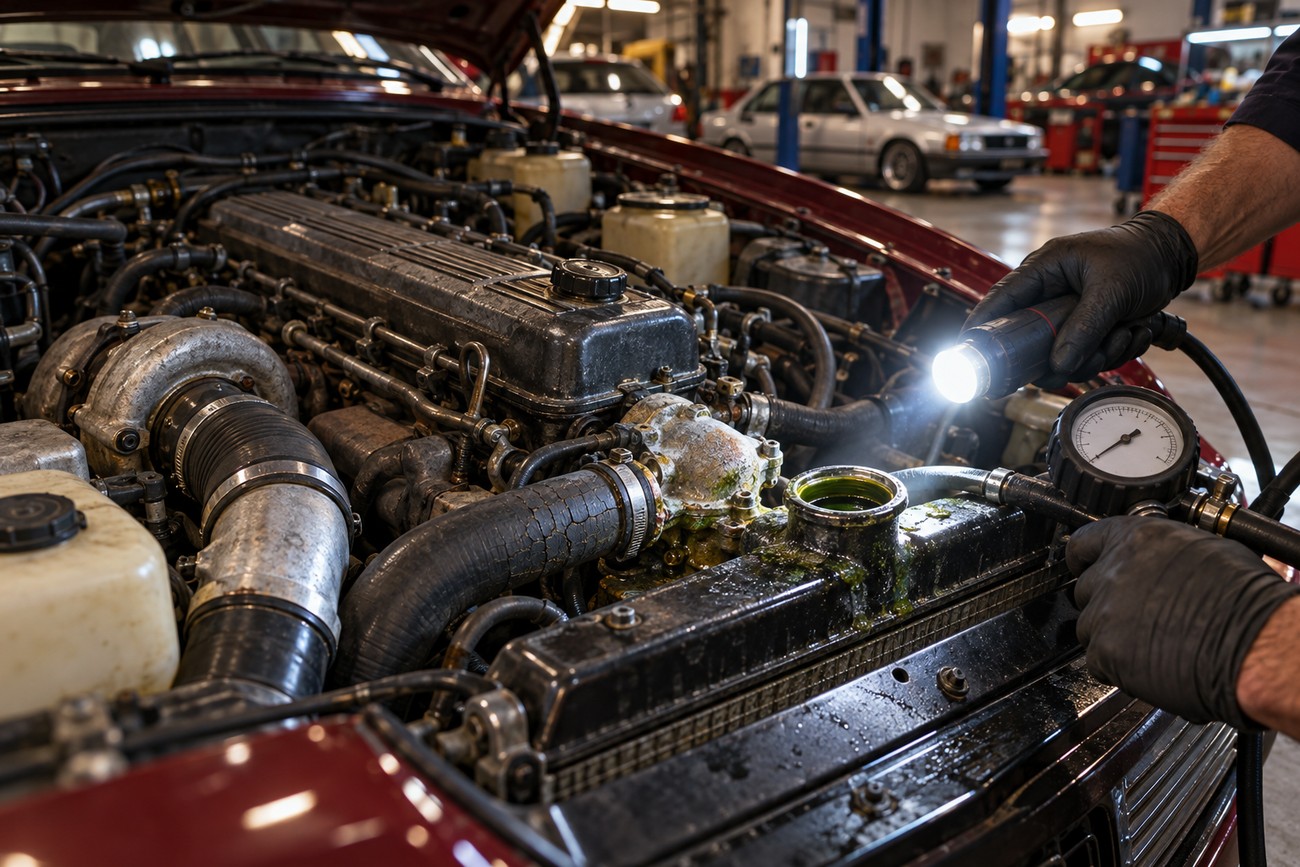
Cooling-system condition is the central mechanical concern. Low coolant, a restricted radiator, trapped air, a faulty thermostat, or poor circulation can raise temperatures quickly. Once an RB30ET overheats, the consequences may include cylinder-head distortion, loss of sealing, and head-gasket damage rather than a simple thermostat replacement.
Correct filling and air removal deserve as much attention as the parts themselves. Old hoses, blocked passages, a corroded radiator, and an incorrectly functioning thermostat can produce similar symptoms. Replacing a gasket without finding the cause leaves the engine exposed to another failure, while replacing a thermostat alone may miss restricted circulation or a head that has already lost its sealing surface.
Cooling diagnosis starts with correct filling, air removal, thermostat operation, and circulation checks. A head-gasket replacement or thermostat swap should follow evidence of the failure, not replace the diagnosis.
The aging factory wastegate actuator can cause unstable boost or boost creep. The turbocharger itself should be checked for shaft play, blue smoke under load, and reduced power. A noticeable whistle may attract attention, yet shaft movement, oil contamination, actual boost under load, and smoke provide more useful evidence of condition.
Fuel, vacuum, and coolant hoses also deserve close inspection. Hardened or cracked hoses can create air leaks, lean running, unstable boost behavior, or overheating. The same applies to old fuel lines and electrical connections: a car may idle acceptably while developing a dangerous mixture or ignition problem under load.
The four-speed automatic adds a separate ownership risk. Its behavior strongly affects the performance impression, and a slow shift or persistent first-gear hold should be investigated rather than dismissed as normal turbo-car character. On a car of this age, seals, wiring, fuel lines, and suspension components can require attention even when the engine still produces useful power.
What to Check Before Buying a VL Commodore Turbo
Start with evidence rather than the Turbo emblem. A compression test, oil-pressure check, cooling-system inspection, and careful search for previous overheating provide a more useful baseline than a short drive. Look for coolant loss, combustion gases, oil contamination, uneven compression, and signs that the cylinder head has already been removed or repaired.
Test the turbo system under load with a reliable boost gauge. Confirm that the wastegate responds correctly and that boost remains controlled through the rev range. Inspect the turbo for shaft play and oil leakage, then check for blue smoke under load and a clear loss of power. A loud turbo is not automatically a damaged turbo, and a quiet one is not automatically healthy.
Trace the wiring, hoses, intake, fuel system, ECU, and ancillary equipment. Modified cars may combine Holden, Nissan Skyline, and aftermarket components, sometimes with undocumented repairs. The block marking alone does not prove an original VL Turbo configuration, because engines and equipment are frequently exchanged over decades of use.
Provenance and body condition can matter as much as engine health. Original VL Turbo body and trim components can be scarce and expensive to replace, particularly when a car has been converted, repaired after damage, or stripped for modification. Check panel alignment, corrosion, interior trim, identification records, gearbox type, and the completeness of the equipment before assigning value to a mechanically strong engine.
A practical inspection sequence is:
- Confirm vehicle records, engine identity, and the history of modifications.
- Check compression, oil pressure, coolant condition, and evidence of past overheating.
- Inspect the radiator, thermostat, hoses, water lines, and signs of trapped air or poor circulation.
- Measure real boost under load and check wastegate operation.
- Inspect turbo shaft play, smoke, oil leaks, fuel lines, vacuum hoses, and wiring.
- Evaluate automatic shifting or manual gearbox condition during a complete road test.
- Compare body, trim, and interior completeness with the cost of sourcing replacement parts.
Modification Myths and Sensible RB30ET Ownership
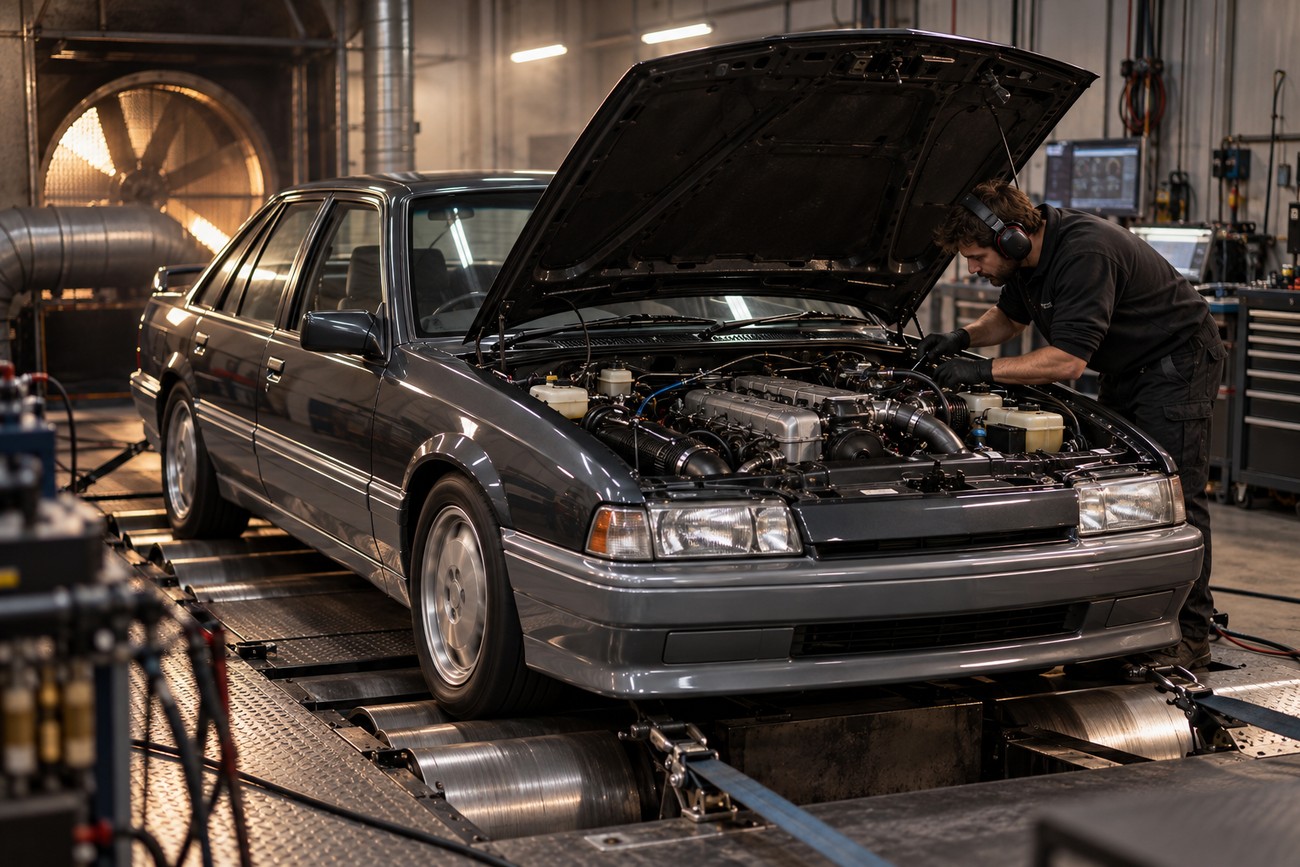
The RB30’s reputation for strength can encourage careless tuning. The factory 150 kW figure describes a new or correctly configured factory engine, not every surviving car with an unknown ECU, old gasket, altered fuel system, or replacement turbocharger. Raising boost above the typical factory level of approximately 7 psi without controlling mixture, detonation, and temperature increases the chance of serious damage.
The head gasket is often treated as the only limitation, but the surrounding system matters just as much. Weak cooling, poor ignition control, inadequate fuel delivery, and a worn turbo can turn additional boost into detonation or excessive heat. A car that survives a few enthusiastic drives has not necessarily demonstrated a safe calibration.
R31 Skyline compatibility is also frequently overstated. Naturally aspirated RB30 parts should not be fitted without checking compression ratio, clearances, fuel requirements, and calibration. Intake, wiring, engine management, and ancillary equipment may differ between the VL application and a Skyline, even where the engine family and basic architecture appear identical.
Replacement ECUs and turbochargers may make a car faster while moving it away from factory specification. That can be a sensible engineering choice when documented and correctly calibrated, but it changes the diagnostic process and may affect legal conformity. During ignition work, the RB30ET firing order is 1-5-3-6-2-4; incorrect lead or wiring connections after service can produce immediate misfires that are easily mistaken for fuel or turbo trouble.
Frequently asked questions
The answers below separate factory data from the condition and history of individual surviving cars. That distinction is essential with a performance vehicle that has often been repaired or modified.
How much is a VL Turbo worth?
There is no single defensible value without considering originality, documented provenance, body and trim completeness, gearbox condition, cooling history, and the quality of modifications. A car with a correct, well-documented configuration and sound body may deserve a different assessment from a mechanically quick example assembled from Skyline and aftermarket parts.
Inspect the structure, panels, interior, identification records, engine management, turbo hardware, and transmission before relying on the engine’s reputation. A strong engine cannot compensate fully for scarce missing trim, poor repair history, or unresolved overheating. Conversely, a modified car with clear records and professional calibration may be more usable than an untouched-looking car with unknown faults.
How much horsepower does a VL Turbo have?
The factory specification is 150 kW at 5600 rpm, with 296 N·m at 3200 rpm. Some advertising and secondary sources state approximately 201–204 hp/PS; those figures arise from power-unit conversion and terminology differences rather than proving separate factory engines.
Actual output from a surviving car depends on compression health, boost control, fuel delivery, ignition calibration, turbocharger condition, and the measuring equipment used. A modified car should be described by its measured configuration and documentation rather than automatically being assigned the factory figure.
How can you tell whether a VL Turbo is an original factory car?
Use a provenance process rather than one identifying feature. Compare registration and service records with the engine, ECU, wiring, intake, turbocharger, fuel system, and body-specific details. The Turbo badge and RB30 block marking are useful clues, yet neither proves that the car retains its original VL Turbo configuration.
Look for consistent connections between the documented vehicle, its engine management, ancillary equipment, and body and trim specification. A replacement engine or ECU does not automatically make a car undesirable, but the change should be recorded clearly because it affects originality, diagnosis, and future restoration.
What is the correct firing order for the RB30ET?
The correct RB30ET firing order is 1-5-3-6-2-4. Confirm the cylinder numbering and lead routing before testing other systems.
An incorrect connection after distributor, ignition, or wiring work can cause immediate misfires and poor running. That simple check should precede assumptions about injector failure, turbo damage, or ECU calibration.







