
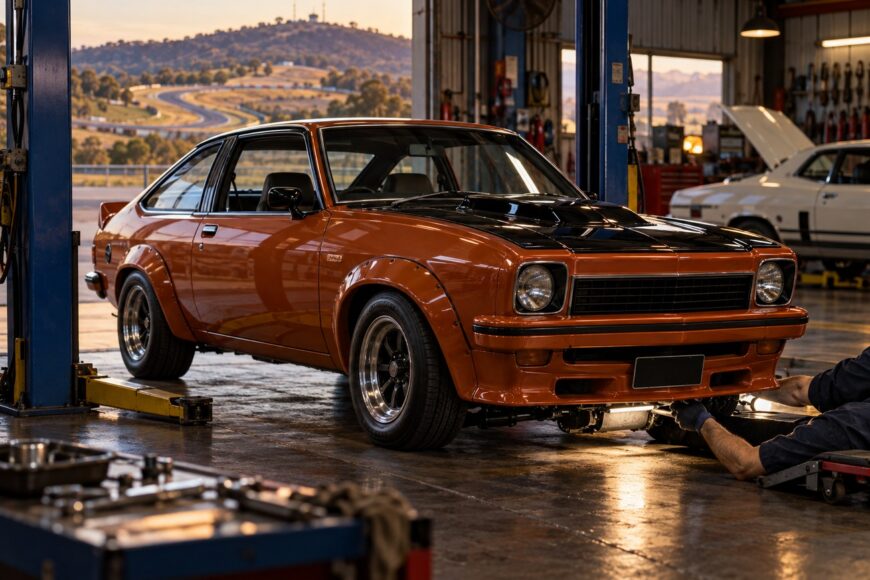
The Holden Torana A9X carries the reputation of a Bathurst weapon, yet its factory identity was more precise. It was a rare option package or special specification for the LX Torana SL/R 5000 sedan and SS hatch, rather than a standalone Holden model. That distinction matters because the market contains genuine factory cars alongside tributes, replicas, and later Bathurst-specification conversions.
Built from 1977 to 1979, the A9X combined a large V8 with competition-minded chassis hardware and road legality. Buyers face familiar risks: missing provenance, altered bodies, scarce original parts, and a ride that can be noisy and tiring outside a circuit. Its significance comes from the way homologation connected an ordinary production car to touring-car competition, provided the example in front of you is genuinely what it claims to be.
- What the Holden Torana A9X actually was
- A9X road-car specification at a glance
- Why the A9X became a Bathurst weapon
- Buying an A9X: authenticity before horsepower
- Frequently asked questions
- What is the rarest Holden Torana?
- How much is a Torana A9X worth?
- What is the top speed of the Holden Torana A9X?
- How fast do cars go at Bathurst 1000?
What the Holden Torana A9X actually was
The A9X was offered for the LX Torana SL/R 5000 sedan and SS hatch. Calling it a separate model is convenient shorthand, though it hides how Holden used production options and special specifications to meet competition requirements. The Bathurst connection is central to its reputation, but the road car remained a road-going homologated compromise.
Production is generally dated to 1977–1979. The Buyers Guide figure is 405 cars in total: 305 sedans and 100 hatchbacks. That split affects collectability, inspection priorities, and valuation, so a seller’s description of “A9X” is incomplete without the body style and supporting records.
Its importance lies in the hardware that could be built into, identified with, and developed from a production car. The popular nickname should not be treated as a complete technical definition. A car wearing the right stripes or body additions may resemble an A9X while lacking the factory specification that gives the name its historic and financial weight.
A9X road-car specification at a glance
The headline figures matter, although the floorpan, axle, brakes, and wheels explain more about the A9X’s competition purpose than power alone.
| Item | Factory specification |
|---|---|
| Engine | 5048 cm³ naturally aspirated V8, single carburetor |
| Power | 164 kW |
| Torque | 406 N·m |
| Transmission | 4-speed manual |
| Brakes | Four-wheel discs, booster, and dual-circuit hydraulics |
| Floorpan | UC floorpan |
| Rear axle | 10-bolt Salisbury rear end |
| Wheels | Wider wheels suited to track use |
| Production | 405 cars: 305 sedans and 100 hatchbacks |
Why the A9X became a Bathurst weapon
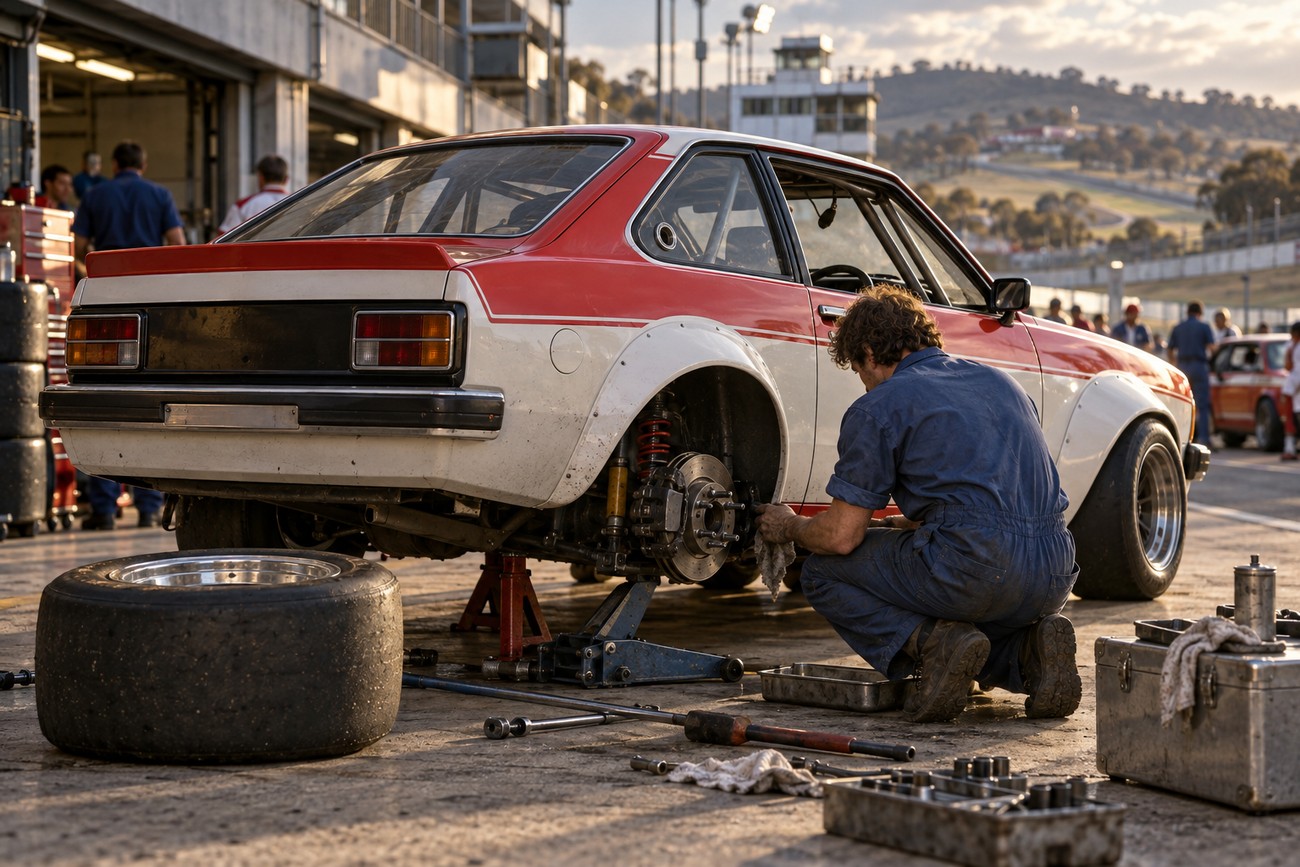
The A9X shows how production homologation could influence touring-car performance. Its road specification included the foundation for stronger braking, improved chassis control, and a more suitable rear axle. Those changes were useful on a long, demanding circuit because consistency and durability matter as much as an impressive engine figure.
The hatchback also offered useful packaging for wider rear tires, which helped competition preparation. That does not make every hatch automatically superior to a sedan. Body style, surviving specification, and the way a particular car was developed matter more than a simple hierarchy between the two.
The Bathurst association is supported by results rather than advertising alone. Peter Janson and Larry Perkins were associated with second place in the 1979 Hardie-Ferodo 1000, a result that helped fix the A9X in Australian performance-car history. The road version still retained a 4-speed manual and the compromises of a usable road car, so it should not be confused with a pure racing machine.
Buying an A9X: authenticity before horsepower
A VIN or badge is a starting point, not proof. A careful assessment combines identification details, matching numbers, ownership history, and physical inspection. The goal is to establish both factory identity and the car’s present specification, since a genuine A9X may have accumulated later modifications.
Inspect the UC floorpan, 10-bolt Salisbury rear end, and four-wheel disc-brake hardware closely. Check for repairs, substitutions, and evidence that a standard Torana was converted later. Paint, decals, wheels, and a powerful engine can create a persuasive appearance while leaving the important structural and mechanical questions unanswered.
Matching numbers and a continuous ownership record strengthen the case, although neither replaces an examination of the car itself. A tribute, race replica, or later Bathurst-specification build may be an enjoyable machine, but it should be described and valued on those terms. Confusing it with a factory A9X creates problems at resale and can make restoration decisions unnecessarily expensive.
Condition brings its own compromise. Original A9X-specific parts can be costly and difficult to source, while returning a modified car to factory specification may require substantial work. The track-oriented setup can also make the car stiff, noisy, and tiring in normal traffic; buyers expecting relaxed classic-road-car manners often underestimate that trade-off.
Frequently asked questions
What is the rarest Holden Torana?
There is no single universal answer because rarity depends on the exact factory variant, body style, and number of documented examples that survive. The A9X is unquestionably scarce at 405 cars, comprising 305 sedans and 100 hatchbacks, but that figure alone does not establish an unsupported overall ranking among every Torana variant.
How much is a Torana A9X worth?
No fixed value applies to every A9X. Documented factory authenticity, body condition, originality, sedan-versus-hatch status, matching numbers, and restoration quality can change the assessment substantially. A later tribute or Bathurst-specification conversion must be valued as that type of car rather than as a factory A9X.
What is the top speed of the Holden Torana A9X?
The supplied factory data does not establish one authoritative top-speed figure. Gearing, mechanical condition, tires, and later modifications make isolated claims unreliable, while the A9X’s historical importance rests more on its homologated chassis and competition relevance than on a single published number.
How fast do cars go at Bathurst 1000?
Bathurst performance varies with the era, regulations, weather, circuit conditions, and the specific race-car setup. Circuit speed is also different from a car’s published top speed because lap performance depends on braking, cornering, gearing, and endurance strategy. A single number would therefore give a misleading picture of A9X-era racing.







