
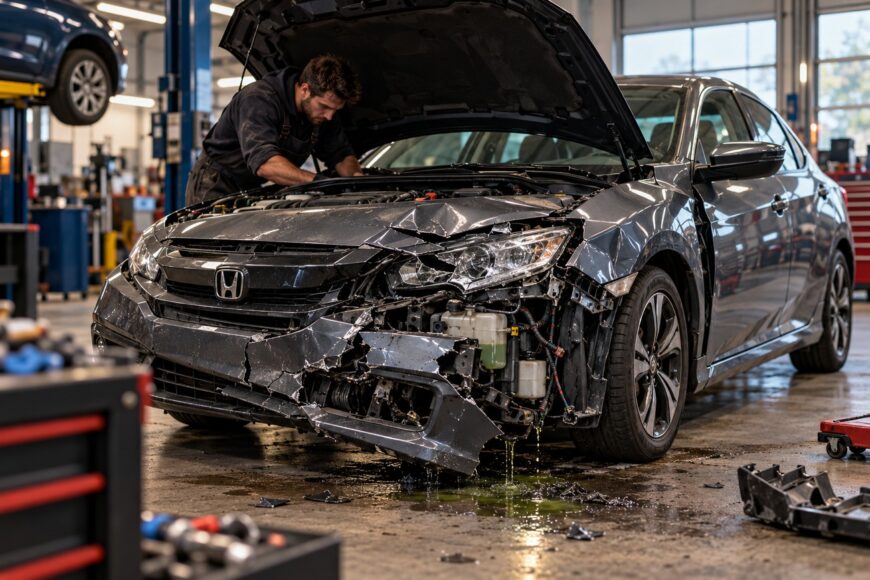
A deer strike can look like a minor front-end hit and still produce a repair estimate of roughly $4,500–$10,000. The visible damage may be limited to a cracked bumper and bent hood, while the impact has also affected a headlight mount, radiator, wiring, or parts behind the front support.
That leaves you with two financial paths: repair the Honda Civic or accept a total-loss settlement. The right decision depends on the car’s actual value, the insurance estimate, the deductible, and whether the inspection has uncovered all damage. A photograph or quick visual check cannot price the job reliably.
- How Much Does It Cost to Repair a Honda Civic After Hitting a Deer?
- Honda Civic Deer-Hit Repair Costs by Repair Path
- Why the Estimate Jumps After the Bumper Comes Off
- Repair or Total Loss? How the Insurance Decision Works
- Frequently asked questions
- How much will insurance go up after hitting a deer?
- What should I ask the body shop before approving a Civic deer-hit repair?
How Much Does It Cost to Repair a Honda Civic After Hitting a Deer?
Owner-reported Civic repair estimates commonly fall around $4,500–$10,000. These are real-world comparisons, not an official price list or a guaranteed quote. The final amount changes with the Civic’s generation, local labor rates, shop equipment, paint requirements, and the parts selected.
A typical front-end repair may involve the bumper, hood, fender, headlight, plastic mounts, wiring, radiators, and nearby engine-bay components. A car can still start and drive while several of these parts are bent, leaking, or electrically damaged. The estimate often grows after the bumper and headlight are removed.
Parts choice creates a substantial difference. Owner-reported comparisons place external aftermarket parts at roughly $2,000–$4,000 and OEM external parts at roughly $6,000–$9,000. Those figures describe parts-related comparisons, not complete repairs with labor, paint, diagnostics, and possible hidden damage.
Some estimates approach $13,000, especially when cooling components, mounts, wiring, or additional panels require replacement. A newer Civic may justify that repair, while an older or high-mileage model may move quickly toward a total-loss decision.
Honda Civic Deer-Hit Repair Costs by Repair Path
The figures below are owner-reported examples. Labor, paint matching, disassembly, diagnostics, calibration, and fitment can dominate the final bill, so a part price should never be treated as a finished repair quote.
| Repair path | Reported cost or range | What the figure may exclude |
|---|---|---|
| DIY or salvage parts | About $400 in a simple case | Professional labor, paint, diagnostic work, time, and the risk of incompatible or damaged parts |
| Aftermarket external parts | Roughly $2,000–$4,000 | Full labor, paint blending, hidden damage, calibration, and cooling-system repairs |
| OEM external parts | Roughly $6,000–$9,000 | Labor, paint, teardown supplements, diagnostics, and damage behind the panels |
| Professional body-shop estimate | Roughly $4,500–$10,000 | The final amount may rise after teardown reveals additional damage |
The roughly $400 outcome is an exceptional DIY or salvage-parts example, not a typical professional repair cost. It may require suitable tools, time, a matching paint color, and careful inspection of every used part. A cheap panel can become expensive if its brackets are bent or its finish does not match.
Why the Estimate Jumps After the Bumper Comes Off
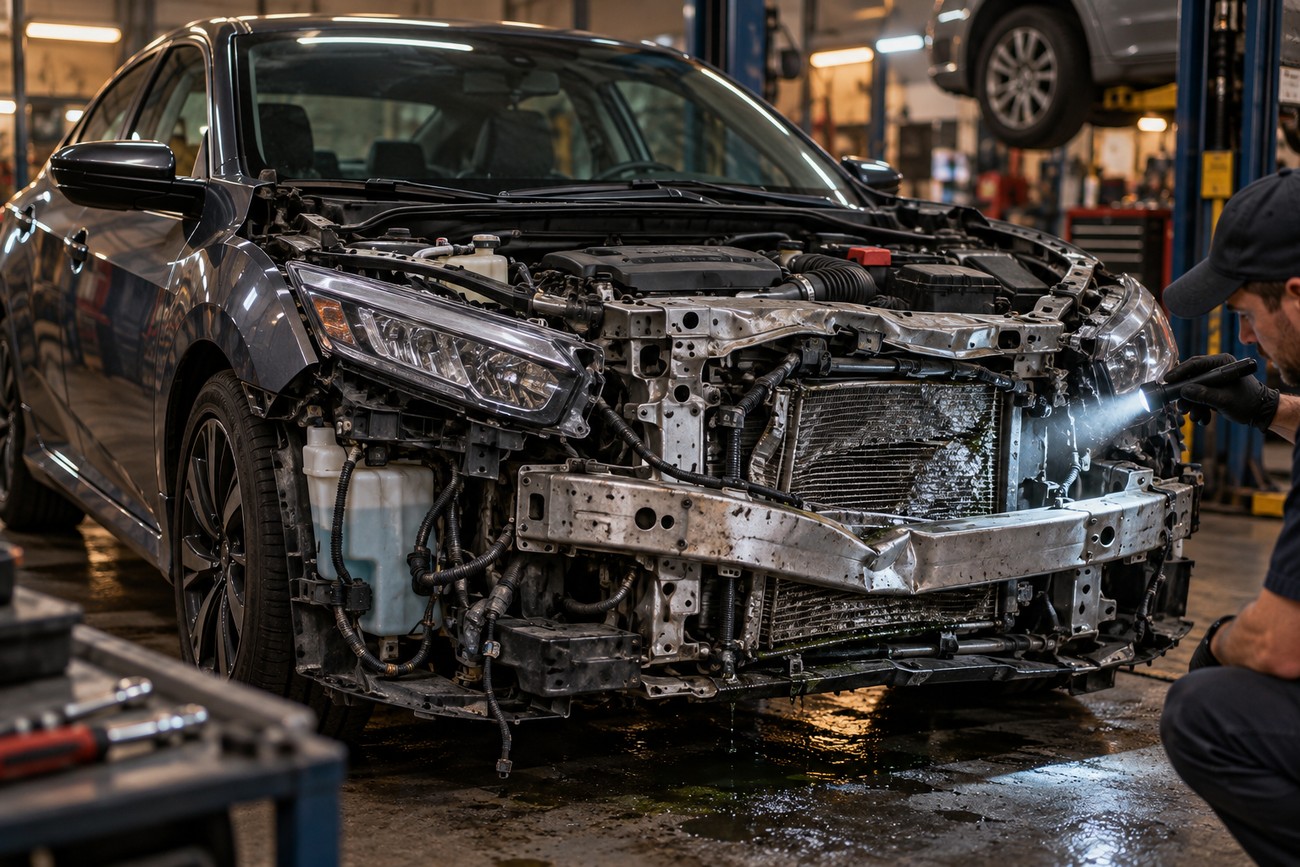
A drivable Civic may still have pinched or broken wiring, damaged radiators, bent mounts, poor geometry, or other engine-bay damage. Cooling damage deserves prompt attention because a vehicle that runs briefly can still overheat after the impact. Headlight mounting points can also be damaged even when the lens appears intact.
No airbag deployment does not prove that damage is superficial. Airbags respond to particular crash forces and sensor conditions; they do not certify the radiator support, wiring, cooling system, or body geometry. The same applies to a car that tracks normally on a short drive.
Technicians inspect behind the bumper and around the radiator support before calling a drivable Civic a minor repair. Headlight mounts and wiring can look intact from above while their attachment points or routing have been disturbed.
Photo estimates are useful for starting a claim, yet they are not final. Hidden damage may appear only after removing the bumper, headlights, or other exterior panels. The inspection should include the engine bay and the underside, especially around mounts, leaks, wiring, and alignment points.
Several common mistakes inflate uncertainty. Owners may accept the first estimate, compare a replacement part with the finished repair, or continue driving with damaged lighting or cooling components. Ask how the shop handles supplements, paint matching, diagnostics, calibration, and newly discovered damage before authorizing work.
Repair or Total Loss? How the Insurance Decision Works
The insurer compares the repair estimate with the Civic’s actual market value and the applicable state or insurer threshold. That value reflects trim, mileage, condition, region, and comparable vehicles. A repair estimate near $13,000 may lead to a total-loss decision, especially for an older Civic.
A $7,000–$10,000 repair may be approved for one Civic and result in a total loss for another. An older, high-mileage, or lower-value car reaches the insurer’s threshold sooner than a newer trim with stronger local market value. The decision is therefore specific to the vehicle and claim.
About 70% of vehicle value is sometimes cited as a Florida rule of thumb, but it is an illustrative reference rather than a nationwide threshold. State rules and insurer procedures differ. Ask for the valuation report, the repair estimate, the deductible treatment, and the basis for any settlement offer.
Compare the proposed settlement with the cost of comparable Civics in your region, including similar trim, mileage, and condition. A settlement that looks close to the repair bill may still leave you short if replacement vehicles cost more. Before signing, confirm whether you can obtain an independent estimate or challenge valuation evidence under the policy and local process.
Frequently asked questions
These answers cover insurance pricing after a deer claim and the checks to complete before approving repairs. They also explain which estimate details can affect the final cost.
How much will insurance go up after hitting a deer?
There is no single insurance increase after a deer claim. The effect depends on the policy, insurer, state, claim history, coverage type, and how the insurer classifies the loss. The repair estimate alone does not predict the premium change.
Ask the insurer whether the claim falls under comprehensive coverage, whether a deductible applies, and how a comprehensive claim affects renewal pricing in your area. Also ask about claim-free discounts and any state-specific rules before deciding whether a small claim is worth filing.
What should I ask the body shop before approving a Civic deer-hit repair?
Ask whether the estimate includes a teardown inspection, radiator and wiring checks, an underside inspection, paint matching, and any required calibration. Confirm which parts are OEM, aftermarket, or salvage, and ask how the shop verifies compatibility with your Civic’s generation and trim.
Get the supplement procedure in writing: who approves added damage, how you will be notified, and whether the insurer must inspect again. Clarify the deductible, expected warranty terms, diagnostic charges, and how the shop will handle poor panel fit or color mismatch discovered after assembly.







