
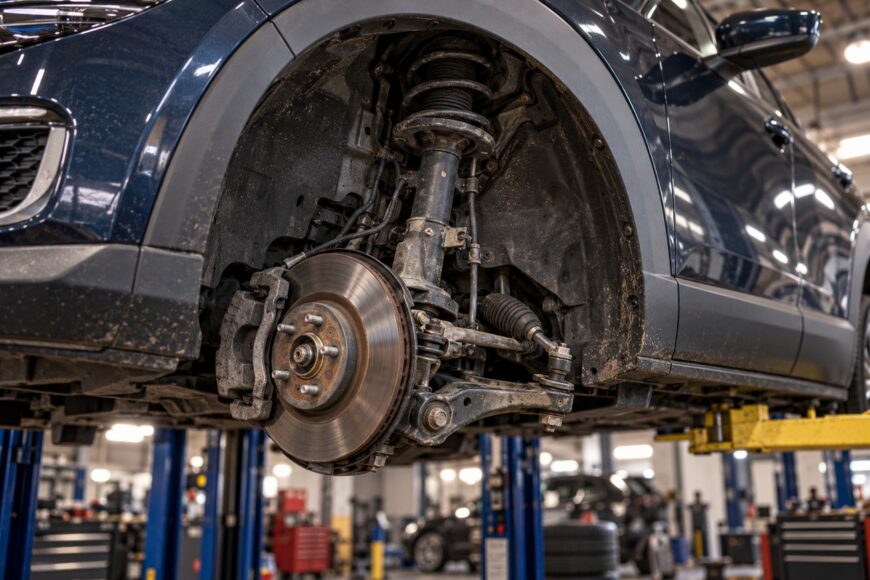
A hard curb strike in a Mazda CX-30 can leave the vehicle driving almost normally while damaging a tire, wheel, hub, or suspension geometry. The visible clue may be a scraped rim, yet the more important change can be a small shift in toe or camber that is difficult to see without measurements.
The sensible decision depends on what the impact actually affected. A safe tire and wheel may allow a careful trip for inspection, while a sidewall bulge, cracked rim, severe pull, loose steering, or fluid leak calls for stopping and arranging recovery. An alignment check is useful only after the wheel and suspension have been inspected for bent or displaced parts.
- What a Hard Curb Hit Can Do to a Mazda CX-30
- What to Check Immediately After the Impact
- Signs of Alignment or Suspension Damage You May Notice Later
- How the CX-30 Alignment Can—and Cannot—Be Adjusted
- Why a “Within Spec” Alignment Reading May Not End the Diagnosis
- Repair Choices: Wheel, Tire, Alignment, or Suspension Part?
- Frequently asked questions
- How can I tell whether a vibration is from the wheel or from alignment?
- What should I ask for on the alignment report after a curb impact?
- What happens if I hit a curb and my alignment is messed up?
- How can I tell if my car is damaged after hitting a curb?
- How hard do you have to hit a curb to cause damage?
What a Hard Curb Hit Can Do to a Mazda CX-30
The impact load enters through the tire and wheel, then travels into the hub, control arm, strut, ball joint, steering tie rod, bushings, and subframe. Each part can absorb some of the force, and a small movement at one mounting point can change the wheel’s position. The result may be altered toe or camber without a visible crack or obvious looseness.
A curb strike at approximately 5–10 km/h can be enough to disturb suspension geometry. The speed alone does not describe the load: a sharp curb concentrates force into a small contact area, especially when the tire hits at an angle. A wheel turned toward the curb creates greater side loading through the strut, ball joint, tie rod, and control arm than more direct contact with the wheel straight.
The wheel can bend at the rim lip, while the tire bead or sidewall can suffer damage that is hidden from the outer face. Behind it, a hub or bearing may receive a sudden lateral load. Rubber-metal bushings can deform without tearing, and a strut can develop a small bend or internal damage that becomes noticeable only later through noise, vibration, or changed ride quality.
That is why a normal-looking suspension does not prove that the geometry is correct. A component shifted by a small amount may leave the CX-30 apparently stable while accelerating tire wear and making the steering less consistent. The longer-term cost often appears on the tread rather than at the moment of impact.
What to Check Immediately After the Impact

Move to a safe place, then inspect the struck corner before continuing. Look for a bulge, cut, or exposed cord on the tire sidewall, damage around the bead, and a cracked or sharply deformed wheel lip. Check whether the tire is losing air and whether the wheel sits normally in the arch.
With the car stationary, note the steering-wheel position and any new looseness in the steering. Look beneath the vehicle for leaking damper fluid or displaced parts, and listen for a fresh clunk, scrape, or repeated knock when the car moves slowly. A severe pull, loose steering, suspected suspension breakage, leaking damper, or damaged tire means the CX-30 should generally be stopped and inspected rather than driven farther than necessary to reach safety.
A quick glance at a tire shop can miss a bent arm, shifted strut, damaged mounting point, or deformed bushing. Tire pressure can explain a pull caused by pressure imbalance, yet it cannot correct altered toe or camber. Balancing addresses wheel-and-tire balance; it does not correct toe, camber, or bent suspension geometry.
If the tire and wheel appear sound and the vehicle remains controllable, arrange a proper suspension inspection and alignment check soon. Avoid testing the vehicle at high speed to “see whether it is still straight.” A controlled inspection provides useful evidence without adding risk to a damaged tire or unstable component.
Signs of Alignment or Suspension Damage You May Notice Later
A pull to one side, a steering wheel that sits crooked on a straight road, or a vehicle that wanders over uneven pavement points toward changed geometry, tire-pressure imbalance, or a difference between the two sides. The steering may feel normal immediately after the impact because small angle changes are difficult to sense through the wheel.
Vibration needs a different line of investigation. A bent wheel or damaged tire often produces a shake related to road speed, while alignment problems more commonly show up as pulling, an off-center steering wheel, or inner- and outer-edge tread wear. Both problems can coexist, so balancing a wheel does not exclude a suspension problem.
New clunks and squeaks may come from a bushing, mount, fastener, ball joint, or strut component that has shifted without an obvious tear. A harsher response over bumps can also indicate altered mounting or a damaged damper. Some faults appear only when the suspension is loaded, which is why a visual inspection on the ground is limited.
Small geometry changes may take several thousand miles to become obvious in the tread. Uneven wear on the inner or outer edge can result from altered toe or camber, and sufficiently disturbed alignment may raise fuel consumption by approximately 5–15%. Compare the left and right tires rather than inspecting only the damaged corner; a gradual difference is often easier to see that way.
How the CX-30 Alignment Can—and Cannot—Be Adjusted
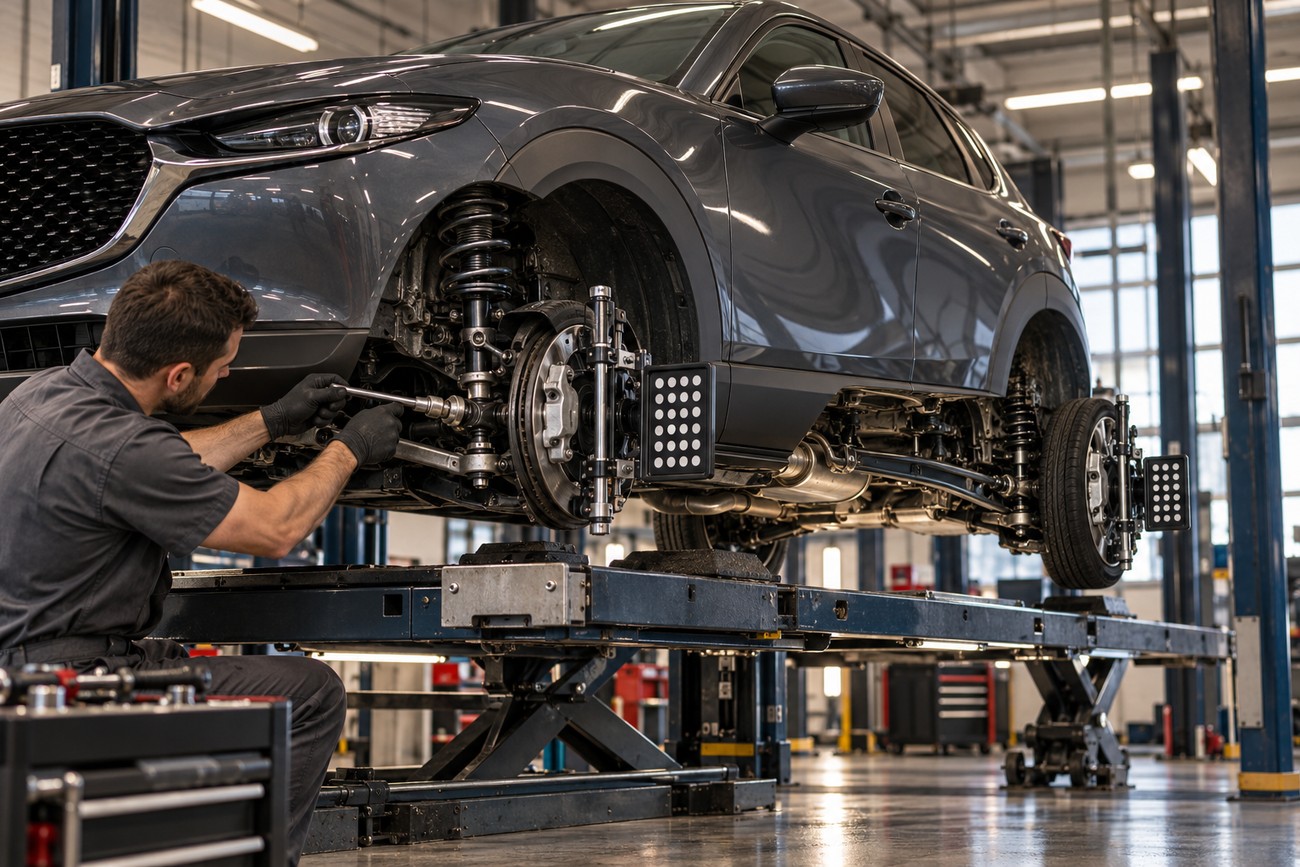
The Mazda CX-30 uses MacPherson struts at the front and a torsion beam at the rear. This layout affects what an alignment technician can correct with normal factory adjustment. The routine adjustment is primarily front toe, set through the steering tie rods and lockouts.
Front and rear camber are essentially non-adjustable through normal factory adjustment. If camber is outside the intended range, the technician should inspect the wheel, hub, strut, control arm, bushings, mounting points, and other related parts. A damaged component generally needs repair or replacement before the final alignment is set.
The torsion beam makes the rear suspension relatively simple, yet rear wheel angles are effectively not routinely adjustable. A rear reading outside target can indicate a shifted or damaged beam, hub, mounting point, or another structural component. Depending on the finding, correction may require torsion-beam replacement or qualified structural correction rather than an adjustment bolt.
This limitation matters when a shop offers to “bring everything into spec” by adjusting the front toe alone. Toe can make the steering wheel look more centered while a bent arm, strut, hub, or beam remains. The alignment printout should support the physical diagnosis, not replace it.
Why a “Within Spec” Alignment Reading May Not End the Diagnosis
After a curb strike, inspection should come before alignment. The technician should check the tire and wheel, measure wheel runout, inspect steering and suspension components with the vehicle lifted, and look for play or displaced fasteners. A road test then helps relate the measured condition to the driver’s complaint.
The alignment report should include before-and-after readings, left-to-right comparison, steering-wheel centering, and rear thrust direction. A green result means the readings fall inside the stated tolerance; it does not automatically rule out uneven left-right behavior, tire wear, a bent component, or a poorly centered steering wheel.
Technicians compare steering-wheel center, left-to-right geometry, thrust direction, wheel runout, and lifted-component play because a green alignment screen can describe acceptable numbers without explaining unusual behavior on the road.
Wheel runout deserves separate attention because a slightly oval or laterally bent rim can imitate an imperfect balance. The machine may balance the assembly, yet the wheel can still produce a speed-related shake. A technician should also check whether the steering wheel returns naturally and whether the vehicle follows the road without a persistent correction.
Some service cases report front-end noises that were resolved by replacing bolts or fasteners even when handling seemed normal. That possibility does not mean every noise signals serious damage, but it does support checking mounting hardware and contact points rather than dismissing a new sound because the alignment screen is green.
One reported CX-30 specification lists a maximum of 10 mm (0.39 in) for an alignment-related parameter. Public information does not clearly explain the parameter’s exact interpretation, so it should not be treated as a universal damage limit or a substitute for component inspection.
Repair Choices: Wheel, Tire, Alignment, or Suspension Part?
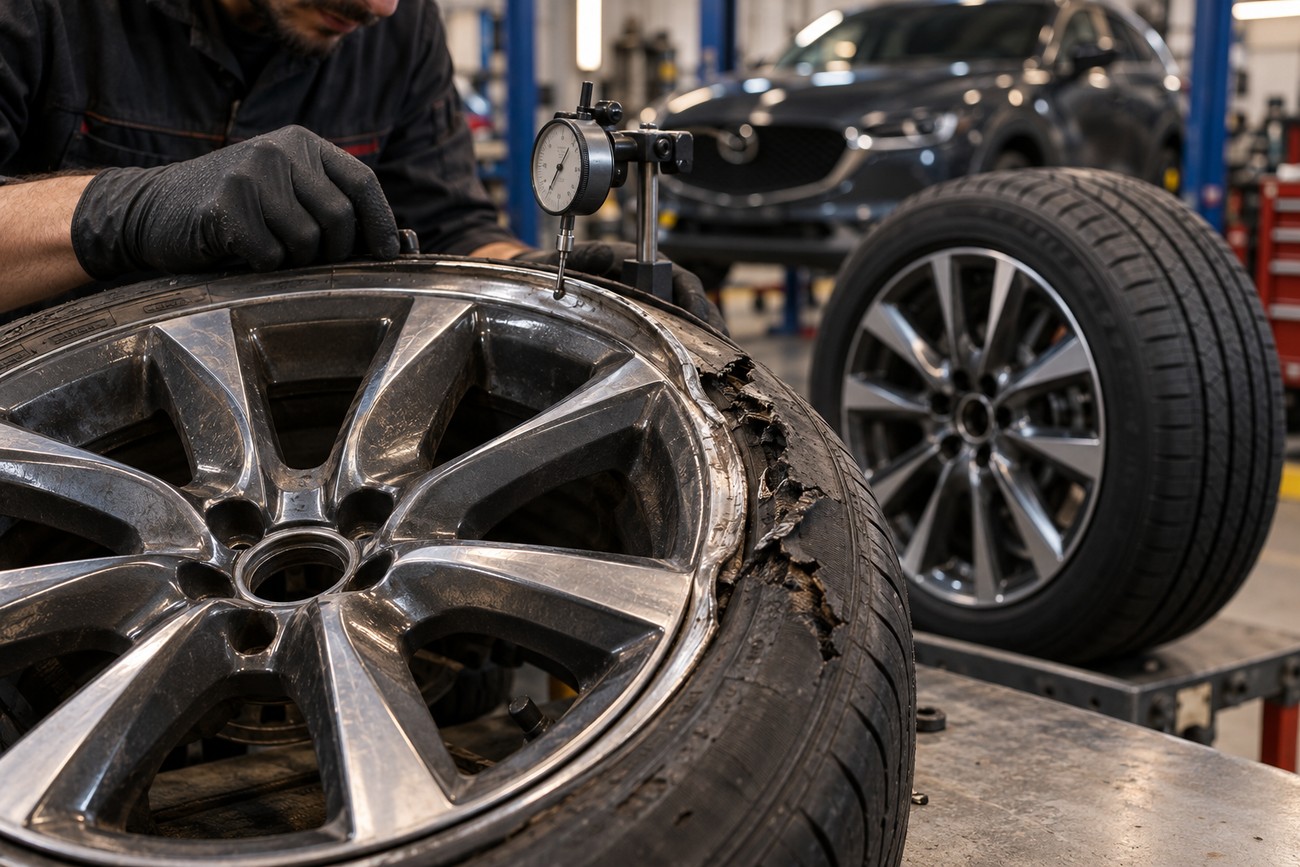
A tire with a bulge, cut, or structural damage should be replaced. A wheel that is cracked, severely deformed, or structurally compromised should also be replaced rather than handled as a routine balancing issue. A minor cosmetic scrape is a different finding, but the wheel still needs a runout and seating check after a hard strike.
Cast-wheel straightening or welding requires caution because a repair can hide a crack or leave the wheel with unacceptable geometry. The decision should be based on the wheel’s material, damage location, measured runout, and the repairer’s assessment. A low-cost repair that leaves vibration or weakens the rim creates another inspection problem later.
If a control arm, tie rod, strut, hub, bushing, mounting point, or torsion beam is bent or displaced, that part must be corrected first. Adjusting front toe around a damaged component can produce a temporary-looking result while the CX-30 still pulls, wears tires, or behaves differently from side to side.
After the repair, obtain a final alignment report and monitor tread wear on both sides of the axle. Professional inspection is sensible after a serious curb or pothole impact and at least annually or every 15,000–20,000 km. Nonstandard alignment settings chosen for handling can increase tire wear and reduce comfort on the CX-30, so factory targets are usually the safer baseline for road use.
Frequently asked questions
How can I tell whether a vibration is from the wheel or from alignment?
A vibration that rises with road speed usually points first toward wheel or tire runout, a bent rim, or tire damage. Pulling, an off-center steering wheel, and inner- or outer-edge wear point more toward alignment geometry. Both conditions can exist after one curb strike, so a balance check should be followed by wheel-runout and suspension inspection if the vibration remains.
What should I ask for on the alignment report after a curb impact?
Ask for before-and-after readings for all measured wheels, a left-to-right comparison, steering-wheel center, and rear thrust direction. The report should also state which adjustments were made and whether any value could not be corrected because a part was bent, shifted, or outside the available factory adjustment.
What happens if I hit a curb and my alignment is messed up?
The CX-30 may pull, wander, wear a tire edge, or use more fuel as the tires scrub against the road. If the alignment change comes from a bent or shifted part, adjusting front toe alone will not solve the cause. Inspection should identify the damaged wheel, tire, suspension component, or rear torsion beam before final alignment.
How can I tell if my car is damaged after hitting a curb?
Check for tire-sidewall damage, air loss, a cracked or deformed wheel, new vibration, steering looseness, a crooked wheel, pulling, leaks, and unfamiliar noises. A normal visual check is insufficient when symptoms remain, because bushings, mounts, strut components, and small geometry shifts may look normal. A proper inspection and alignment measurement provide a more reliable answer.
How hard do you have to hit a curb to cause damage?
There is no dependable universal speed or impact threshold. A strike at approximately 5–10 km/h can alter geometry, particularly when the wheel is turned or the curb applies a sharp side load. The tire construction, wheel, contact angle, and exact impact point all matter, so the condition of the car after the strike is more useful than speed alone.







