
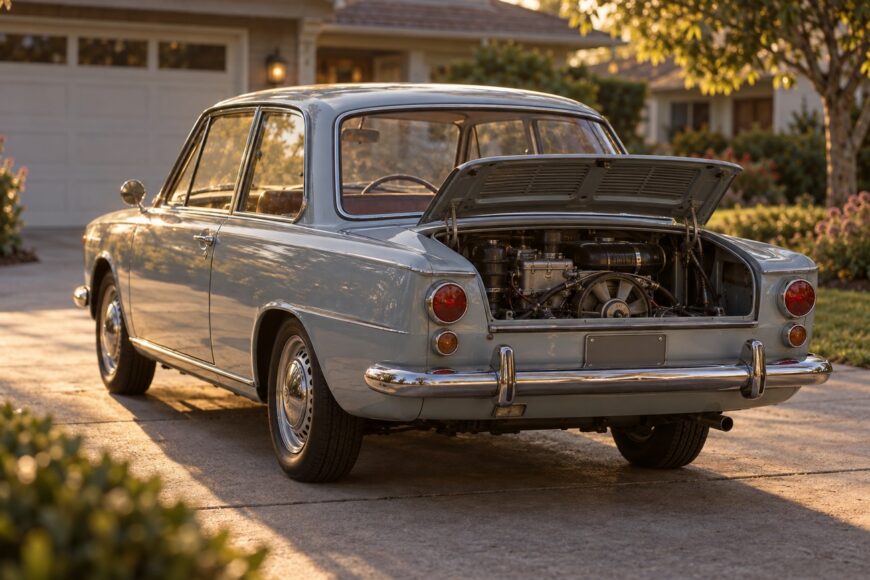
The Hino Contessa 1300 has the kind of shape that makes a compact sedan memorable: clean Michelotti lines, a low visual mass, and details that look purposeful rather than ornamental. Its unusual engineering is just as important. The engine and gearbox sit behind the passenger compartment, driving the rear wheels in a layout retained from the earlier Contessa concept.
That arrangement gives the car lively balance, yet ownership also brings demanding swing-axle behavior, cooling challenges, corrosion risks, and a parts supply that can punish casual ownership. The standard sedan, coupé, 1300S, and L/Racing-related cars should not be treated as interchangeable. The useful way to understand the Contessa is to separate documented specifications from disputed performance claims, period variations, and collector mythology.
- Why the Hino Contessa 1300 Still Looks Different
- Engine, Gearboxes, and the 55-to-65 hp Divide
- Michelotti Style Meets Rear-Engine Packaging
- How It Drives: Swing Axles, Weight Bias, and Speed Claims
- The Ownership Reality: Cooling, Corrosion, and Parts
- Buying and Restoring a Contessa Without the Usual Mistakes
- Hino Contessa 1300 Sedan vs Coupé: Key Specifications
- Frequently Asked Questions
- Why do sources quote both 130 km/h and 145 km/h for the Contessa 1300?
- Was the Hino Contessa 1300 the same car as the Hindustan Contessa?
- Which Contessa 1300 version is most valuable to collectors?
Why the Hino Contessa 1300 Still Looks Different
The second-generation Hino Contessa 1300 debuted in September 1964 as a sedan. Giovanni Michelotti designed the body, giving it a restrained European character without turning it into a direct copy of any one rival. Its compact proportions and crisp surfaces still distinguish it from the more anonymous family sedans of the period.
The connection with the Triumph 1300 is part of the model’s historical interest. Michelotti developed related design themes for different manufacturers, so the visual resemblance is understandable. That does not mean the Hino and Triumph were mechanically identical; their shared design language should not be mistaken for shared engineering.
Under the skin, the PD series continued the rear-engine arrangement associated with earlier Contessas. The engine and gearbox are mounted at the rear, and power reaches the rear wheels. This freed the front end for a relatively clean shape and helped create the car’s distinctive proportions, while also concentrating mechanical work in a less accessible area.
The result is a car whose styling and layout are inseparable. The Contessa looks different because its engineering allowed it to be different, although the same decisions that made it distinctive also shaped its handling, heat management, and restoration costs.
Engine, Gearboxes, and the 55-to-65 hp Divide
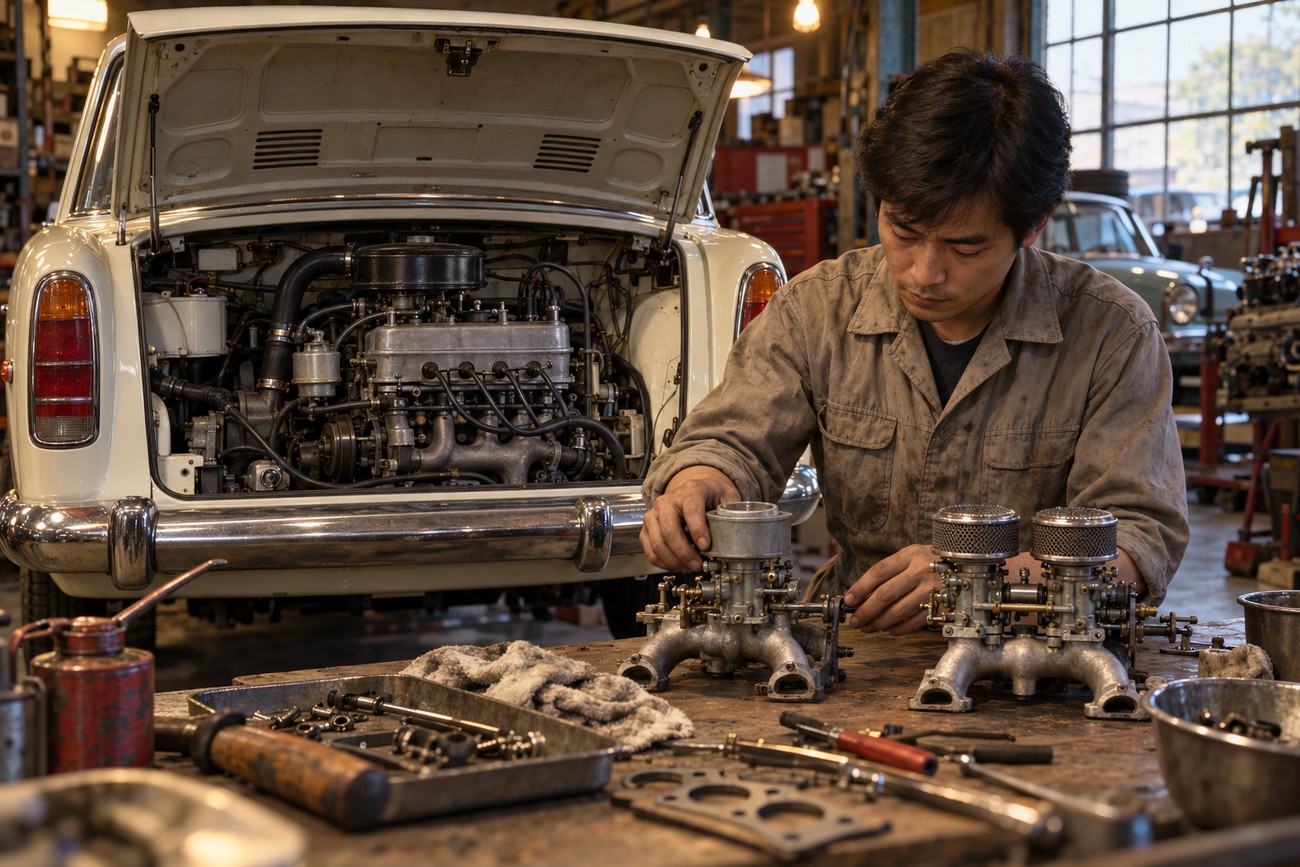
The sedan uses the GR/GR100 inline four-cylinder OHV engine, with approximately 1,251–1,255 cc and five main bearings supporting the crankshaft. That specification gives the engine a useful degree of structural sophistication for its period, but it does not make every 1300 a high-output car.
A standard sedan is commonly rated at approximately 55 hp. Coupé and 1300S versions, associated with twin carburetors and higher compression, are generally quoted at approximately 64–65 hp. The difference matters in both performance expectations and parts selection; a sedan specification sheet cannot safely be applied to a sporting version.
Road cars used either a three-speed column-shift manual or an optional four-speed manual. The three-speed suits relaxed period driving, while the four-speed gives the engine more useful ratios on faster roads. Neither transmission should be assumed interchangeable without checking the exact car and production specification.
Documentation is particularly important because model names such as 1300S, L, and Racing can appear inconsistently in surviving literature. Before ordering carburetor parts, internal engine components, or gearbox hardware, verify the body style, engine identification, and factory or sporting specification. A generic “Hino 1300” listing is often too broad to be useful.
Michelotti Style Meets Rear-Engine Packaging
The PD sedan is approximately 4.1–4.15 m long and about 1.5 m wide. Those dimensions give it a compact footprint, but the rear powertrain prevents it from feeling like a conventional front-engine sedan when viewed or serviced. The cabin and luggage arrangements reflect a careful compromise between exterior elegance and mechanical packaging.
The coupé sharpens the same theme with a lower, more sporting profile and a weight advantage of approximately 100 kg over the sedan. That reduction helps explain why the coupé can feel more energetic even when its engine specification is similar. It also contributes to the enduring collector preference for clean, properly documented coupés.
Michelotti’s identity is carried by small details as much as by the main silhouette. Headlights, mouldings, badges, lamps, and trim pieces are specific, age-sensitive components. Many are difficult to source, and accurate reproduction is uncommon, so a complete but imperfect car can be a better restoration candidate than a cheaper shell missing its exterior hardware.
The Triumph 1300 relationship adds another layer of interest. Collectors see the Contessa as part of a broader Michelotti design story, while restorers must deal with the practical consequence: visual similarity does not guarantee that a trim component, lamp, or mechanical part will fit.
How It Drives: Swing Axles, Weight Bias, and Speed Claims
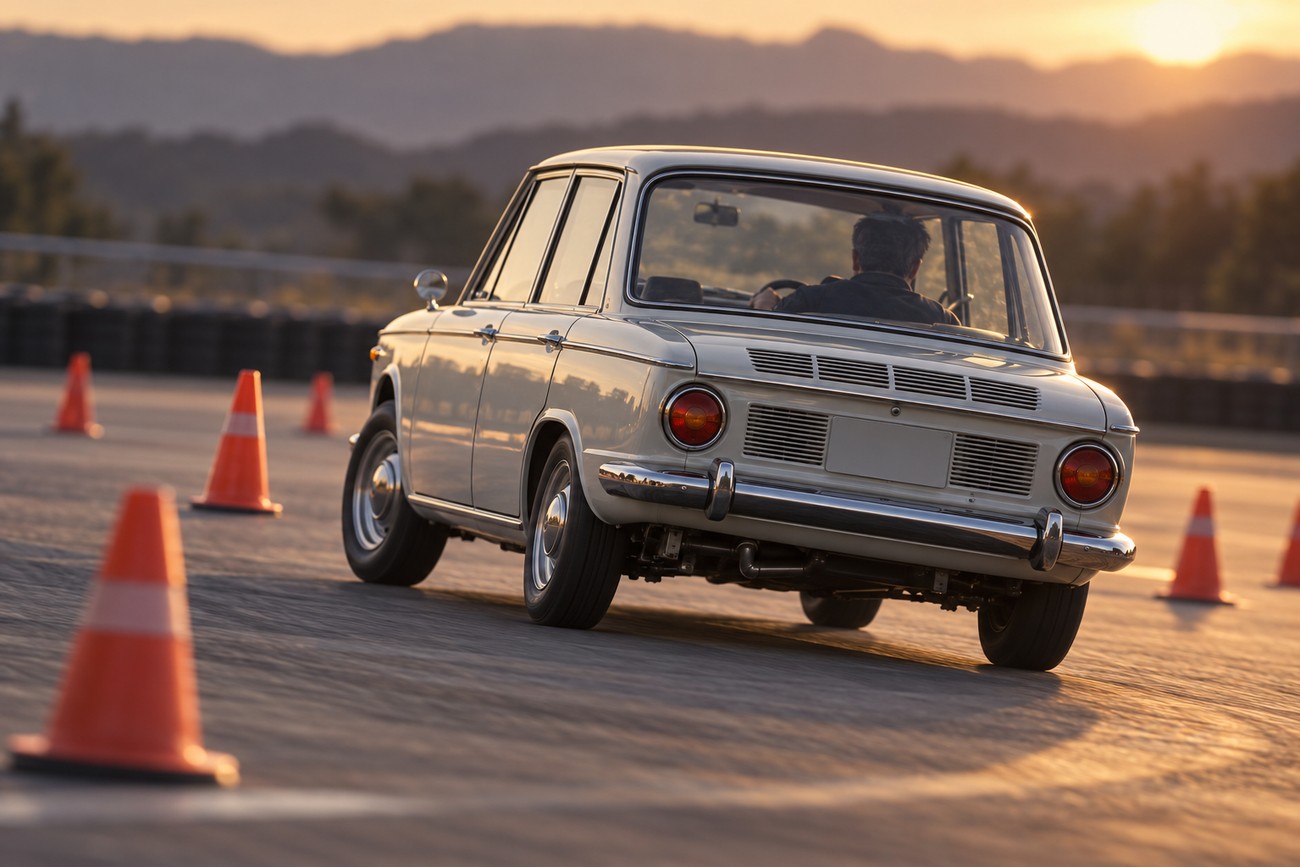
The Contessa has independent front suspension and rear swing axles. With the engine and gearbox behind the cabin, the car carries a strong rear weight bias. That can produce lively traction and responsive acceleration, but the swing-axle geometry changes camber as the suspension moves.
During an abrupt manoeuvre or when heavily loaded, the rear tires can move into a less forgiving attitude. The result may be unexpected oversteer or a sudden change in the car’s balance. A driver accustomed to a modern sedan should treat the Contessa as a period design with different limits, especially on uneven roads or in emergency lane changes.
Rear-wheel alignment deserves more attention than its modest appearance suggests. Camber and toe settings influence whether the car feels predictable or nervous. Fitting wide modern tires without correcting the geometry can make the swing-axle behavior harsher, rather than delivering the hoped-for improvement in grip.
Rear-wheel alignment should be checked before judging a Contessa’s handling. A poorly set car can make a fundamentally lively design feel unstable, while wider tires may amplify the original geometry rather than cure it.
The sedan is commonly quoted at approximately 130 km/h. Coupé claims range from approximately 130 km/h to approximately 145 km/h, depending on the source and specification. The higher figure should be treated as a period or variant claim rather than a universal capability for every Contessa 1300.
The Ownership Reality: Cooling, Corrosion, and Parts
Rear placement makes engine and transmission work more labor-intensive than on a typical front-engine sedan. Access is restricted, and tasks that look routine in a brochure can require more dismantling, more time, and more careful planning. This affects maintenance budgets even when the mechanical design itself is straightforward.
Cooling is another ownership concern. Owners report rising temperatures in hot climates, traffic, and long climbs, where airflow and heat rejection are placed under greater strain. A car intended for regular use needs preventive attention to the cooling system rather than repairs only after the temperature gauge has become a warning.
Cabin comfort is also period-specific. Limited factory sound insulation allows engine noise and heat to reach the passenger compartment, particularly because the powertrain is directly behind it. The Contessa can be enjoyable on a scenic drive, but it is less convincing as an effortless modern daily driver.
Rust commonly affects the sills, lower door edges, and rear panels. These areas can look acceptable after a quick inspection while hiding weakened metal, previous patching, or moisture traps. Original engine, suspension, body, and exterior-trim parts are difficult to source, even in Japan, so body condition should usually outrank a low purchase price.
Some related Renault components may fit selected cars, but compatibility requires exact identification of the year and series. A part that appears similar in a catalog can still differ in dimensions, mounting, or specification. Treat cross-reference information as a starting point for measurement, not as proof of interchangeability.
Buying and Restoring a Contessa Without the Usual Mistakes
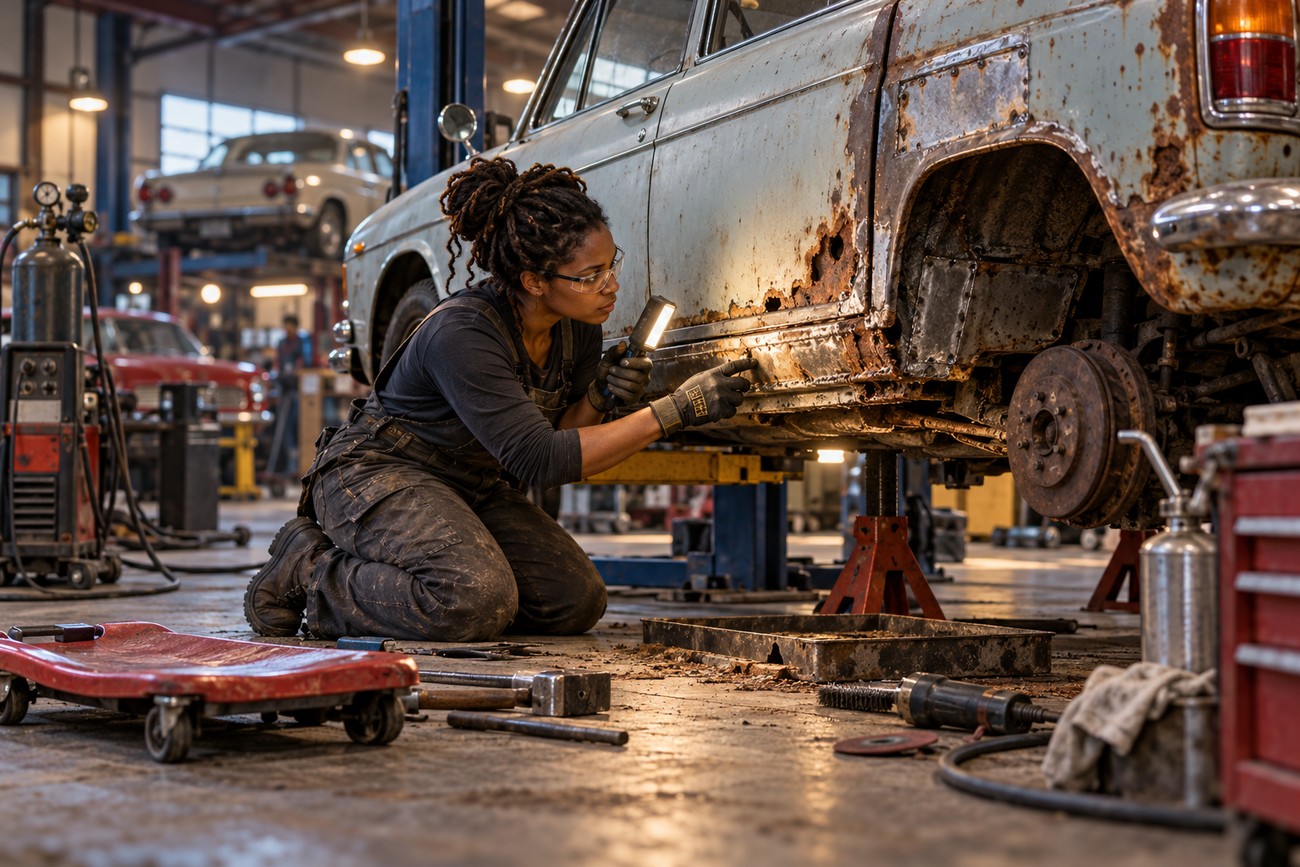
Buying for styling alone is the quickest way to underestimate a Contessa. Inspect the sills, lower door edges, rear panels, floor areas, and previous repairs before placing value on paint, trim, or apparent originality. Structural corrosion can consume the budget that seemed to be saved at purchase.
Check the stamped engine and chassis identification before ordering parts. Sedan, coupé, 1300S, and L/Racing-related specifications can differ in carburetion, engine preparation, suspension details, and trim. One encyclopedia entry or a generic 1300 catalog listing is not sufficient evidence for a correct restoration order.
Stamped engine and chassis identification should be checked alongside the rear-wheel alignment record before parts are ordered. That combination helps establish what the car is and how its suspension is actually behaving, rather than relying on a generic 1300 description.
Twin-carburetor versions require skilled synchronization and regular adjustment. Poorly matched carburetors can reduce power and increase fuel consumption, leaving an owner to blame the engine for a tuning problem. Cooling-system maintenance and suspension checks are equally important if the car will be used routinely.
Wide modern tires need careful consideration. Without appropriate alignment and camber control, they can worsen swing-axle behavior and make the car more abrupt at the limit. Serious modern handling cannot be obtained from the original swing axles through tires alone; substantial modification would change the car’s engineering character and may create new restoration compromises.
L/Racing and other factory or semi-factory sporting specifications may command substantially more collector value than ordinary examples. That premium depends on credible identification and documentation, however. A standard car with added badges should not be valued as a genuine sporting specification without supporting evidence.
Hino Contessa 1300 Sedan vs Coupé: Key Specifications
Figures vary by body style, specification, and source. The table separates the standard sedan from coupé and 1300S-oriented versions rather than presenting one generic Contessa specification.
| Specification | Standard sedan | Coupé / 1300S-oriented versions |
|---|---|---|
| Engine | GR/GR100 inline four-cylinder OHV | GR/GR100 inline four-cylinder OHV |
| Displacement | Approximately 1,251–1,255 cc | Approximately 1,251–1,255 cc |
| Crankshaft support | Five main bearings | Five main bearings |
| Quoted power | Approximately 55 hp | Approximately 64–65 hp |
| Carburetion and compression | Standard specification | Twin carburetors and higher compression associated with the higher output |
| Transmission | Three-speed column-shift manual or optional four-speed manual | Three-speed column-shift manual or optional four-speed manual, depending on specification |
| Weight relationship | Reference body | Approximately 100 kg lighter than the sedan |
| Quoted top speed | Approximately 130 km/h | Sources range from approximately 130 km/h to approximately 145 km/h |
Frequently Asked Questions
The main questions about the Hino Contessa concern conflicting performance figures, model identification, and collector value. The answers below keep those issues tied to the car’s body style, specification, and documentation.
Why do sources quote both 130 km/h and 145 km/h for the Contessa 1300?
The disagreement reflects differing sedan and coupé claims, as well as conflicting figures for coupés of different specifications. The sedan is commonly quoted at approximately 130 km/h, while some sources give approximately 145 km/h for a coupé or sport-oriented version.
Technical references do not consistently describe the same equipment, testing conditions, or model variant. Neither figure should therefore be treated as a universal maximum for every Hino Contessa 1300.
Was the Hino Contessa 1300 the same car as the Hindustan Contessa?
No. The Hino Contessa 1300 was a Japanese model developed by Hino, while the Hindustan Contessa belongs to a later and separate automotive context. The shared name can create misleading search results, so parts, specifications, and restoration advice must be tied specifically to the Japanese Hino model.
For identification, use the Hino model designation, body style, chassis information, and engine details rather than relying on the word “Contessa” alone.
Which Contessa 1300 version is most valuable to collectors?
Documented L/Racing, factory, or semi-factory sporting specification can matter more than simply choosing a coupé body. Provenance, correct equipment, and credible identification support the premium; badges or aftermarket modifications do not establish a genuine sporting variant.
A sound, complete sedan can still be the wiser restoration purchase if a sporting car has hidden corrosion or missing specialist parts. Condition and documentation usually matter more than an attractive description.







