
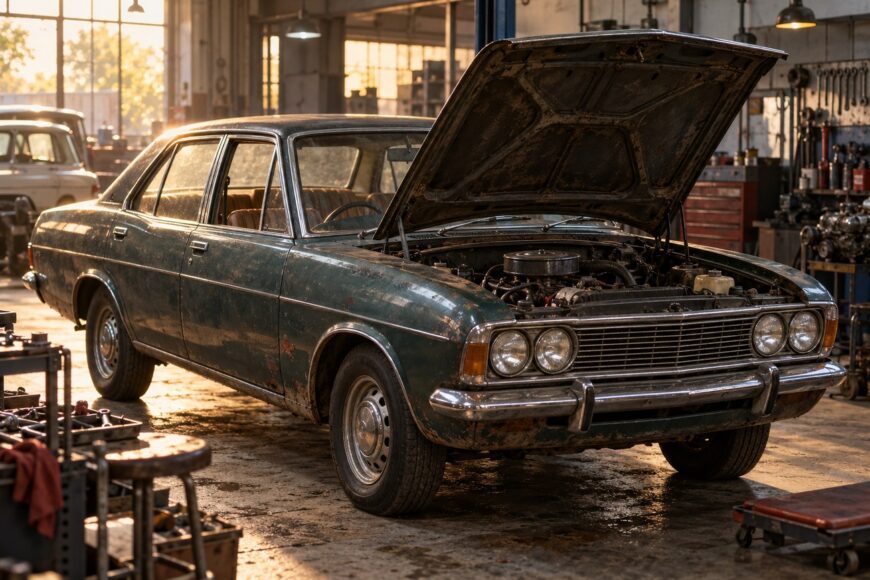
The Hindustan Contessa wears the visual language of a muscle car: a long bonnet, a formal four-door body, rear-wheel drive, and a broad, American-influenced stance. Its earliest engine tells a quieter story. The 1.5-litre BMC B-Series produced approximately 50 hp, so the shape promised considerably more drama than the powertrain could deliver.
That tension defines the Contessa today. Its British Vauxhall origins, changing engine specifications, and increasingly difficult parts supply matter as much as the paint and chrome. The useful question is which version, repair history, and surviving structure lie beneath the styling.
- Why the Contessa looks like a muscle car but isn’t one
- British foundations, Indian identity
- Hindustan Contessa engines and versions: what changed
- What the specifications cannot promise on the road
- Buying a Contessa: inspect the structure before the shine
- Parts, swaps, and the true cost of keeping one
- Frequently asked questions
- Was the Hindustan Contessa built after 2002?
- What documents can help verify a Contessa’s original engine?
- Which car looks like the Contessa?
- What is the Contessa, the Indian muscle car?
Why the Contessa looks like a muscle car but isn’t one
The Contessa’s image comes from proportion more than performance. Its long bonnet, squared-off cabin, four doors, and rear-wheel-drive layout give it the visual presence associated with large American sedans and classic muscle cars. The stance is persuasive even when the mechanical specification is modest.
Technically, the Contessa belongs to a different lineage. Its underlying design came from the British Vauxhall Victor FE, a model produced in the 1970s. Hindustan adapted that foundation for Indian production, creating a sedan with an American-influenced silhouette rather than an American performance car.
The early powertrain makes the distinction especially clear. A 1.5-litre BMC B-Series engine producing approximately 50 hp, paired with a four-speed gearbox, had to move a substantial four-door body. That specification could suit steady transport, while the bodywork encouraged expectations of stronger acceleration.
Later Isuzu-powered versions changed the character of the car, especially through the move to a five-speed manual gearbox. Even then, the Contessa’s reputation rests primarily on its presence and rarity. Calling it a muscle-car lookalike is useful shorthand for its appearance, provided the term is not treated as a technical classification.
British foundations, Indian identity
The Contessa was an Indian-built adaptation of the Vauxhall Victor FE, rather than a clean-sheet Indian design. The British model supplied the essential architecture and production lineage, while Hindustan’s manufacturing decisions and local market position shaped the car that Indian buyers knew.
Series production is commonly dated from 1984 to 2002. Some accounts allow for cars assembled or supplied to order after 2002, yet there is no single confirmed end date for that activity. The cautious description is therefore a 1984–2002 series-production period with uncertain later exceptions.
Its visual identity gave the Contessa a distinctive place in Indian motoring culture. In a market where many cars followed more compact or utilitarian proportions, the Contessa looked formal, substantial, and unusually close to the imagery of American road cars. That contrast helped create its cult following long after production ended.
The result is a car with two identities operating at once. Its design ancestry is British, its production history is Indian, and its public image is heavily influenced by American styling. Understanding all three avoids turning a striking adaptation into a fictional origin story.
Hindustan Contessa engines and versions: what changed
The most important mechanical divide is between the early BMC-powered car and the later Isuzu versions. Reported outputs vary by engine origin and production period, so the figures below should be read as version-specific descriptions rather than universal specifications.
| Version or period | Engine | Reported output | Transmission | Practical identification point |
|---|---|---|---|---|
| Early Contessa | 1.5-litre BMC B-Series petrol | Approximately 50 hp | Four-speed manual | Adapted from the Ambassador powertrain; the least powerful major version |
| Contessa Classic, introduced in 1987 | 1.8-litre Isuzu 4ZB1 petrol | Approximately 88 hp is reported for early imported engines | Five-speed manual | Classic identifies the 1.8-litre version rather than a separate generation |
| Later locally assembled 1.8-litre versions | 1.8-litre Isuzu petrol | Some are reported at approximately 75 hp and 135 Nm | Five-speed manual associated with the Classic specification | Do not apply the early imported-engine figure to every 1.8-litre car |
| 1990s diesel versions | Approximately 2.0-litre Isuzu 4FC1 diesel | Output varies by naturally aspirated or turbo-diesel specification | Manual transmission | Late names included 2.0 DLX and 2.0 TD |
| Late petrol specification | 1.8-litre Isuzu petrol | Version-specific; local assembly affects reported figures | Manual transmission | 1.8 GLX was among the late version names |
The 1987 arrival of the Contessa Classic marked a substantial change in use. The Isuzu 4ZB1 1.8-litre petrol engine and five-speed manual gearbox gave the car a more suitable mechanical package than the early 1.5-litre combination. “Classic” is generally associated with this 1.8-litre version and does not describe a separate generation.
Output figures require particular care during inspection. Approximately 88 hp is reported for early imported engines, while some later locally assembled examples are reported at approximately 75 hp and 135 Nm. A badge, engine swap, or old advertisement cannot establish which specification a surviving car actually has.
The 1990s brought approximately 2.0-litre Isuzu 4FC1 diesel versions, including a turbo-diesel. Late names included 1.8 GLX, 2.0 DLX, and 2.0 TD. Registration records, engine identifiers, and the condition of the installation are more dependable than assumptions based on appearance.
What the specifications cannot promise on the road
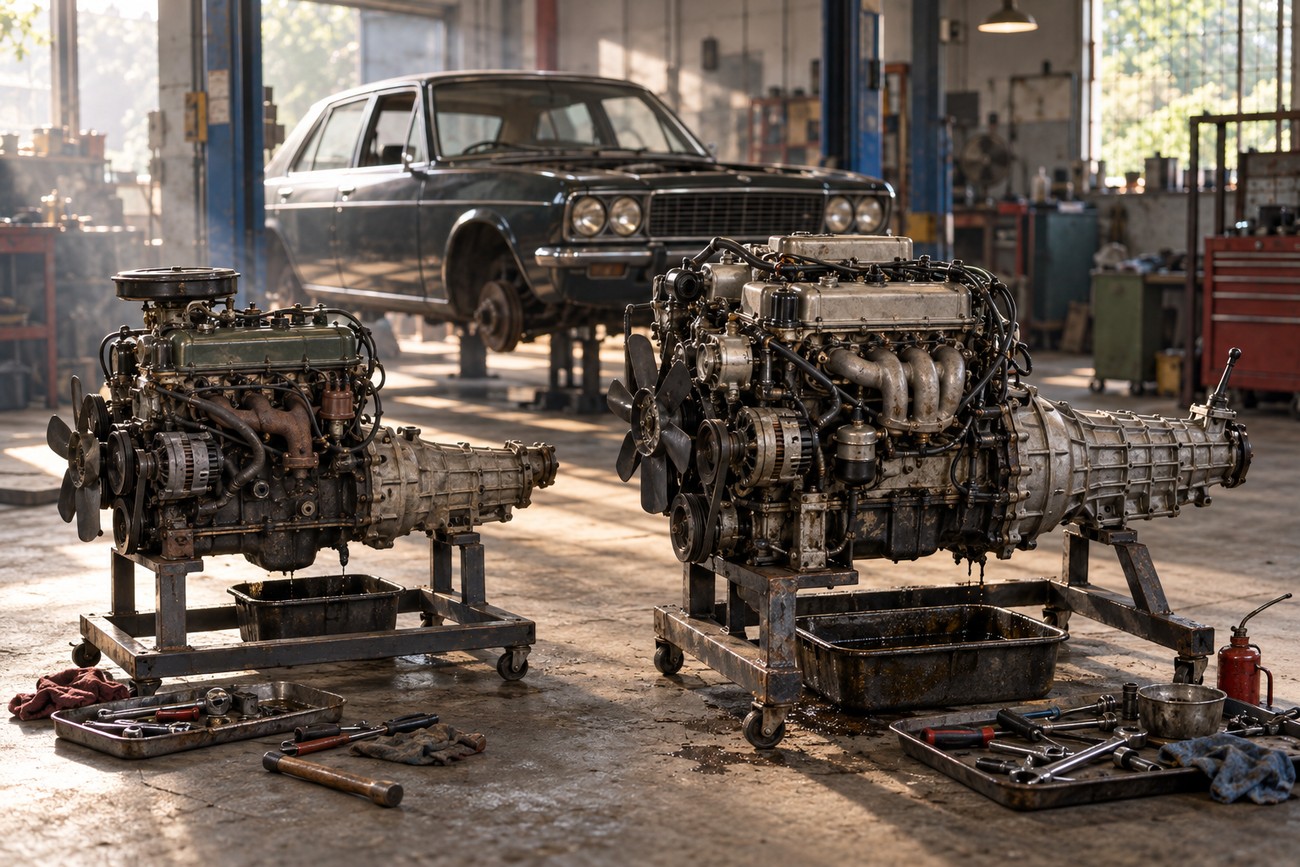
The transition from the BMC 1.5 and four-speed gearbox to the Isuzu 1.8 and five-speed gearbox matters more than the familiar exterior. The early car’s approximately 50 hp explains why its imposing body should not be read as evidence of brisk performance. The later petrol version had a more appropriate engine and an extra ratio, although reported outputs differ between imported and locally assembled examples.
The five-speed gearbox also changes the way the engine can be used. It gives the 1.8-litre car a broader spread of ratios and makes the Classic specification mechanically distinct from the early model. That distinction is easy to miss when cars share the same basic body and have been modified over several decades.
Refinement remains tied to the 1970s Vauxhall Victor FE foundation. Noise insulation, seating ergonomics, switchgear, ride behavior, and cabin safety belong to an earlier design era. The Contessa can provide period character and rear-wheel-drive balance, yet it should not be judged against modern standards of passive safety, quietness, or packaging.
Present condition can outweigh the original specification. A well-maintained early car may be a more coherent ownership proposition than a neglected 1.8 or turbo-diesel with attractive trim. Conversely, a correct engine and gearbox cannot compensate for severe corrosion, poor repairs, or an incomplete interior.
Buying a Contessa: inspect the structure before the shine
Begin underneath the car and inside its shut lines. Inspect the floors, sills, pillars, and window surrounds for corrosion before giving much weight to fresh paint or polished chrome. Rust in these areas can affect structural integrity and turn apparently minor bodywork into a major restoration project.
Next, establish the condition of the engine, especially if the car has spent a long period stored or has been restored cheaply. Check for evidence of neglected lubrication, overheating, poor starting behavior, and improvised repairs. Compression testing and a careful inspection of the cooling, fuel, and ignition systems can reveal more than a clean engine bay.
Mechanical health and access to model-specific panels and trim should be confirmed before cosmetic bodywork is authorized; otherwise, a finished shell can remain unusable while the project waits for essential parts.
The gearbox, rear axle, and brakes deserve the same attention. Confirm that the transmission selects its gears correctly, listen for abnormal axle noise, and inspect the braking system rather than assuming that a recent-looking master cylinder means the whole system is sound. A road test, where safe and legal, should support these checks rather than replace them.
Age-related faults extend into the electrical system, seals, and interior. Brittle wiring, leaking window or door seals, cracked trim, missing instruments, and damaged upholstery can consume time even when the body appears presentable. The condition of a particular car and its repair history often matter more than its original trim level.
Before committing to paint or panel replacement, make a parts plan. Identify the source of structural panels, glass surrounds, interior pieces, and specialist hardware, then decide whether the engine and running gear are worth preserving. This sequence reduces the risk of a restoration stopping after the visible work is complete.
Parts, swaps, and the true cost of keeping one
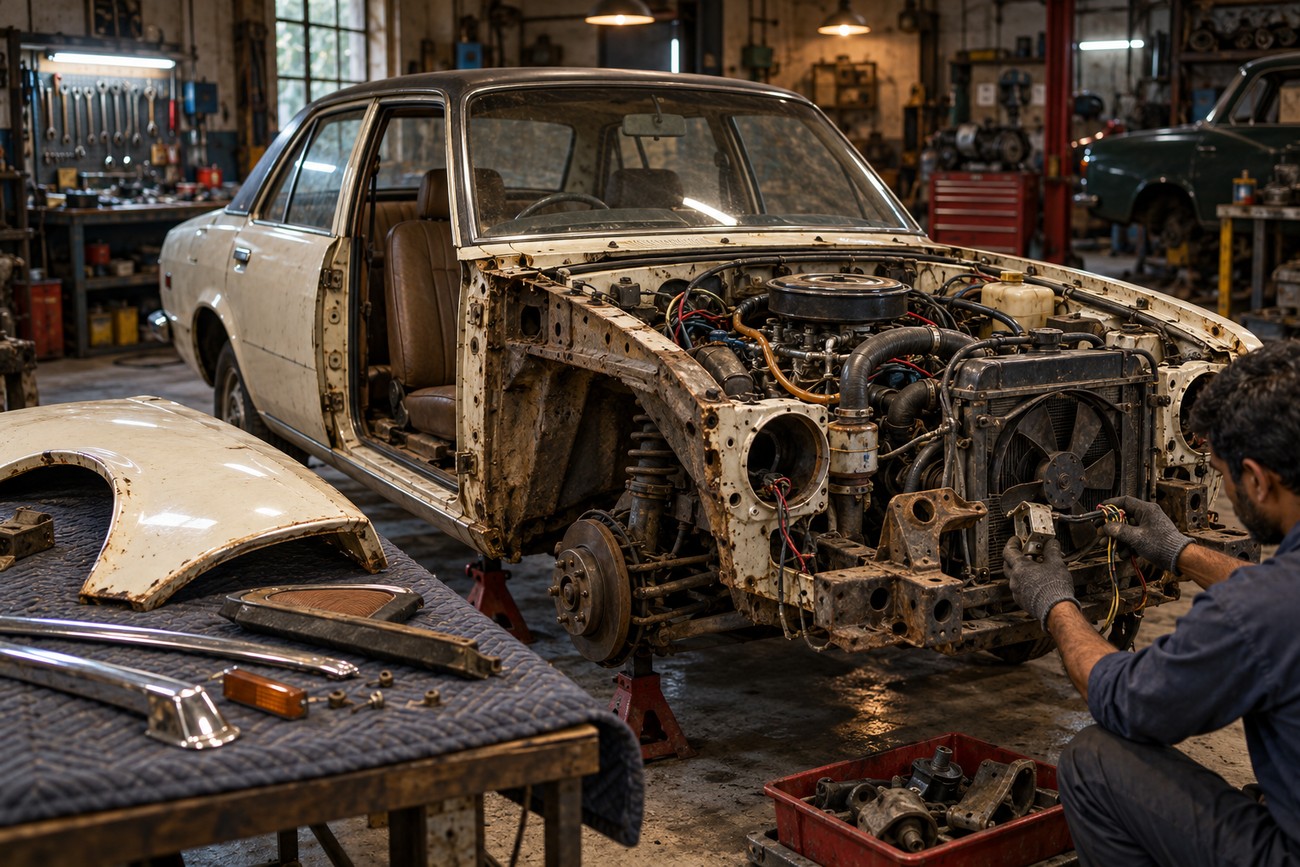
Isuzu mechanical components can appear to make some Contessas easier to maintain, but that advantage has limits. Body panels, original trim, interior fittings, and sound donor cars are reported to be difficult to find. A commonly available engine family does not make every Contessa-specific part readily available.
Engine swaps complicate the picture further. An installed Isuzu engine does not, by itself, prove that the car left the factory with that specification. Mountings, wiring, fuel delivery, gearbox details, cooling arrangements, and registration records should be checked together before ordering parts or planning a restoration.
Turbo-diesel cars require particular care during diagnosis. Their systems can demand more specialized parts matching and a clearer understanding of previous modifications than naturally aspirated versions. A familiar engine badge is insufficient evidence that the installation is complete, correctly configured, or easy to return to service.
The sensible way to estimate a project is to separate it into structure, mechanical systems, electrical work, trim, and documentation. Give priority to the areas that determine whether the car can be made safe and usable, then assess the cosmetic ambition. The repair and modification history may ultimately matter more than the factory specification printed in an old brochure.
Frequently asked questions
Was the Hindustan Contessa built after 2002?
Series production is commonly dated from 1984 to 2002. Claims of cars being produced or supplied to order after 2002 exist, but they do not establish a single confirmed later end date.
For a particular car, registration documents, sale records, chassis information, and production references are more useful than a general claim that the model continued until a later year. A late registration alone does not prove late manufacture.
What documents can help verify a Contessa’s original engine?
Compare the registration record with the engine and chassis identifiers, then check surviving service invoices, inspection documents, and period sale records. These sources can indicate whether the fitted engine matches the car’s recorded specification or was installed later.
Paperwork may be incomplete, especially for an aging car that has changed owners or undergone restoration. When records conflict, treat the engine number, mounting details, wiring, fuel system, and gearbox as a combined evidence set rather than relying on the engine badge alone.
Which car looks like the Contessa?
The Contessa most closely resembles large 1970s sedans influenced by American styling, while its direct design ancestor is the British Vauxhall Victor FE. Its long bonnet and formal four-door profile create the visual comparison; the engineering lineage remains British and Indian.
What is the Contessa, the Indian muscle car?
The Contessa is a rear-wheel-drive, four-door Indian sedan based on the Vauxhall Victor FE. “Indian muscle car” describes its visual image and cultural status more accurately than its performance class.
Early cars used an approximately 50-hp 1.5-litre BMC engine, while later Contessa Classic models used a 1.8-litre Isuzu engine and five-speed manual gearbox. The name therefore covers several mechanical specifications beneath a broadly familiar shape.







