
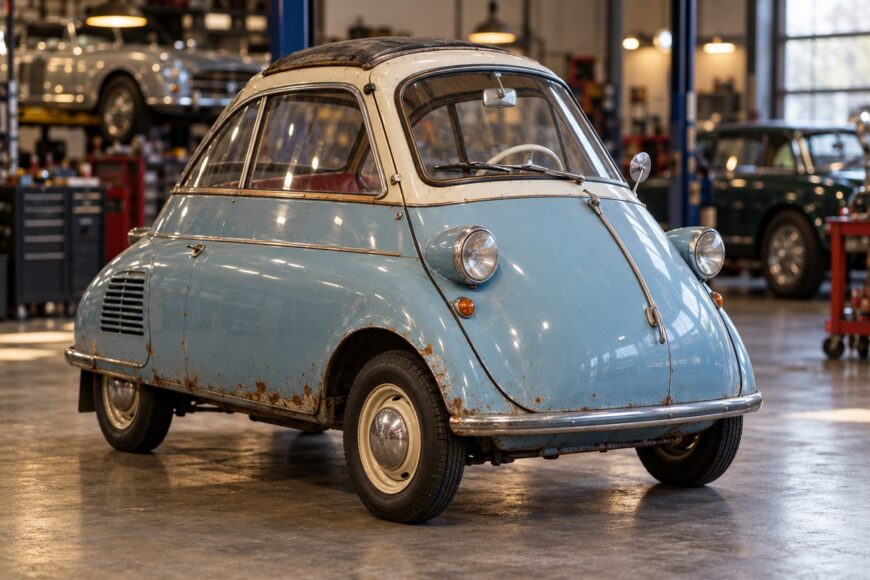
The Heinkel Kabine looks like a miniature car: an enclosed body, a steering wheel, and room for two people. Its rear-mounted single-cylinder engine, light weight, and modest power tell a different story. The charm is immediate; the limits become clearer when you consider a full load, a fast road, or a restoration that needs parts no longer on a shelf.
Names add another trap. The rounded 175 and 200 labels appear alongside Typ 150, Typ 153, and Typ 154, which identify specific versions. Treating those names as interchangeable can lead to the wrong assumptions about an engine, a document, or a replacement part. The Kabine deserves to be judged as its own postwar microcar, with its specifications translated into what you can expect from one today.
- What the Heinkel Kabine actually was
- Heinkel Kabine versions: Typ 150, 153, and 154
- How the Kabine works: entry, drivetrain, and performance
- What it is like on the road—and what the numbers hide
- Buying and restoring a Heinkel Kabine
- Heinkel or Trojan 200? History, identity, and common myths
- Frequently asked questions
- How much is a Heinkel Kabine or other bubble car worth?
- What was the first bubble car?
- Who made the Trojan 200 bubble car?
- Which bubble cars opened from the front?
What the Heinkel Kabine actually was
Built in Germany from approximately 1956 to 1958, the Kabine belonged to the postwar wave of small enclosed vehicles intended to provide basic mobility with little engine capacity. Its cabin seated two people and kept them under a roof, while the engine sat at the rear. That combination offered more shelter than a motorcycle without giving the car the space or performance of a conventional small automobile.
Its resemblance to the BMW Isetta is easy to understand, particularly from the front. Both belong to the bubble-car era and have front-opening doors, but the Kabine was a distinct design with Heinkel engines and its own range of chassis layouts. Calling it a German Isetta hides differences that matter when identifying a surviving vehicle or ordering parts.
The three-wheeled range comprised Typ 150 and Typ 153; Typ 154 had four wheels. Those layouts deserve attention beyond their visual novelty. They affect how you assess the chassis and handling, and they make a type designation more useful than the general description “Heinkel bubble car.”
Heinkel Kabine versions: Typ 150, 153, and 154
The type number is the starting point for identifying a Kabine. Rounded 175 and 200 labels are useful catalog shorthand, but they do not specify every engine or chassis detail.
| Type | Wheel layout | Engine displacement | Approximate power | Rounded label |
|---|---|---|---|---|
| Typ 150 | Three wheels | 174 cc | 9.2 hp | 175 |
| Typ 153 | Three wheels | 204 cc | 10.1 hp | 200 |
| Typ 154 | Four wheels | 198 cc | Check the specific vehicle’s documentation | 200 |
These were air-cooled, single-cylinder four-stroke engines with overhead valves. That specification distinguishes their operating character and maintenance needs from those of the two-stroke engines found in many other period microcars. Even within the “200” group, the 204 cc Typ 153 and 198 cc Typ 154 should not be treated as having the same engine specification.
The smaller 198 cc displacement was associated with tax and insurance classifications in some markets. It is therefore more than a catalog discrepancy. If paperwork calls a car a “200,” check its exact type and engine against the documents and the vehicle itself before buying parts or describing its provenance.
How the Kabine works: entry, drivetrain, and performance
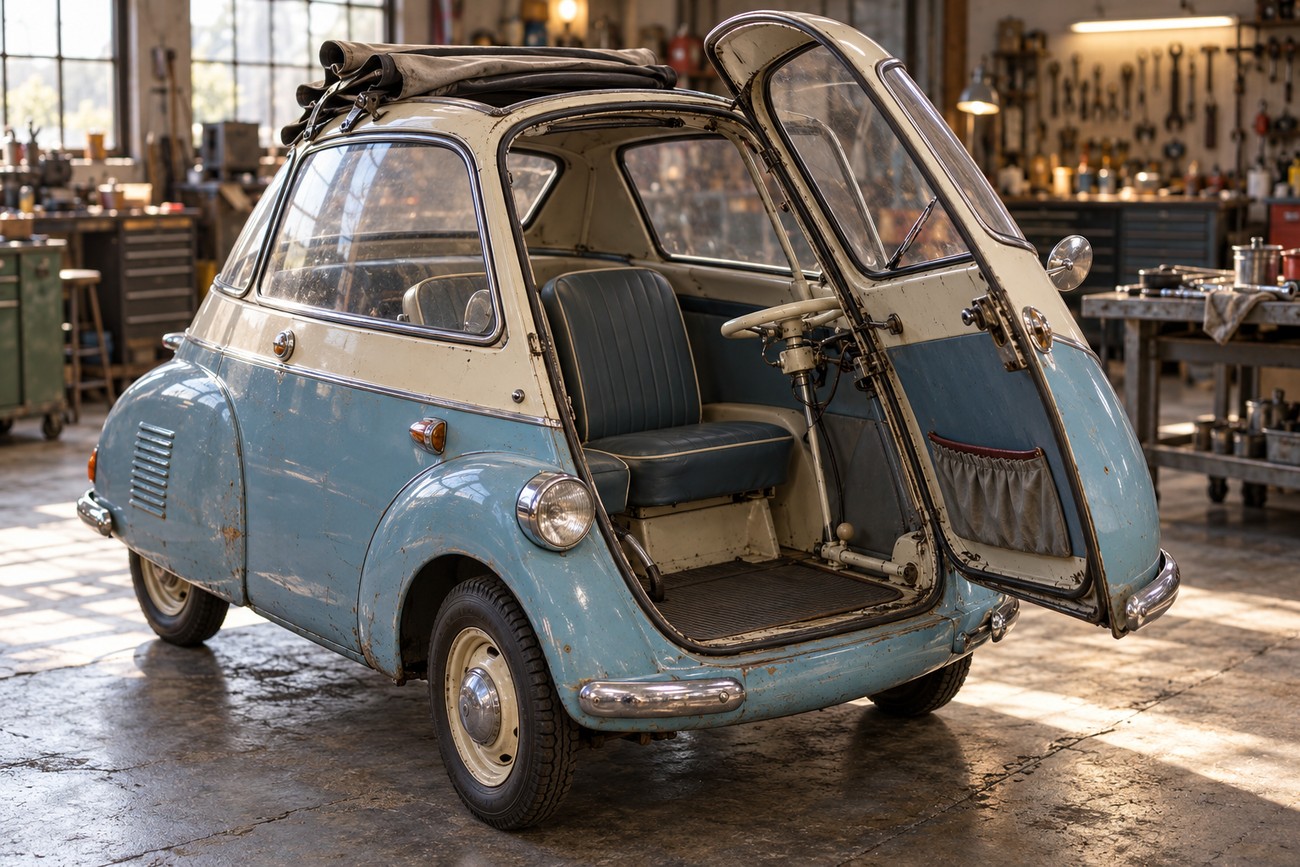
A single front door provides access to both seats. It gives the Kabine its striking face, although a parked vehicle needs enough space ahead for occupants to get out. The folding roof could also serve as an emergency exit if the door was blocked; on a car being returned to use, its condition matters for more than appearance.
The front wheels handle steering, while the engine is mounted behind the cabin. A four-speed manual gearbox sends power to the rear wheel on the three-wheeled versions. The controls may look familiar to a car driver, but the small power unit and compact chassis call for more deliberate planning at junctions and on climbs.
Factory figures for the 175 version list approximately 250 kg, a gross weight of 475 kg, and a maximum speed of 87 km/h. For the 200 version, the corresponding figures are about 290 kg, 510 kg, and 90 km/h. The gap between vehicle and gross weight is a reminder that two occupants and their belongings form a substantial part of the load.
Those speeds are historical maximum-speed claims, not recommendations for cruising on a modern road. They say nothing about how comfortably an old example reaches that speed, how it stops, or how stable it feels in traffic. Mechanical condition and the route matter far more to a sensible journey than the last few kilometers per hour in a period specification.
What it is like on the road—and what the numbers hide
With approximately 9.2 hp in Typ 150 and 10.1 hp in Typ 153, the Kabine has little power in reserve when carrying two adults. Acceleration and hill climbing demand patience, especially compared with what its car-like body might lead a newcomer to expect. A four-stroke single also makes its presence known; the enclosed cabin does not turn it into a quiet conventional car.
The three-wheeled versions warrant caution during abrupt maneuvers and under side loads. Their narrow, light layout rewards smooth steering and conservative speeds rather than a hurried correction. A four-wheeled Typ 154 has a different chassis arrangement, but an additional wheel does not confer modern handling or crash protection.
Top speed leaves out braking distance, ventilation, noise, and occupant protection. Each matters on a longer drive or in mixed traffic, where the ability to maintain a speed is only one part of keeping up safely. The design predates modern crash-protection expectations, so the quoted 87–90 km/h should never stand in for a present-day safety assessment.
Roadworthiness is also specific to the example in front of you. Age, storage, and restoration quality can change how the steering, brakes, and engine behave, even if two cars share a type designation. A short, careful test on a suitable route tells you more about usability than an advertised maximum speed.
Buying and restoring a Heinkel Kabine
Start beneath the paint. Inspect the frame and body for corrosion, then check steering joints, brakes, hubs, and wiring before treating the vehicle as ready to drive. Decades of storage can leave worn mechanical parts alongside a presentable exterior, and a fresh finish offers little evidence about what is sound underneath.
Establish exactly what is present and what works. The engine internals and four-speed gearbox deserve careful assessment, while glass, instruments, and cabin fittings should be checked piece by piece. Limited space around the mechanical assemblies can make even an ordinary repair less straightforward than the equivalent job on a conventional car.
Original parts can be scarce, and some may need restoration or remanufacture. That shifts the ownership calculation away from the purchase price alone: an incomplete car can absorb substantial work before it is usable. Ask what has actually been rebuilt, what was merely cleaned or painted, and whether any replacement component matches the documented type.
Weight claims deserve similar care. Factory and catalog figures are about 250–290 kg, while some listings cite about 305 kg. Equipment, fluids, and weighing method may explain the difference, so do not treat a listing figure as proof of an unusual version without supporting evidence.
Heinkel or Trojan 200? History, identity, and common myths
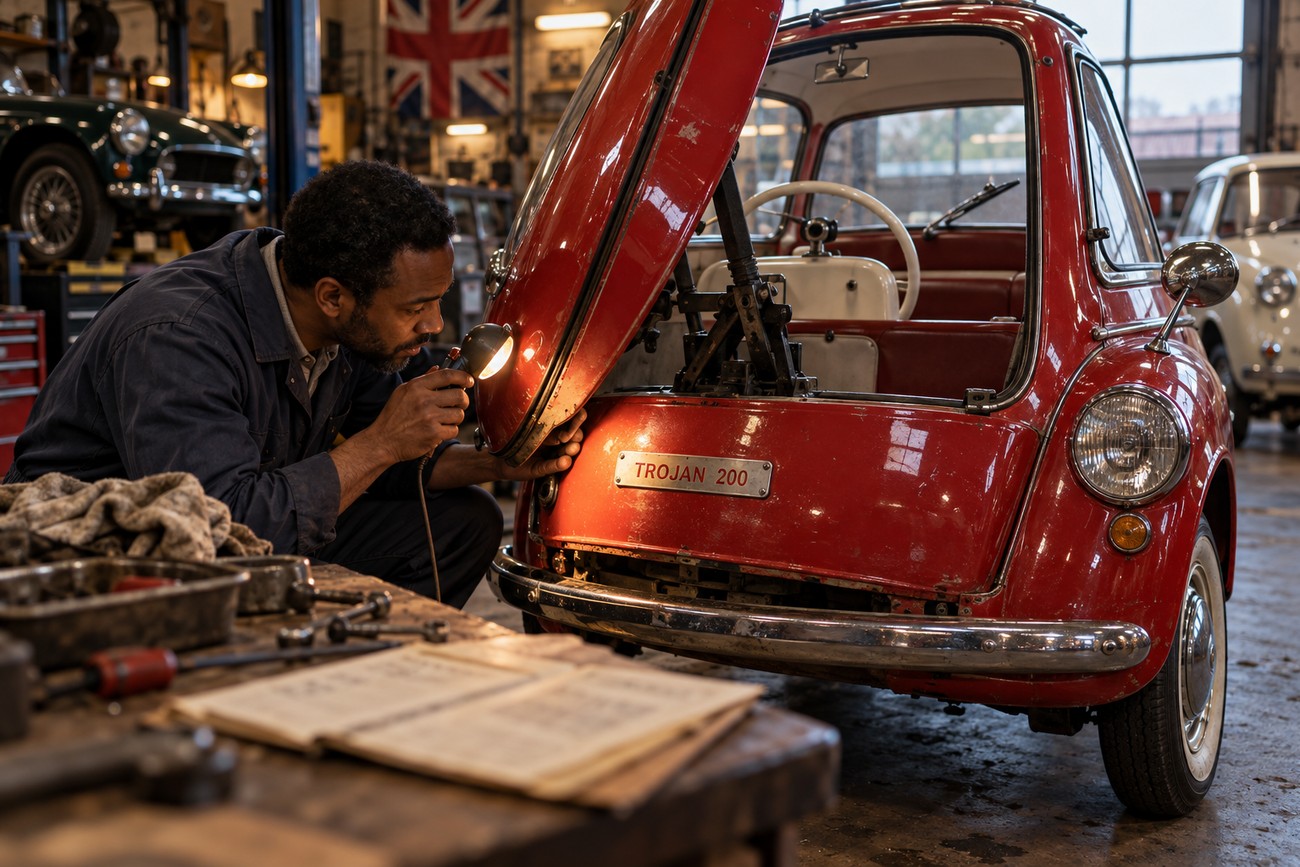
German production ended after the Kabine’s approximately 1956–1958 run. Licensed production followed in Ireland and the United Kingdom as the Trojan 200, continuing until 1966. A Trojan is closely related to the Heinkel design, but it is not automatically a German-built Heinkel.
That extended history gives buyers more to verify than a badge or a rounded engine label. Markings, documents, and parts can vary across production periods and markets. Record the precise identity of the vehicle you are inspecting before assuming that a component described as fitting a “Heinkel 200” will fit it.
Three common shortcuts cause trouble. A “200” label does not mean every example has the same displacement; a Trojan name does not establish German manufacture; and neither four wheels nor a claimed 90 km/h establishes modern safety. The useful evidence is the exact type, its documented origin, and the condition of its actual chassis and mechanical parts.
Frequently asked questions
Bubble-car names cover a broad group of small vehicles. The details matter when identifying a car or assessing its value, especially when an advertisement offers little documentation.
How much is a Heinkel Kabine or other bubble car worth?
There is no useful universal price for a Heinkel Kabine or for bubble cars as a group. Value depends on the exact type, documented origin, originality, completeness, mechanical condition, and quality of restoration. A glossy but incomplete example may require more costly work than a worn-looking car that retains its correct engine, glass, instruments, and trim.
Compare vehicles with similar identities and levels of work completed. Ask for records that show what was repaired and what remains to be done; an asking price alone cannot tell you the likely cost of putting a scarce-parts microcar into dependable condition.
What was the first bubble car?
There is no universally accepted first bubble car. “Bubble car” is a broad retrospective label applied to several small, often enclosed vehicles, and the answer changes with the definition used. The Heinkel Kabine’s German production began approximately in 1956, placing it within that wider postwar movement rather than settling a claim to being first.
Who made the Trojan 200 bubble car?
The Trojan 200 was a licensed-production successor to the Heinkel Kabine, produced in Ireland and the United Kingdom. For an individual car, the Trojan name identifies the licensed line rather than proving that Heinkel built it in Germany. Its documents and physical markings are the better guide to where a particular example belongs in that history.
Which bubble cars opened from the front?
Front-opening entry appeared on more than one period microcar, including the Heinkel Kabine and BMW Isetta. The feature helped make compact cabins accessible, but it cannot authenticate a Kabine on its own. Use the door as one visual clue, then check the chassis type, engine, markings, and paperwork before identifying the vehicle.







