
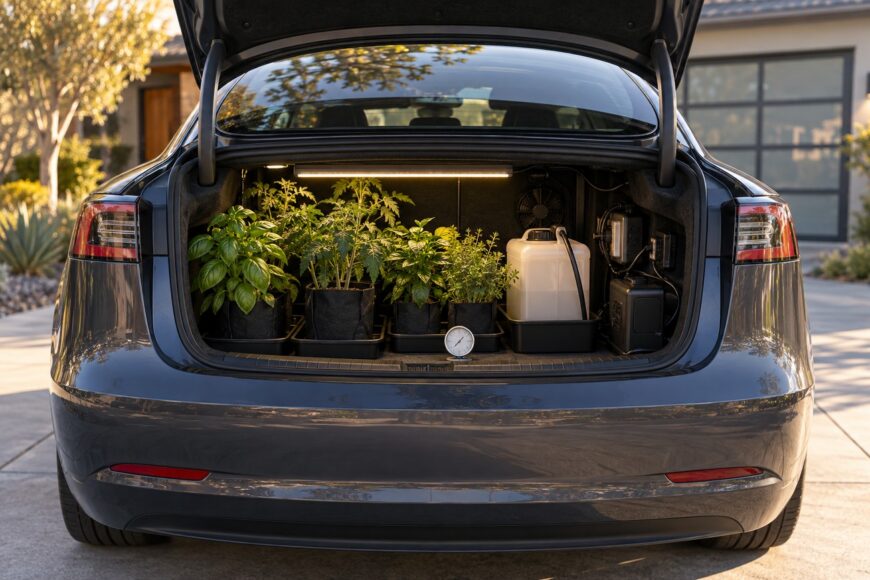
The spare space in a Tesla Model 3 trunk can make a small plant setup seem plausible. Pots and a light may fit, and the car has climate control. The difficulty is that the car controls cabin conditions, while a plant inside the trunk experiences its own temperature, humidity, light, and airflow.
That makes trunk growing a monitored, temporary experiment rather than a ready-made method. Heat, spilled water, condensation, and electrical equipment all introduce risks to the plants and the vehicle. Before using the space, decide whether you can measure conditions where the leaves will be and stop the trial when those conditions become unsuitable.
- Can You Actually Grow Plants in a Model 3 Trunk?
- Fit the Plants Without Turning the Trunk Into a Spill Zone
- Why Cabin Climate Cannot Protect Trunk Plants
- Manage Light, Air, and Water Without Creating an Electrical Hazard
- Test the Empty Setup Before Putting Plants at Risk
- When the Better Growing Space Is Outside the Car
- Frequently asked questions
- How much weight can I put in a Tesla Model 3 trunk?
- What should I do if a plant wilts after a trip in the trunk?
- Why are so many people getting rid of their Teslas?
- What are some secret voice commands for Teslas?
Can You Actually Grow Plants in a Model 3 Trunk?
A plant can survive a trip in the trunk without establishing that it can grow there. Sustained new growth requires suitable light, water, temperature, humidity, and ventilation; a shortage of any one can limit the result. Transport is a short exposure, while cultivation means keeping those conditions suitable through parking, weather changes, and repeated watering.
Documented long-term growing experience specific to the Model 3 trunk is limited; available experience more often concerns plant transport. There is therefore little basis for treating a complete growing cycle in this space as a reliable method. A healthy-looking plant after a brief trial may still be experiencing conditions that will cause damage later.
Cabin climate control does not automatically establish a suitable trunk-growing environment. The standard system is designed for the cabin, not for an enclosed plant box in the cargo area. Any proposed setup needs its own measurements and a way to manage air movement and moisture without compromising electrical safety.
Fit the Plants Without Turning the Trunk Into a Spill Zone
The supplied figures are 594 L behind the second row, 682 L maximum total, and 88 L in the separate front trunk. Those figures describe volume, not allowable cargo weight, and the growing space shrinks once you add pots, a containment box, light clearance, and equipment. Check the assembled layout with the trunk closed before assuming that a plant has room to grow without touching a fixture or enclosure wall.
A stable waterproof tray or box should contain the pots and any drainage water, with a separate barrier protecting carpet and floor panels. Secure the enclosure and pots so they cannot slide or tip during braking. Wet soil, containers, and stored water add weight, while a spill can reach trim and floor panels even if the visible trunk covering appears protective.
An opaque, insulated enclosure can reduce direct sun exposure and moderate rapid temperature changes. It still needs managed airflow; sealing it airtight would create another problem. An uncovered rack leaves plants and equipment more exposed to shifting, spills, and changing conditions, while pots placed directly on trunk trim give escaping water a path into the vehicle.
Why Cabin Climate Cannot Protect Trunk Plants
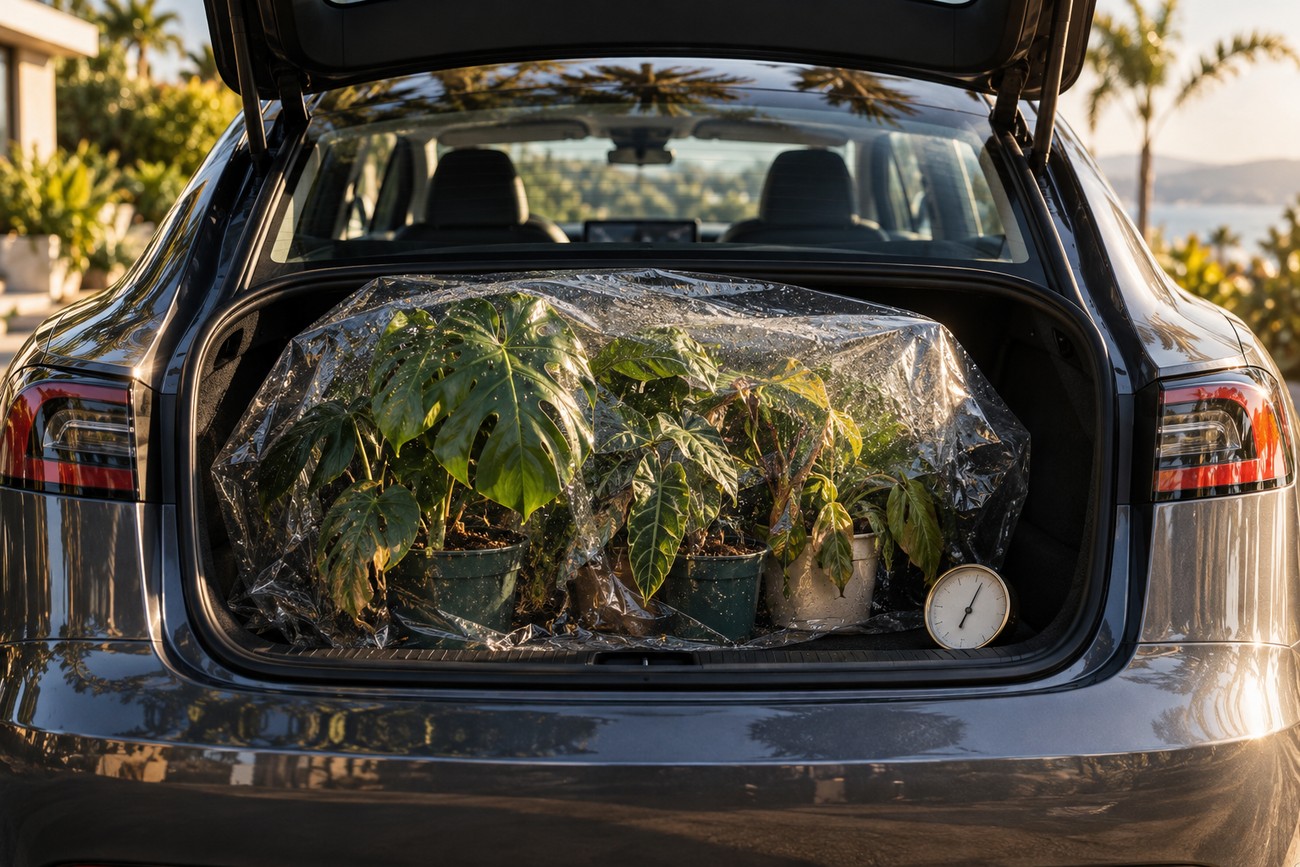
A closed car can heat up quickly in summer, and the temperature around a plant in the trunk may differ substantially from the cabin reading. Air conditioning does not guarantee suitable trunk temperature, humidity, or air exchange. It also does not remove every risk of leaf sunburn where direct sunlight reaches a plant.
Cold presents a separate problem, especially when a parked car is no longer maintaining cabin comfort. Many houseplants can be damaged below 10 °C; for many tropical plants, a typical comfort range is around 21–27 °C by day and 16–20 °C by night. A closed trunk should not be assumed to protect those plants as well as a monitored cabin during a cold-weather trip.
Tesla’s stated sustained ambient range of approximately −30 to +60 °C describes vehicle limits, not safe plant conditions. It says nothing about the temperature at leaf level inside a box or beside a trunk panel. Using that vehicle specification as a plant-care target would leave a wide gap between what the car can tolerate and what the plant needs.
Rear cabin vents are in the center console, so cabin airflow is not a dependable supply for a trunk enclosure. Climate control may also dry the air, while transitions between cooling and outdoor heat can produce condensation. Never assume that a climate setting alone makes unattended trunk plants safe.
Manage Light, Air, and Water Without Creating an Electrical Hazard
A grow light must provide suitable light at the plants without crowding leaves against the fixture or trapping heat in a small box. LEDs still have drivers and wiring that can overheat or fail. Treat the vehicle’s available power as a limited electrical supply, and avoid cheap or overloaded adapters rather than assuming an outlet can support any combination of lights, fans, pumps, and humidifiers.
Keep LED drivers and electrical connections outside the humid growing zone, physically separated from watering points and protected from spills. An IP-rated light alone does not establish safety against condensation reaching drivers or electrical connections. Check the entire arrangement, including cables and connectors, rather than relying on the fixture’s rating.
A small fan can circulate air inside an enclosure, but it should not blow continuously straight onto leaves. Internal circulation can reduce stagnant pockets of damp air; it does not provide dependable fresh-air exchange in a closed vehicle. The Model 3’s standard climate system is designed for the cabin, not a sealed plant box in the trunk.
Water only in amounts the containers and waterproof tray can hold, and keep open reservoirs away from electrical equipment. If maintaining the plants would require exposed connections near water, overloaded accessories, or changes to vehicle wiring, stop the setup. A simpler arrangement is preferable to adding devices whose failures would be difficult to notice in a closed trunk.
Test the Empty Setup Before Putting Plants at Risk
Assemble the enclosure without plants, secure it as you would for a trip, and place an independent temperature-and-humidity logger where the leaves would be. Run the trial through ordinary parking and climate changes for at least 24 hours before adding plants. One day of readings helps identify immediate problems, but it does not establish safety across all seasons.
Place the logger at leaf height inside the enclosure. A reading near the trunk lid or from the cabin sensor can miss the conditions the plant would experience.
Review the readings alongside what you can see and feel in the empty setup. Inspect the enclosure, vehicle surfaces, and electronics for condensation, particularly after a shift from air-conditioned conditions to outdoor heat. Check that the enclosure remains secure and that its airflow path has not been blocked.
If the test shows excessive heat, damaging cold, persistent moisture, or unstable airflow, revise the arrangement and test it again—or abandon the trunk plan. Do not substitute the cabin display for a measurement at the intended plant position. Once plants are added, continued monitoring remains necessary because watering introduces moisture that the empty trial could not reproduce.
When the Better Growing Space Is Outside the Car
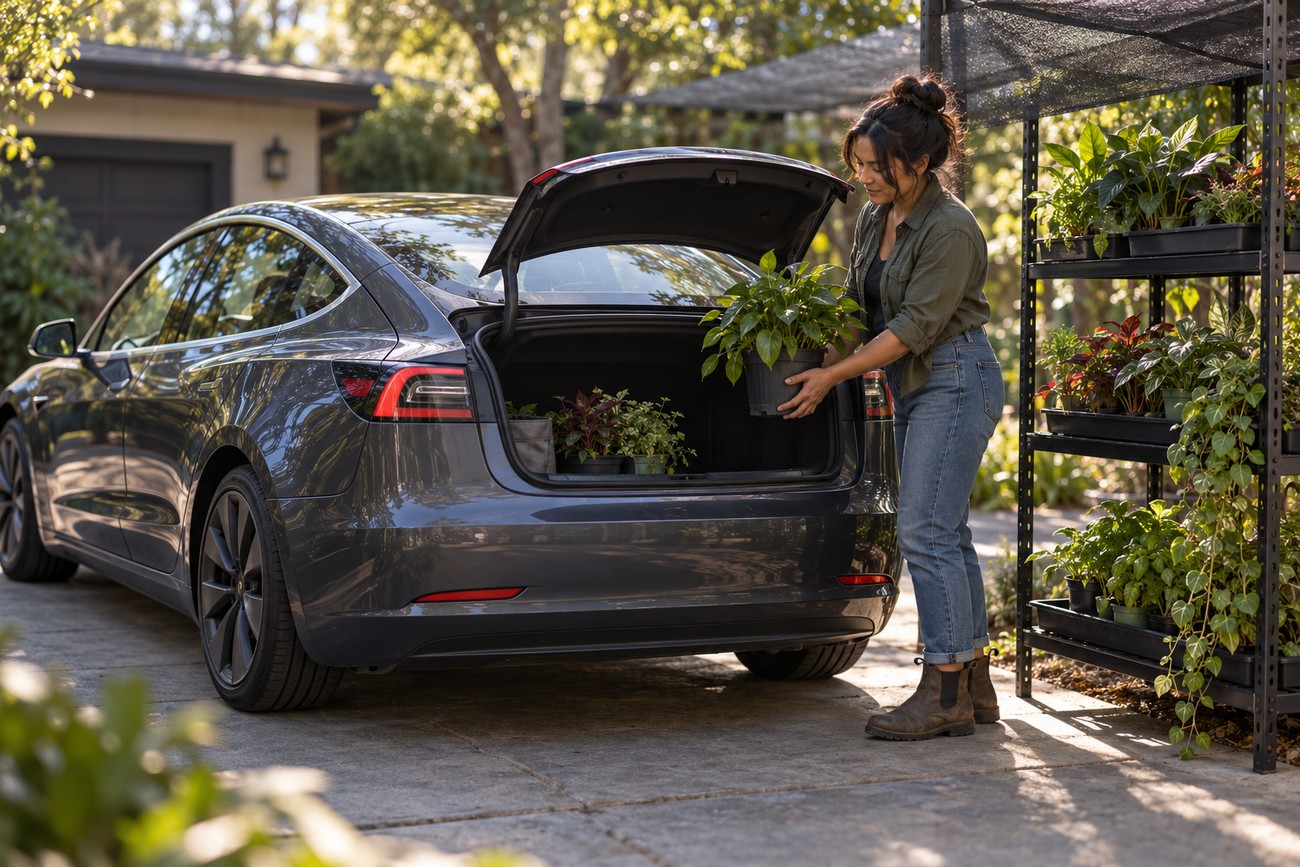
Stop a trunk-growing trial if you cannot control temperature, prevent persistent condensation, provide dependable air exchange, or isolate electrical components from moisture. These are functional limits, not minor inconveniences. A plant that fits physically still needs conditions that remain suitable when the car is parked.
For a short, supervised trip, the cabin is generally preferable in cold weather because you can more directly monitor the space around the plants. Keep them secure and away from direct sun: leaves can be damaged even when the surrounding air feels comfortable. Many houseplants can be damaged below 10 °C, so avoid leaving them in a cold parked vehicle.
A full growing cycle belongs in a stationary space where light, watering, humidity, temperature, and fresh air can be controlled and checked without depending on the car. Documented long-term growing experience specific to the Model 3 trunk is limited, and cabin climate control does not guarantee suitable conditions there. Use the trunk for a carefully monitored trial only if its risks and stop conditions are manageable.
Frequently asked questions
Loading, transport recovery, and vehicle controls raise different questions from the growing setup itself. For vehicle-specific limits and features, use the information provided for your particular car.
How much weight can I put in a Tesla Model 3 trunk?
The cargo-volume figures are space measurements, not a trunk-specific weight rating. Check your vehicle’s loading information and account for passengers, equipment, pots, wet soil, and water together. Keep the load secured and within the limits specified for your vehicle.
What should I do if a plant wilts after a trip in the trunk?
Move it to a stable location suited to that plant and keep it out of harsh direct sun while you assess it. Check the soil before watering: wilt can follow either drying out or stress from heat and cold, so adding water automatically may make matters worse. Watch for worsening leaf damage over the following days and resume its normal care only as conditions stabilize.
Why are so many people getting rid of their Teslas?
That question assumes a widespread trend that cannot be established from individual sale listings or anecdotes. Owners sell cars for many reasons, including changing transport needs and ownership costs. Those decisions do not establish whether a Model 3 trunk is suitable for growing plants.
What are some secret voice commands for Teslas?
There is no dependable “secret” command list to use across every Tesla software version and region. To see which voice controls your car supports, consult its current on-screen guidance and owner documentation, then test commands while parked. Voice controls do not measure or regulate conditions inside a trunk plant enclosure.







