

The Gordon-Keeble GK1 sits at an intriguing intersection: a rare, elegant British four-seat GT with Chevrolet Corvette power, yet a chassis and parts supply that demand specialist knowledge. Its fiberglass body and Bertone styling suggest an exotic grand tourer, while the American V8 appears to promise straightforward mechanical support.
That apparent simplicity can mislead. The real buying question is whether a GK1 is an affordable American-powered classic or an expensive specialist restoration with a familiar engine installed in an unfamiliar system. Even its headline specifications require care: some sources cite about 300 bhp, while technical records give 280 bhp for certain later or detuned configurations, and the often-repeated 160 mph claim is difficult to support.
- What the Gordon-Keeble GK1 Was Trying to Be
- Corvette V8 Power, De Dion Engineering, and Real Performance
- A Four-Seat GT in the Real World
- Buying a GK1: Identity, Frame, and Fiberglass Matter More Than Shine
- Ownership Reality: Cooling, Electrics, Fuel, and Specialist Setup
- The GK1 Myths That Can Distort a Purchase
- Frequently asked questions
- What paperwork should accompany a Gordon-Keeble GK1 before purchase?
- How should a GK1 with a 280 bhp or 300 bhp claim be valued?
- What makes a modified GK1 less desirable than a standard car?
What the Gordon-Keeble GK1 Was Trying to Be
The Gordon-Keeble GK1 was produced from 1964 to 1967 on a deliberately limited scale. About 100 cars are often quoted, although that figure comes from a single source and should be checked against a chassis register before it is treated as definitive. Either way, this was a small production program, with little opportunity to develop the parts infrastructure associated with a mainstream luxury marque.
The intended customer was an executive or international business traveler who wanted to cover long distances quickly and arrive in comfort. The GK1 was therefore conceived as a four-seat GT rather than a stripped-down sports car. Its mission combined substantial cruising speed, a usable cabin, and a degree of visual distinction that a conventional grand tourer could not easily provide.
Its design reinforced that brief. The production body was fiberglass, with styling created by the young Giorgetto Giugiaro for Bertone. The material helped keep body weight under control and allowed a distinctive shape to be produced in small numbers, but it also created a long-term restoration issue: original panels are difficult to source, and replacement work must account for the way fiberglass changes around mounting points over time.
That context matters when comparing the GK1 with better-known British GTs. It is more accurate to regard the car as a niche, Corvette-powered British experiment than as a direct, high-volume Aston Martin rival. Its rarity gives it collector appeal, but rarity also means that ownership depends heavily on the surviving documentation, the quality of previous repairs, and the availability of people who understand the complete car.
Corvette V8 Power, De Dion Engineering, and Real Performance
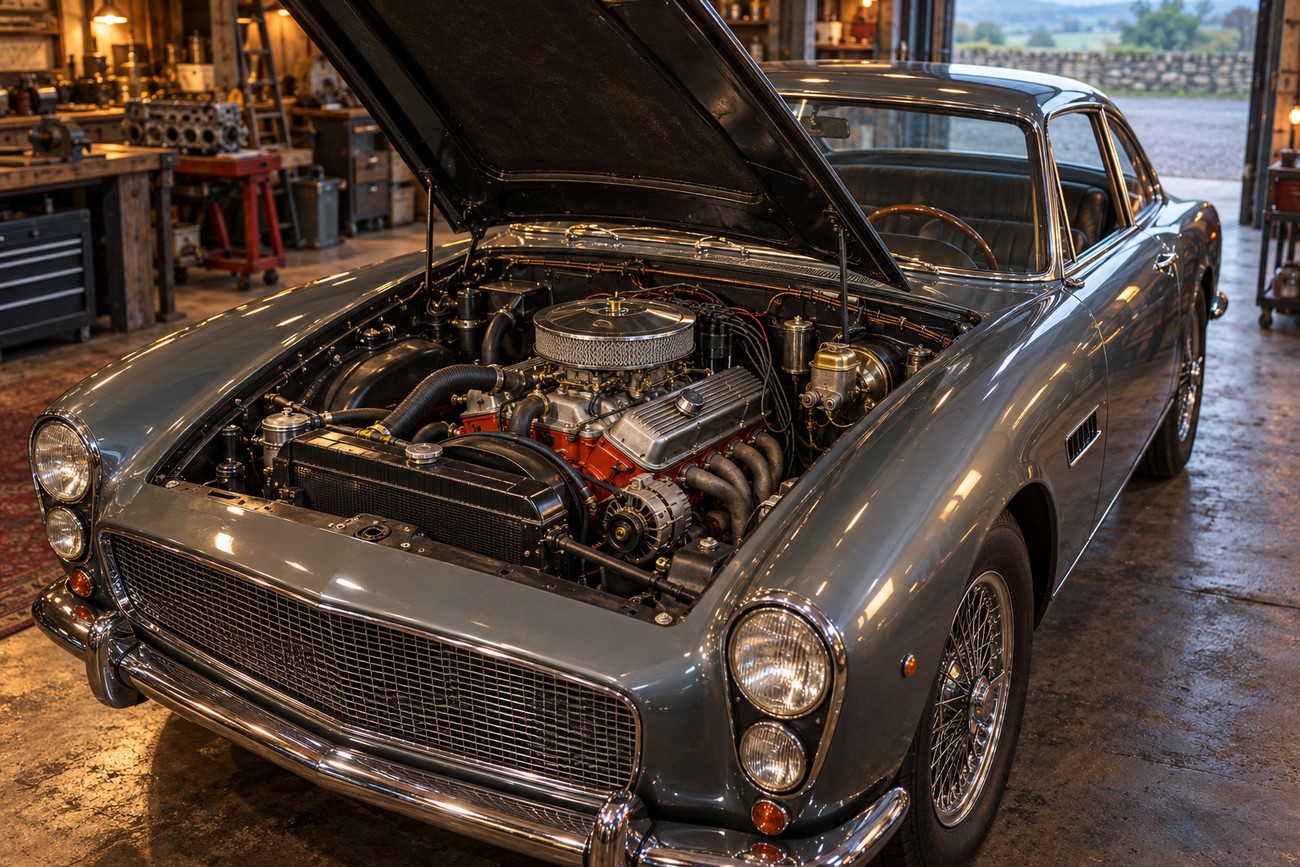
At the front sits a Chevrolet Corvette 327 V8 of approximately 5.3–5.4 liters. The engine’s broad torque curve suited the GK1’s touring role, with approximately 360 lb-ft, or about 488 N·m, available to move the relatively compact GT. The familiar Chevrolet architecture can make routine engine work easier than work on a unique British power unit, provided the car has not been altered carelessly.
Power figures need to be read as a range of specifications rather than a single unquestionable number. Club material and some sources cite about 300 bhp, while some technical records identify 280 bhp for later or detuned configurations. Engine identification, period records, and the actual specification of the particular car matter more than a high figure repeated in a sales description.
Drive goes to the rear wheels through a four-speed Warner T-10 manual gearbox. The transmission is part of the car’s identity, and a replacement or heavily modified unit should be documented rather than accepted as an automatic improvement. The chassis uses a square-section tubular space frame, a De Dion rear axle, and four-wheel disc brakes, giving the GK1 a more sophisticated mechanical foundation than its low production volume might suggest.
Period and club performance figures commonly place 0–60 mph acceleration at approximately 6–6.2 seconds. Reported top speed is approximately 139–145 mph, or 223–233 km/h. Those figures are sufficiently strong for the car’s period, but they should not be confused with the unsupported 160 mph claim that appears in some popular descriptions.
The important point for a driver is balance. A stronger engine does not automatically make a better GK1 if the De Dion layout, brakes, cooling system, and frame have not been prepared for the additional load. The car’s performance depends on the condition and geometry of the whole chassis, not simply on whether the V8 starts easily or carries a familiar Chevrolet casting number.
A Four-Seat GT in the Real World
The GK1’s appeal begins with the combination of shape and purpose. Its low, formal bodywork, fiberglass construction, and carefully styled proportions give it the presence expected of an expensive GT, while the four-seat layout promises more versatility than a two-seater. The original aviation-style instrument panel strengthens that impression, adding a distinctive feature that collectors value and restorers seek to preserve.
That promise has limits. Access to the rear seats is restricted, and rear-passenger comfort is less convincing than the phrase “four-seat GT” might suggest. The rear compartment is useful for occasional passengers or additional luggage flexibility, but it should not be judged by the standards of a modern executive sedan.
The fiberglass body also needs a more careful inspection than a quick walk around a polished example provides. Cracks or distortion can develop around mounting points, particularly where the body has been removed, poorly supported, or repaired after an accident. A straight-looking panel may conceal movement at its attachment points, and a fresh paint finish can make that problem harder to see.
The cabin creates a similar distinction between presentation and substance. Correct trim, instruments, switches, and badges are scarce, so a car with an attractive but mixed interior may be pleasant to use while remaining difficult to return to authentic specification. The original dashboard and turtle emblem are especially important originality markers because replacing them with generic parts changes both the character and the collector case.
Buying a GK1: Identity, Frame, and Fiberglass Matter More Than Shine
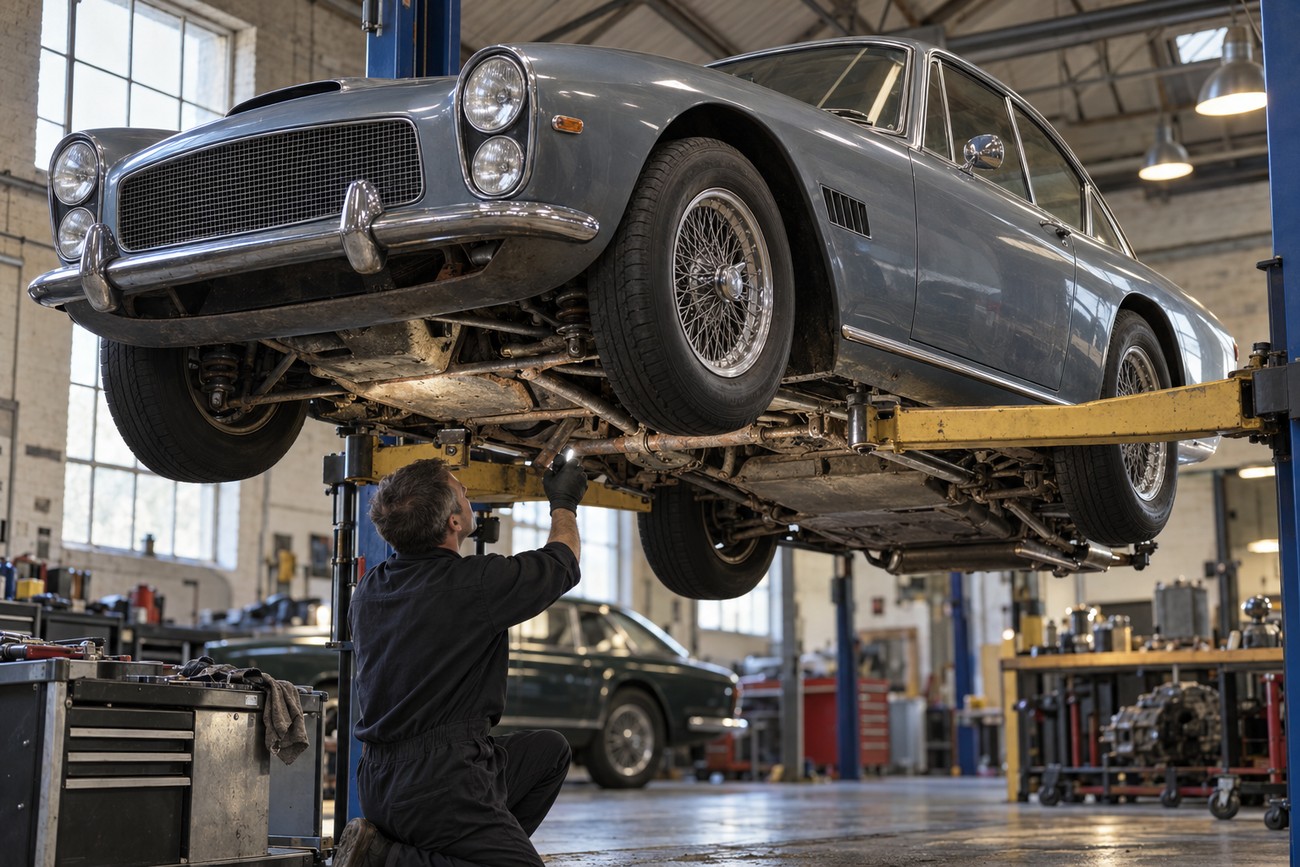
Begin with identity, not paint. A chassis-register check, owner-club documentation, and a coherent record of the car’s engine, gearbox, and major repairs can establish whether the vehicle is a genuine, consistent GK1 or a mixture of parts assembled over several restorations. The Chevrolet Corvette 327 and Warner T-10 should be identified and their history recorded, even if the car is not represented as fully original.
The tubular space frame deserves inspection on a lift by someone familiar with structural restoration. Look for corrosion inside accessible sections, cracking around suspension and mounting points, signs of distortion, and repairs that do not follow the original geometry. Damage from a serious accident is expensive because the frame is complex, and a visually tidy repair may still leave the suspension pickup points incorrectly positioned.
Paint quality is a late-stage consideration on a GK1. Specialists first establish that the frame is straight, sound, and correctly aligned, because a glossy body can conceal a structural repair whose cost exceeds the value of the cosmetic work.
Fiberglass panels should be checked for stress cracks, uneven gaps, distortion, and evidence of repeated removal. Original panels and correct trim are difficult to obtain, so an apparently minor fitment issue can become a substantial restoration project. The same caution applies to the interior: new upholstery may look attractive, but missing original fittings, instruments, or badges can be harder to replace than worn seat coverings.
Incomplete history is common enough to affect valuation. Records should ideally connect the chassis to its owners, engine, gearbox, restoration invoices, and any structural work. A car with honest gaps in its history may still be sound, but the cost of proving what it is and correcting what was changed should be reflected in the purchase decision.
Do not buy on appearance alone. A polished car with an incorrect engine, improvised wiring, non-standard suspension settings, and a mixed interior may require more work than a less attractive example with strong documentation and an intact frame. On a GK1, originality is a mechanical and documentary question as much as a cosmetic one.
Ownership Reality: Cooling, Electrics, Fuel, and Specialist Setup
The Chevrolet engine can simplify access to many consumables, but it does not turn the GK1 into an ordinary American-powered classic. Overheating may appear in dense traffic or hot climates when the cooling system is tired, incorrectly configured, or fitted with a replacement radiator that does not suit the installation. Before using the car for touring, the radiator, airflow, hoses, fan arrangement, and temperature control should be assessed as one system.
Age-related electrical faults are another recurring nuisance. The original wiring and aviation-style instruments can develop small but persistent failures, from unreliable readings to intermittent switches. Randomly replacing components may keep the car moving while making the wiring harder to understand; a proper circuit inspection and documented repair are more useful for future ownership.
The fuel system has its own trap. The GK1 uses two fuel tanks, with taps and gauges that must operate correctly. Incorrect tap operation, inaccurate gauges, or an unbalanced system can create unexpected range problems and uneven fuel distribution. A pre-purchase inspection should confirm that both tanks fill, feed, vent, and report their contents as intended.
Suspension setup is particularly important. The De Dion rear axle responds noticeably to ride height, alignment, and camber, so adjustments made by eye can change the car’s behavior and tire wear. Specialists familiar with the GK1 frame and its geometry are scarce; a general workshop may be able to service components, but that does not guarantee that the finished car has the correct stance or alignment.
This is why ownership costs remain high despite the availability of Chevrolet parts. Engine consumables may be accessible, while GK1-specific chassis work, fiberglass repair, trim, instruments, and suspension setup remain difficult. Fuel consumption is also significantly higher than in many typical British GTs, particularly in urban driving, and should be included in the practical ownership budget.
The GK1 Myths That Can Distort a Purchase
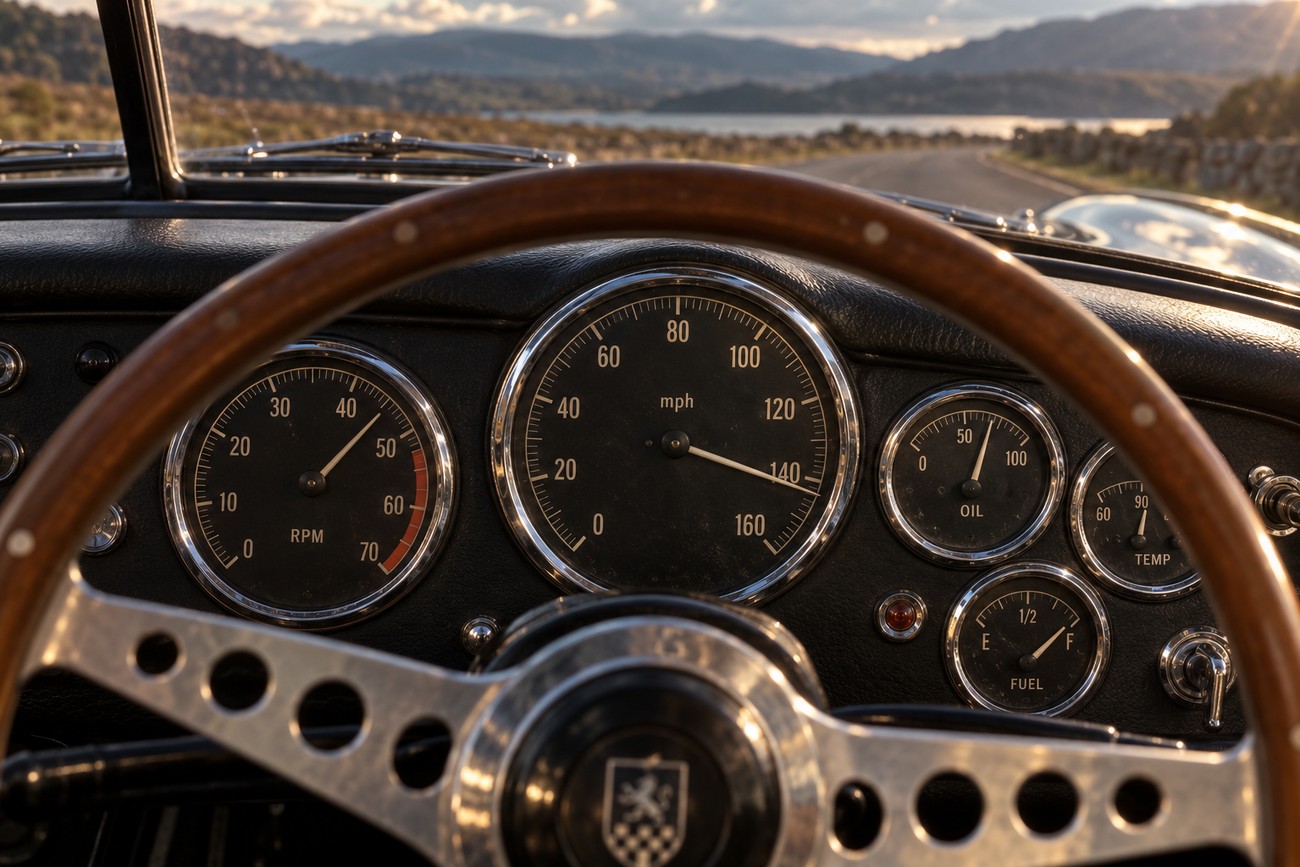
The 160 mph claim is the clearest example of a specification that has gained authority through repetition. The better-supported test and club range is approximately 139–145 mph, or 223–233 km/h. That remains serious performance for the period, and there is no benefit in using a less credible figure when assessing a car’s history or mechanical condition.
The same caution applies to power. About 300 bhp is a legitimate figure found in club and other sources, but it was not universal. Some technical descriptions and registers cite 280 bhp for later or detuned configurations, so a lower stated output does not automatically indicate an inferior car. Collector value may favor a well-documented, correctly specified engine over an undocumented unit advertised with a higher number.
It is also misleading to describe the GK1 as inexpensive to maintain because its V8 was mass-produced. Chevrolet service parts can help with routine engine work, but the rare frame, De Dion assembly, body, interior, and electrical systems determine much of the real cost. A car with a standard engine and correct chassis can be cheaper to own than a modified example that requires specialist correction.
More powerful V8 conversions deserve particular scrutiny. Additional output can place greater demands on the De Dion axle, brakes, gearbox, and frame, while poorly engineered drivetrain changes may reduce stability and durability. The GK1 is best understood as a niche Corvette-powered British GT experiment: distinctive and quick, but too rare and structurally specialized to be judged by the assumptions applied to a mass-produced sports car.
Frequently asked questions
What paperwork should accompany a Gordon-Keeble GK1 before purchase?
Useful paperwork includes chassis-register evidence, a continuous or at least coherent ownership history, engine and gearbox identification, restoration invoices, and records of structural or accident repairs. Documentation should show whether the Chevrolet Corvette 327 and Warner T-10 are original to the car or later replacements.
Owner-club confirmation can add valuable context where factory records are incomplete, particularly when it links the chassis to known specifications or earlier photographs. Invoices should be read critically: a large restoration bill does not prove correct work, but detailed records of frame repairs, fiberglass work, suspension setup, and electrical changes make future assessment much easier.
How should a GK1 with a 280 bhp or 300 bhp claim be valued?
Value the claim through engine identification, period specification records, and evidence of the actual configuration rather than the number in an advertisement. A dyno sheet can help, but it should be considered alongside casting and component details, carburetion, compression-related changes, and the history of the engine.
A documented 280 bhp configuration may be preferable to an alleged 300 bhp engine with unknown internals or aggressive modifications. For a collector, originality, sound installation, correct gearbox, and credible paperwork often matter more than a small difference in claimed output. The lower figure should not be treated as a defect without establishing what specification the particular chassis is meant to have.
What makes a modified GK1 less desirable than a standard car?
Undocumented engine, gearbox, brake, or suspension changes affect safety, drivability, originality, and future valuation. A more powerful V8 may overload the De Dion axle, brakes, or frame if the rest of the car was not engineered to match it, while altered ride height or alignment can change handling in ways that are difficult to diagnose from a road test.
Modification is not automatically disqualifying, especially if the work is reversible and supported by engineering records. The concern is uncertainty: future insurers, appraisers, and buyers may struggle to assess a car with mixed components and no clear baseline. A standard, well-documented GK1 is usually easier to inspect, maintain, and value than a faster car whose history depends on assumptions.







