
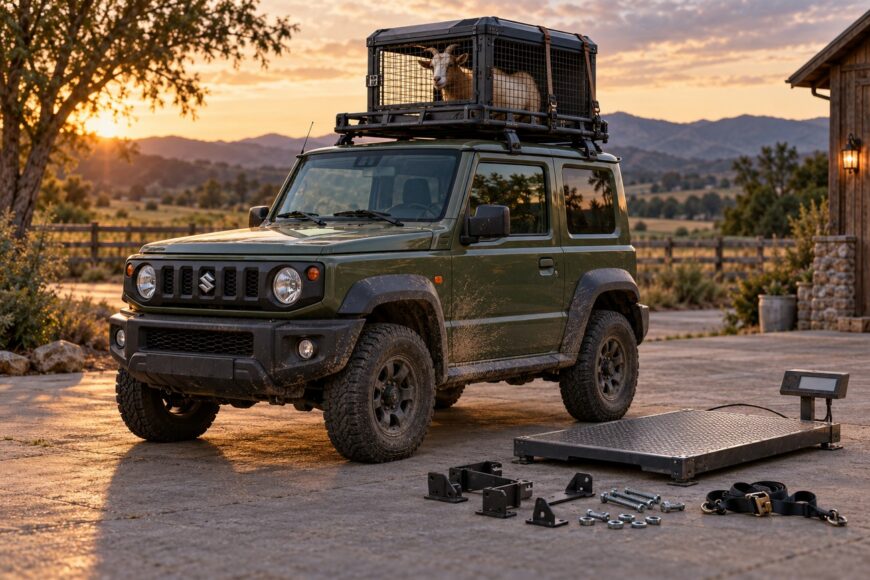
Goats on the roof of a Suzuki Jimny make a memorable photograph, but the engineering question is less entertaining: can the complete moving load stay within the vehicle’s limits? The relevant weight includes the crossbars, basket, floor, cage, restraints, and animal. A goat also moves, shifts its weight, and can turn a modest static load into a much higher short-lived force.
Suzuki’s original crossbar system specifies a maximum roof load of 30 kg total, including the crossbars and accessories. Larger figures appear in claims for some racks or from individual owners, including 40–50 kg and, for specialist systems, up to 85 kg. Those figures are not universal approval for every Jimny, and they do not remove the handling risks of carrying a live animal high above the road.
- The Jimny’s 30 kg Roof Limit Is Not a Goat Limit
- Why a Goat Loads the Roof Differently from Luggage
- The Mistakes That Make a Roof-Goat Setup Riskier
- So, Can a Suzuki Jimny Safely Carry a Goat?
- Frequently Asked Questions
- How can I verify the roof-load limit for my exact Suzuki Jimny?
- What should I do if the dealer says 40 kg but the Suzuki crossbars say 30 kg?
- Which Suzuki Jimny years should I avoid for carrying roof cargo?
The Jimny’s 30 kg Roof Limit Is Not a Goat Limit
The 30 kg figure applies to the complete original roof system. It is not 30 kg of usable animal cargo. The original Suzuki crossbars weigh approximately 6.3 kg, leaving about 23.7 kg for the goat, platform, enclosure, restraints, and other equipment.
An approximately 8 kg Suzuki basket reduces that remaining allowance to about 22 kg before the animal and its securing equipment are added. A goat weighing approximately 20–30 kg can therefore use most or all of the available payload before a cage or floor is counted. Simple arithmetic leaves little room for uncertainty, wear, or movement.
A basket’s own load rating answers a different question. It describes what the basket may support under its stated conditions; it does not automatically increase the Jimny’s roof or crossbar allowance. The roof, mounting points, crossbars, and rack can each have different limits, and the lowest applicable limit controls the setup.
Some sellers or owners cite 40–50 kg, while specialist systems may cite up to 85 kg. Such figures may relate to a different vehicle configuration, a particular rack, or a static condition. They should be treated as claims requiring vehicle-specific confirmation, not as universal Jimny approval.
Why a Goat Loads the Roof Differently from Luggage
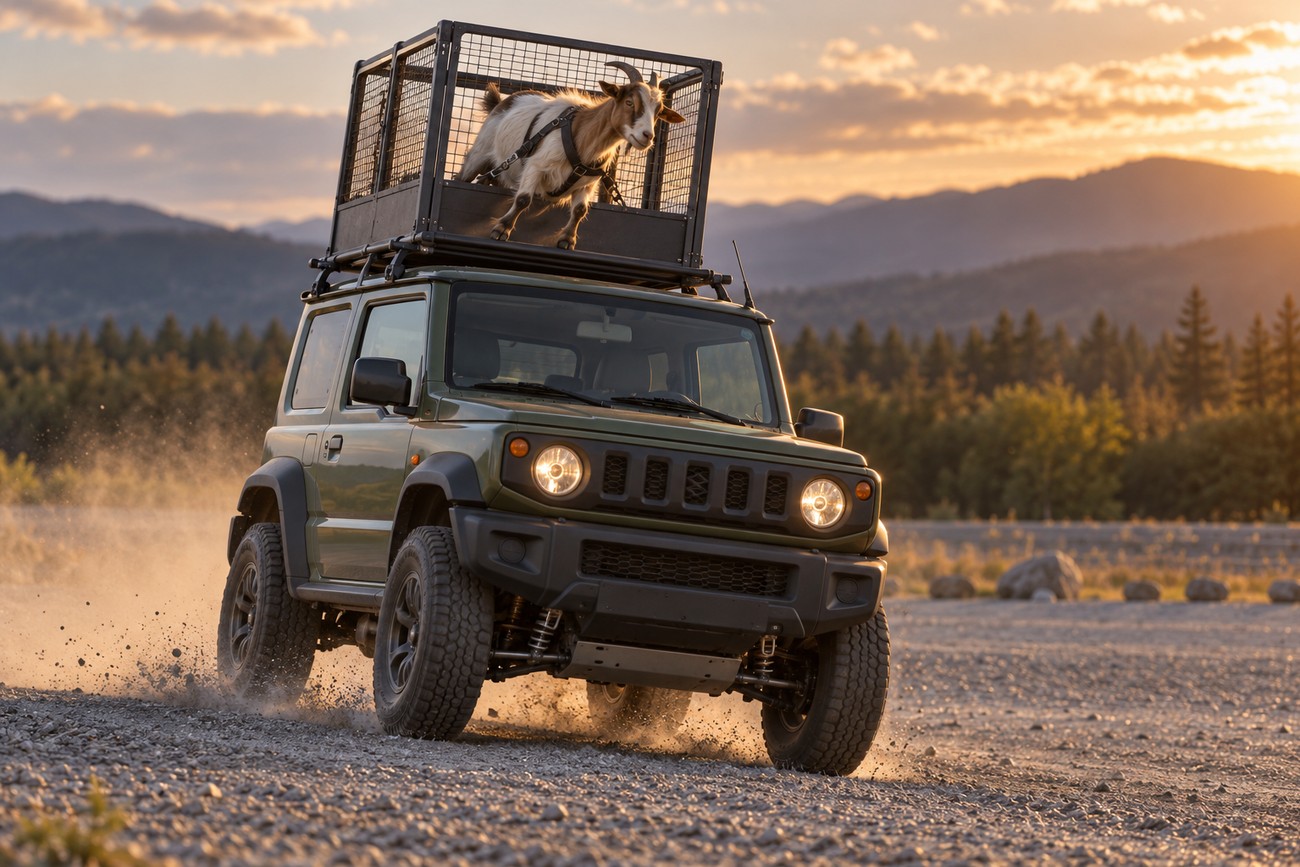
A 20–30 kg goat is not equivalent to a stationary 20–30 kg suitcase. Luggage normally stays where it is placed, while an animal can stand, lean, turn, jump, or press against one side of its enclosure. Those movements create dynamic loads that can briefly exceed the animal’s simple body weight.
Braking and cornering add another source of force. A goat moving at the same time can shift the load toward one mounting point or one side of the roof. Side slopes, potholes, off-road impacts, and crosswinds make the effect more pronounced, especially with a tall or wide cage.
High roof cargo raises the Jimny’s center of gravity. That can make the vehicle feel less settled during sudden maneuvers, on a side slope, or on uneven ground. Owners who report frightening behavior from a heavily loaded roof are describing a handling problem, even if the roof has not visibly bent or failed.
A low platform and rigid enclosure can limit movement and reduce sharp impacts. They cannot turn an over-limit arrangement into a safe one. They also do not eliminate the need to protect the animal from falling, escaping, or being struck by the cage during braking.
The Mistakes That Make a Roof-Goat Setup Riskier
The first error is weighing only the goat. The calculation must include the crossbars, basket, floor, cage, partitions, restraints, padding, and protective parts. A heavy expedition basket or cage can consume the useful allowance before the animal is placed on the roof.
The second error is confusing three different ratings: the vehicle’s roof limit, the crossbar or mounting-system limit, and the rack manufacturer’s headline capacity. A rack advertised for a high load does not grant the Jimny permission to carry that load. The complete assembly must comply with the vehicle-specific limit and remain properly supported at every contact point.
A moving cage can concentrate force on one side of the roof, so a sound assessment starts with the complete assembled mass and the contact pattern at the mounting points, rather than the rack’s headline capacity.
An ordinary luggage strap is also inadequate as the main safety barrier for a live animal. The enclosure should be rigid, closed, and securely attached, with restraints appropriate to the animal and the route. A strap that holds a bag in place may fail to control a goat that pushes, turns, or jumps during a sudden stop.
Weight checks must include passengers, fuel, luggage, and any tow equipment when the vehicle’s total mass is considered. Jimny gross vehicle mass figures vary by market and version, with official specifications showing approximately 1420–1545 kg. Even a roof setup within its own limit can contribute to an overloaded vehicle if the rest of the load is ignored.
Damage may appear before a dramatic mechanical failure. Concentrated forces can mark the paint, distort the roof, damage seals, or stress mounting points. Inspecting only whether the car drove away from a short trip misses these slower and less visible consequences.
So, Can a Suzuki Jimny Safely Carry a Goat?
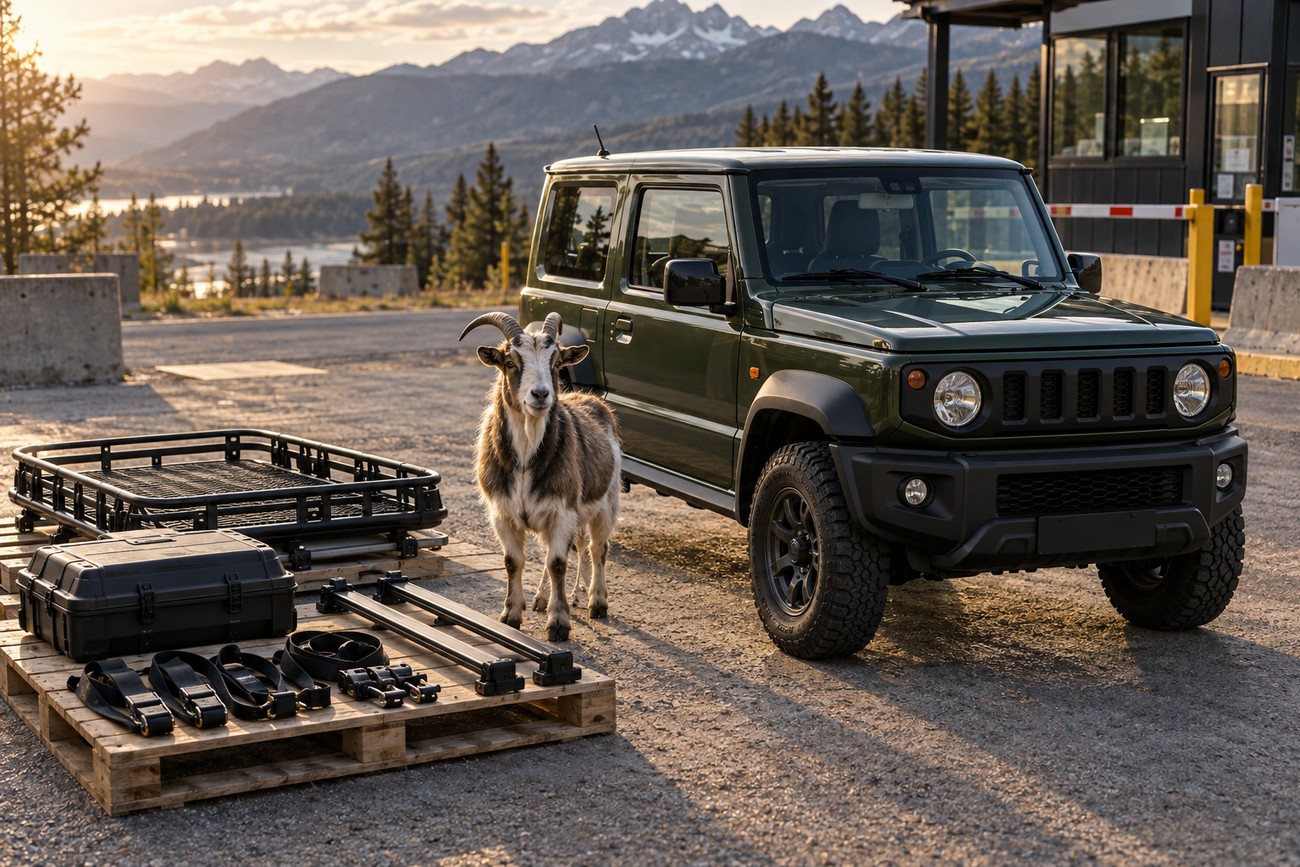
The practical answer is usually no for a typical moving roof setup. A very small animal might fit the arithmetic only with a carefully weighed, officially compliant system, yet a 20–30 kg goat plus a rack and rigid enclosure leaves little or no margin under the original Suzuki system’s 30 kg total limit.
A Jimny that drives without immediate damage has not been proven safe. The critical event may be emergency braking, a sharp turn, a crosswind, or a side slope rather than ordinary travel on a straight road. Static strength at a standstill also says little about dynamic loads while the animal is moving.
Reports of an owner carrying approximately 100 kg show that a vehicle has been used that way; they do not validate that load as a safe allowance. The same applies to a rack rated up to 85 kg. A specialist rack may be strong enough in isolation while the vehicle roof, attachments, handling, or total mass remain limiting factors.
Use the exact market, version, and VIN-specific owner’s manual and official documentation as the reference. Weigh every component, preserve a meaningful margin, and place heavy cargo lower in the vehicle where possible. If the numbers are close, use a trailer, a suitable animal transport vehicle, or another lower and more controlled method instead of the roof.
Frequently Asked Questions
Jimny roof-load specifications can differ by market and version. The following checks help resolve common disputes before a roof transport setup is built.
How can I verify the roof-load limit for my exact Suzuki Jimny?
Identify the vehicle’s market, model version, and VIN, then check the VIN-specific owner’s manual and official Suzuki accessory documentation. Confirm whether the stated limit is dynamic, whether it includes crossbars and accessories, and which parts of the system it covers.
Keep the written specification for the exact vehicle and roof system. A general internet listing or a figure for another market is weaker evidence than the documentation supplied for your Jimny.
What should I do if the dealer says 40 kg but the Suzuki crossbars say 30 kg?
Request the written specification for the exact vehicle and the exact crossbar system. Ask whether the 40 kg figure refers to the vehicle, the bars, a rack, or a stationary load; these are not interchangeable ratings.
Until the conflict is clarified in official documentation, use the lower confirmed limit. Do not resolve the disagreement by relying on the rack seller’s number or on an owner’s successful trip.
Which Suzuki Jimny years should I avoid for carrying roof cargo?
There is no sound blanket model-year rule based on the available information. The relevant checks are the market-specific roof limit, the vehicle’s condition, the integrity of its mounting points, and the complete configuration of bars, rack, enclosure, and load.
Inspect for corrosion, previous roof damage, distorted mounts, damaged seals, and poorly fitting accessories. A newer vehicle with an overloaded or badly secured system can be less suitable than an older, properly documented, and carefully maintained example.







