
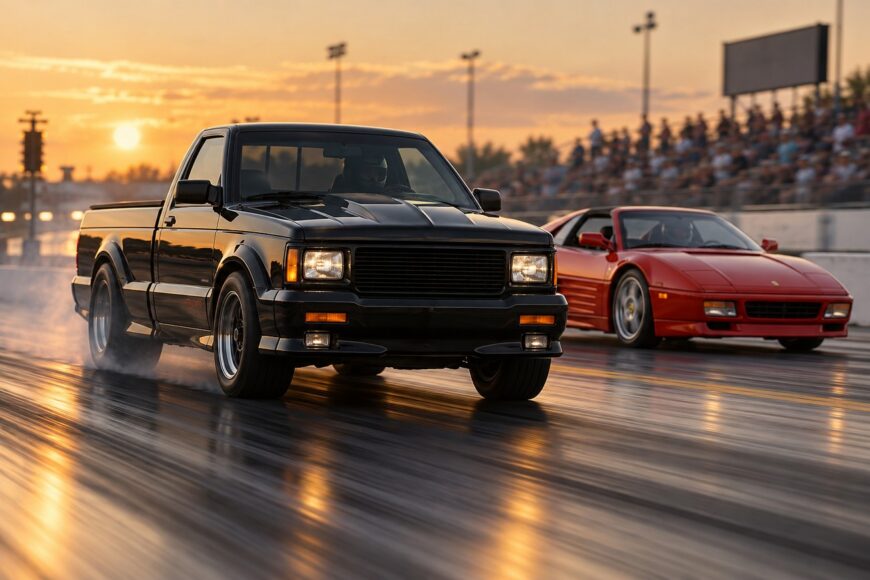
A compact GMC pickup beating a Ferrari sounds like a garage joke until the launch lights turn green. The 1991 GMC Syclone used a turbocharged V6, full-time all-wheel drive, and a short, aggressive chassis to deliver acceleration that embarrassed far more exotic machinery.
That headline needs careful handling. Period tests recorded supercar-grade straight-line performance, while the Syclone retained modest brakes, rough pickup-truck refinement, limited utility, and mechanical weak points that can become expensive today. It is a performance landmark, but ownership resembles running a temperamental collector sports car more than maintaining an ordinary GMC truck.
- Why the GMC Syclone Shocked the Performance World
- The Hardware Behind the Shockwave
- GMC Syclone vs. Ferrari 348 ts: What the Claim Really Means
- Where the Syclone’s Speed Becomes a Liability
- Buying a Syclone Today: Originality Matters More Than the Dyno Sheet
- The Syclone Myths That Still Mislead Buyers
- Frequently asked questions
- Was the GMC Syclone faster than a Ferrari?
- Which Ferrari did the GMC Syclone beat?
- What does “survivor Syclone” mean to collectors?
- Why is the Syclone’s transfer case important when buying one?
Why the GMC Syclone Shocked the Performance World
The Syclone arrived for the 1991 model year only, based on a compact pickup that looked closer to a contractor’s tool than a supercar rival. Production was approximately 2,995–3,000 examples, although official GM figures vary by production batch and VIN range. That scarcity gave the truck lasting collector interest, while its performance gave it cultural impact far beyond its numbers.
Period testing placed 0–60 mph acceleration at approximately 4.3–4.6 seconds. The quarter-mile took approximately 13.4–13.6 seconds at about 98 mph. Those results were remarkable in an era when many sports cars still required careful launches and favorable conditions to reach similar figures.
The famous Ferrari comparison mainly involved the Ferrari 348 ts, whose period 0–60 mph figures were approximately 5.5–6.0 seconds. Under suitable conditions, the GMC could beat that Ferrari in a straight-line acceleration test, creating one of the most memorable performance stories of the early 1990s.
That result did not make the Syclone a superior sports car. The comparison concerned acceleration, particularly the first seconds after launch, rather than braking, cornering, top speed, comfort, or refinement. The truck’s significance lies in how effectively it exploited traction and torque, not in any universal victory over Ferrari.
The Hardware Behind the Shockwave
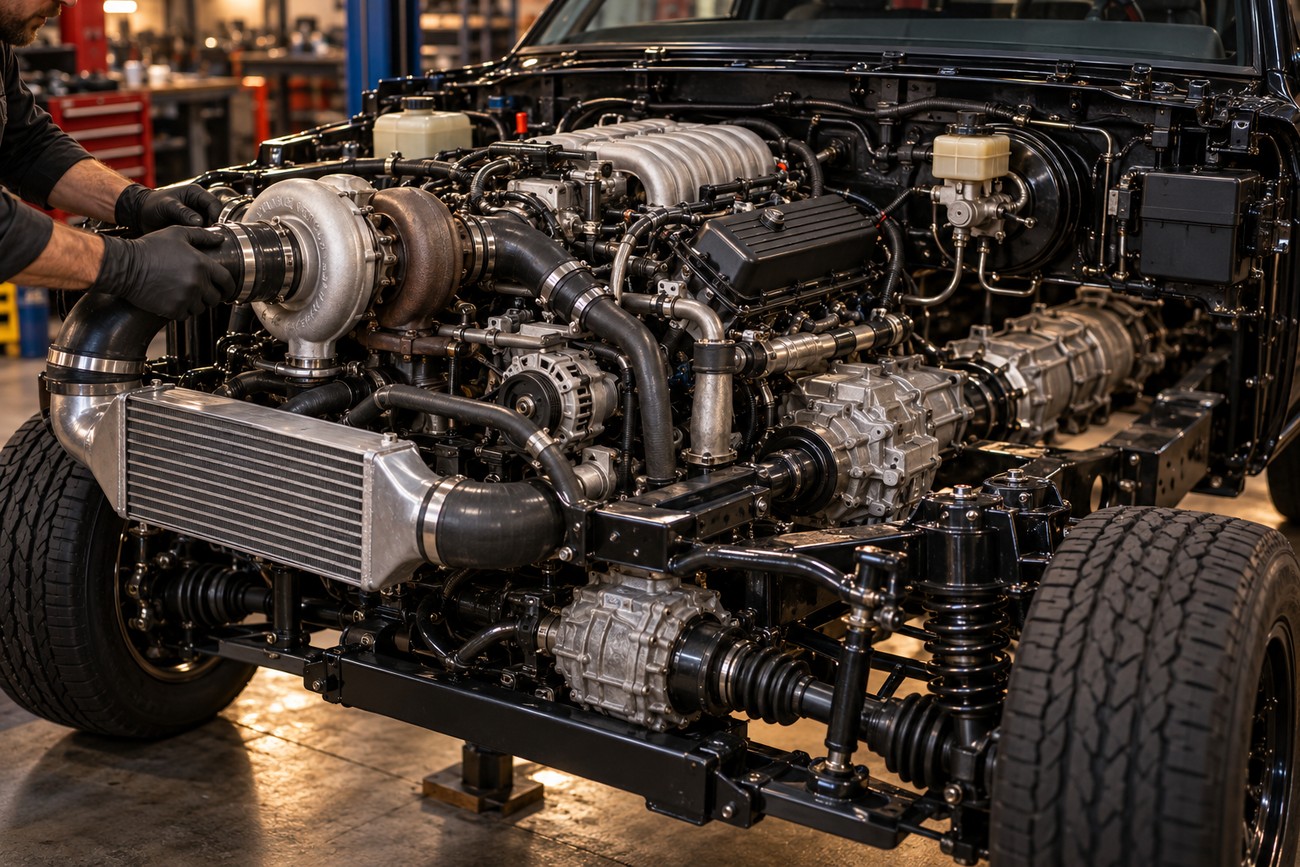
Power came from a 4.3L LB4 V6 with a Mitsubishi TD06-17C turbocharger and intercooler. Factory output was approximately 280 hp and 350 lb-ft, or about 475 N·m. Those figures were substantial for a compact pickup, but the Syclone’s launch performance depended as much on how it delivered torque as on its headline horsepower.
A four-speed 4L60 automatic transmission, also associated with the 700R4 designation, handled the shifting. The BorgWarner 4472 full-time all-wheel-drive system helped convert turbocharged torque into forward motion before the rear tires had much opportunity to overwhelm the surface. Enthusiast sources commonly report an approximately 35% front and 65% rear torque split, but that detail should be treated as forum-reported drivetrain information rather than a substitute for factory documentation.
The chassis was a lowered GMT400-based compact-pickup platform with independent torsion-bar front suspension and rear leaf springs. Stronger stabilizer arrangements and the reduced ride height helped control the body, yet the underlying architecture remained truck-based. The suspension was set up to support hard acceleration, not to provide the composure, wheel control, or load-carrying ability of a modern performance vehicle.
That distinction matters in ownership. The Syclone has the cargo-bed shape of a pickup, but its useful role is limited compared with a conventional work truck. Repeated heavy loads, rough roads, and hard launches place demands on components that were selected for a short, specialized production run rather than ordinary commercial service.
GMC Syclone vs. Ferrari 348 ts: What the Claim Really Means
The comparison is best understood as a period straight-line test, not a verdict on two complete vehicles.
| Point of comparison | GMC Syclone | Ferrari 348 ts | What the headline leaves out |
|---|---|---|---|
| Model-year context | 1991 turbocharged compact pickup | Contemporary mid-engine sports car | The vehicles were designed for very different jobs |
| 0–60 mph | Approximately 4.3–4.6 seconds in period testing | Approximately 5.5–6.0 seconds in cited period figures | Test method, surface, launch, and driver affect the result |
| Drivetrain concept | Turbocharged V6 with full-time AWD | Rear-wheel-drive sports-car layout | Early traction favored the GMC in suitable conditions |
| Performance claim | Could win specific straight-line tests | Was not defeated in every performance category | The claim does not cover handling, braking, top speed, or refinement |
The Syclone’s advantage was strongest during a hard launch. All-wheel drive could make the truck less dependent on perfect throttle control and rear-tire grip, especially on a marginal surface. A clean, dry road with strong traction could reduce that advantage, while a poor launch or a driver unfamiliar with the truck could change the result quickly.
Driver technique also mattered. Turbo response, automatic-transmission behavior, and the ability to manage wheelspin influenced every run. A magazine test showing a dramatic result should therefore be read as evidence of capability under defined conditions, not as a permanent ranking between the two models.
The Ferrari’s broader sports-car abilities remain a separate issue. The Syclone was not automatically faster than more powerful Ferrari models of the period, and its acceleration did not erase the differences in braking, cornering balance, top speed, steering feel, or cabin refinement. “Faster than a Ferrari” is accurate only when tied to the specific Ferrari 348 ts comparison and the relevant straight-line test.
Where the Syclone’s Speed Becomes a Liability
The braking hardware did not match the drama of the acceleration. The Syclone used front disc brakes and rear drum brakes, and early examples were delivered without ABS. Owners often regard the stock braking performance as marginal for a truck that can reach high speeds so quickly, particularly after repeated hard stops.
Brake fade and a long-feeling pedal can become more noticeable when the vehicle is driven as its reputation encourages. Modern performance cars usually provide stronger thermal capacity, more sophisticated electronic assistance, and better tire technology. A stock Syclone can therefore feel startlingly quick in a straight line and surprisingly ordinary when asked to shed that speed repeatedly.
Heat creates another ownership concern. The stock radiator and intercooler arrangements can struggle during aggressive driving in hot conditions, especially when the truck is modified or subjected to repeated launches. A short test drive may reveal impressive boost yet fail to show the temperature rise that appears after sustained use.
Ride quality is firmly pickup-like. The lowered suspension can feel harsh and unsettled on damaged pavement, while basic early-1990s compact-pickup materials and limited sound insulation make the cabin noisy by modern standards. The contrast between the truck’s collector value and its ordinary interior is substantial.
These compromises explain why the Syclone is closer to a temperamental sports car than a dependable utility pickup. Its bed and body shape suggest practical hauling, but the chassis setup, limited load-carrying role, braking capacity, and age make it a poor substitute for a normal work truck.
Buying a Syclone Today: Originality Matters More Than the Dyno Sheet
A modified Syclone can look like the cheaper route into the model, especially when a seller presents a large dyno number and a list of upgraded parts. That presentation can conceal a slipping 4L60, unstable fuel delivery, overheated intercooling, worn turbo hardware, or years of hard drag launches. A ready-made project deserves more scrutiny than a plain, documented truck.
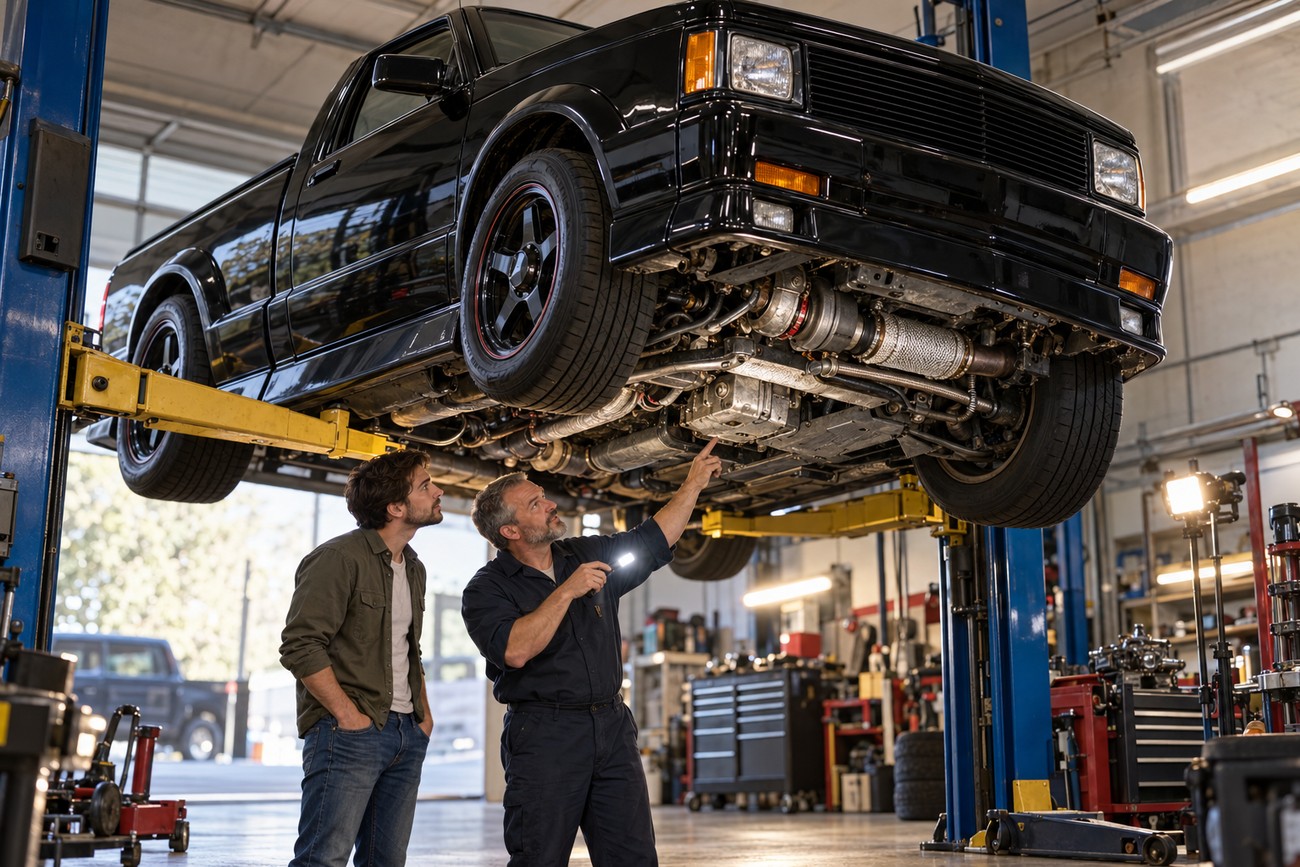
Start underneath. Inspect the frame rails, body mounts, rear arches, floor sections, and cab underside for corrosion, with particular attention to repairs that conceal weakened metal. A clean-looking body does not prove that the frame is sound, and a low odometer reading does not offset structural damage.
A pre-purchase road test should verify repeatable boost, consistent 4L60 shifts, transfer-case noise, and cooling performance. Compression numbers and a dyno sheet cannot reveal every failure that appears only after heat and repeated load.
During the drive, check for consistent boost, detonation-related faults, erratic fueling, transmission slip, and overheating. Listen for abnormal noise from the BorgWarner 4472 system and confirm that the full-time AWD behaves normally. Age-related wiring and sensor faults can make the truck feel like a different vehicle from one drive to the next.
Original turbochargers, intercoolers, specialized sensors, and BorgWarner 4472 components can be difficult to source. Some repairs also require extensive disassembly because the engine bay is tightly packed around the turbocharger and exhaust hardware. Specialist support, parts research, and a realistic repair reserve matter more here than familiarity with ordinary GM pickups.
Collectors generally value well-preserved survivor trucks: largely original examples without a drag-racing history or extensive modifications. Live examples often exceed $40,000–$70,000, and low-mileage, stock trucks can command more. At that level, VIN originality, factory equipment, service records, and documented ownership history may matter more than an engine upgrade that makes the truck faster but less defensible as a collectible.
The Syclone Myths That Still Mislead Buyers
The first myth is that the Syclone was faster than every Ferrari of its era. Its strongest reputation comes from straight-line acceleration against the Ferrari 348 ts, under conditions that favored its launch traction. That does not make it the faster vehicle through corners, under braking, at top speed, or across every comparison with more powerful Ferrari models.
The second myth treats the truck as reliable in the same way as an ordinary GM pickup. The basic engine architecture may look familiar, but turbocharging, full-time AWD, specialized parts, heat management, and hard-use histories change the ownership equation. Repeated launches can make the 4L60 slip, overheat, or fail, particularly when tuning adds torque without supporting transmission work.
More boost is not a free performance upgrade. Increasing it without upgrading fuel delivery and related systems can cause detonation, piston damage, and connecting-rod failure. Conservative factory engine management offers some margin, but it does not remove the mechanical limits imposed by cooling, fueling, drivetrain condition, and age.
Careful chip tuning is often reported to produce meaningful gains without immediate hardware changes, and the restrictive stock exhaust can limit response. A modest exhaust upgrade may improve responsiveness. Neither change eliminates the need to control temperatures or protect the transmission, so sensible tuning begins with a healthy, documented truck rather than a target dyno number.
Frequently asked questions
Was the GMC Syclone faster than a Ferrari?
It could be faster than the Ferrari 348 ts in specific period straight-line acceleration tests. The Syclone’s approximately 4.3–4.6-second 0–60 mph results compared favorably with the Ferrari’s approximately 5.5–6.0-second period figures.
The result does not establish universal superiority. Handling, braking, top speed, refinement, surface grip, launch technique, and driver skill all affect the comparison, and the Syclone was not automatically faster than every Ferrari of its era.
Which Ferrari did the GMC Syclone beat?
The specific Ferrari behind the famous headline was the Ferrari 348 ts. Popular retellings often remove that model designation and turn a defined acceleration comparison into the broader claim that the pickup beat “a Ferrari.”
That wording is misleading because it ignores the test context. The Syclone’s advantage centered on the launch and straight-line acceleration, where its turbocharged torque and full-time AWD were especially effective.
What does “survivor Syclone” mean to collectors?
A survivor Syclone is generally a largely original, unmodified example that retains its factory configuration and has avoided extensive drag-racing use. The term does not guarantee perfect mechanical condition; age-related maintenance and deterioration still require inspection.
Collectors often place greater value on originality, documentation, and an unaltered VIN identity than on extra power. A modified truck may be quicker, yet a stock survivor can be easier to authenticate and more desirable as part of the model’s limited production history.
Why is the Syclone’s transfer case important when buying one?
The BorgWarner 4472 is a specialized part of the Syclone’s full-time AWD system, and good replacement components can be difficult to source. A worn or damaged unit can therefore turn a drivetrain fault into a lengthy and expensive search for usable parts.
Buyers should check for abnormal noise, vibration, binding, and evidence of neglected service during a proper road test. Treating the Syclone like an ordinary GM pickup is risky because its transfer case, transmission, turbo system, and electronics all reflect a rare performance application.







