
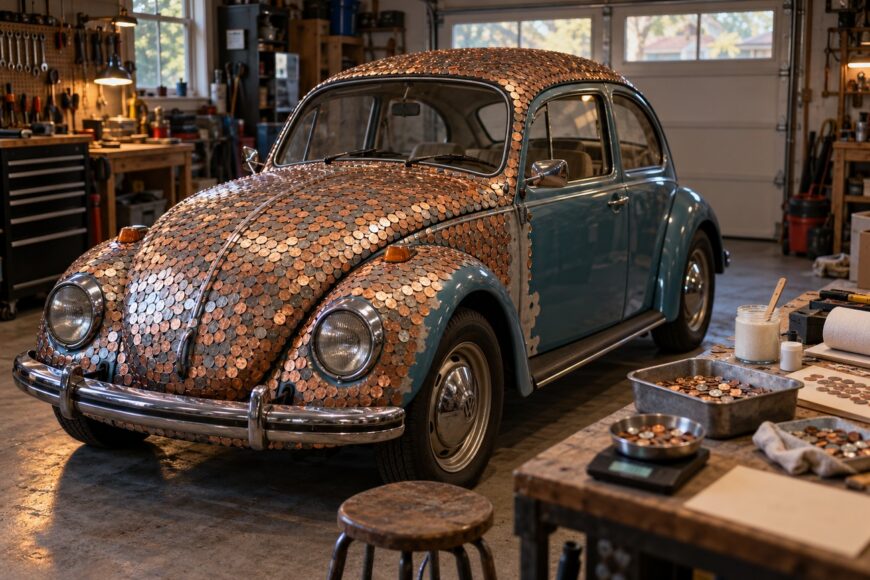
A Volkswagen Beetle covered in 100,000 coins has an immediate visual pull: the rounded body becomes a reflective, irregular mosaic, and every panel catches light differently. In photographs, that surface can look strikingly dramatic.
The engineering problem is less about decoration. Coin cladding adds uncertain mass, places unusual loads on curved panels, and exposes the bond to rain, washing, ultraviolet light, temperature changes, vibration, and impact. It can also trap moisture against the body and make ordinary repairs difficult or irreversible.
The exact weight cannot be stated from the number of coins alone. It depends on denomination, country, mint year, and alloy. Copper- and steel-based coins can add hundreds of kilograms; enthusiast cases sometimes claim several tonnes, but there is no single verified calculation for 100,000 coins.
- What 100,000 Coins Really Add to a Beetle
- Why the Coin Skin Fails: Glue, Water, Heat, and Vibration
- The Beetle Problems You Cannot See Until Later
- How to Evaluate the Idea Before Covering the Car
- The Myths, Cost, and Labor Behind the Viral Finish
- Frequently asked questions
- What year should you stay away from when buying a VW Beetle?
- What is the most collectible VW Beetle?
- What was Hitler’s connection to the VW Beetle?
- What do Germans call the VW Beetle?
What 100,000 Coins Really Add to a Beetle
Coin count is a poor mass estimate because coins with similar appearances can differ substantially in thickness, diameter, and density. A collection of small, light coins produces a different result from the same count of larger copper- or steel-based coins. Country of issue and mint year also matter because specifications can change over time.
The relevant calculation starts with a representative sample. Weigh a known number of the actual coins, account for adhesive and any backing materials, and scale the result to the planned coverage. That estimate still needs a margin for uneven application, overlapping edges, and coins placed on panels with different shapes.
Copper- and steel-based coins can add hundreds of kilograms to a vehicle. Enthusiast cases sometimes claim several tonnes of coin covering, but there is no single verified calculation for 100,000 coins. Such claims should be treated as anecdotal until the coin type, coverage area, adhesive mass, and weighing method are documented.
The safety limit comes from the specific car, not from a general Beetle rule. Use the manufacturer’s gross vehicle mass and axle-load ratings, then consider how the added load is distributed between the front and rear axles. A total within the vehicle’s rating can still create an axle problem if too much material is concentrated on one end.
Extra mass increases the work required from the brakes, tires, steering system, and suspension. Acceleration and fuel economy may worsen, while braking distances, tire temperatures, suspension deflection, and handling margins can also change. A heavy exterior layer may look evenly spread from a distance while still creating local loads and service problems at panel seams, doors, and access covers.
Why the Coin Skin Fails: Glue, Water, Heat, and Vibration
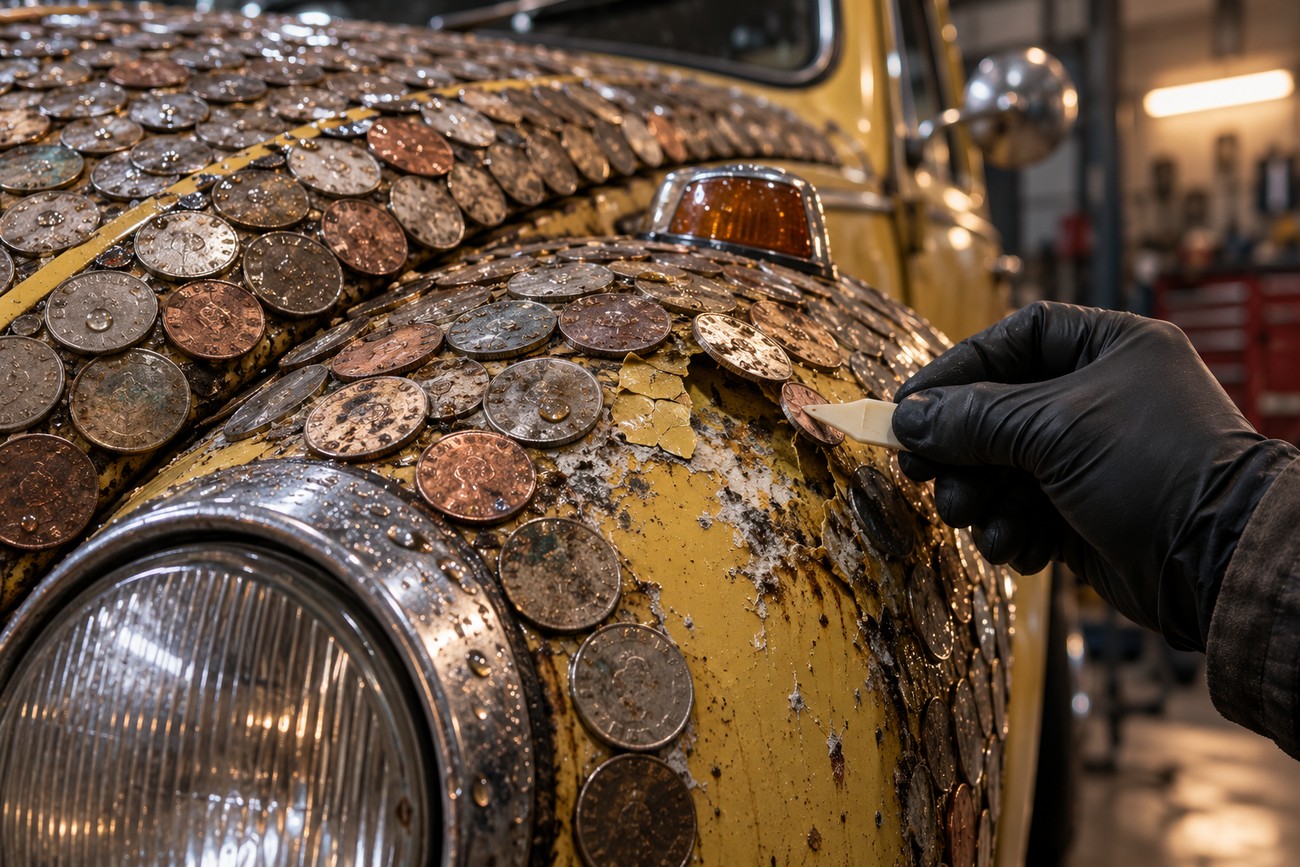
Exterior bonding on a working vehicle is a materials problem rather than ordinary craft work. The paint or metal must be clean, degreased, and appropriately abraded, with oxidation removed or evaluated and compatibility with the existing coating checked. Smooth, dirty, greasy, or oxidized surfaces sharply reduce adhesion.
Coins introduce another variable because different alloys and oxide films can bond differently to the same adhesive. A coin that feels clean may carry polishing residue, skin oils, or a stable oxide layer. The adhesive may also react differently with old paint, modern refinishing products, and clear coats across the same vehicle.
Static bond strength is only an initial indicator. On the road, the joint experiences vibration, impact from debris, water pressure during washing, ultraviolet exposure, and repeated temperature cycles. A bond that holds a coin in a quiet shop test can fatigue after repeated expansion and contraction of the body, coin, and adhesive.
Delamination commonly begins at edges and stress concentrations. Rounded Beetle panels make this harder because a coin may touch at its perimeter while the center sits above the panel, creating an adhesive bridge or an air pocket. Larger variations in coin thickness make the surface harder to seal and increase the forces carried by individual pieces.
A thicker adhesive layer is not automatically stronger. Excess material can remain more flexible, cure unevenly, retain voids, and place the joint under unfavorable peel or shear loads. Controlled application, correct open time, surface preparation, and compatibility matter more than simply applying more product.
The Beetle Problems You Cannot See Until Later
A coin layer can conceal the condition of the body for a long time. Water and dirt may enter through small gaps and remain against the paint or metal, especially around seams, trim openings, wheel arches, and panel edges. That trapped moisture can create hidden corrosion beneath an exterior layer that initially appears intact.
The Beetle’s rounded panels increase the risk of uneven contact, adhesive bridges, and air pockets. These voids can retain moisture and create unsupported areas that flex under vibration. Different coin geometries make the surface harder to clean, inspect, and dry after washing.
Added weight changes more than acceleration and fuel use. It affects braking, steering response, suspension life, tire behavior, and safety margins, particularly when the load is concentrated toward one axle or high on the body. A heavy surface can also alter how the vehicle behaves during sudden maneuvers or when tires heat up under sustained use.
Serviceability deteriorates as soon as the coins become part of the body finish. Access to fasteners, drains, hinges, inspection points, and removable panels may be blocked. Removing bonded coins can damage both the coins and the paint or metal beneath them, so later corrosion repair or collision work may require destructive removal and refinishing.
That irreversibility has a practical consequence: a successful installation can still be a poor restoration decision. Original paint, repaired metal, and replacement panels may become impossible to inspect without sacrificing the decorative layer. The longer the car remains exposed to weather, the more difficult it becomes to distinguish adhesive failure from corrosion progressing underneath.
How to Evaluate the Idea Before Covering the Car
Begin with a representative coin sample and a small test area on the actual vehicle or on a prepared panel using the same paint system. The test should examine whether the adhesive affects the paint or clear coat, whether the coins remain stable after curing, and whether the joint tolerates moisture and temperature changes. If the test area fails, the full project should stop.
Surface preparation must address dirt, grease, oxidation, and the condition of the metal or coating. Document what has been removed and what remains, because aggressive abrasion can expose bare metal while insufficient preparation leaves a weak boundary layer. A compatible primer or bonding system may be required, but its suitability must be confirmed rather than assumed.
Make a full mass estimate before buying or sorting the entire coin supply. Include the coins, adhesive, sealers, fillers, and any protective top layer, then compare the result with the manufacturer’s gross vehicle mass and axle-load ratings. A qualified inspection of the actual vehicle is prudent if the estimate approaches a significant portion of its permitted load.
Map drainage and ventilation before placing anything. Preserve water paths, service openings, door gaps, hinge areas, wheel-arch clearances, and access to components that will need inspection. The design must account for places where water can collect, because sealing a decorative surface while blocking drainage can turn a cosmetic project into a corrosion trap.
Edges and joints need particular protection because they are common starting points for delamination. Seal design should prevent water entry without creating new pockets behind the coins. Plan removal routes and repair access in advance; if a panel cannot later be removed or inspected without destroying the finish, that limitation belongs in the project decision.
The Myths, Cost, and Labor Behind the Viral Finish
A strong household adhesive is not automatically suitable for an exterior automotive surface. Many household products degrade under sunlight, rain, washing, and temperature changes, while some soften, yellow, or lose flexibility. Automotive use demands a system that matches the substrate, the coin materials, the expected movement, and the exposure conditions.
The idea that more glue solves the problem is also unreliable. Thick adhesive can increase curing problems and create uneven support, while fatigue still develops under vibration and thermal movement. A bonded exterior layer does not prevent rust; it can hide corrosion until the damage is advanced.
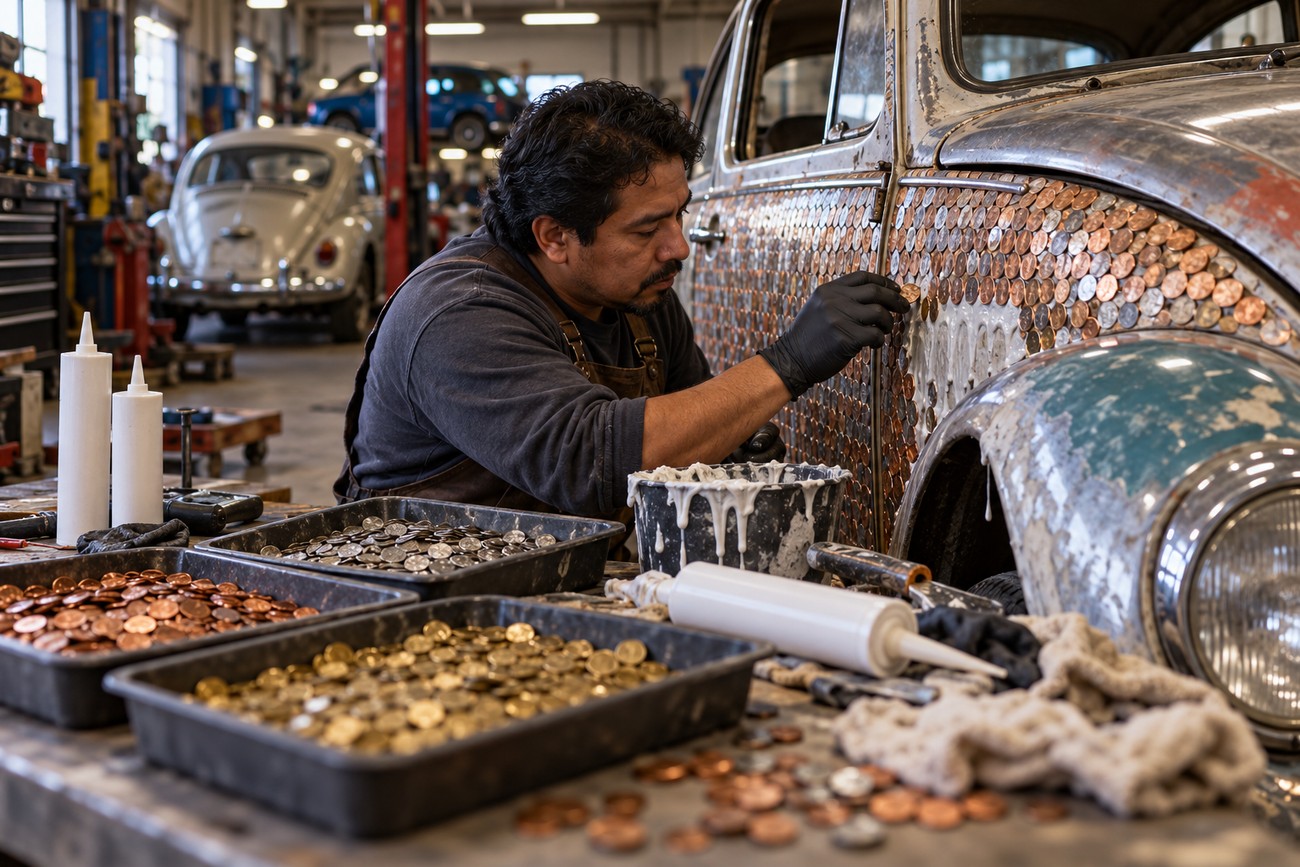
The labor is substantial even before installation begins. Coins must be sorted, cleaned, inspected, positioned, supported on curved surfaces, allowed to cure, and possibly sealed or polished. A pattern that looks simple from a distance becomes slow around door gaps, trim, wheel arches, compound curves, and panel transitions.
Common complaints include coins lifting during washing or driving, adhesive yellowing or softening in the sun, increased vehicle weight, and difficult body service. Removal may destroy the coin layer and the finish beneath it. That makes mistakes expensive because correction often means stripping, refinishing, and rebuilding rather than simply replacing a few pieces.
Some makers report that the coin mosaic looks more impressive in photographs than in person because glare and visual noise overwhelm the pattern at normal viewing distance. That is anecdotal, not universal, and depends on lighting, coin condition, spacing, and the quality of the installation. A small finished sample viewed outdoors is a better aesthetic test than a digital lockup.
Frequently asked questions
Buying or modifying a Beetle calls for attention to its condition, history, and parts. Collectibility depends on originality as well as appearance. The following answers cover those questions, along with the car’s origins and German name.
What year should you stay away from when buying a VW Beetle?
There is no single year that should be avoided solely because it is a Beetle. Condition, structural rust, previous repairs, parts support, engine and transmission specifications, and the quality of restoration work matter more than a blanket year rule.
Inspect the heater channels, floor areas, suspension mounting points, spare-wheel well, windshield surrounds, and door alignment. Model-specific differences can affect parts availability and restoration cost, so confirm the car’s production details before purchase. A sound, well-documented example is generally a safer buy than a heavily modified car from a supposedly desirable year.
What is the most collectible VW Beetle?
Collectibility depends on rarity, originality, provenance, condition, and the desirability of a particular variant. Early cars, unusual body styles, limited-production versions, and examples retaining documented original components may attract stronger collector interest than common cars with extensive undocumented modifications.
Collector value is not determined by appearance alone. A complete history, matching or appropriately documented mechanical parts, correct trim, and preserved structural metal can matter more than a dramatic custom finish. Coin cladding would usually complicate authentication and inspection because it obscures the original body and makes future restoration harder.
What was Hitler’s connection to the VW Beetle?
Adolf Hitler supported the development of an affordable mass-market German car and promoted the project through the National Socialist state. The design work was associated with Ferdinand Porsche, while the vehicle was tied to the German labor and “people’s car” program known as KdF-Wagen.
World War II redirected production toward military vehicles, and civilian Beetle production became significant after the war under British administration. The Beetle’s later global success reflects postwar industrial development and export markets, while its origins remain connected to the political and industrial structures of Nazi Germany.
What do Germans call the VW Beetle?
In German, the Beetle is commonly called the Volkswagen Käfer. “Volkswagen” means “people’s car,” while “Käfer” means “beetle.” The name became the everyday German term for the rounded Volkswagen that was marketed under other names in different countries.
The term is useful when searching German-language parts listings, historical documents, and restoration references. Regional descriptions and model designations can still vary, so the car’s production year, body style, and engine specification should accompany the word Käfer when researching parts or technical information.







