
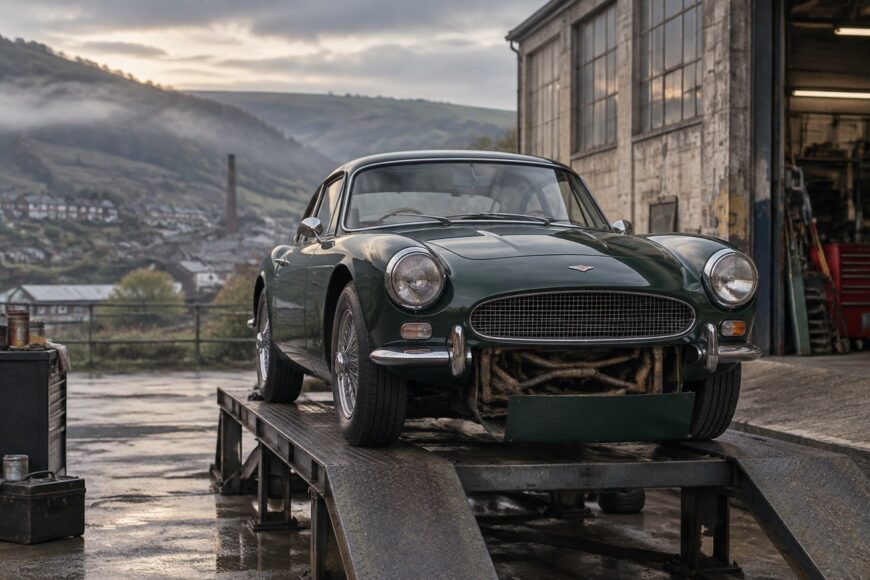
The Gilbern Invader is a rare Welsh GT with a particularly deceptive weakness. Its fiberglass body can remain presentable while corrosion attacks the steel frame beneath it, turning an attractive car into a demanding structural restoration. The cabin’s walnut veneer, electric windows, and Ford V6 suggest a compact luxury coupe; the inspection priorities belong to a specialist-built sports car.
Outside Gilbern circles, the Invader is often dismissed as a Ford-based kit car. That description misses the engineering and creates the wrong expectations about parts support. Each car must be assessed as a mixed Ford, MG, and British Leyland system, with significant differences caused by its series, axle specification, tuning, and whether it was professionally assembled or completed by an owner.
- Gilbern and Wales’ Forgotten Sports-Car Industry
- From the Genie to the Invader
- How the Gilbern Invader Was Engineered
- Mk I, Mk II, Mk III, and the Rare Estate
- The Hidden Risks of Owning One
- Buying, Restoring, and Valuing a Gilbern Invader
- Frequently asked questions
- How many Gilbern Invaders were made?
- Where were Gilbern cars made?
- What happened to Gilbern cars?
- Was the Gilbern Invader a kit car or a factory-built sports car?
Gilbern and Wales’ Forgotten Sports-Car Industry
Gilbern Sports Cars (Components) Ltd was one of the few Welsh companies to build road cars. Its factory stood at Llantwit Fardre in the Rhondda Valley, Wales, where the company operated from about 1959 to 1973. That setting gives the marque genuine industrial and cultural importance, even though Gilbern never approached the scale of a mainstream manufacturer.
The company’s range consisted of the GT, Genie, and Invader, with just over 1,000 cars produced in total. Such a small output explains why the cars remain obscure: there was no large dealer network, no deep supply chain, and no broad market of surviving examples to keep the name familiar.
Gilbern’s significance lies in what it represents. A Welsh firm developed distinctive sports cars, assembled them locally, and offered customers an alternative to the better-known British specialist marques. The Invader became the most substantial expression of that ambition, yet its rarity also means that ownership depends heavily on specialist knowledge rather than standard workshop routines.
From the Genie to the Invader
Introduced in July 1969, the Invader was developed from the Genie. It was more than a cosmetic revision. Gilbern strengthened the chassis, fitted larger brakes, and gave the car a richer interior intended to move the model toward grand-touring territory.
Equipment could include walnut veneer and electric windows, features that made the Invader feel more upmarket than many contemporary kit-based sports cars. The result was a useful blend of V6 performance, rear-wheel drive, and long-distance comfort, although the equipment adds age-related failure points today.
Gilbern sold cars in several forms, including kits and partially assembled examples. This sales model reduced tax exposure and allowed buyers to complete the work themselves, but it also created wide variation in final quality. Panel alignment, wiring, fasteners, weather sealing, and suspension setup may reflect the competence and choices of the original builder rather than a single factory standard.
That history matters when comparing two cars that appear identical in photographs. One may be a carefully finished factory or specialist build, while another carries years of improvised assembly. Their restoration requirements, reliability, and collector appeal can be far apart.
How the Gilbern Invader Was Engineered
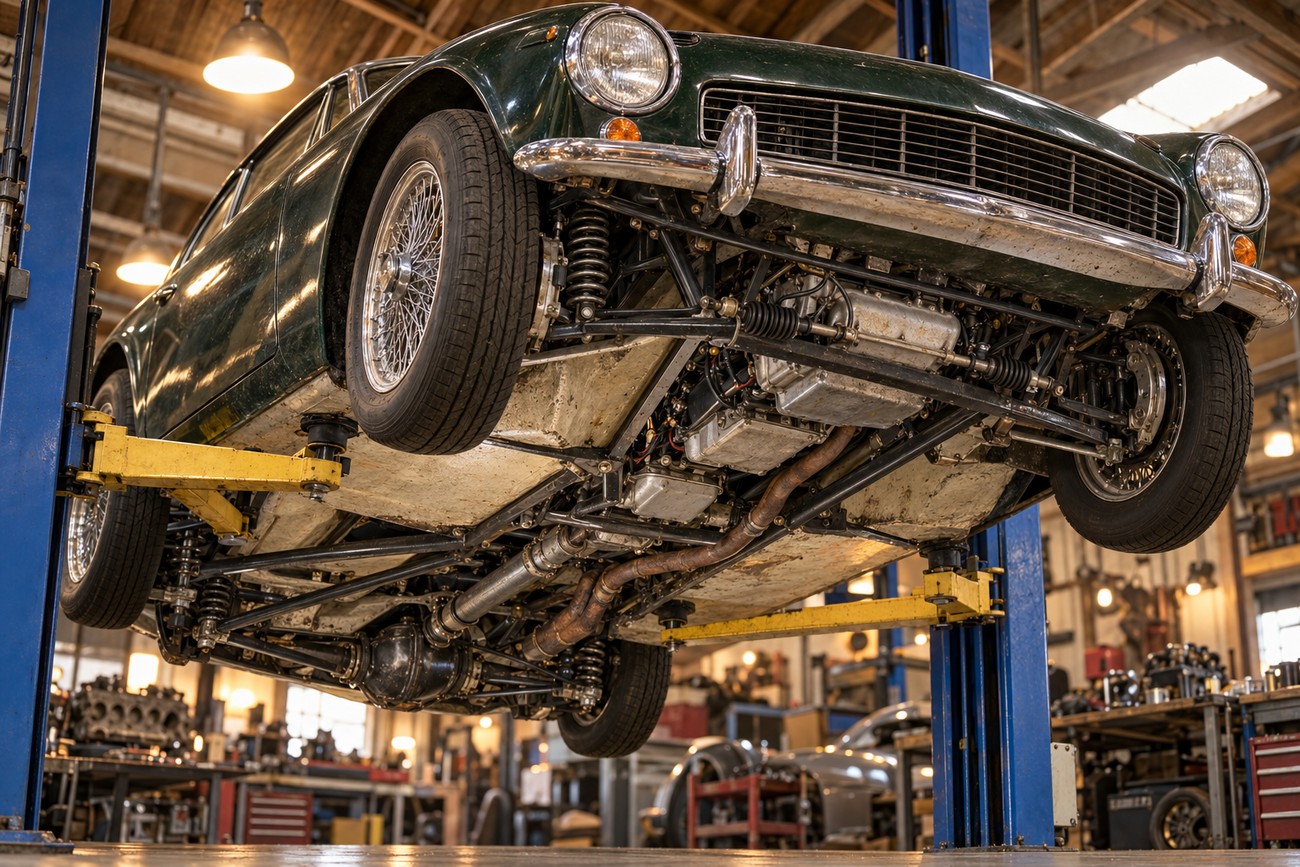
The Invader combines a multi-tube steel frame with a fiberglass body and rear-wheel drive. Its front suspension is based on MGC and British Leyland components, while the rear axle could be sourced from British Leyland or Ford depending on the series and specification. This combination gave Gilbern access to established mechanical parts without making the whole car mechanically uniform.
Power came from the 3.0-liter Ford Essex V6. Enthusiasts commonly cite 140–141 bhp, while published figures range approximately from 138 to 144 bhp; torque figures similarly vary from about 230 to 245 N·m. The safest interpretation is that the Invader offers strong period road performance, while a catalog figure alone cannot identify the exact specification of a surviving car.
Transmission choices included a four-speed manual with overdrive or a three-speed automatic. The manual version suits the car’s sporting character and gives more flexibility on faster roads, while the automatic can make the Invader a relaxed cruiser. Condition, gearing, cooling, and tuning usually matter more to the driving impression than a small difference between published power figures.
Owners should expect a character shaped by compromises. The Essex V6 supplies useful torque, but heat, mechanical noise, and vibration can enter the cabin more readily than a newcomer expects from the walnut-trimmed interior. Suspension tuning also has a substantial effect: a softer period setup preserves the GT character, while firmer modifications can change its balance and ride quality.
Mk I, Mk II, Mk III, and the Rare Estate
The principal versions were the Invader Mk I, produced from 1969 to 1971, the Mk II from 1971, and the Mk III from 1972. Treating every Invader as mechanically identical creates errors in parts ordering, valuation, and restoration planning.
Approximately 600–603 Invaders were produced across all versions and body styles. The small variation in published totals reflects counting conventions, surviving records, and the inclusion of both coupes and Estates. Either way, the Invader is rare even by specialist-car standards.
The Estate is a separate collector category, with approximately 68 cars produced. Its unusual body shape gives it extra interest, while the rear structure and body attachment areas deserve especially close inspection. A scarce body style does not compensate for a poor frame or incomplete trim, and replacement parts can be harder to reproduce than those for the coupe.
Axle choice, suspension details, and engine tuning complicate direct comparisons between cars. A correct period specification is usually more valuable to marque specialists than a mixture of attractive upgrades, particularly when modifications obscure which parts belong to the original series.
The Hidden Risks of Owning One
Fiberglass resists rust, but it does not protect the steel structure from it. The frame, outriggers, suspension mounting points, and body attachment areas can deteriorate beneath an apparently clean shell. A glossy paint finish therefore provides weak evidence of structural condition, and repairs may require extensive dismantling before their true scope becomes clear.
The mechanical parts create a second source of uncertainty. Ford components are present, yet the car also relies on MG/MGC and British Leyland hardware, with specific combinations changing between versions. A parts catalog search based only on “Ford Invader” can produce the wrong brake, suspension, or axle component and waste both money and workshop time.
Inspection should begin underneath the fiberglass, at the frame, outriggers, and suspension mounts. A clean body surface says little about the load-bearing structure hidden below it.
Original fiberglass panels, moldings, badges, and interior components can be difficult or expensive to replace. Even when a usable substitute exists, reproducing the correct shape, finish, or mounting method may require specialist fabrication. Electric windows, instruments, and other nonstandard electrical items also suffer from age, previous repairs, and deteriorated wiring.
Driving comfort has its own qualifications. Heat from the V6, cabin noise, and vibration can be more prominent than the luxurious trim suggests, especially if insulation and seals have deteriorated. A car that feels charming on a short test drive may become tiring on a long trip if these issues have been ignored.
Owner-built examples deserve particular caution. Poor panel fit, improvised wiring, inconsistent fasteners, and unsuitable suspension adjustments can undermine reliability even when the engine starts easily. The most expensive Invader is often the apparently cheap project whose frame, body, and assembly faults only emerge after restoration has begun.
Buying, Restoring, and Valuing a Gilbern Invader
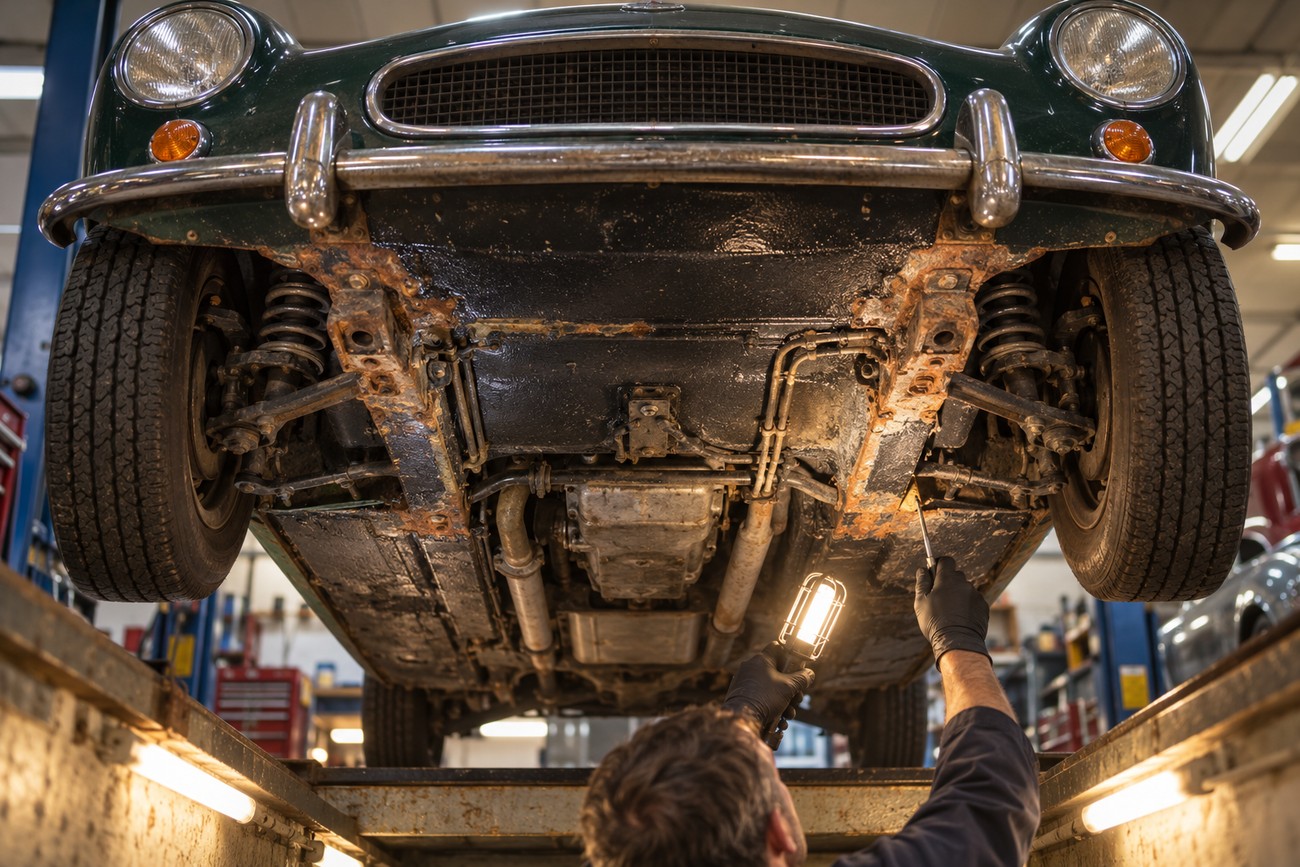
A pre-purchase inspection should start with the steel frame, suspension mounts, outriggers, and body attachment points. Inspectors need access beneath the fiberglass and should trace repairs rather than accepting fresh underseal as proof of soundness. Paint, chrome, and interior trim come later because cosmetic work has little value if the structure requires major reconstruction.
Parts availability should be investigated before purchase. The Ford Essex V6 is familiar, but that does not make every Invader component easy to source. Brake assemblies, suspension parts, axle details, electrical fittings, and body trim may require club contacts, specialist searches, or careful cross-referencing between Ford, MG, and British Leyland applications.
Originality has practical value as well as historical interest. A correct Ford Essex V6, period-appropriate axle, and matching series components make the car easier to explain and generally more attractive to marque specialists. Heavily modified cars or those assembled from mixed specifications may drive well, yet their collector appeal can be lower and their future repair history harder to establish.
Restoration costs can escalate quickly because rare trim and fiberglass work are labor-intensive. The Gilbern Owners Club and wider specialist community often provide information absent from ordinary manuals, including component identification and workable repair solutions. Insurance valuation can also be difficult: rarity produces disagreements between owners, insurers, and dealers, so a documented agreed value and photographic record are sensible safeguards.
The Invader is therefore best bought as a known, structurally sound car rather than as a cheap route into classic GT ownership. Its mixed engineering, limited production, and Welsh origin make it a significant part of motoring history. They also make it a niche commitment whose rewards depend on accepting the car’s irregularities rather than wishing them away.
Frequently asked questions
The Invader’s records are complicated by several versions, different sales formats, and the survival of cars with modified specifications. These answers separate the firm facts from the counting and classification issues that often confuse buyers.
How many Gilbern Invaders were made?
Approximately 600–603 Gilbern Invaders were produced, including coupes and Estates. Published totals vary slightly, while the Estate itself accounts for only about 68 cars, making it a particularly scarce body style within an already limited production run.
Where were Gilbern cars made?
Gilbern cars were made at Llantwit Fardre in the Rhondda Valley, Wales. Gilbern Sports Cars (Components) Ltd was therefore a Welsh car manufacturer, rather than simply a Welsh badge applied to an imported kit.
What happened to Gilbern cars?
Gilbern production ended around 1973, after the company had built just over 1,000 cars across the GT, Genie, and Invader ranges. The manufacturer disappeared, but surviving cars continue through enthusiast ownership, specialist repairs, club support, and carefully maintained private collections.
Was the Gilbern Invader a kit car or a factory-built sports car?
It was both a factory-developed sports car and a car that could be supplied as a kit or partially assembled example. Gilbern designed the chassis, body, and component package, while the delivery format meant that final build quality and authenticity depend heavily on how a particular car was completed.







