

Mercedes-AMG low-profile tires deliver precise steering, strong cornering support, and stable behavior on smooth pavement. A giant pothole exposes the cost of that response: the short sidewall has little room to deform before the wheel, bead, and suspension absorb the impact.
The result can be a sidewall bulge or crack, a bent wheel, alignment damage, or a tire that looks inflated while carrying hidden structural damage. Harshness and road noise are part of the same design compromise, and staggered AMG fitments can make replacement expensive because the front and rear tires may require different sizes.
There is no universal “pothole-proof” tire for every AMG. The sensible decision depends on the exact model, brake and suspension configuration, approved fitment, road conditions, inspection after impact, and how much warm-weather performance you are willing to exchange for comfort and damage resistance.
- Why a Giant Pothole Is So Hard on AMG Low-Profile Tires
- What the Pothole Can Damage Besides the Tire
- Choosing Between AMG UHP Tires and Track-Focused Rubber
- AMG Tire Choices by Road Use and Pothole Risk
- Why Wider and Lower Does Not Always Mean More Grip in the City
- What to Check After a Pothole Strike—and Before Replacing Tires
- Frequently asked questions
- What tire brand does Mercedes recommend for an AMG?
- Which cars handle potholes the best?
- What tires should I stay away from for daily AMG driving?
- How should I set tire pressure after hitting a pothole?
Why a Giant Pothole Is So Hard on AMG Low-Profile Tires
A low-profile tire is commonly identified by a height-to-width ratio, H/B, of approximately 0.7–0.88. Ultra-low-profile tires fall below H/B 0.7. Compared with a taller sidewall, this design leaves less rubber available to compress between the road surface and the wheel rim.
Mercedes-AMG GT fitments commonly range from 255/35 R19 to 295/30 R20, with variations by axle and configuration. Those numbers describe specific applications rather than a universal specification for every AMG model. The same nominal wheel diameter can require different tire widths, load ratings, clearances, and manufacturer approvals.
UHP tires use stiff sidewalls and reinforced carcasses designed to preserve shape under high lateral load and speed. That construction helps the car respond accurately during cornering and braking. During a pothole strike, however, the sidewall has less deformation reserve, so impact energy is more readily transferred to the wheel and suspension.
The risk rises when a pothole is deep, the tire is underinflated, or the wheel meets the edge at an unfavorable angle. A stiff tire can still absorb an impact, yet its operating priorities favor steering precision rather than maximum protection from abrupt road damage. Speed, vehicle load, and road-surface condition determine how much force reaches the wheel.
What the Pothole Can Damage Besides the Tire
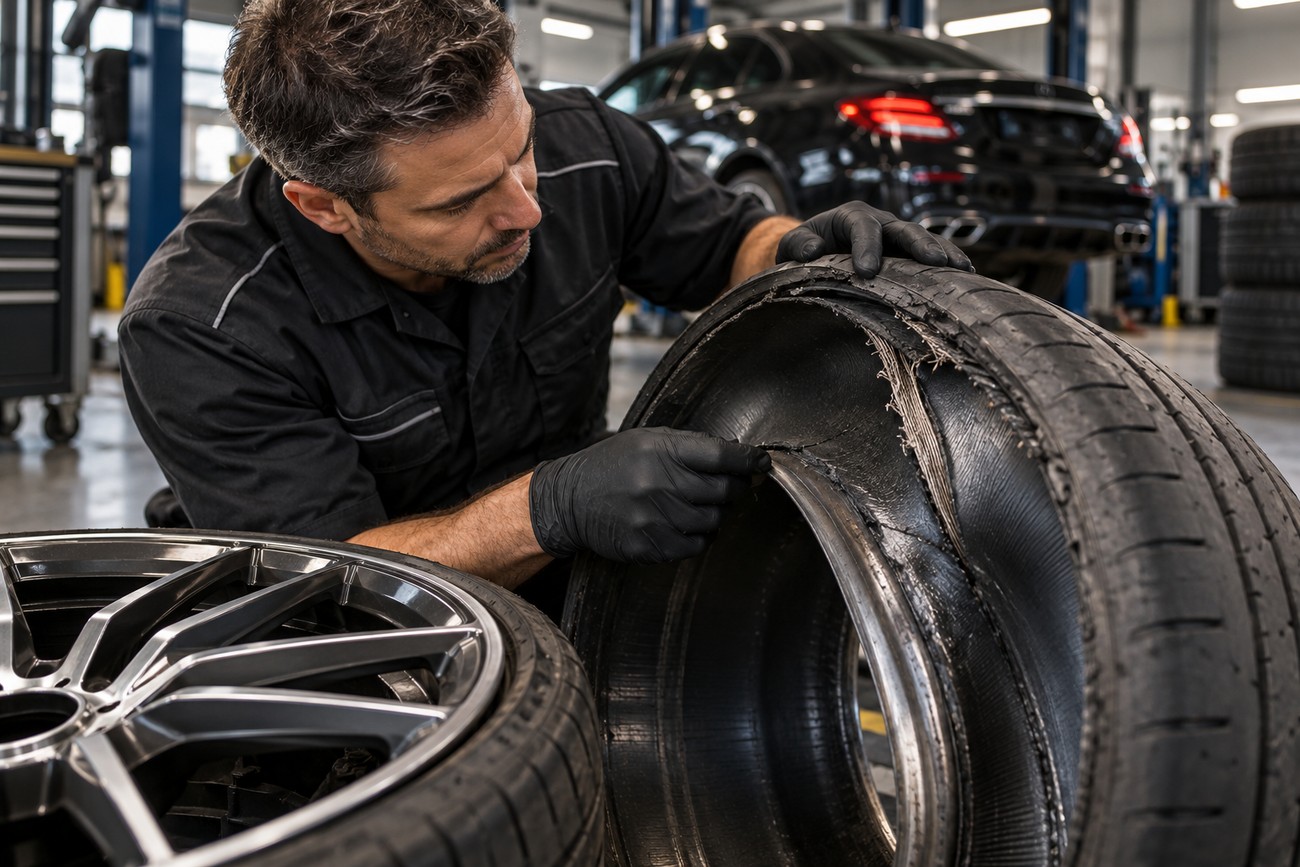
Inspect both sidewalls after a hard strike, including the inner side, which is difficult to see with the wheel fitted to the car. Bulges, cuts, cracking, exposed cords, or a newly uneven contour are warning signs of structural damage. A tire may retain normal pressure while its internal structure has been compromised.
The wheel can bend at the rim edge or inside the barrel, where damage is less visible from outside. The bead area may also be affected if the tire was pinched against the rim. Symptoms can include vibration, a steering wheel that no longer sits straight, slow pressure loss, or a new pull under braking.
Impact forces may reach suspension components and alter alignment even without an obvious broken part. Uneven wear can then develop across the tread, making the original pothole damage appear to be a tire problem several weeks later. A visual check is useful for triage, but it cannot confirm wheel runout, bead sealing, or alignment condition.
Inspect the inner wheel barrel, bead area, alignment, and pressure-loss pattern rather than judging damage from the visible outer sidewall alone. A wheel can look acceptable from the outside while running out of true or sealing poorly at the bead.
After a severe impact or any change in handling, arrange a professional wheel, tire, and alignment inspection. Do not assume that restoring pressure makes the car safe to drive normally. Continuing at speed on a damaged tire or wheel can worsen the failure and complicate the diagnosis.
Choosing Between AMG UHP Tires and Track-Focused Rubber
Road-oriented UHP tires are street-performance products that balance dry grip, wet behavior, durability, and road use. They are not equivalent to slicks. Their tread, compound, and construction are intended to function across a broader range of street conditions than a dedicated racing tire.
Sporting and UHP tires commonly have working speed ratings from approximately 240–270 km/h and higher, depending on the tire model and speed index. The load index matters just as much. Choosing a tire by dimensional size alone can leave the car with an incorrect load or speed index, even if it mounts on the wheel.
Track-only and semi-slick/R-compound tires usually focus on warm-weather circuit performance. That focus can bring worse cold and wet grip, more noise, a harsher ride, and faster wear in daily use. Their operating window may be narrower, so a tire that feels exceptional after warm-up can feel vague or unforgiving on a cold commute.
Treadwear markings provide a useful comparison within relevant products, though they do not predict every aspect of road behavior. A treadwear minimum of 200 often appears in amateur track series, while softer compounds generally wear faster. A track-oriented tire can also lose its intended balance through heat cycles before its tread appears completely worn.
Confirm the exact AMG model, brakes, suspension, axle widths, approved front and rear sizes, load index, speed index, and manufacturer approval before buying. Manufacturer-approved specifications may include construction details that a generic replacement listing does not show. The correct choice is the one that matches the vehicle and its real operating conditions.
AMG Tire Choices by Road Use and Pothole Risk
This comparison is a decision aid, not a substitute for checking the exact vehicle fitment and tire model. Pothole tolerance, wet grip, noise, and service life vary within each category.
| Tire category | Pothole tolerance | Cold and wet behavior | Noise and ride | Treadwear | Daily AMG suitability |
|---|---|---|---|---|---|
| Road-oriented UHP | Generally the most forgiving option in this group, though low profiles still provide limited impact reserve | Usually the broadest operating range; exact wet performance depends on the model and tread condition | Firm, with noise varying by construction and vehicle | Generally suitable for road mileage | Best fit for regular street use when the approved specification is followed |
| Aggressive UHP | Moderate; stiff construction can transmit more impact to the wheel | Strong in suitable temperatures, with greater model-to-model variation in cold rain | Typically louder and harsher than road-oriented UHP | Often reduced compared with touring-focused products | Suitable for drivers who accept more compromise for sharper dry response |
| Semi-slick/R-compound | Limited; sidewall stiffness and low profile leave less protection from severe impacts | Cold or wet grip can be poor until conditions suit the compound | Usually loud and firm | Soft compounds generally wear faster; a treadwear minimum of 200 often appears in amateur track series | Conditional; requires careful temperature, weather, and road-use judgment |
| Track-only | Low for ordinary road hazards | Often unsuitable for cold, wet, or variable street conditions | Harsh and noisy for daily driving | Usually short service life, especially with softer compounds | Appropriate only where the product is permitted, the conditions suit it, and track use is the priority |
A wider tire does not guarantee better real-world grip on cold or damaged urban pavement. Surface quality, compound temperature, pressure, vehicle mass, and tread condition can outweigh the theoretical benefit of a larger contact patch.
The legal tread minimum in many road regulations is approximately 1.6 mm or 2/32 inch. That is a compliance baseline, not a strong wet-weather safety reserve. As tread wears, water evacuation and resistance to aquaplaning can deteriorate, especially on a powerful car with wide tires.
Track-focused products also demand realistic storage and seasonal planning. A tire that works well in warm, dry conditions may be a poor choice for a car driven through cold mornings and heavy rain. Marketing language about “track feel for every day” should be tested against the actual commute, climate, and road surface.
Why Wider and Lower Does Not Always Mean More Grip in the City
Low-profile construction can improve steering response on smooth pavement because the sidewall flexes less. The same limited flex reduces comfort and damage tolerance on broken roads. A smooth circuit rewards immediate response, while a pothole-ridden city demands compliance and impact reserve.
Width alone does not determine traction. A wider tire may perform worse on cold or poor urban pavement because the compound is outside its preferred temperature range, the surface is contaminated or broken, or the tire pressure is unsuitable. Added width can also increase sensitivity to road grooves and uneven surfaces.
Low-profile tires can show more noticeable handling and stability changes from small pressure deviations. Pressure that is too low increases sidewall stress and heat, while excessive pressure can reduce compliance over rough surfaces. Use the vehicle’s specified recommendation for the exact tire size and check it when the tires are cold.
In wet conditions, tread design and wear state can matter more than the tire’s UHP marketing position. A technically sophisticated performance tire with a worn or unsuitable tread may provide less useful rain performance than a less aggressive road tire designed for broader conditions. The best urban grip is the result of the whole system: tire, pressure, temperature, alignment, and surface.
What to Check After a Pothole Strike—and Before Replacing Tires
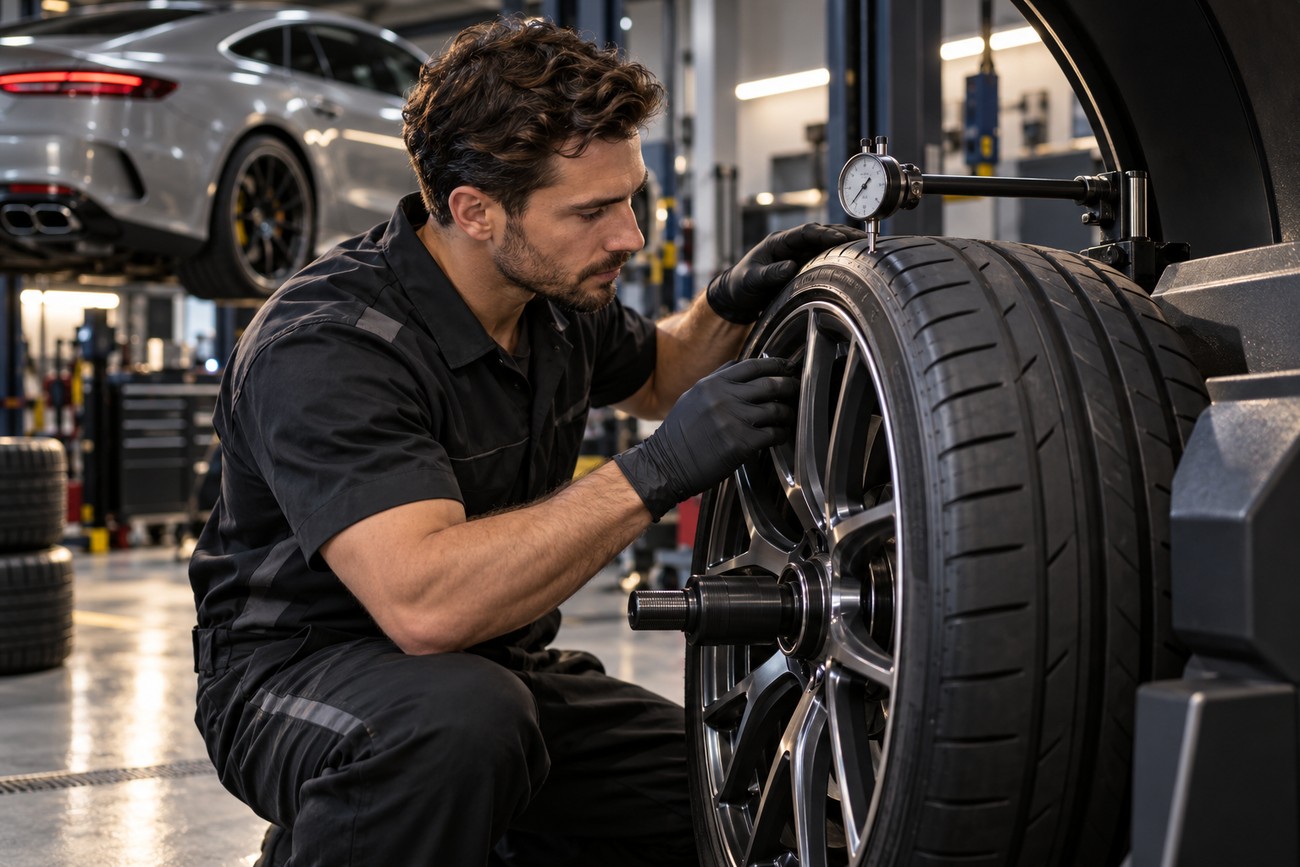
Stop safely and check both sidewalls, the tread, and the visible wheel rim. Look for a bulge, cut, crack, exposed cord, distorted bead area, or fresh scraping. Check pressure loss against the vehicle’s specified cold-pressure recommendation, then avoid high-speed driving if the impact was severe or the car feels different.
Inspect the inner side of the wheel and tire as soon as practical. A slow leak, vibration, steering pull, or steering wheel that sits off-center justifies a professional examination. The inspection should cover wheel runout, bead sealing, tire structure, alignment, and suspension components rather than focusing only on the outer sidewall.
A pressure-loss pattern can reveal damage that a quick visual check misses: a persistent slow leak may point to the bead or wheel, while a new vibration can indicate runout even when the tire has no visible bulge.
Staggered front and rear fitments limit rotation options and can accelerate uneven wear. Replacement therefore requires the axle-specific size, load and speed indices, and the vehicle’s exact brake and suspension configuration. Replacing only one tire may also be unsuitable if the remaining tire on that axle has substantially different wear or construction.
Alignment and pressure should be treated as one system. Incorrect alignment can destroy a new tire’s shoulder, while incorrect pressure changes its contact behavior and impact response. The legal tread minimum in many regulations is approximately 1.6 mm or 2/32 inch, but wet-weather grip may already have a reduced safety margin above that limit.
Frequently asked questions
What tire brand does Mercedes recommend for an AMG?
Mercedes approval applies to an exact tire specification, not simply to a brand name. Check the particular AMG model, axle, size, load index, speed index, construction, and manufacturer-approved marking listed for the vehicle. A tire from a familiar brand can still be unsuitable if one of those details is wrong.
Approval can also vary with brakes, suspension, wheel width, and staggered fitment. Use the vehicle documentation and a reputable fitment source, then confirm that the replacement matches the approved specification for that axle.
Which cars handle potholes the best?
Cars with taller sidewalls, smaller wheels, and less aggressively stiff suspension setups generally have more impact reserve. More sidewall can deform before the wheel reaches the road edge, reducing the force transferred into the rim and suspension.
That rule describes a vehicle configuration rather than a guarantee of durability. Vehicle weight, wheel design, tire pressure, suspension condition, and road speed still matter. Ultra-low-profile performance configurations usually prioritize response over pothole protection.
What tires should I stay away from for daily AMG driving?
For ordinary street use, reject track-only products that are poorly suited to cold or wet conditions, tires with incorrect load or speed indices, and any tire whose fitment ignores the staggered axle layout. A semi-slick may also be a poor daily choice if noise, rapid wear, or weak cold grip conflicts with your climate and commute.
Check the model’s road legality, temperature range, tread design, and approved dimensions rather than relying on a performance label. The exact AMG variant determines whether a tire clears the brakes and supports the required axle load.
How should I set tire pressure after hitting a pothole?
Restore pressure using the vehicle’s specified cold-pressure recommendation for the exact tire size and load condition. Do not copy a pressure from another AMG model, another axle, or a different tire size.
Pressure correction cannot replace inspection. A tire can hold the recommended pressure while the wheel is bent, the bead is damaged, the sidewall is structurally compromised, or alignment has changed. Arrange a professional check if pressure falls again or the car develops vibration, pulling, or altered steering response.







