
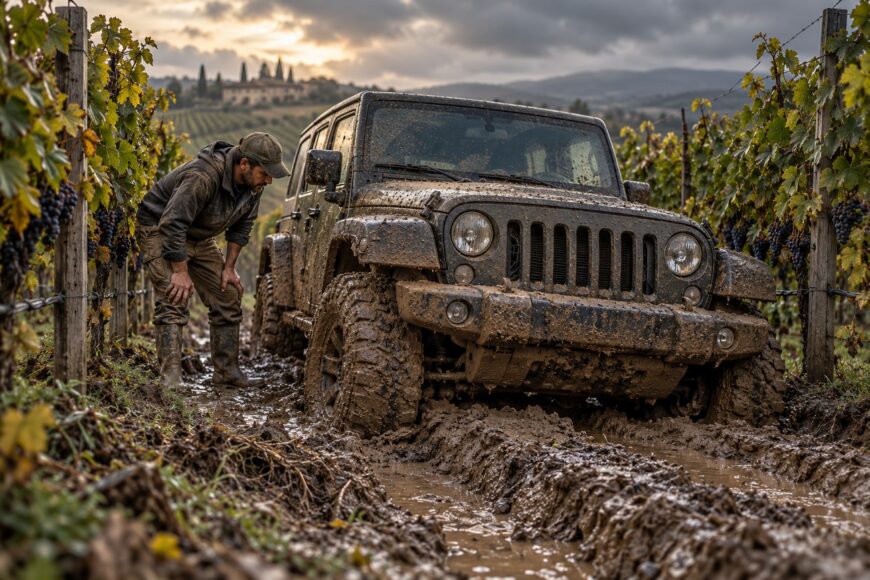
A Jeep can lose traction quickly in a narrow vineyard row, where another throttle attempt may deepen the rut or damage vines, posts, and drainage. Four-wheel drive does not prevent sinking into soil or the underbody settling onto the ground.
First identify what is holding the vehicle. If the tires still have useful clearance and grip, a controlled drive-out may work; if the Jeep is high-centered or the route is blocked, stop and plan a recovery that protects people, equipment, and the vineyard.
- Stop Before the Ruts Deepen
- Find What Is Holding the Jeep
- Build a Safe Pull in a Narrow Row
- Pull Slowly and Check the Damage
- Frequently asked questions
- What if the Jeep’s recovery points are buried or damaged?
- What percentage of Jeep customers are considered dreamers?
- What is the most common problem with a Jeep Cherokee?
- What do I do if I get stuck in a ditch?
- How do people get unstuck from mud?
Stop Before the Ruts Deepen
Stop wheelspin as soon as the Jeep stops gaining ground. Repeated wheelspin can deepen ruts and reduce useful traction, while mud packed into the tread makes each attempt less effective. Select neutral or park as appropriate, apply the parking brake, and assess the vehicle before moving equipment.
Driving on wet soil can worsen rutting and compaction, affecting roots, drainage, and later machinery access. A narrow row also leaves little room to correct a slide, so agree on an exit route and any anchor location with the vineyard owner before bringing in another vehicle or recovery gear.
Move bystanders away from the Jeep, the intended line of pull, and any tensioned rope or strap. Keep only the people needed for the recovery close enough to communicate, and follow the vehicle and equipment instructions for the danger zone. A clear plan is safer than repeated attempts made under pressure.
Find What Is Holding the Jeep
Look under the Jeep before increasing force. If it rests on an axle or underbody, clear the obstruction and restore wheel load before pulling. Dig away packed soil beneath the differential, skid plates, sills, or other contact points, and remove stones that are holding a wheel or frame member up.
Clean mud from the tire tread and check whether a wheel has dropped into a hole or is against a bank. More throttle will usually deepen the rut when the problem is ground clearance. On loose ground, lower tire pressure only within manufacturer limits, then restore the specified road pressure before normal driving.
Check for a caught step, damaged bumper, trellis material, or buried root that could move suddenly. If the obstruction cannot be cleared without entering an unsafe space, stop and arrange suitable recovery assistance. A winch or tow vehicle cannot make a damaged attachment point safe.
Build a Safe Pull in a Narrow Row
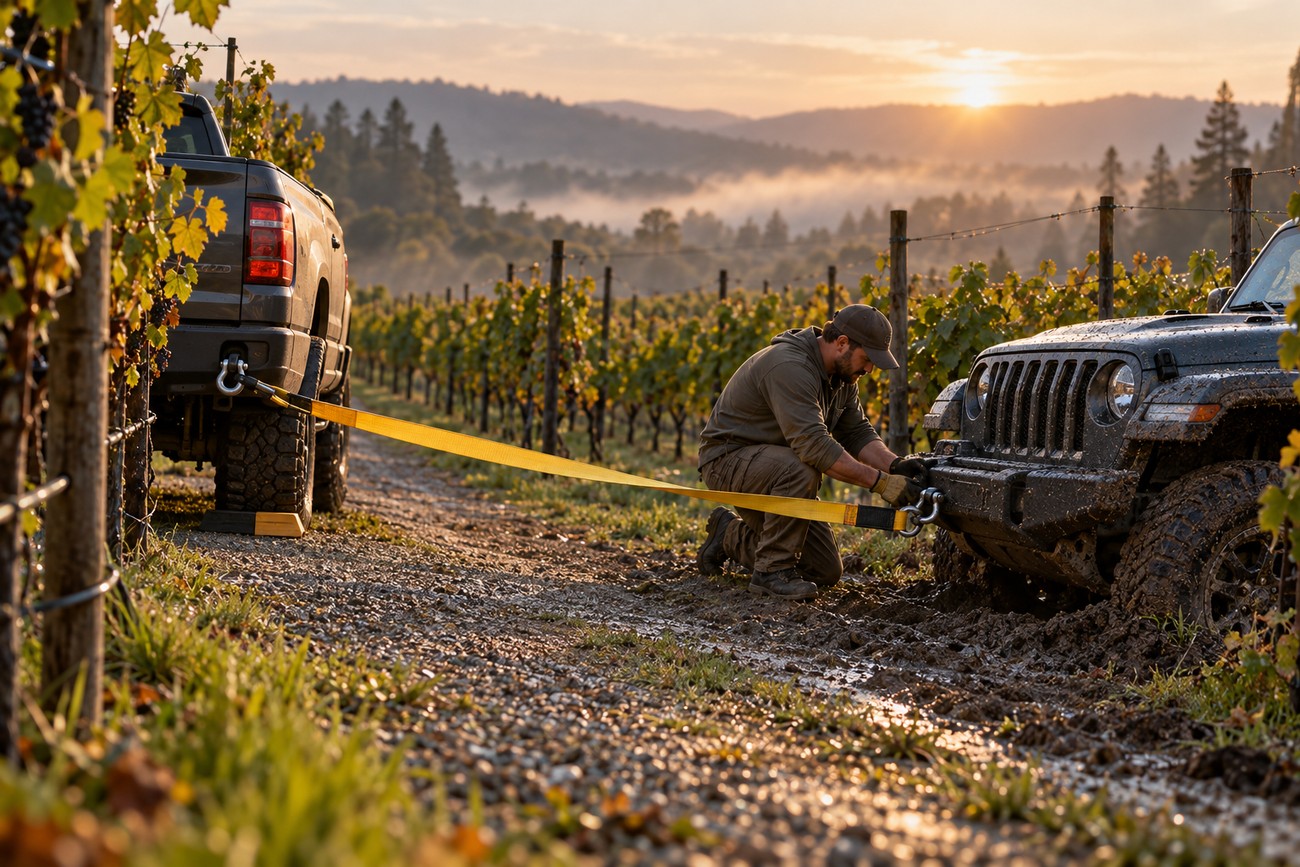
Prefer a pull along the Jeep’s longitudinal axis. Vines, trellis posts, and narrow row spacing can make that difficult, but a side pull increases side loading and can cause uneven winch-line spooling. Use manufacturer-designated recovery points, never a tow ball, suspension or steering component, or plastic bumper.
Set the recovery vehicle on firm ground and prevent it from moving. Use a suitable anchor with rated equipment; a healthy tree requires a protective strap rather than a cable wrapped around its trunk. If a straight line is blocked, a suitably rated direction-changing pulley can redirect the line while keeping the pull controlled and avoiding excessive side loading on the Jeep or its recovery points.
Keep people out of the tensioned line, including the spaces near hooks, shackles, and anchor points. Jeep Cherokee guidance specifies at least 40 feet of separation for observers; check the instructions for the actual vehicle and equipment. A winch alone cannot compensate for a poor anchor, pull angle, or attachment point.
Pull Slowly and Check the Damage
During setup, secure both vehicles with parking brakes and, where needed, wheel chocks. Follow the winch or recovery-system procedure for a slow, coordinated pull, with the driver using the lowest suitable gear and minimal wheelspin. Stop immediately if the anchor or recovery vehicle shifts, the line rubs a post, or the Jeep moves toward the vines.
Do not create a sharp jerk with an ordinary tow strap. Shock loads can damage recovery points, the frame, drivetrain, or strap, and a sudden release can send hardware or a vehicle in an unpredictable direction. Prolonged winching can also overheat the electric motor and battery, so pause according to the equipment instructions.
Inspect the rope, cable, strap, hooks, and shackles after contact with rocks, posts, or metal. Do not reuse equipment with cuts, severe abrasion, broken fibers, kinks, or other damage. Recovery ends only when the Jeep is stable on suitable ground and the equipment has been safely unloaded.
Wash mud from the brakes, hubs, electrical connectors, and underbody protection, then check for bent parts or leaks. Inspect the tires and recovery points, and restore road tire pressure if it was reduced. Repair deep ruts and leave the row ready for vineyard machinery rather than treating the extraction as the final task.
Frequently asked questions
The next step depends on what is holding the Jeep and whether its recovery points are sound. Mud and ditch recoveries call for the same basic checks: clearance, traction, and a safe route out. If those checks reveal damage or an unsafe angle, stop and seek recovery assistance.
What if the Jeep’s recovery points are buried or damaged?
Expose and inspect the manufacturer-designated points only if you can do so safely. Never replace them with a tow ball, suspension part, steering component, or bumper. If no sound attachment is available, stop and arrange professional recovery rather than improvising a connection.
What percentage of Jeep customers are considered dreamers?
There is no reliable general percentage for that label. It is a subjective marketing or survey term, not a standard Jeep ownership measure, so any precise figure would require a clearly defined study and sample.
What is the most common problem with a Jeep Cherokee?
There is no single common problem across every Cherokee generation, engine, and drivetrain. A stuck vehicle should be diagnosed on its own evidence—such as wheelspin, underbody contact, tire damage, or a recovery-point fault—rather than assumed to have a model-wide cause.
What do I do if I get stuck in a ditch?
Stop wheelspin, secure the Jeep, and check whether the axle or underbody is resting on the ground. Clear the obstruction only from a safe position, then use a planned pull from a manufacturer-designated recovery point. If the vehicle is leaning, damaged, or close to a rollover, obtain professional assistance.
How do people get unstuck from mud?
They first restore traction and clearance: clean the tread, dig away mud under the underbody, and reduce tire pressure only within manufacturer limits. If that is insufficient, use a rated recovery system with a suitable anchor and a slow pull, keeping everyone clear of the tensioned line.







