
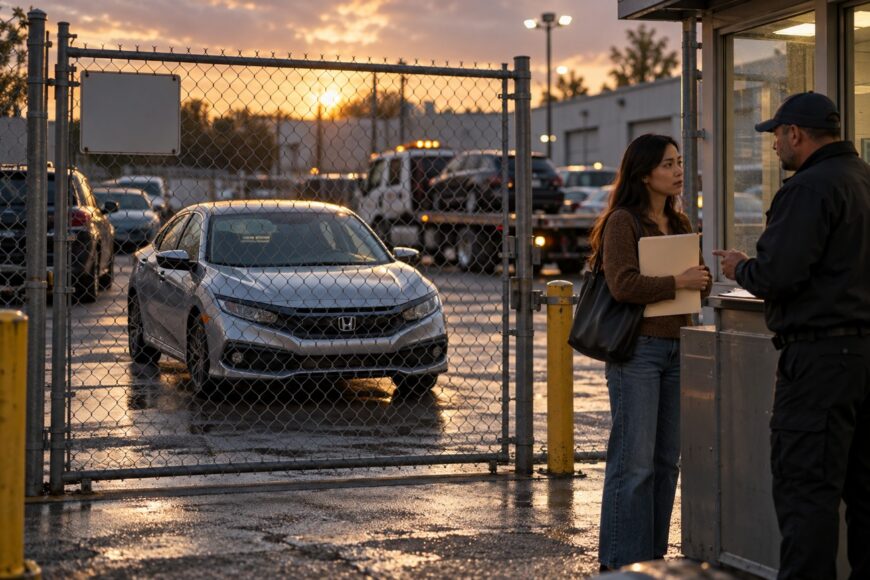
Your Honda Civic may be accumulating storage charges while the impound lot, police department, lender, and other agencies give different instructions. The correct release path depends on why the vehicle was taken and who placed the legal hold.
A police or municipal tow, a private-property tow, a lender repossession, and a government or court-related seizure can require different documents and payments. Paying the storage lot alone may not release the Civic. You first need to identify the hold, gather the required paperwork, settle the correct balance, and act before sale or disposal becomes possible.
Start by obtaining the storage location, case or invoice number, and the name of the agency, lender, court, or other authorized party that can order release. That information prevents you from paying the wrong party or losing time while storage charges continue.
- First, Find Out Why Your Honda Civic Was Impounded
- What to Do in the First 24 Hours
- Documents and Payments Needed for Release
- How Much Does It Cost—and What If You Cannot Pay?
- When the Hold Is Wrong: Ownership, Appeals, and Deadlines
- Release Day: Inspect the Civic and Close the File
- Frequently Asked Questions
- What should I do if I cannot afford to get my Honda Civic out of impound?
- What happens if the impound lot refuses to release the car after I paid?
- How can I protect myself if the Civic was damaged or personal property is missing?
First, Find Out Why Your Honda Civic Was Impounded
The reason for the impoundment controls the process. A police or municipal tow may result from a crash, parking violation, expired registration, or another local enforcement action. A private tow may follow a property rule or contract dispute, while a lender repossession concerns an unpaid vehicle loan. A government or court-related seizure follows a different legal route.
Ask the lot for the storage location, intake or case number, current balance, and authority that placed the hold. Then contact that authority directly and request the document that authorizes continued custody. The lot may physically hold the Civic while the release authority remains with a police agency, court, lender, or another government office.
Do not assume that the registered owner, the person who was driving, and the person who can authorize pickup are always the same. If someone else owns the Civic, financed it, or asks you to collect it, the lot may require written authorization and proof of the owner’s identity.
A quick written record can prevent conflicting instructions. Note whom you spoke with, the date and time, the exact amount quoted, the documents requested, and whether the person promised a release authorization or only described the next step.
What to Do in the First 24 Hours
Call the impound lot and the releasing agency as soon as possible. Request written instructions and a current itemized balance showing towing, storage, administrative charges, and any other documented amount. Ask whether charges continue to accumulate and whether a sale, hearing, or disposal deadline applies.
Check relevant official records where available, including agency systems that show an active tow, lien, restriction, or enforcement case. If a lender is involved, confirm the repossession status and ask whether the vehicle can still be recovered. Informal statements from a lot employee may not show every hold recorded by another authority.
Create one complete file containing the tow or seizure notice, release requirements, payment records, government-issued identification, and proof of ownership or authorization. Keep screenshots of online records, copies of emails, receipts, and notes from phone calls. These records are useful if the amount changes or an agency later says that a document was missing.
Waiting has a direct financial cost because storage charges can continue while the Civic remains at the lot. Delay can also cause you to miss a hearing, redemption, or sale deadline. If the vehicle is already scheduled for sale, ask for the deadline and required action in writing rather than relying on a general promise that payment will resolve the matter.
Documents and Payments Needed for Release
The usual release packet includes government-issued identification, proof of ownership or authorization, and the documents specified by the responsible authority. Depending on the case, that may include a title, registration, bill of sale, insurance proof, lender authorization, tow notice, court document, or release form. Requirements vary by jurisdiction and by the reason for the impoundment.
Confirm which documents the lot will accept before traveling there. Ask whether originals, copies, or electronic versions are permitted, whether the vehicle owner must attend, and whether a third party may collect the Civic. Also confirm accepted payment methods, daily storage cut-off times, and whether a separate agency must issue clearance first.
The recovery cost may include towing, storage, administrative or collection fees, an enforcement fee, the underlying fine, a repossession balance, or other documented charges. Paying the original ticket or debt may therefore leave a remaining storage or release balance. Request an itemized statement that identifies each charge and the party receiving it.
Paying the storage invoice does not cure a missing release authorization, lienholder clearance, or identity document. The counter may be ready to accept money even though another agency still controls the legal release.
A lender or its agent may control the release or disposition process in a repossession case. The storage lot may release the Civic only after receiving the lender’s written instruction. Obtain confirmation that the hold has been cleared, and keep the payment receipt and release document together.
How Much Does It Cost—and What If You Cannot Pay?
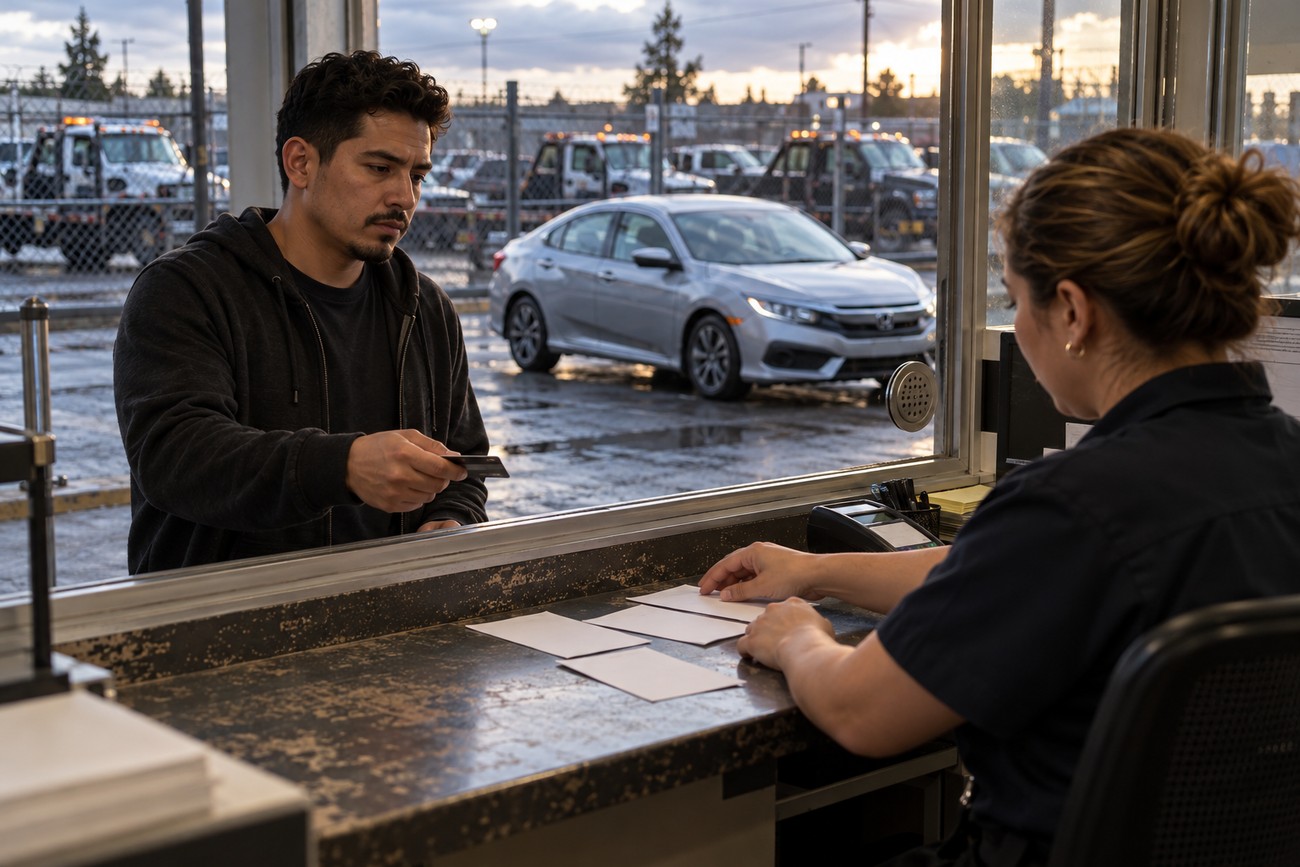
There is no single reliable national price for releasing a Honda Civic from impound. The case-specific total depends on the tow basis, location, storage period, agency rules, lender involvement, and the underlying obligation. A modest original fine can become a larger recovery amount once towing, storage, and administrative charges are added.
Ask for a written balance using a direct request: “Please provide the full itemized amount required for release today, identify every fee, and state whether any separate clearance is still required.” Ask how the balance changes if payment is made later, and whether a sale or disposal date has already been set.
If you cannot pay the full amount, ask specifically about a payment arrangement, hardship option, supervised pickup, or other program. Such options may exist, but they are not automatic. Get the terms from the agency, lot, or lender in writing, including whether storage continues during the arrangement and whether the Civic remains subject to sale.
Compare the cost of recovery with the consequences of leaving the vehicle in storage. In a lender repossession, voluntary surrender or sale may affect the remaining loan balance and credit record differently from a negotiated recovery, but the result depends on the agreement and applicable law. Do not treat surrender as debt cancellation.
If a lender sells the Civic and the sale proceeds do not cover the loan balance, the borrower may still face a deficiency balance in applicable U. S. situations. Ask the lender for the proposed disposition terms, the payoff amount, and an explanation of how any remaining balance will be calculated before choosing an option.
When the Hold Is Wrong: Ownership, Appeals, and Deadlines
A complaint to the storage lot alone may not challenge the legal basis of the tow or seizure. The correct contact may be the police agency, municipal office, court, lender, or other authority that issued the hold. First identify the disputed issue: improper tow, mistaken identity, paid debt, ownership conflict, lien problem, or a sale notice.
Request the hearing, review, or appeal deadline in writing. Ask what form must be filed, where it must be submitted, and whether filing pauses storage charges or a planned sale. Keep proof of submission and continue checking the case status; a complaint does not necessarily stop enforcement automatically.
An ownership dispute requires evidence of the right to possess the Civic. Useful records may include the title, bill of sale, payment records, insurance records, registration documents, loan paperwork, and communications with the person who delivered or sold the vehicle. The claimant may need to prove ownership or authorization through a formal process rather than at the storage counter.
The vehicle’s physical location or registration status does not by itself cancel an active lien, debt, restriction, or enforcement action. A transfer or failure to update registration may leave the underlying claim intact. If the Civic has already been sold, recovery becomes substantially harder and may involve the buyer as well as the original parties.
Photograph the vehicle and its identifying details if inspection is permitted before release. Record the VIN, visible damage, missing parts, and the condition of the interior. If the hold is based on mistaken identity or a wrong VIN, those photographs and the intake record can support a prompt correction request.
Release Day: Inspect the Civic and Close the File

Before accepting the Civic, compare the VIN and vehicle condition with the tow or storage intake documentation. Check the exterior, windows, wheels, lights, interior, and personal property. Photograph existing damage and any new damage from several angles, preferably with the vehicle still at the lot.
Collect the paid receipt, release authorization, itemized balance, and any document confirming that the hold was cleared. If the lot says another agency must remove a restriction, ask which agency, what reference number applies, and whether the clearance has already been transmitted.
A paid storage invoice is not necessarily proof that every lien, restriction, or enforcement record has been removed. After release, check relevant official databases or agency records for stale entries before registration, insurance changes, sale, or another transaction involving the Civic.
If property is missing or damage appears, report it promptly in writing to the lot, insurer, lender, or responsible agency, as appropriate. Keep photographs, intake records, witness details, receipts, and copies of every notice. Retain the complete file until registration, insurance, lender, and agency records show no unresolved restriction.
Frequently Asked Questions
Release rules and fees vary by the reason for impoundment, the agency involved, and local requirements. A written itemized balance and written release requirement are more reliable than informal verbal assurances.
What should I do if I cannot afford to get my Honda Civic out of impound?
Request an itemized payoff first, then ask specifically about payment arrangements, hardship programs, or a lender-approved recovery plan. Confirm whether storage continues, whether the vehicle remains scheduled for sale, and what payment preserves your right to recover it.
Compare continued storage with voluntary surrender, sale, or another disposition. In a lender case, ask how each option affects the loan and any possible deficiency balance. Do not make a partial payment unless the recipient explains in writing what legal or practical benefit it provides.
What happens if the impound lot refuses to release the car after I paid?
Ask whether the refusal concerns an unpaid balance or a separate legal hold. Request the refusal and the exact missing requirement in writing, including the controlling agency, case number, and any additional amount claimed. A lot may have accepted payment while still lacking the clearance required from a police agency, court, lender, or other authority.
Compare the written balance with your receipt before paying again. Contact the controlling authority directly and ask for a release document or confirmation sent to the lot. Avoid duplicate charges based only on verbal instructions.
How can I protect myself if the Civic was damaged or personal property is missing?
Before leaving the lot, photograph the Civic, VIN, interior, and every area of damage. Compare the vehicle with the intake photographs or condition report, collect receipts and release papers, and record the names or contact details of witnesses who saw the condition.
Send prompt written notice to the relevant lot, insurer, lender, or agency, attaching the photographs and documents. Keep copies and note the date of delivery. A clear contemporaneous record is more useful than a later general complaint, especially if the vehicle has already been moved or repaired.







