
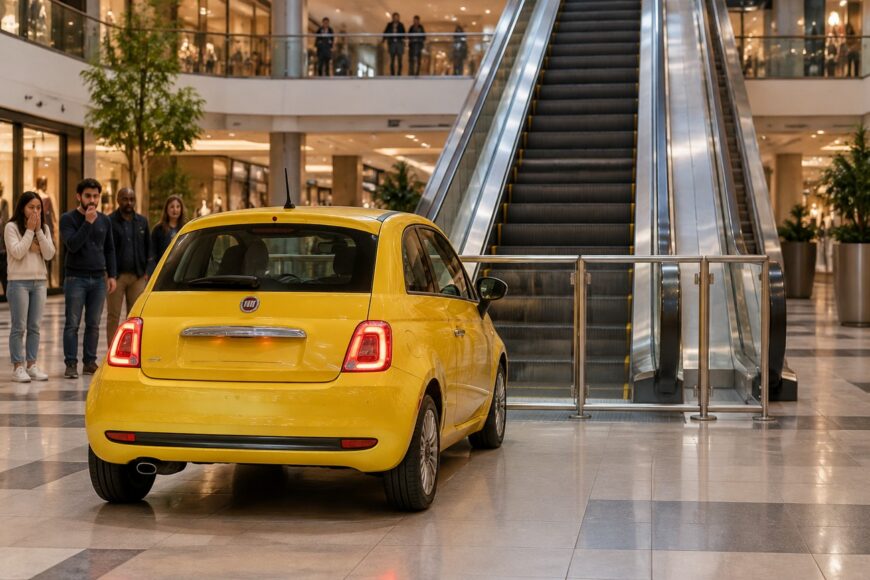
A Fiat 500 on an escalator has the makings of a memorable image: a small city car apparently riding upstairs with the shoppers. Its rounded shape makes the idea look almost plausible at a glance. The visual joke ends where the machinery begins, though. A modern Fiat 500 is a substantial vehicle, and its wheels, underside, and body were never meant to meet an escalator’s steps and changing slope.
A passenger escalator is built for people, with rules governing how they stand and move. Those rules do not become more flexible because the car is compact or the escalator is switched off. If the real aim is to put a Fiat 500 on an upper floor for a display, delivery, or film shoot, the useful task is to arrange an approved vehicle route.
- Can a Fiat 500 go up an escalator?
- The Fiat 500 is small—but not light
- Where the escalator geometry fails
- Operating rules are not a vehicle permit
- Getting the car to an upper floor safely
- The stunt illusion and the mistakes behind it
- Frequently asked questions
- What paperwork should an indoor Fiat 500 display organizer prepare?
- What year is the bad Fiat 500?
- What are some aftermarket upgrades available for a Fiat 500 Abarth?
- Why is the Fiat 500 so cheap?
- What is the common problem with the Fiat 500?
Can a Fiat 500 go up an escalator?
A passenger escalator is not an appropriate way to move a Fiat 500, whether someone drives the car or pushes it. Its purpose is to carry people through a controlled entry, incline, and exit. A car introduces different contact points, concentrated loads, and consequences if it shifts or catches.
On a moving escalator, the steps change position beneath the wheels while the vehicle remains too large for anyone nearby to control safely. People at either landing could also have little room to get clear. Treating the trip as a stunt would expose bystanders and the venue’s equipment to risks that the car’s modest appearance does nothing to reduce.
Switching the escalator off removes the moving-step hazard, but it does not turn the installation into an approved vehicle ramp. The steps, landings, structure, and surrounding clearances would still need to be assessed for a vehicle move. A decision to move a car through a venue belongs with its operator and the people responsible for a suitable transport plan, rather than whoever has the keys.
The Fiat 500 is small—but not light
The 2007-onward Fiat 500 measures 3,546 mm long, 1,627 mm wide, and 1,488 mm high. Those dimensions make it easy to picture in a tight city parking space. They do not describe an object that can be treated like hand luggage on a passenger escalator.
Base modern versions have an approximate curb weight of 865 kg. That figure is a starting point, rather than a specification for every Fiat 500: petrol and electric versions differ, and the exact car must be identified before any venue move is assessed. People sometimes mistake a short body for a light load, even though the running gear, body, and equipment still have to be supported.
The original Fiat 500 dates from 1957–1977 and should not be confused with the 2007-onward model. Photos and claims about an early car can make the modern one seem smaller or lighter than it is. For an indoor move, the vehicle’s actual model and specification matter far more than the familiar badge on its nose.
Where the escalator geometry fails
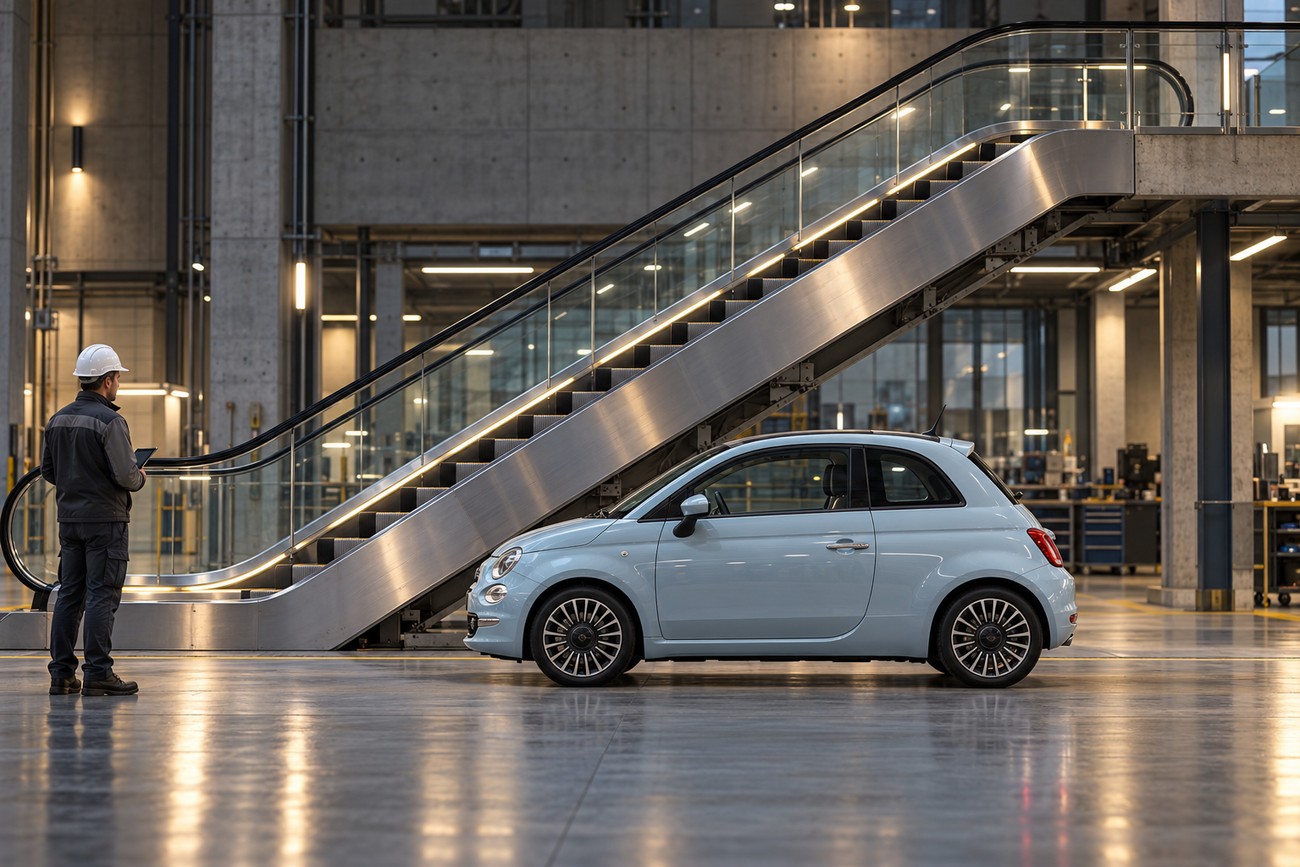
A width check cannot establish that a car can use an escalator. The modern Fiat 500’s 2,300 mm wheelbase means its front and rear wheels would encounter different parts of the incline at the same time. Escalator steps, gaps, and changes in slope create hazards that a measurement between the balustrades cannot resolve.
At the entry and exit, a bumper or the underside could catch as the surface changes angle. On the incline, the wheels would place weight on a stepped surface designed around a different pattern of contact. The approximate 865 kg curb weight of a base car matters, but the location and movement of that load matter too.
A snag or shift would leave little margin for correction in a confined passage. Nearby people could be trapped between the vehicle, the sides of the escalator, and the landings. This is why a car that appears to fit in a photograph has not passed a meaningful safety check; the parts hidden below and beyond the camera frame may be the limiting ones.
Operating rules are not a vehicle permit
Passenger instructions explain how people should ride an escalator, including where to stand and how to use the handrail. They say nothing about approving a vehicle load. That distinction matters because ordinary, safe passenger use cannot be stretched into permission for an unusual object occupying the full passage.
The occupational guidance described for escalators prohibits work while an escalator is moving. For certain restricted-clearance situations, it specifies a stopped escalator or supervision with the ability to stop it immediately. Those are controls for the situations the guidance addresses; neither provision authorizes transporting a car.
A venue may also have its own access, fire-safety, and equipment rules. Anyone planning a display or shoot should ask the site operator what route is permitted and who must approve the move. An informal assurance that the escalator will be stopped is no replacement for an assessed plan covering the vehicle, equipment, and people nearby.
Getting the car to an upper floor safely
For an indoor display, delivery, or film shoot, start with the destination and an approved route through the building. A suitable vehicle route may exist, or the venue may have a freight lift explicitly rated and approved for the specific car. A passenger lift and an ordinary ramp should not be assumed adequate simply because an opening looks wide enough.
Give the venue and equipment operator the exact vehicle specification. As a reference, a base 2007-onward Fiat 500 is approximately 865 kg and measures 3,546 mm long, 1,627 mm wide, and 1,488 mm high; a different version needs its own figures. The plan must account for clear openings, turning space, floor capacity, the loading method, and permission to use each part of the route.
Agree on who controls access during the move and how the car will be placed at its final position. Display and filming needs can add constraints, such as keeping public circulation clear after the vehicle arrives. Those details are easier to solve before the car reaches a loading area than beside an escalator with no approved way forward.
The stunt illusion and the mistakes behind it
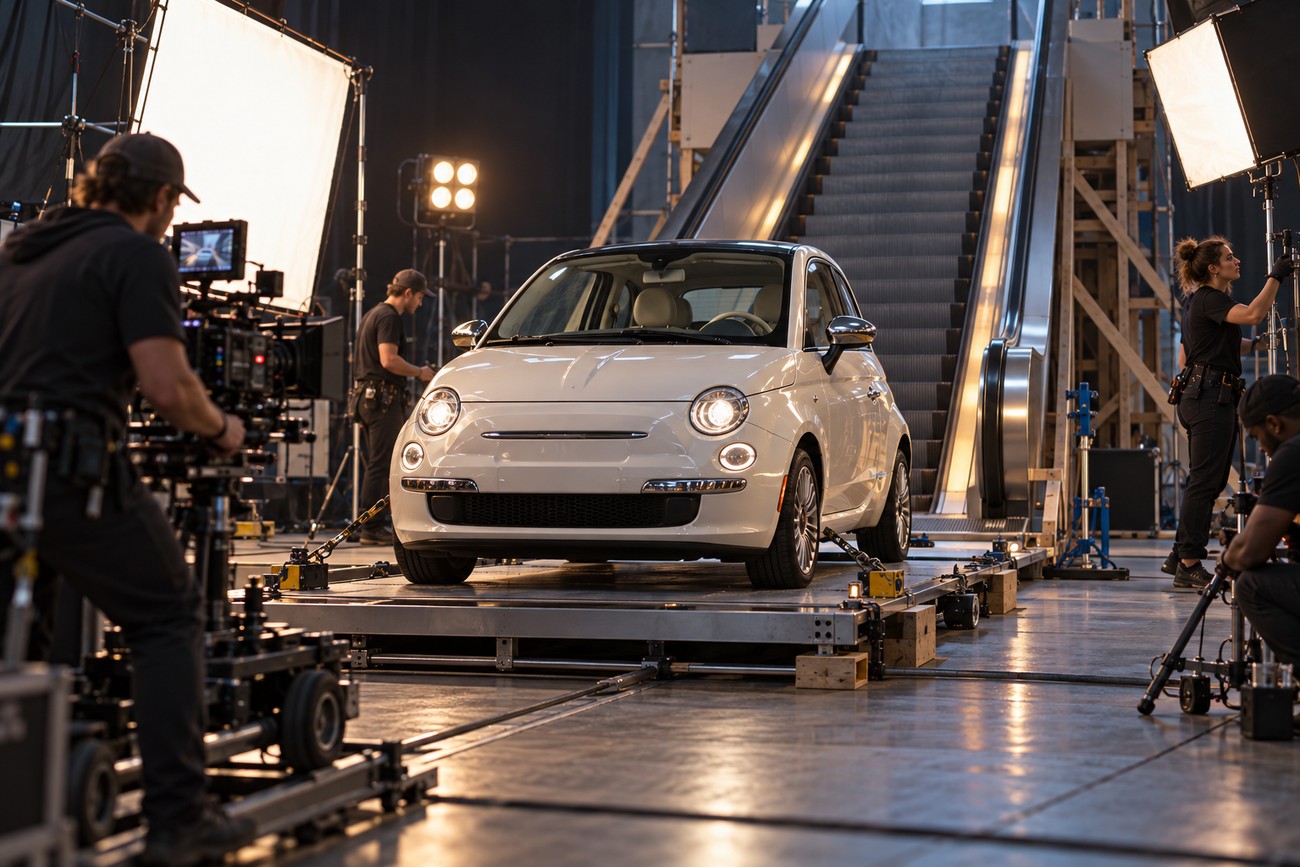
A photograph or advertisement can suggest an escalator journey without putting an operable car on the equipment. Subject to venue approval, a static set, a prop, or an edited visual can create the intended impression while keeping the real vehicle on a suitable surface. The audience gets the joke; the building does not have to participate in it.
The first misleading shortcut is the claim that a Fiat 500 weighs about 500 kg. A single source gives a roughly 500-plus-kg figure for an early car, which is not a specification for the 2007-onward Fiat 500. Base modern versions weigh approximately 865 kg, and other versions require their own figures.
The other shortcuts concern the escalator itself. Stopping it does not make it an approved vehicle ramp, and a tight width measurement says little about steps, slope changes, or clearance beneath the car. For a credible image, production design can solve the visual problem; for an actual upper-floor delivery, only a venue-approved transport route solves the physical one.
Frequently asked questions
The same Fiat 500 name appears in questions about indoor displays, model years, modifications, and ownership costs. Answers depend on the particular vehicle and, for a display, the particular site. These distinctions help prevent an attractive photo idea from becoming a poor equipment decision.
What paperwork should an indoor Fiat 500 display organizer prepare?
Prepare the exact vehicle specification, a proposed route, written venue permissions, any required equipment approval, and a site-specific risk assessment. Include how the car will be moved and where it will sit once in place. Required forms vary by venue and location, so confirm the package with the operator and any relevant insurer rather than relying on a universal checklist.
What year is the bad Fiat 500?
There is no single Fiat 500 model year that can fairly be called “the bad one” from the information here. The original was made from 1957–1977, while the modern model began in 2007; those are different cars. For a used modern example, its maintenance record, condition, transmission behavior, and suitability for your driving matter more than a blanket judgment about its year.
What are some aftermarket upgrades available for a Fiat 500 Abarth?
Depending on the exact Abarth version and local rules, owners may consider replacement wheels and tires, brake components, suspension parts, or exhaust components. Check fitment and whether a change affects road legality, insurance terms, or warranty coverage before buying. A modification for road use also does nothing to make an escalator a suitable vehicle route.
Why is the Fiat 500 so cheap?
A low asking price for a used Fiat 500 can reflect age, mileage, condition, specification, or local demand; it is not a reliable verdict on every car. The small cabin and 185-liter luggage compartment may also make some examples less attractive to buyers who need more space. Compare cars with similar histories and have any prospective purchase inspected before treating the price as a bargain.
What is the common problem with the Fiat 500?
There is no one fault that describes every Fiat 500 version. Common owner complaints concern limited rear-seat and luggage space, modest performance from the 1.2 petrol engine on faster roads, and jerky behavior from some robotized transmissions in traffic. For a particular car, check the variant and service history, then assess how it drives rather than assuming a general complaint applies to it.







