
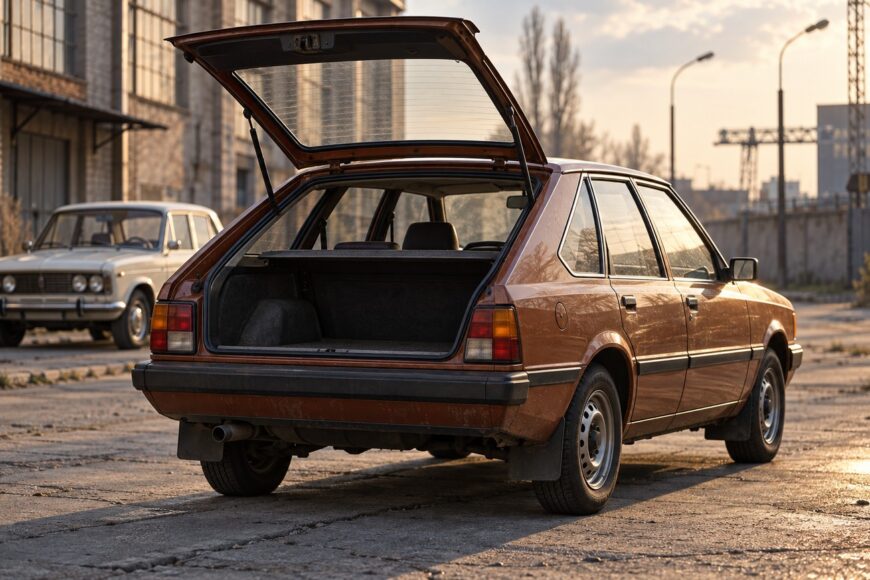
In 1978, the FSO Polonez looked like a modern European fastback, yet beneath its new body it retained the rear-wheel-drive mechanical foundation of the Polski Fiat 125p. That contrast defines the car more accurately than either its shape or its Fiat connections alone. It offered hatchback practicality and a distinctive Polish identity while carrying engineering that already belonged to an earlier generation.
For a buyer now, the attraction is entry into an unusual classic with relatively straightforward mechanicals. The risk is a bodywork project disguised as a running car: corrosion and old repairs can matter far more than an engine that starts promptly. Condition, version, and market specification deserve closer attention than the badge on the tailgate.
- The fastback that was not a clean-sheet Fiat
- Rear-wheel drive under the hatchback shell
- Polonez versions, engines, and the numbers that cause confusion
- What owning one is actually like
- Buying and restoring a Polonez: inspect the shell before the engine
- Why the Polonez still matters—and where its story ends
- Frequently asked questions
- Was the FSO Polonez a good car?
- What is the top speed of the FSO Polonez?
- Why do sources give different total production figures for the Polonez?
The fastback that was not a clean-sheet Fiat
Produced in Warsaw, Poland, from 1978–2002, the Polonez was a rear-wheel-drive hatchback with a fastback-style body. Its mechanical basis was the Polski Fiat 125p, so describing it as an entirely original design built from scratch gives the wrong impression. Equally, calling it merely a rebodied Fiat overlooks how substantially the new body changed its appearance and everyday use.
The sloping rear and hatch distinguished the Polonez from the older sedan on which its mechanical package was based. Loading bulky belongings through a large rear opening was a practical gain, and the profile suggested a newer kind of family car. The change was visible and useful, even though it did not bring an equally new drivetrain or chassis underneath.
That split explains much of the Polonez’s character. Its exterior invited comparisons with newer European hatchbacks, while its running gear preserved the layout and limitations of the Polski Fiat 125p. Reading the car as an evolution of existing components, rather than a clean-sheet replacement, makes its engineering choices easier to understand without excusing their shortcomings.
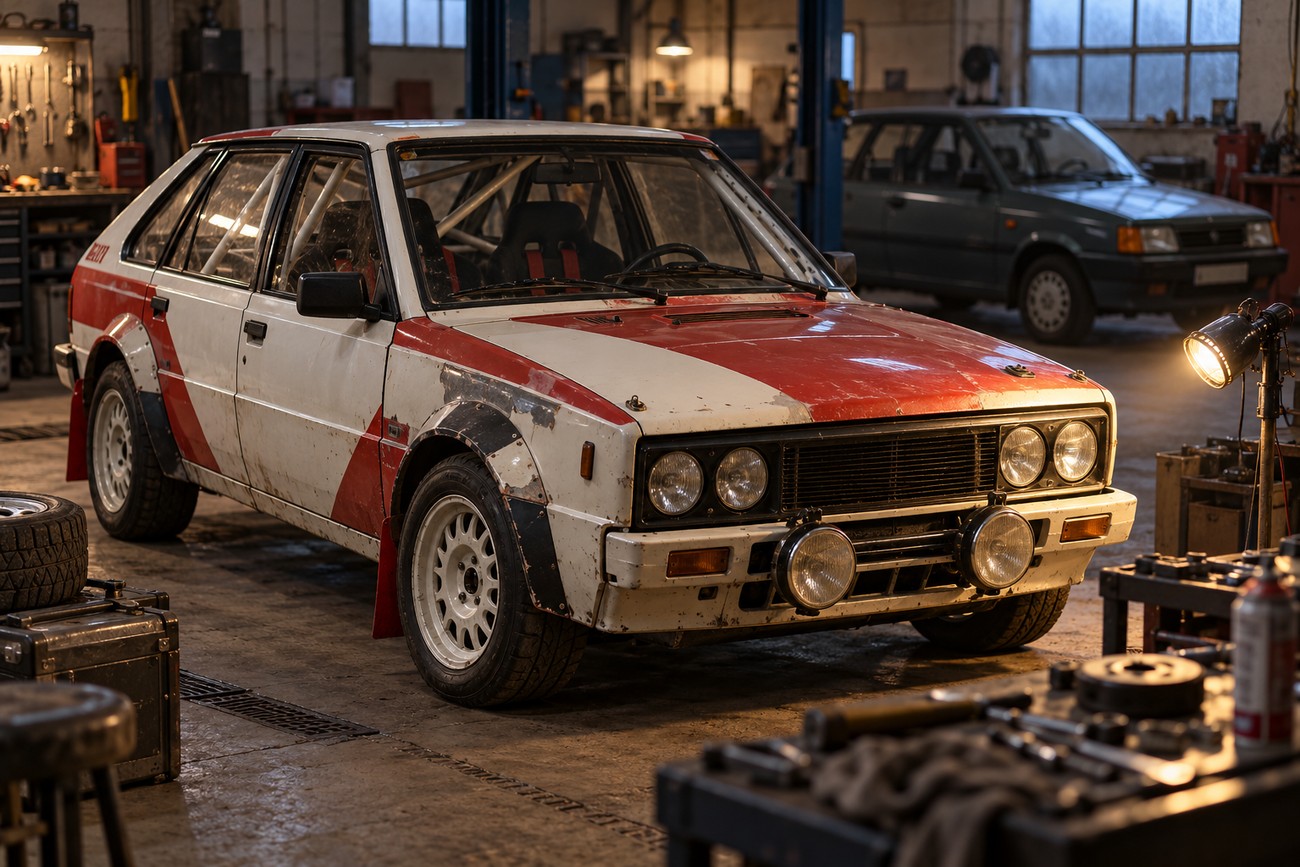
The early range included 1300, 1500, and 2000 Rally versions. Those labels need context: “2000” referred to engine displacement, not a model year or a new generation. The sporting derivative also shows that the Polonez story extended beyond basic family transport, although a rare version’s history should never be assumed from badges alone.
Rear-wheel drive under the hatchback shell
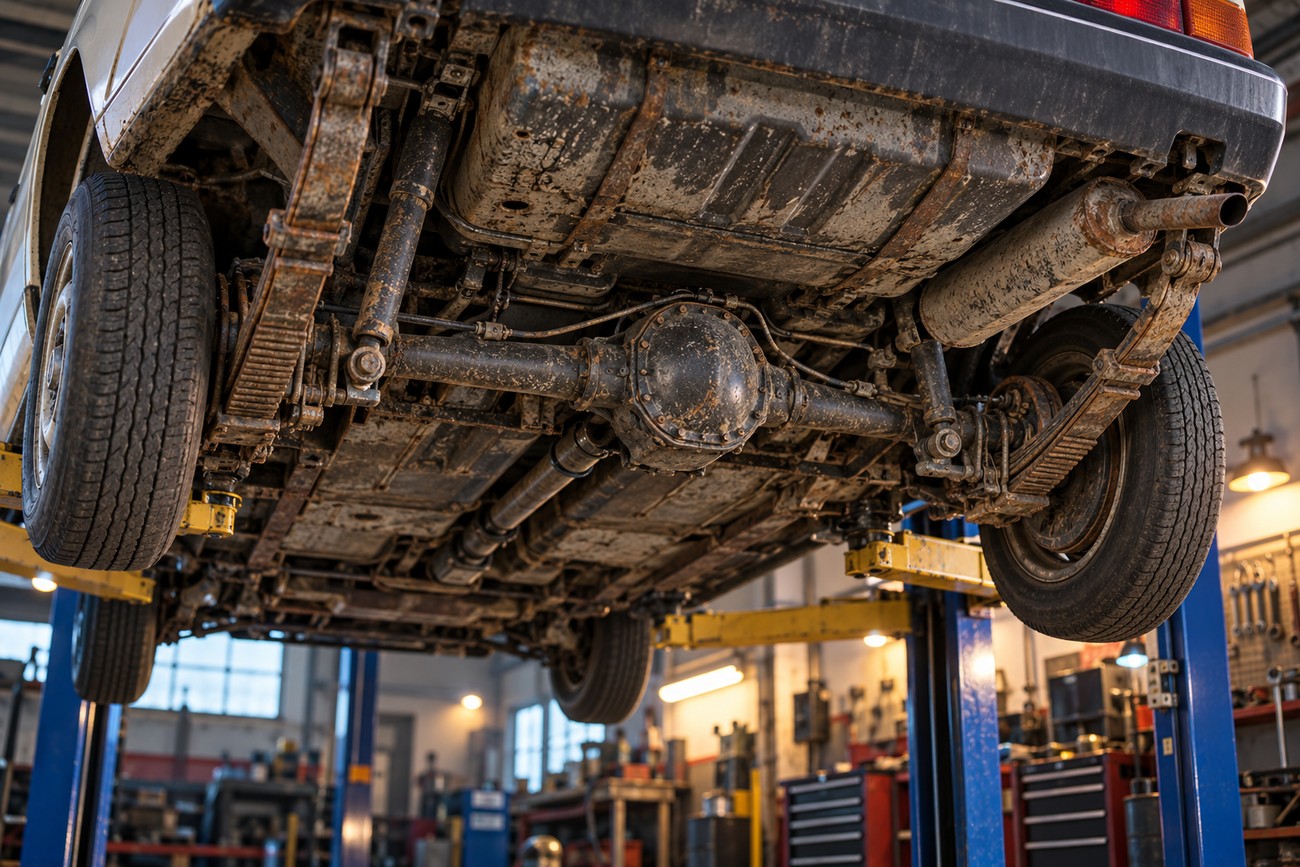
The Polonez kept rear-wheel drive when its body suggested a newer approach to hatchback design. At the front it used independent spring suspension with a stabilizer; at the rear, longitudinal leaf springs with reaction rods. That combination matters more to the driving experience than the fastback profile, particularly on uneven roads or during quick changes of direction.
Owners commonly describe heavy or vague steering and a dated sense of weight distribution. The rear suspension can make rough surfaces feel more prominent than the body shape leads you to expect, while speed may expose looseness or nervousness in a tired example. These impressions call for a careful road test, since worn components can exaggerate traits already present in the design.
Sources for the model list manual transmissions only, and reported power figures run from approximately 64–103 hp, depending on version and source. In ordinary driving, engine and gearing differences affect how readily the car keeps pace with traffic. There is little value in assigning one acceleration or top-speed claim to every Polonez when the specifications changed across years and markets.
It is fairer to judge the chassis on its own terms than against a much newer front-wheel-drive hatchback. A sound car can feel consistent and understandable once you learn its responses; it still has the steering effort, ride characteristics, and acoustic character of older engineering. A test drive should establish whether those qualities appeal to you, and whether a particular car feels sound rather than merely familiar.
Polonez versions, engines, and the numbers that cause confusion
Engine labels are a starting point, not a complete specification: year, market, emissions equipment, and fuel system can change what a particular Polonez actually has.
| Version or listing | What it tells you | What to check on the car |
|---|---|---|
| Early 1300 and 1500 | Displacement-based labels in the early range; published outputs are version-dependent. | Confirm the installed engine and its specification rather than relying on the rear badge. |
| 2000 Rally | A sporting derivative; “2000” refers to engine displacement, not a year or generation. | Check that the mechanical specification and identifying details support any claim of originality. |
| Later gasoline and diesel listings | Different engines appear in market-specific records, so there is no single definitive late-engine list. | Match the vehicle’s identity and paperwork to its market before ordering engine parts. |
| 1.4 and 1.6 injection versions | Later gasoline options appeared in market-dependent combinations; catalogs separately list a 1.4 16V MPi rated at 103 hp. | Identify the fuel system and engine fitted to the individual car. |
| Catalog figures and imported-engine claims | Reported power spans approximately 64–103 hp, depending on version and source. Some sources attribute late engines to Rover or Citroën. | Verify disputed engine claims by VIN and market; do not treat a catalog entry as proof for every car. |
Across the nameplate, sources list manual transmissions only. The table should therefore help narrow an individual car’s specification, rather than imply that every engine in a listing was available everywhere. Even two cars wearing the same displacement badge may require different service parts if their fuel or emissions equipment differs.
This becomes particularly important with an older car maintained using parts acquired over many years. An engine swap or altered fuel system can make a tidy-looking example diverge from its paperwork. Before buying components, record the vehicle identification details and inspect the hardware fitted; a catalog match based solely on the model name may waste both time and scarce parts.
What owning one is actually like
Life with a Polonez can be more demanding than its simple layout suggests. Cabin squeaks and rattles, drivetrain noise, and loose-feeling trim are familiar complaints on aged cars, while a quiet example is worth checking for evidence of good maintenance. Replacing one worn component may improve a particular noise without making the whole vehicle feel newly built.
The driving position and controls also reflect the car’s origins. A high floor, modest cabin packaging, and a simple dashboard can feel awkward if you expect the space implied by the outside dimensions. Heavy steering adds effort in slow maneuvers, while wind, road, and mechanical noise make long journeys more tiring than the hatchback outline might suggest.
Older engines have a reputation for straightforward maintenance and reasonable durability, but oil and seal leaks are common enough to inspect carefully. Look at the engine after it has run, as well as at the ground beneath it; a freshly cleaned bay tells you little about the source of a leak. Simple mechanical work is still work, and repeated small repairs can erode the appeal of a cheap purchase.
Corrosion is the larger threat. Wheel arches, sills, and the underbody are recurring problem areas, and visible rust can be only part of the repair. A car may remain usable while corrosion spreads beneath coverings or behind earlier patches, so the ability to drive home is weak evidence of a healthy shell.
Original parts may require patient searching through breakers, careful matching with other Fiat or FSO components, or adaptation where appropriate. Interchangeability should be checked part by part; a familiar mechanical ancestry does not guarantee that Polonez-specific glass, trim, or bodywork will be easy to replace. Its passive safety is also outdated by modern standards, a practical limitation to accept rather than explain away with nostalgia.
Buying and restoring a Polonez: inspect the shell before the engine
Begin an inspection beneath the attractive fastback shape. Check the wheel arches, sills, floors, and other accessible underbody areas for corrosion, then look for uneven seams, fresh coverings, and repairs that deserve a closer examination. A running example can conceal substantial metalwork, and a brief drive will not reveal what lies beneath an old patch.
Previous repairs need as much scrutiny as original rust. Poor welding can leave vulnerable edges or distorted metal, while non-original panels may fit badly and complicate later work. Compare panel gaps and alignment across both sides of the car, then assess whether the doors and hatch shut consistently; one isolated gap is less informative than a pattern.
Mechanical condition still matters: listen for unhealthy noises, inspect for leaks, and establish which engine and fuel system are actually fitted. A sound body is usually more valuable to a restoration than a theoretically correct but replaceable engine. That does not make an engine swap irrelevant, particularly on a sporting version, but it puts originality claims in proportion to the cost and difficulty of saving the shell.
Before committing to a rare version, identify its missing pieces. Glass, exterior panels, dashboard parts, and interior trim can be harder to source than routine mechanical items, and shipping or adapting them may shape the project more than expected. Confirm availability for the exact year and variant rather than assuming every Polonez shares the same equipment or parts.
Late cars warrant the same discipline. Their equipment may look more appealing, but preservation and a documented history of use often tell you more about the likely workload than the specification sheet. Keep records, identification details, and photographs of previous repairs together; they help separate a well-kept car from one that has simply been made presentable for sale.
Why the Polonez still matters—and where its story ends
The Polonez is historically interesting because its two halves tell different stories. Its fastback body presented a newer kind of family car, while the mechanical roots in the Polski Fiat 125p reveal how the project made use of established components. Neither fact cancels the other. Together, they explain both its visual distinctiveness and its old-fashioned road manners.
Versions such as the 2000 Rally add a sporting strand to that history. They are worth recognizing without treating the entire production run as if it shared their purpose or specification. For a buyer, the distinction has practical consequences: a claim that a car is a particular derivative should be supported by its identity, hardware, and history.
Late-1990s updates were partial adaptations; the basic 1970s-era architecture remained. By the end of the 1990s, the model was increasingly out of step with newer EU environmental requirements, alongside rising expectations for refinement and safety. Updated equipment or an injection engine could address a particular need, but neither transformed the underlying car.
Production ended in 2002, with total figures ranging from approximately 1,061,807 to 1,062,000 units, depending on rounding or counting method. That long run gave the Polonez a place in Polish motoring history without making every surviving example a wise purchase. The strongest case for ownership is a structurally sound, accurately identified car whose limitations suit the way you intend to use it.
Frequently asked questions
These answers address the broad claims most likely to mislead someone comparing individual cars or checking published specifications.
Was the FSO Polonez a good car?
A structurally sound Polonez can be a durable, mechanically straightforward classic for someone willing to maintain an older car on its own terms. Its hatchback body is useful, and its inherited mechanical layout is generally easier to understand than its parts situation might suggest. Buy the best shell you can assess, with records that support the seller’s account of the car.
It is a poor choice if you need modern crash protection, quiet long-distance travel, light controls, or effortless access to original parts. Those expectations will not be fixed by choosing a later model or by getting the engine to run perfectly.
What is the top speed of the FSO Polonez?
There is no single dependable top-speed figure for the entire Polonez nameplate. Engines, fuel systems, emissions specifications, and markets varied, so a figure quoted for one version should not be applied to another. A catalog number is most useful when it identifies the same engine and specification as the car being examined.
For a purchase, top speed is a weak shortcut to condition. How the car tracks, brakes, and sounds on an appropriate road test will tell you more about its suitability than an unverified maximum-speed claim.
Why do sources give different total production figures for the Polonez?
Figures of approximately 1,061,807 and 1,062,000 are compatible accounts of Polonez production, rather than evidence of two separate production histories. The smaller number is more precise; the larger can reflect rounding or a different counting method. Neither difference changes the established 1978–2002 production span.
For collectors, an individual car’s identity and documented history are more useful than choosing one total as definitive. Production figures describe the model as a whole; they cannot establish whether a particular engine, trim combination, or sporting claim is authentic.







