
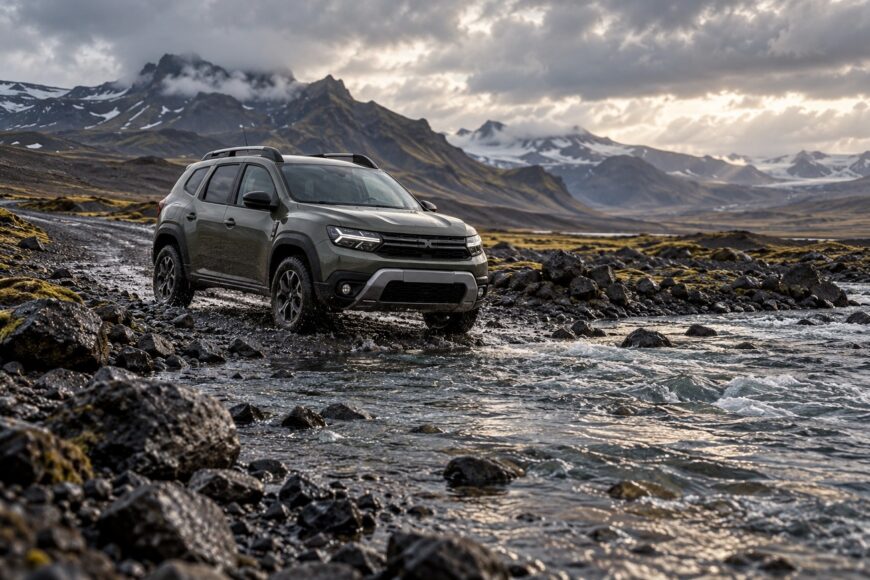
A 4WD Dacia Duster can look like a straightforward choice for any Icelandic F-road. That assumption becomes risky when a gravel route reaches an unprotected river ford. The decision depends on the specific road, the day’s weather and water level, the condition and load of your vehicle, and what your rental agreement allows.
A Duster can suit some light and medium F-roads in good conditions. Yet a route that feels manageable for hours can end at one river that is too deep or fast to cross. There is no universal safe ford depth for a Duster, and an F-road being open does not mean every driver can complete it.
- Can a Dacia Duster Drive Iceland’s F-Roads?
- Choosing F-Roads That Match a Duster
- Why River Crossings Are the Real Duster Test
- How to Approach a Ford—and When to Turn Back
- Checks Before Taking a Duster onto an F-Road
- Common Duster F-Road Mistakes and Hidden Costs
- Frequently asked questions
- What are the best F-roads in Iceland for a first Duster trip?
- How do you know if a road is an F-road in Iceland?
- What should you do if an F-road ford looks unsafe after arriving?
Can a Dacia Duster Drive Iceland’s F-Roads?
Yes, a Dacia Duster can drive some Icelandic F-roads, provided the route and current conditions suit the vehicle. An F-road is a mountain gravel route that may include rough surfaces, changing weather, exposed rocks, and unprotected river fords. The 4WD system helps with traction on loose ground; it does not remove the hazards posed by deep water, strong current, or limited ground clearance.
The distinction matters when rental descriptions call a Duster “F-road capable.” That may be useful shorthand for access to suitable mountain gravel roads, but it is not approval for every route or river. SafeTravel cautions that not every 4WD vehicle suits every F-road. Its guidance indicates that some routes call for a larger Land Cruiser, while particularly demanding routes require a modified superjeep.
Judge the whole journey rather than the road number alone. Firm gravel, modest ruts, and a ford that remains safely passable present a different task from loose rock followed by a fast river. A successful Duster trip reported by another driver shows what was possible at that time, in that vehicle, under those conditions. It cannot establish what your rental Duster can do today.
Choosing F-Roads That Match a Duster
Start route planning by filtering for the hardest obstacle, especially any river ford, rather than choosing the most appealing destination first. Individual drivers report successful Duster journeys on F35, F338, F550, and the northern section of F208, among other routes. Those reports can suggest places to research for a trip in suitable conditions; they are neither official permissions nor predictions of this season’s water levels.
Route names also hide variation within a journey. A comparatively straightforward stretch of F208 should not be treated as evidence that every section of F208 is suitable for a standard Duster. Drivers have described fords on F208 and F261, and on routes toward Þórsmörk, as too deep or fast for the vehicle. The water crossings on the approach toward Þórsmörk warrant particular caution, including on F249.
F88 and F905 have sometimes proved impassable for Duster drivers because of water levels. Rain or warmer weather can change that assessment quickly, even if a trip report describes an uncomplicated crossing. A sensible plan allows for a turnaround before a river without making the rest of the day depend on reaching the far bank.
Long sections of easy driving can create misplaced confidence just before the critical obstacle. A road may be passable for most of its length and still have a single ford that rules out the trip in your vehicle. Look at the route in both directions, too: a river you cross on the way in must remain crossable when you return.
Why River Crossings Are the Real Duster Test
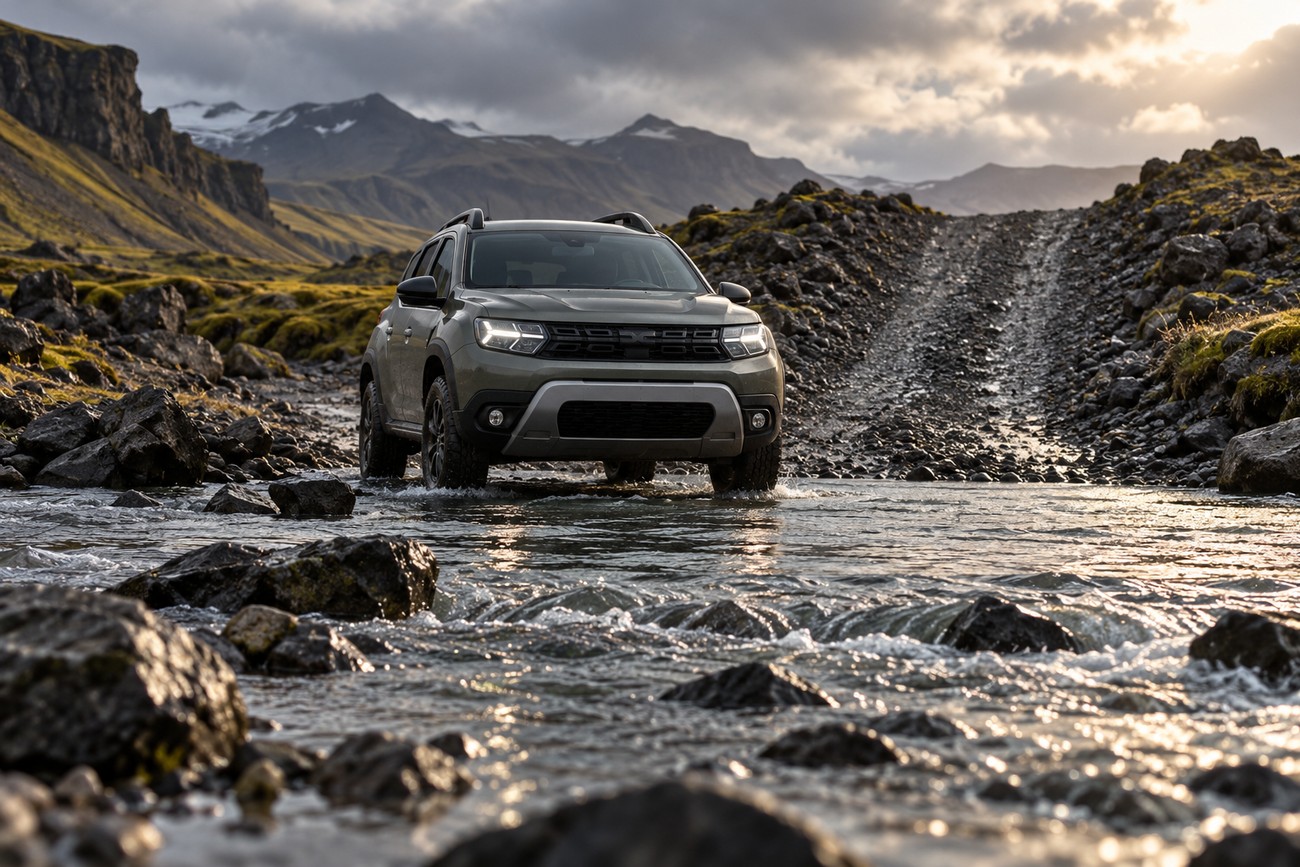
A ford cannot be reduced to a water-depth number. Flowing water pushes against the vehicle, while submerged rocks and ruts alter the depth along your intended line. The approach angle and the far bank matter as well: a steep, wet, or loose exit may stop a Duster after it has already crossed the main current.
Vehicle details narrow the margin further. Ground clearance can decrease with passengers and luggage, and exposed parts under the vehicle can strike rocks that are difficult to see through water. The front overhang may meet the bank or a submerged obstacle before the tires climb it. Water reaching the engine intake presents a different, potentially severe risk from scraping the underside.
There is no official universal safe or permitted ford depth for a Dacia Duster or for all Icelandic F-roads. One practical source mentions an intake height of about 80–90 cm in connection with some routes, but that figure is not an official Duster crossing allowance. It says nothing reliable about the current, hidden holes, the vehicle’s loaded stance, or whether a wave will reach the intake; do not use it as a target.
Rain and warmer weather can raise a river’s level and speed within hours. A crossing completed yesterday, or even one made earlier in the day, may be unsafe on the return. Likewise, a road marked open describes its access status, not the safety of a particular ford for your vehicle. The water in front of you takes precedence over a map, a sign, or a previous driver’s account.
How to Approach a Ford—and When to Turn Back
Stop before the water, well clear of the entry, and give yourself time to assess it without pressure from vehicles behind you. Watch the current and where other vehicles emerge, but do not assume their tire tracks identify a safe line for a Duster. A larger vehicle may cross a rut that puts a smaller vehicle in deeper water.
Inspect depth, current, submerged rocks, and the opposite-bank exit on foot only where it is safe to do so. If the water is too forceful or unclear to assess safely, do not enter it on foot or in the car. The intended line should favor the shallowest, calmest water; it may curve or run diagonally rather than follow the shortest visible path.
Once a crossing has been judged suitable, enter gently and maintain controlled, steady progress. Avoid charging in, which can throw water toward the intake and reduce control. Do not drive directly against the current. If you cannot identify a manageable line from entry to exit, the crossing has not passed the assessment.
Turn back if the water is rising, the exit is unclear, the current makes inspection unsafe, or larger vehicles and local drivers are reversing. Uncertainty is enough reason to stop. Waiting for current information or for conditions to improve is safer than testing the Duster’s limits, though a wait is useful only if you still have a practical, safe plan for leaving.
Checks Before Taking a Duster onto an F-Road
Check seasonal access before building an itinerary around a mountain route. Most F-roads are closed roughly from mid-September until June or July; opening and closing dates vary with conditions and road-authority decisions. On the day of travel, check road.is, SafeTravel, and fresh local information. An old blog can help identify obstacles, but it cannot verify today’s ford.
Confirm the exact rental model and permitted routes with the rental company before departure. “4WD” and “F-road capable” do not tell you whether your particular agreement permits a specific road or whether the vehicle has the tires and equipment you expect. Read the exclusions as carefully as the list of included coverage: SafeTravel warns that rental-car insurance does not cover damage from river crossings, including water damage to the engine. Check your own contract for its precise terms rather than assuming a general protection package changes that risk.
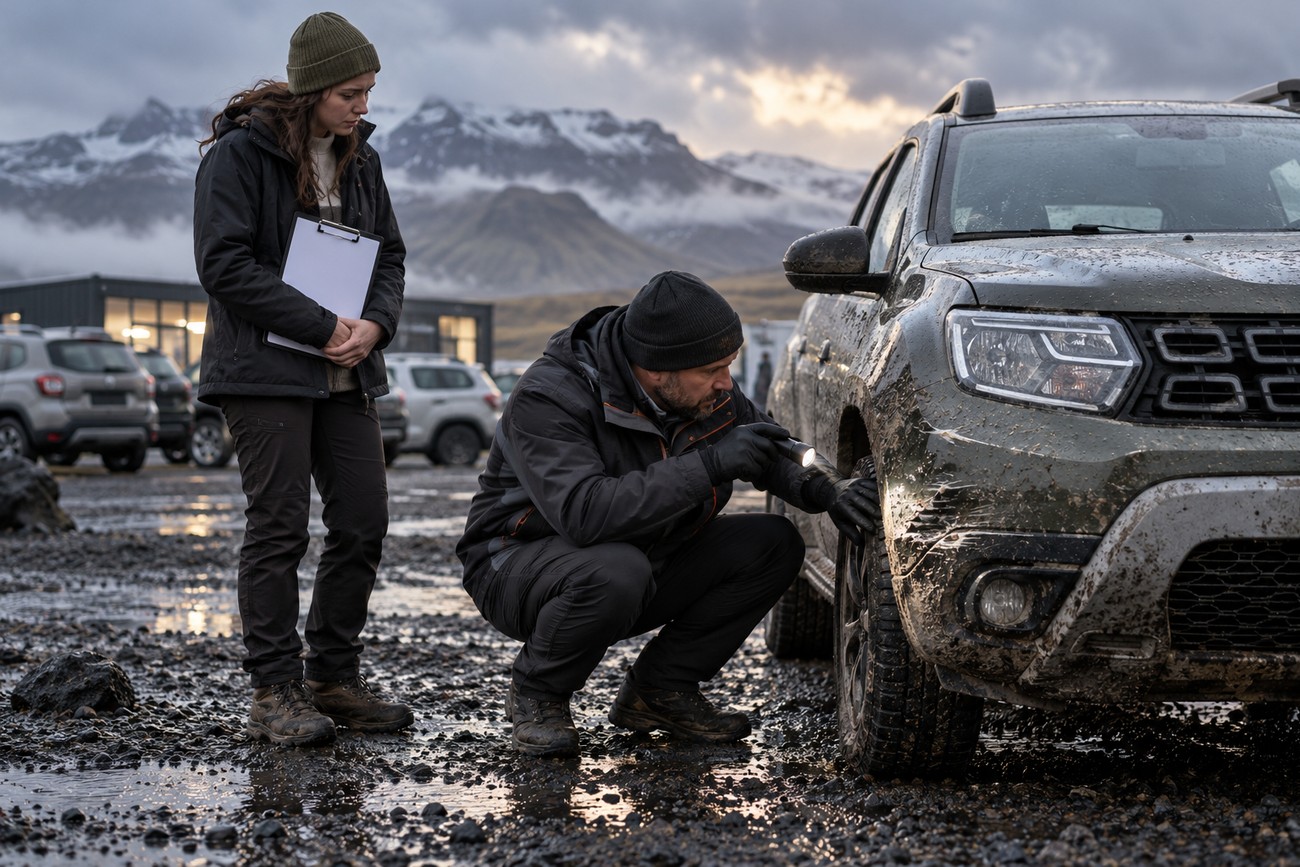
Inspect the vehicle while you still have the option to resolve a problem or revise the trip. Look at tire condition, visible underbody components, plastic parts around the front overhang, and any existing damage; account for how passengers and luggage affect ride height. Intake layout, clearance, and protection vary by vehicle, so do not substitute a specification from a different Duster for an inspection of yours.
Finally, separate three decisions: whether the F-road is legally open, whether your rental company permits your vehicle on it, and whether its conditions are safe for your Duster today. All three must work in your favor. An “open” status is a starting point for a journey assessment, never a promise that a river ford will be passable.
Common Duster F-Road Mistakes and Hidden Costs
The most consequential mistake is treating the 4WD badge as a complete vehicle rating. It tells you the Duster can drive all four wheels, not that its clearance, intake, and bodywork are suited to every river or rocky approach. Confidence can grow on the easy part of a route, precisely where it is least useful for judging the ford ahead.
Previous trips and visible tire tracks need similar caution. A report from last year may describe different weather, water levels, or even a different crossing line. Tracks can lead into a deeper rut, while a vehicle that crossed moments earlier may have had more clearance. Use those observations as clues to investigate, not instructions to follow.
Water is not the only source of cost. Long stretches of coarse gravel and exposed rock can cause underbody impacts or damage plastic parts near the front overhang. Slow, careful driving reduces avoidable strikes, but it cannot make an unsuitable route suitable. A single damaged component may also leave you far from a straightforward repair.
At a failed ford, the sound outcome is often a change of plan: turn around safely, wait for reliable information or lower water, or take another route. Trying to save the itinerary can create a much larger problem. River-crossing damage, including engine water damage, may remain the renter’s financial responsibility, so the decision to stop has practical value as well as a safety benefit.
Frequently asked questions
These answers separate route planning from the decision you make at the roadside. Both matter: a good initial choice leaves room to change plans when conditions do.
What are the best F-roads in Iceland for a first Duster trip?
For a first Duster trip, choose a route for its scenery and manageable conditions rather than for the challenge of completing a difficult ford. F35, F338, F550, and northern F208 appear in reports of successful Duster journeys, but none deserves a permanent “best for beginners” label. Compare the day’s weather and route information, identify potential turning points, and favor an itinerary that remains worthwhile if you decide not to cross a river.
How do you know if a road is an F-road in Iceland?
The F designation appears in the route number on maps and route information, as in F35 or F208. Treat that designation as one check, then confirm the road’s current status on road.is and whether your rental agreement permits your Dacia Duster to use it. Vehicle suitability is a third decision: an open, permitted F-road can still contain a river ford that is unsafe in current conditions.
What should you do if an F-road ford looks unsafe after arriving?
Stop clear of the water and do not attempt a crossing to test it. Note your location and the road number, then seek current information from SafeTravel, road.is, or a reliable local contact where communication is available. If conditions might improve, wait only where you can do so safely and still have a sound return plan; otherwise, reverse or turn around at a safe place. Leaving an unsafe ford uncrossed is a successful route decision, even if it changes the destination.







