
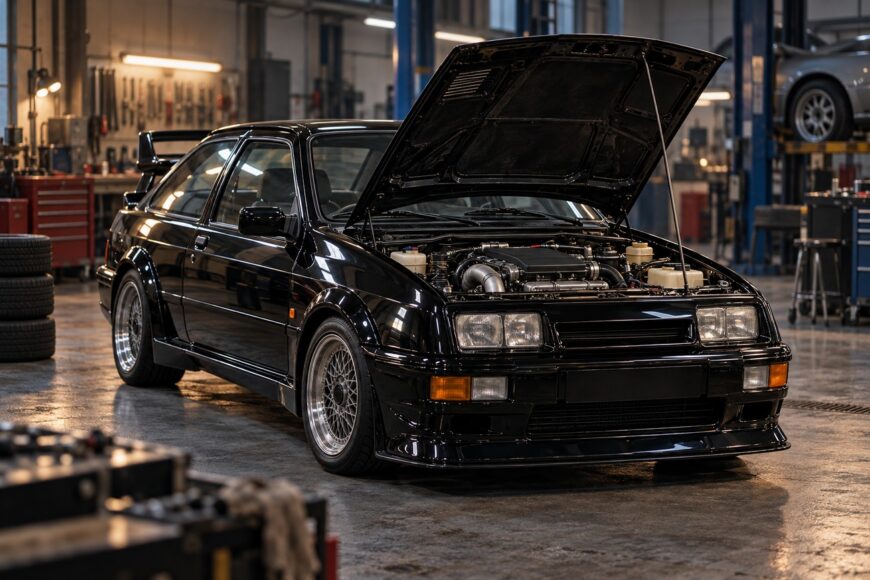
The Ford Sierra RS500 is remembered through the lens of Group A racing: enormous power, aggressive bodywork, and a reputation for making ordinary touring cars look tame. The road car was more specific than that legend suggests. It was a rear-wheel-drive homologation special with a quoted 224 bhp, built to give Ford’s racing program a more capable base for development.
That distinction matters to anyone considering one today. Acceleration is only part of the story; rarity, provenance, originality, corrosion, and the correct interpretation of power claims can matter just as much. The RS500 earned its name through a tightly defined homologation purpose, and that purpose explains both its engineering changes and its current collector appeal.
- What the Ford Sierra RS500 Was Built to Do
- The Engineering Changes Behind the RS500 Name
- How the RS500 Feels on the Road—and Why It Can Bite
- Buying an RS500: Identity Before Numbers
- Age-Related Weak Points: Rust, Cooling, and Driveline Stress
- Road-Car Reality Versus RS500 Myths
- Frequently asked questions
- How much is a Ford RS500 worth?
- How many RS500 Cosworths are left?
- What is the rarest Cosworth?
- Why is the RS500 more valuable than a standard Sierra Cosworth?
What the Ford Sierra RS500 Was Built to Do
The RS500 was an evolution homologation version of the Ford Sierra RS Cosworth. Its purpose was to extend the car’s eligibility and development potential in Group A competition, where production-based racing regulations tied important technical freedoms to road-car numbers and specifications. The extra hardware was therefore designed with racing engineers in mind, even though every example sold to the public remained a road-registered hatchback.
Group A homologation required 500 additional road-going examples of the special evolution model. Ford produced exactly 500 RS500 road cars, creating a much smaller and more tightly defined series than the standard Sierra Cosworth. The number was a regulatory requirement rather than a marketing flourish, although it later became central to the car’s collectability.
All 500 cars were right-hand-drive hatchbacks converted by Aston Martin Tickford. That detail is important because the RS500 was not simply a standard Sierra Cosworth fitted with a dealer-installed spoiler package. The conversion process and the resulting specification formed part of the car’s identity, while the body and mechanical revisions gave racing teams a more suitable starting point.
The road car’s visual drama can obscure the underlying logic. The enlarged front bumper, additional air ducts, altered body elements, and twin rear spoiler were connected to aerodynamic and cooling requirements associated with homologation. They made the RS500 immediately recognizable, but appearance alone cannot establish whether a car is genuine or correctly preserved.
The Engineering Changes Behind the RS500 Name
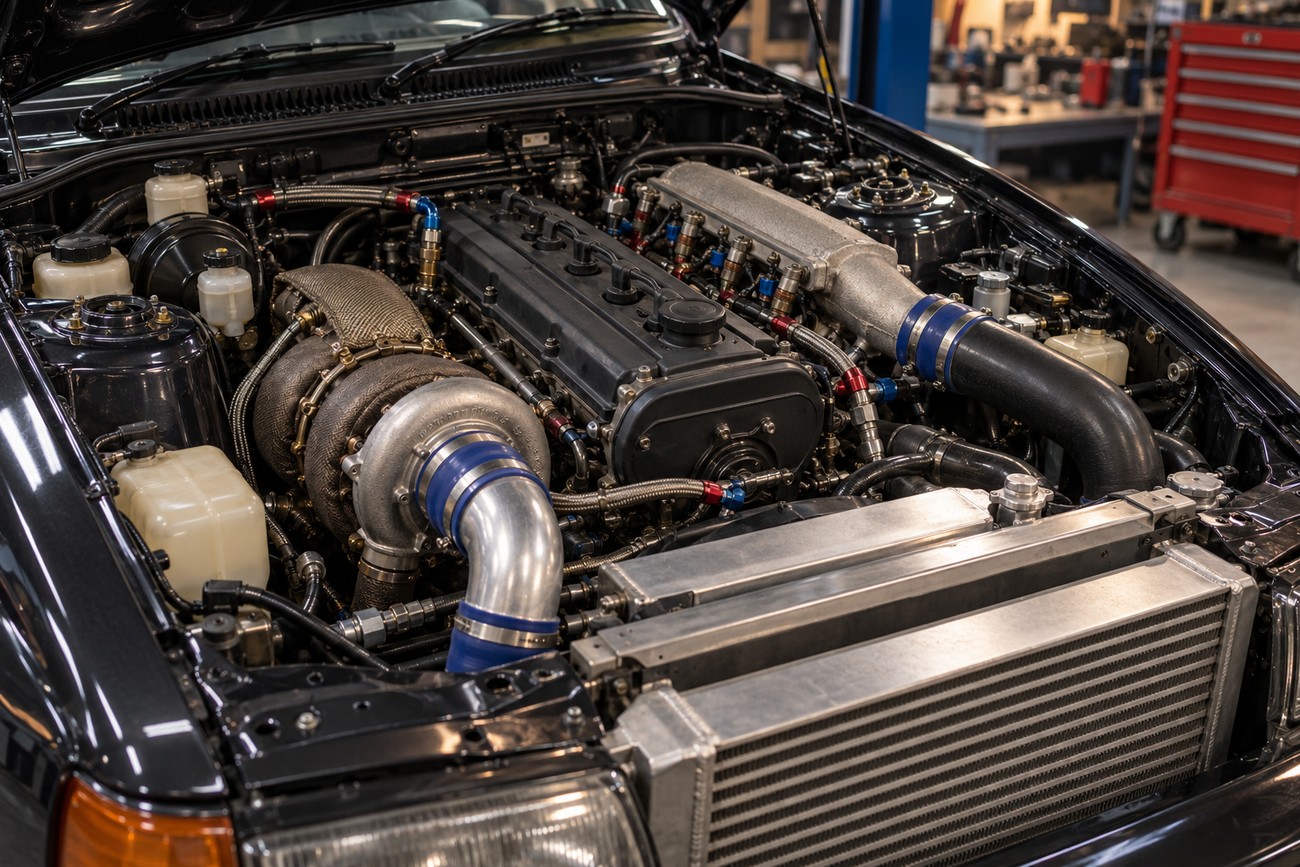
The RS500’s mechanical identity rests on a revised version of Ford’s YB engine rather than on a cosmetic package. It uses a 1,993 cc YBD inline-four with double overhead camshafts, 16 valves, and Garrett turbocharging. The road specification was quoted at 224 bhp at 6,000 rpm and 206 lb-ft.
Compared with the standard RS Cosworth, the RS500 received a larger turbocharger, a larger intercooler, additional injectors, and revised cooling hardware. Those changes increased the engine’s potential under sustained racing conditions, where airflow, fuel delivery, and heat management could be developed within the Group A rules. A normal road driver rarely exploits that potential in the same way.
The drivetrain remained comparatively straightforward: rear-wheel drive, a five-speed Borg-Warner T5 gearbox, and a viscous limited-slip differential. This layout gives the car its characteristic balance of traction and attitude, but it also places more responsibility on the driver and on the condition of the driveline. A tired differential or poorly calibrated engine can make the car feel far less coherent than a healthy original example.
Race specifications must be kept separate from the road car. Group A configurations can reach approximately 545 bhp and 624 N·m, but those figures describe competition builds, not the standard factory road version. They involve different calibration, supporting systems, operating conditions, and often extensive preparation. Quoting them as though every RS500 left the road-car conversion with that output is a fundamental error.
How the RS500 Feels on the Road—and Why It Can Bite
Published performance figures place the road car in a distinctly serious category for its period. 0–62 mph figures range from 6.0 to 6.1 seconds, depending on test method and vehicle condition, while published top-speed figures are approximately 153–154 mph. These numbers should be treated as a range rather than a promise, especially with an older car whose turbocharger, fuel system, tires, and calibration may no longer match factory condition.
The driving experience is shaped by the arrival of boost as much as by the headline figures. The turbocharged YB can deliver a sharp increase in thrust, and the rear axle may break traction if the driver applies power carelessly while cornering or on a low-grip surface. That response is part of the car’s character, although worn suspension bushes, incorrect geometry, or poor tires can turn a lively chassis into an unpredictable one.
Its bodywork has a practical engineering origin. The larger front bumper and extra ducts support airflow and cooling requirements, while the twin rear spoiler reflects the aerodynamic development needed for the homologated competition design. Those features do not transform the road car into a complete Group A package; race cars required different preparation, settings, and operating support.
A good RS500 feels responsive and mechanically connected rather than effortlessly modern. The reward is information through the controls, but the cost is that neglected systems are noticed immediately. A road test should therefore include boost delivery, straight-line stability, differential behavior, gearbox engagement, braking consistency, and temperature control rather than focusing only on acceleration.
Buying an RS500: Identity Before Numbers
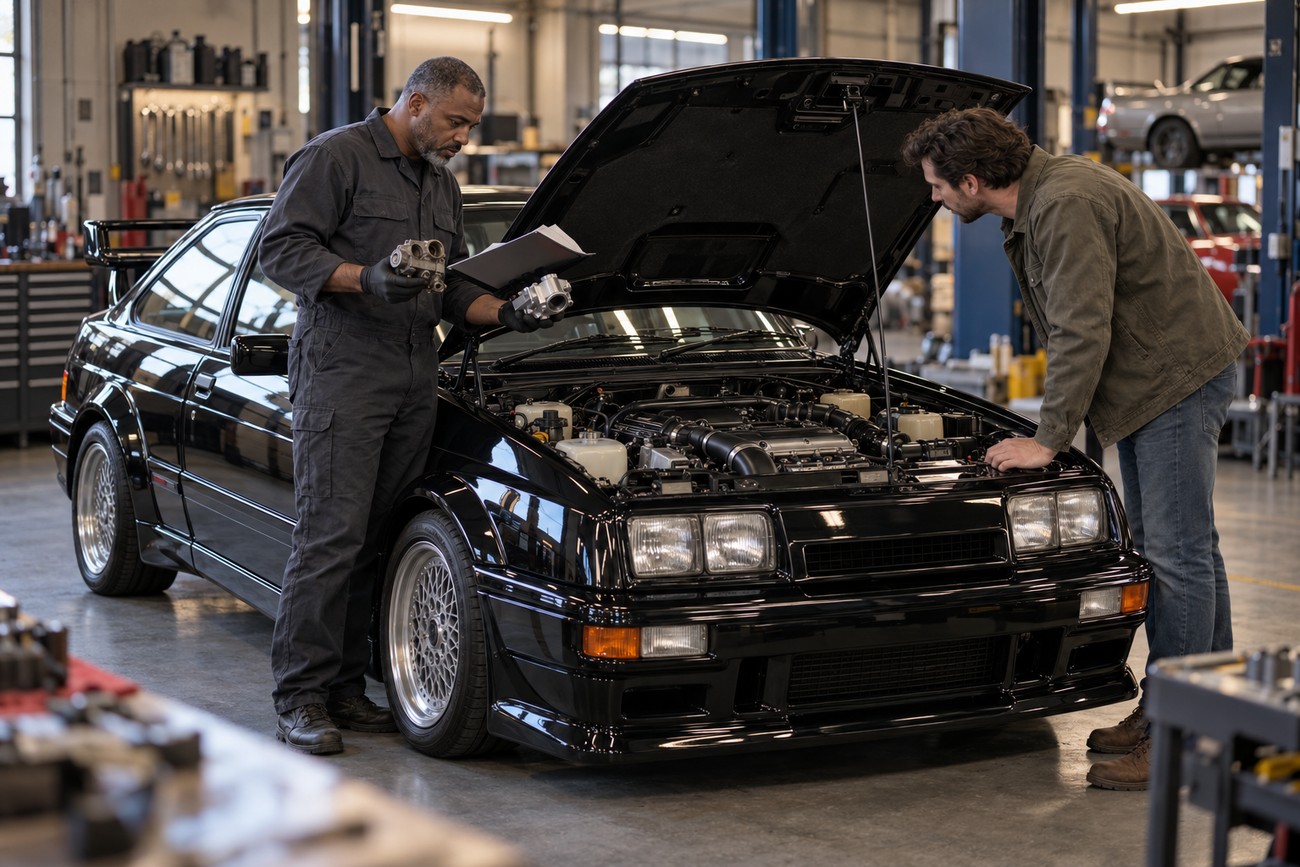
Authentication should begin with the VIN, documentation, provenance, and correspondence with factory RS500 details. Spoilers, badges, bumpers, and dramatic paintwork are evidence of appearance, not proof of identity. A buyer should establish whether the car’s history supports its claimed origin and whether the major mechanical and body components are consistent with that history.
Originality is often partial. An engine, turbocharger, seats, spoilers, and other homologation components may have been replaced during racing, restoration, or ordinary ownership. Some cars contain a mixture of original parts, correct replacements, and replica panels. That does not automatically make a car worthless, but it changes how its condition and significance should be understood.
Rear-spoiler mounting points and surrounding seams deserve inspection before a fresh paint finish receives any credit. Cosmetic restoration can conceal structural corrosion, repaired impact damage, and body parts gathered from different cars.
The best inspection compares several forms of evidence: stamped identification, period records, physical construction details, and the condition of the car’s mechanical specification. A claimed factory engine does not prove the presence of the original turbocharger, while a correct-looking body does not prove an untouched shell. Buyers should be wary of any seller who treats visual recognition as a substitute for documentation.
Rare parts also change the consequences of ownership. An original bumper or aerodynamic component may be difficult and expensive to replace after even a minor incident, and a collection of convincing replicas can hide a car with little surviving factory hardware. The central question is not whether the car resembles an RS500, but how clearly its identity and specification can be traced.
Age-Related Weak Points: Rust, Cooling, and Driveline Stress
Corrosion deserves a structural inspection, not a quick look around the wheel arches. Important areas include seams, wheel arches, sills, the underside, and the mounting areas for the rear spoiler. Hidden rust around repaired joints or mounting points can be more consequential than visible bubbling, particularly when a fresh restoration has concealed the previous condition of the shell.
Cooling is another priority. High-boost or heavily tuned cars can suffer overheating, cracks, and fatigue in the cooling system, especially in traffic and hot weather. The RS500’s factory revisions improved its potential, but they do not cancel the effects of age. Radiators, hoses, seals, wiring, and other rubber or electrical components may now be as important to reliability as the engine’s basic design.
Hard use can leave the gearbox, differential, driveshafts, and related mounts tired. A car that spent time in competition or was modified for high power may have experienced substantially greater driveline stress than a lightly used road example. Noise on overrun, difficult engagement, vibration under load, and inconsistent limited-slip behavior deserve diagnosis rather than optimistic interpretation.
Engine condition should be established through compression, oil pressure, turbocharger inspection, fuel-system checks, cooling-system checks, and calibration verification. A dyno figure is useful only when the test conditions and supporting systems are understood. Fresh paint and an impressive output claim can coexist with a tired block, unsuitable boost control, or a cooling system close to failure.
Road-Car Reality Versus RS500 Myths
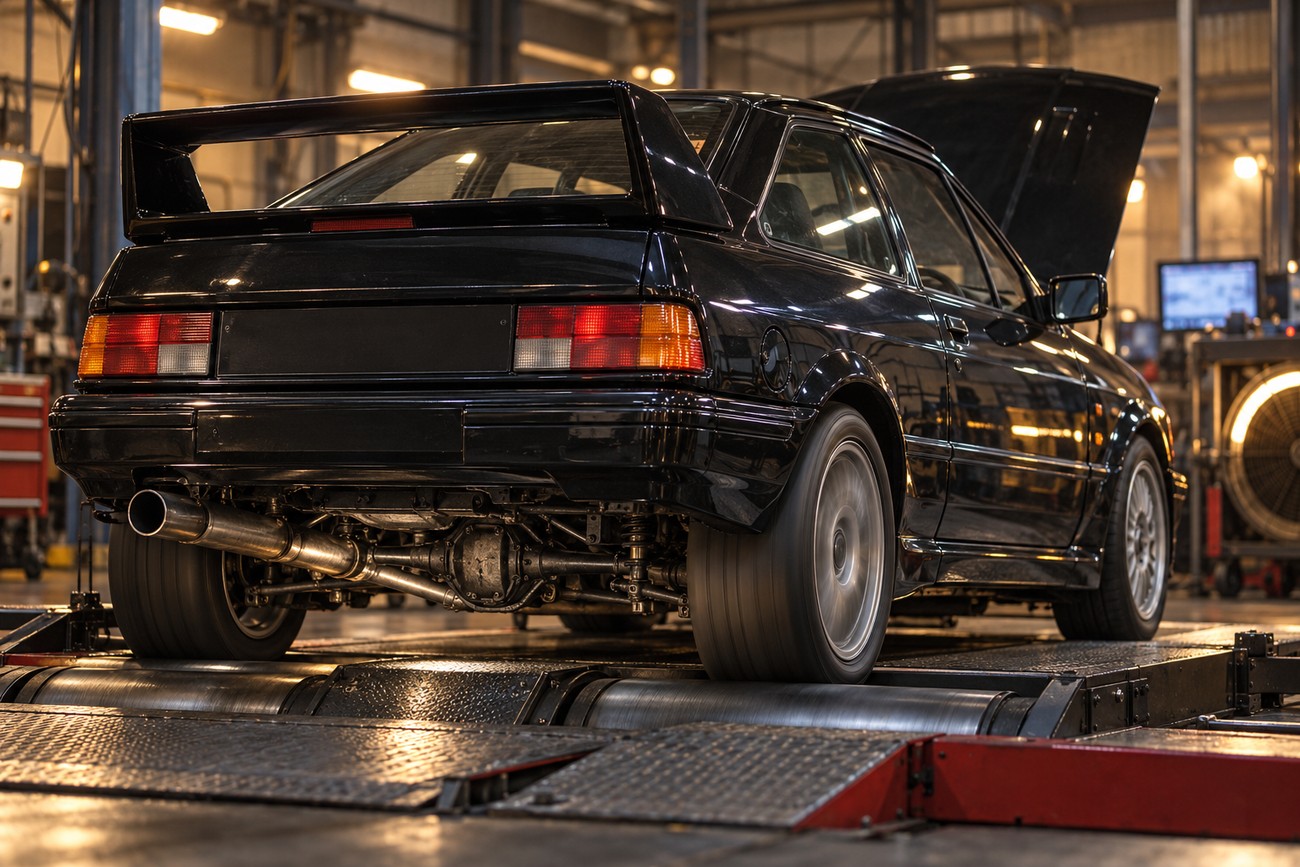
The most damaging myth is that every RS500 was a 500-bhp road car. The standard road-car figure was approximately 224 bhp, while approximately 545 bhp and 624 N·m belong to cited Group A race specifications. Claims of 300–500 bhp usually describe tuning or racing configurations, and they should trigger a request for detailed evidence rather than automatic admiration.
The RS500 was also rear-wheel drive. The later Sierra Cosworth 4×4 is a different model, and its drivetrain should not be projected backward onto the RS500. Confusing the two leads buyers to misunderstand the car’s handling, its transmission layout, and the stresses imposed on the rear axle.
A larger modern turbocharger cannot be judged in isolation. There is no universal safe tuned power figure because reliability depends on fuel, temperatures, turbocharger choice, boost control, engine condition, cooling, brakes, transmission, and suspension geometry. Increasing output without assessing those systems can make the car quicker on a dyno while making it less durable and less predictable on the road.
The RS500’s collector premium over a standard Cosworth is driven heavily by rarity, specification, racing relevance, and provenance. The road-power difference alone does not explain it. For a buyer, the valuable distinction is therefore between a documented, correctly specified RS500 and a modified Sierra wearing the visual language of one.
Frequently asked questions
The RS500’s fixed production number makes its identity unusually clear, but ownership, survival, and value are less simple. Condition, documentation, and the scope of the comparison all affect the answer.
How much is a Ford RS500 worth?
There is no single defensible value without examining the individual car. Authenticity, factory specification, originality, documented provenance, corrosion, and mechanical condition all influence the market far more reliably than a claimed horsepower figure.
A documented, structurally sound example with correct RS500 hardware will be judged differently from a heavily modified car, a partial replica, or a restored shell with uncertain history. The inspection should establish what the car is before any valuation discussion begins.
How many RS500 Cosworths are left?
Exactly 500 RS500 road cars were produced, but the surviving total cannot be stated confidently from that production figure alone. Cars have been exported, damaged, restored, dismantled, modified, and sometimes represented by inconsistent or incomplete registries.
That uncertainty is another reason to assess a specific car through its VIN, documents, and physical evidence. A registry entry may confirm that an identity is known, but it does not by itself prove the condition or originality of the vehicle carrying it.
What is the rarest Cosworth?
“Rarest” depends on the scope of the comparison. The answer changes if the subject is limited to Sierra variants, road cars, racing derivatives, or every product associated with Cosworth.
The RS500 can be positioned accurately as a 500-car evolution homologation road series. That makes it exceptionally scarce and historically important within the Sierra Cosworth family, without requiring a broader claim about every Cosworth-derived vehicle.
Why is the RS500 more valuable than a standard Sierra Cosworth?
Its collector interest comes from limited homologation production, identifiable evolution hardware, historical racing relevance, and documented provenance. Those qualities can outweigh a relatively modest difference in quoted road-car power.
Value also depends on how much of the car remains correctly specified and how convincingly its history is documented. A standard-looking car with excellent records may command more respect than a visually dramatic RS500 with mixed-origin parts, hidden corrosion, or unsupported performance claims.







