
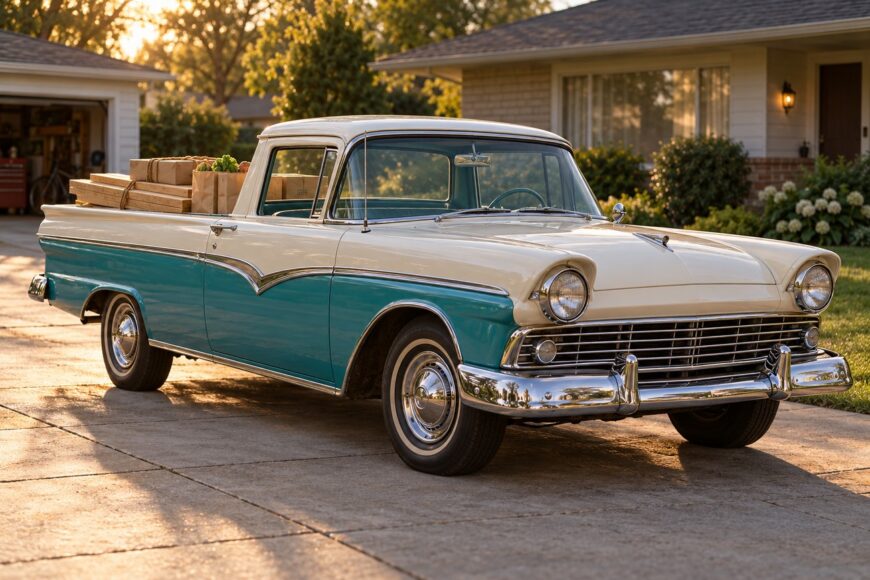
A Ford Ranchero looks like a full-size car that lost its trunk and gained a pickup bed. That visual contradiction explains much of its appeal: it offers the seating, ride, and styling of a passenger car while carrying bulky loads in an open rear compartment.
Ford introduced the Ranchero to the U. S. market for the 1957 model year, two years before Chevrolet introduced the El Camino for 1959. The Ranchero was the first mass-market car-based pickup in the United States, although its usefulness had limits that are easy to miss beside a full-size F-Series truck.
Under the skin, the Ranchero uses passenger-car unibody construction with a specially modified and reinforced rear cargo section. It can be useful, quick, and collectible, yet its structure, brakes, suspension, and load capacity require a different approach from a body-on-frame work truck.
- Why Ford Built the Ranchero Before the El Camino
- Seven Generations: From Full-Size Ford to Fairmont
- What the Ranchero Could Carry—and What It Was Not
- Ranchero vs. El Camino: Similar Shape, Different Story
- The Rust and Restoration Traps Buyers Miss
- Living With One: Handling, Brakes, Modifications, and Value
- Frequently asked questions
- What Ford was the car that looked like an El Camino?
- Why is a Ranchero sometimes called a ute?
- How are Rancheros usually classified for insurance and registration?
- Where can owners verify the correct specifications for a specific Ranchero year?
Why Ford Built the Ranchero Before the El Camino
Ford saw a gap between a conventional sedan and a truck. Many buyers wanted one vehicle for commuting, family use, and occasional hauling without accepting the ride, size, and manners of a traditional pickup. The Ranchero answered that demand by combining a passenger-car front half with an open cargo area.
The idea was not created in isolation. Ford Australia’s ute format had appeared in the 1930s, establishing the broader concept of a passenger-car-based utility vehicle. The American Ranchero adapted that idea to U. S. tastes, using the larger proportions and styling language of Ford’s domestic passenger cars.
Ford debuted the Ranchero for the 1957 model year, making it the first mass-market car-based pickup in the United States. Chevrolet’s El Camino followed for 1959, so the familiar visual association between car-based pickups and Chevrolet should not obscure the chronology.
The early Ranchero was also more carefully engineered than the phrase “sedan with the rear cut off” suggests. Its rear structure, cargo floor, mounting points, and suspension arrangements were specially modified and reinforced. That distinction matters during restoration because ordinary sedan parts may look similar while having different dimensions, brackets, or load requirements.
Seven Generations: From Full-Size Ford to Fairmont
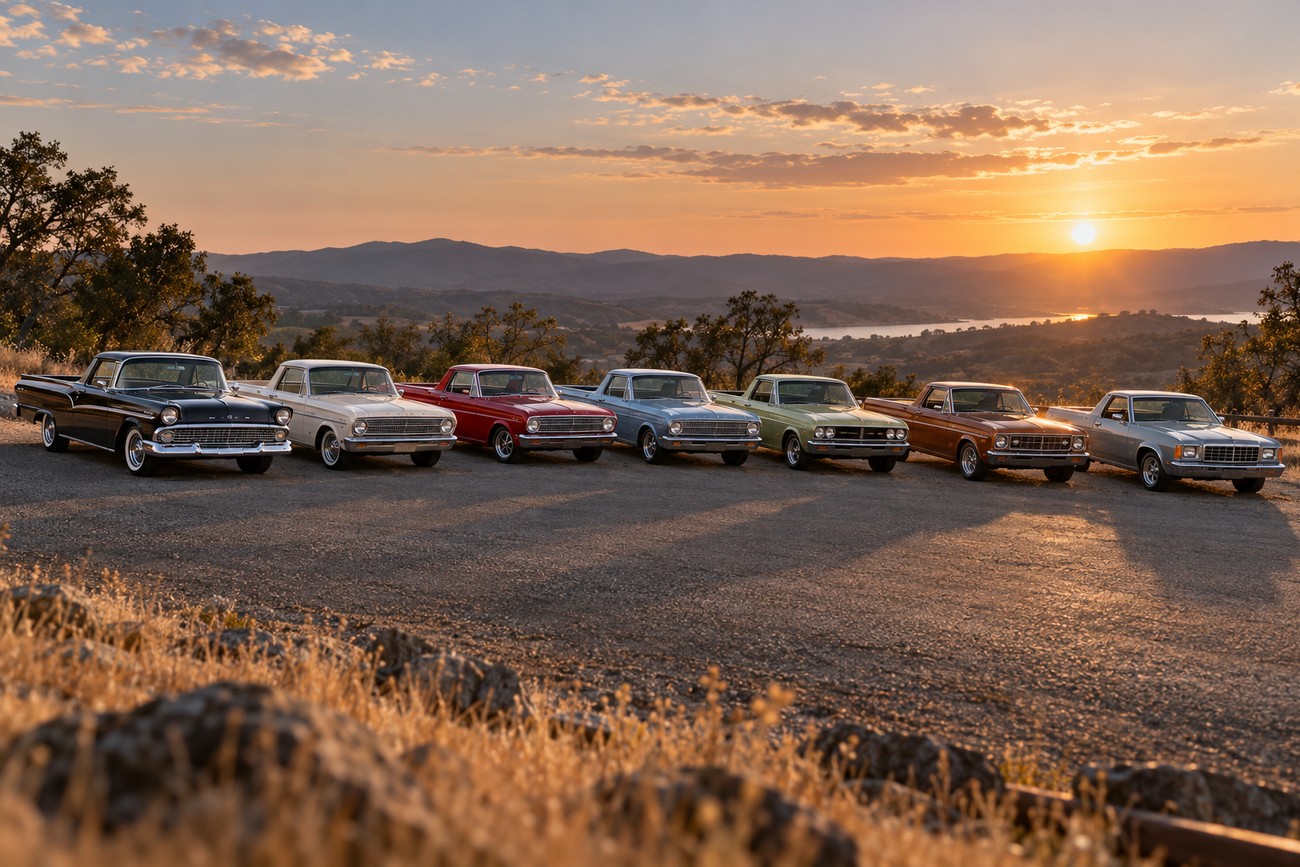
Ranchero production covered the 1957–1979 model years and is commonly divided into seven generations. The earliest cars were related to full-size Ford Custom and station-wagon architecture, giving them substantial bodywork and a distinctly 1950s presence.
As the market changed, Ford moved the Ranchero through different platform families. Later versions drew on compact Falcon-related architecture, while the final generation used Fairmont-related underpinnings. This progression changed the vehicle’s dimensions, cabin layout, suspension details, electrical systems, and available engines.
The result is a model range that shares a name and a basic formula more readily than it shares parts. A grille, bed component, wiring harness, door, or suspension piece from one generation cannot be assumed to fit another. Even a donor sedan or wagon from the same model year may provide only selected components.
That variation is useful for owners who research carefully. Some Ranchero generations overlap mechanically with Ford families such as the Falcon, Torino, and Fairmont, and specialist clubs often maintain practical cross-reference catalogs. Those references can reduce repair costs, but only after the exact model year, body style, engine, and factory specification have been confirmed.
What the Ranchero Could Carry—and What It Was Not
The Ranchero’s passenger-car unibody was adapted for light utility work. Ford reinforced the rear cargo section and made corresponding changes to the rear suspension and supporting structure. For 1957–1959 versions, factory manuals describe an early cargo rating of approximately one-half ton, or about 500–600 kg.
That rating should not be read as permission to treat the car like an F-Series. A body-on-frame pickup separates much of its working load from the passenger body through a dedicated frame. The Ranchero places more responsibility on its integrated body structure, so repeated heavy loads can accelerate rear suspension sag, metal fatigue, deformation, and cracking around stressed areas.
The engine range was broad. Rancheros could be fitted with 144–250 cu. in. inline-six engines or 260–460 cu. in. V8 engines, depending on generation and specification. Some 1970s versions exceeded 300 hp under factory specifications, which helped create the muscle-car image associated with certain examples.
That image does not describe the whole model line. Many Rancheros left the factory with inline-six engines and modest output. A six-cylinder car with an intact original drivetrain may be historically significant and easier to live with than a heavily modified V8 conversion, particularly where the brakes, cooling system, suspension, and structural condition remain original.
Overloading creates problems gradually, which makes them easy to miss. A Ranchero may carry a heavy load once without obvious damage, while years of similar use leave the rear sitting low and introduce stress cracks in areas that are difficult to inspect. Its useful role is light-duty utility rather than the sustained workload expected of a heavy-duty pickup.
Ranchero vs. El Camino: Similar Shape, Different Story
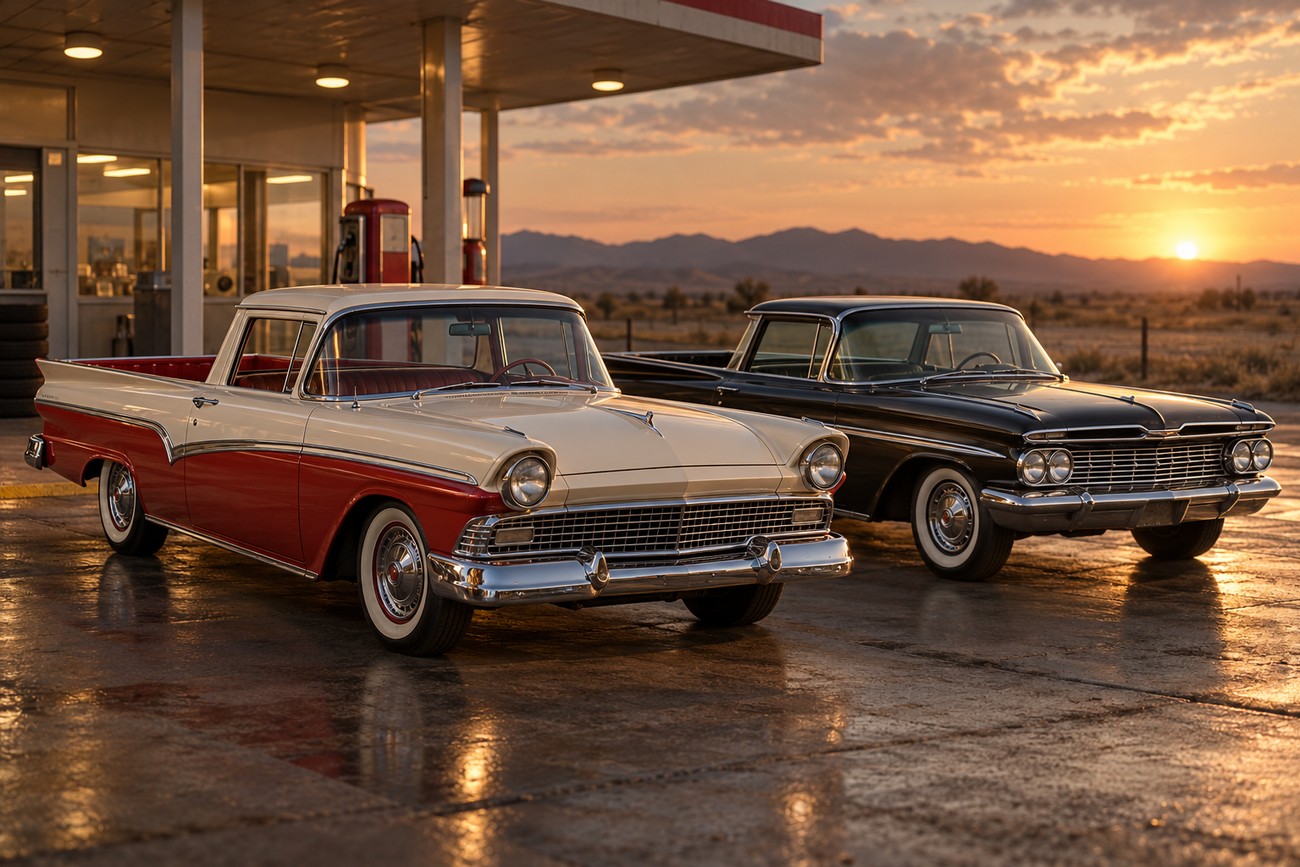
Both the Ranchero and El Camino combine a passenger-car body concept with an open cargo bed. They offer car-like seating and road manners, while their rear sections provide a practical advantage over a conventional trunk. Their silhouettes invite direct comparison, but the mechanical and historical details are different.
The Ranchero reached the U. S. market in 1957, while the El Camino followed in 1959. The Ranchero then continued through seven generations and several Ford platform families, moving from large full-size roots to compact Falcon-related and later Fairmont-related architecture.
El Camino comparisons also become less useful when they ignore the specific year. A 1957 Ranchero, a late-1960s V8 example, and a 1970s compact car-based pickup have different dimensions, suspension arrangements, parts availability, and collector priorities. The same applies to El Camino generations.
There is no universal parts interchange system between the two models. Each must be assessed by its own donor platform and factory specification. In practical terms, the Ranchero remains closer to a light-duty car-based utility vehicle than to a full-size pickup, regardless of how aggressive its engine or styling may appear.
The Rust and Restoration Traps Buyers Miss
Rust is the financial dividing line between a desirable Ranchero and an expensive shell. Because the body is a unibody, corrosion in the rear structure can affect alignment, stiffness, and the way loads move through the vehicle. Surface rust on a fender is a cosmetic problem; weakened supports or mounting points can become a body-repair project.
Inspect the base of the rear cab wall, the cargo-bed mounting points, structural seams, supports, and the lower sections of the doors. Look from above and underneath, and check for swollen seams, thin metal, amateur patches, and evidence that water has remained trapped between overlapping panels. The bed floor alone does not reveal the condition of the structure beneath it.
Inspect the rear cab-wall seam, cargo-bed mounting points, and structural supports from underneath before judging paint, trim, or engine quality. Those areas show whether the car needs a Ranchero-specific structural repair rather than ordinary cosmetic work.
Early body panels and brightwork can be difficult to source in good condition. Reproduction coverage is limited for some generations, while other parts depend on used stock, NOS components, or small-batch reproductions. A complete-looking project can therefore become difficult when one missing molding, bracket, tailgate component, or bed fitting is finally identified.
Similarity to a sedan or wagon can also mislead buyers. Some suspension and interior pieces are shared within the correct model family, but Ranchero-specific panels, mounts, trim, and rear structures may differ. Confirming interchange through a year-specific parts reference is cheaper than discovering the mismatch after paint or assembly.
Cosmetic restoration should come last. A glossy exterior, fresh upholstery, or rebuilt engine cannot compensate for rotten unibody supports. Buying a project before inspecting its structural metal is one of the quickest ways to turn an apparently affordable Ranchero into a restoration whose cost exceeds the value of the finished car.
Living With One: Handling, Brakes, Modifications, and Value
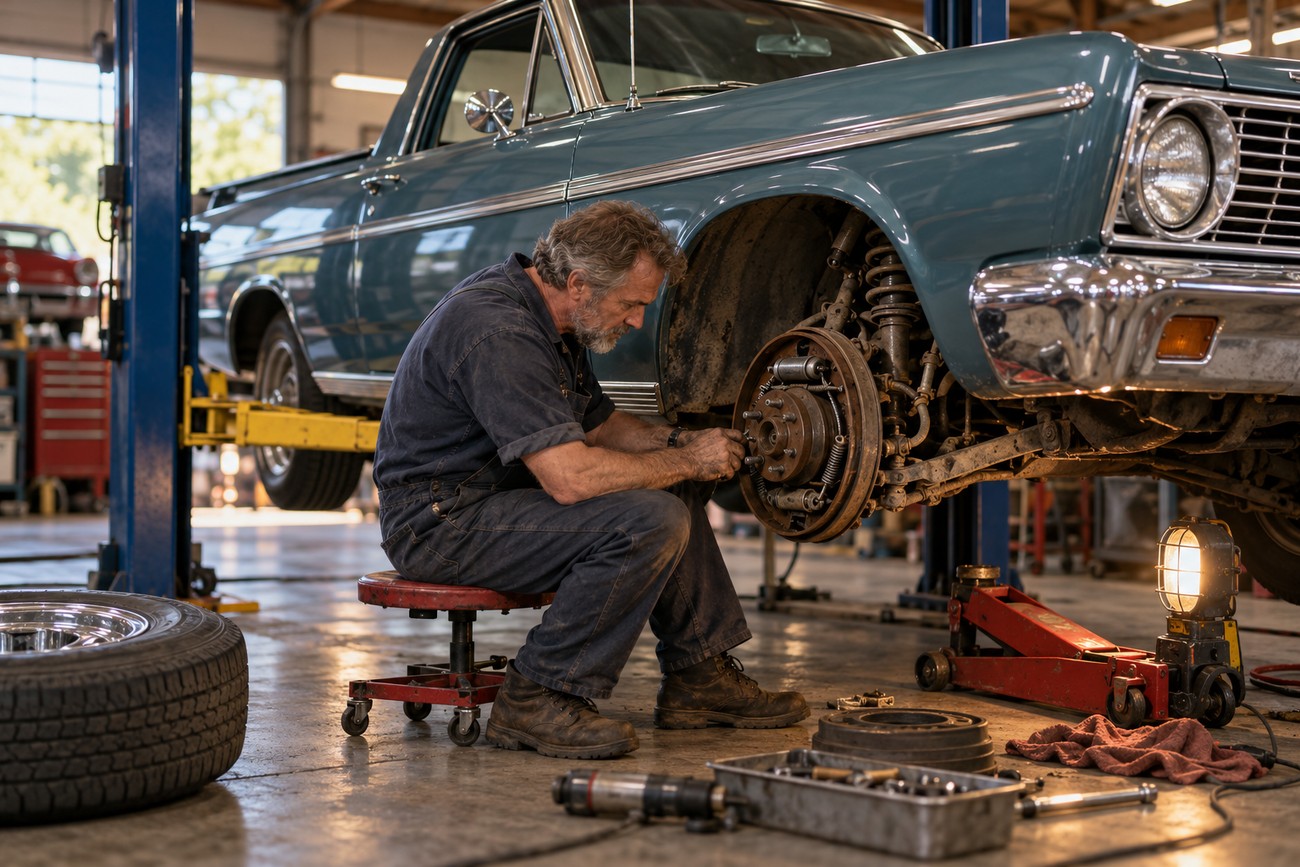
Period driving behavior requires some adjustment. Many Ranchero versions used drum brakes that are weak by modern standards, especially when the car is carrying weight or running in traffic with contemporary vehicles. Brake condition, hose age, adjustment, and tire quality deserve attention before performance modifications.
An empty cargo bed leaves relatively little weight over the rear axle. That can reduce traction and make the car feel light at speed, particularly on worn tires or uneven roads. A Ranchero with tired dampers, incorrect springs, or excessive rear ride height may feel unsettled even when its engine runs well.
Wet and salted climates accelerate corrosion in the bed, lower body, seams, and hidden supports. Proper cleaning, drainage, and corrosion protection help preserve a sound example, but they cannot reverse weakened metal. A car from a dry region may still need close inspection if old repairs trapped moisture inside the structure.
Modern V8 swaps, wide tires, and increased output can be sensible engineering projects when the whole car is upgraded together. More power should be matched with suitable brakes, suspension, cooling, steering components, wheels, and tires. Adding a large engine while leaving marginal brakes and fatigued unibody structure untouched creates a faster version of the original problem.
Estimated total production is approximately 500,000–550,000 vehicles, based on registry and club estimates; no official single total is established. Early 1957–1959 Rancheros and notable 1966–1971 examples have attracted stronger collector interest, particularly cars with original V8s or rare trim. Original cargo-bed finishes, moldings, fasteners, and other details can influence value because they are difficult to replace correctly.
Classification can affect ownership costs as well. Insurance and registration systems may treat a Ranchero as a passenger car, pickup, or special light-duty vehicle, depending on the jurisdiction and insurer. Confirming that category before purchase avoids surprises with coverage, valuation, taxes, or agreed-value policies.
Frequently asked questions
The Ranchero’s long production run and mixed car-truck identity create recurring specification and ownership questions. Exact answers depend on the model year, but the following points provide a reliable starting framework.
What Ford was the car that looked like an El Camino?
The Ford model was the Ranchero. It debuted in the United States for the 1957 model year, before the Chevrolet El Camino arrived for 1959, making the Ranchero the first mass-market car-based pickup in the U. S. market.
The name covers seven generations, so the visual resemblance does not mean every Ranchero has the same chassis, engine, or parts. Identification should include the model year and generation.
Why is a Ranchero sometimes called a ute?
“Ute” is a shortened form of “utility,” commonly used for a passenger-car-based utility vehicle. Ford Australia’s ute format appeared in the 1930s and helped establish the broader concept before Ford adapted it for the American Ranchero.
In everyday use, calling a Ranchero a ute describes its layout and cultural lineage rather than a separate Ford model designation. The Ranchero remains the U. S. model name.
How are Rancheros usually classified for insurance and registration?
Classification varies by insurer and local registration authority because the Ranchero sits between passenger car and pickup categories. Some systems may use its utility body style, while others rely on historical registration records, title wording, or vehicle use.
Owners should confirm the category before buying a policy and explain whether the car is used for collecting, commuting, or hauling. Agreed-value coverage may also require photographs, restoration records, and a specialist appraisal.
Where can owners verify the correct specifications for a specific Ranchero year?
Start with the factory manual for the exact model year, then compare its engine, suspension, load, brake, and body information with a specialist club catalog. Year-specific parts references are useful for confirming whether a donor component actually matches.
Generic Ford data can combine several generations and create false matches. Period manuals, registry records, and established club cross-references provide a stronger basis for verifying original specifications and planning repairs.







