
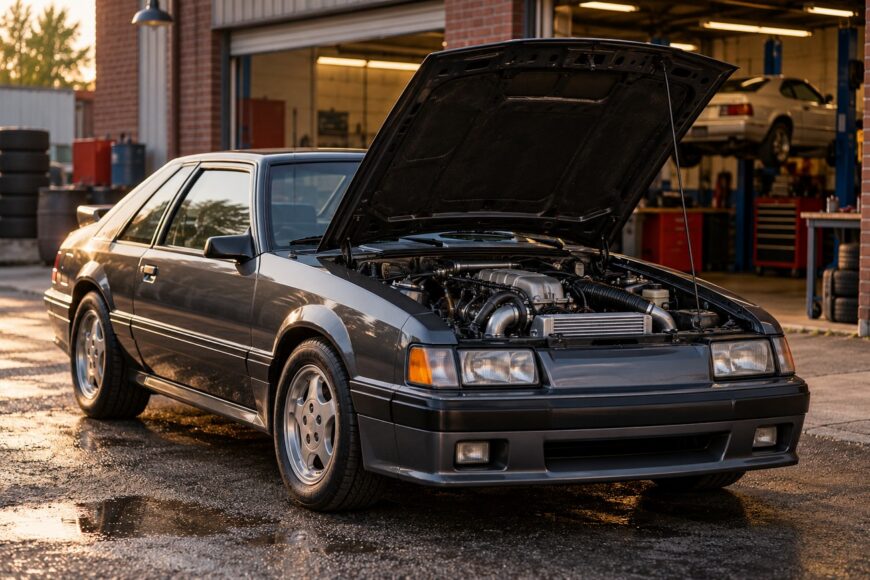
The Ford Mustang SVO was a sophisticated turbocharged performance car whose present-day value depends heavily on fragile, scarce, and easily misdiagnosed details. Its 2.3-liter turbocharged Lima engine, intercooling, electronic controls, and dedicated chassis made it technically distinctive when new. Age has made those same details expensive to verify and restore.
The real story is larger than four cylinders versus a V8. The SVO represents engineering ambition balanced against restoration risk: a lighter Fox-body Mustang developed around turbo response, gearing, and chassis behavior, then exposed to decades of wiring faults, corrosion, modifications, and parts shortages. Model-year differences matter because the 1984 car and the 1985½/1986 cars are closely related, yet mechanically different enough to change both driving character and buying decisions.
- Why Ford Built a Turbo Four-Cylinder Mustang
- 1984 vs. 1985½ and 1986: What Actually Changed
- Was the Mustang SVO Actually Fast?
- The Chassis Details That Make an SVO More Than a Badge
- Buying a Mustang SVO: Inspect the Structure Before the Turbo
- Common SVO Problems and the Diagnostic Traps Behind Them
- Boost, Tuning, and the Myth of Unlimited Turbo Strength
- Frequently asked questions
- What is the holy grail of Mustangs, and does the SVO qualify?
- Was the Mustang SVO fast by 1980s standards?
- What is a Mustang SVO worth today?
Why Ford Built a Turbo Four-Cylinder Mustang
Ford produced the Mustang SVO from 1984 through 1986 as a special Fox-body version positioned above the ordinary four-cylinder Mustang. Its purpose was performance through a different engineering route. The car used a 2.3-liter turbocharged Lima four-cylinder, a mechanical intercooler, and EEC-IV engine management rather than relying on the familiar V8 formula.
That combination gave Ford a way to use lower engine mass while adding controlled, forced-induction power. The turbocharged engine required careful management of fuel, ignition, vacuum signals, and boost, so the SVO became an integrated powertrain project rather than a simple engine swap. EEC-IV helped regulate the system and shaped how the engine delivered its torque.
The chassis received equal attention. The SVO specification included different hubs, wheels, tires, transmission details, gearing, and suspension tuning. These changes affected steering feel, traction, braking behavior, and the car’s ability to carry speed through corners.
That distinction matters today because a car wearing SVO badges can still contain ordinary Fox-body problems underneath. Its significance comes from the relationship between the turbo engine and the chassis. Removing or replacing specialized parts may leave a usable Mustang while reducing the historical and technical identity that makes an SVO worth preserving.
1984 vs. 1985½ and 1986: What Actually Changed
The 1985½ designation identifies a transition series within the 1985 model year, rather than a separate full model year. This period brought substantial engine changes, and catalog differences have created persistent confusion over the later horsepower rating.
| Specification | 1984 | 1985½ transition series | 1986 |
|---|---|---|---|
| Engine | 2.3-liter turbocharged Lima four-cylinder | 2.3-liter turbocharged Lima four-cylinder with the mid-1985 update | 2.3-liter turbocharged Lima four-cylinder with the updated hardware |
| Turbocharger and engine hardware | Mechanical intercooler; original turbo specification | Water-cooled turbocharger, revised intake, camshaft, injectors, and exhaust | Water-cooled turbocharger, revised intake, camshaft, injectors, and exhaust |
| Rated output | 175 hp | 200–205 hp, depending on the source | 200 hp in the factory brochure; some specialist sources report 205 hp |
| Torque | 210 lb-ft | 240–248 lb-ft, depending on the source and transition-year interpretation | 240–248 lb-ft, depending on the source and transition-year interpretation |
| Compression and advertised boost | 8.0:1 compression; boost up to 14 psi | Later specification; published figures vary by source | Later specification; published figures vary by source |
| Transmission | Five-speed Borg-Warner T-5 manual with a Hurst shifter | World-Class T-5 manual with a Hurst shifter | World-Class T-5 manual with a Hurst shifter |
| Final-drive ratio | 3.45:1 | 3.73:1 | 3.73:1 |
The horsepower disagreement should be treated as a documentation issue rather than a definitive mechanical dividing line. The 1986 factory brochure lists 200 hp, while some specialist sources report 205 hp for 1985½ and 1986. Torque figures are similarly reported as 240–248 lb-ft, depending on the source and how the transition series is classified.
The hardware change is easier to identify than the number. The mid-1985 update introduced a water-cooled turbocharger, revised intake, camshaft, injectors, and exhaust. The later World-Class T-5 and 3.73:1 final drive also changed acceleration response and cruising behavior compared with the 1984 car’s 3.45:1 gearing.
A seller who describes every 1985 car as identical may be overlooking the most important specification details. Buyers should verify the build information, engine hardware, transmission, rear gearing, and surviving SVO-specific components before assigning a model-year premium or assuming a particular output figure.
Was the Mustang SVO Actually Fast?
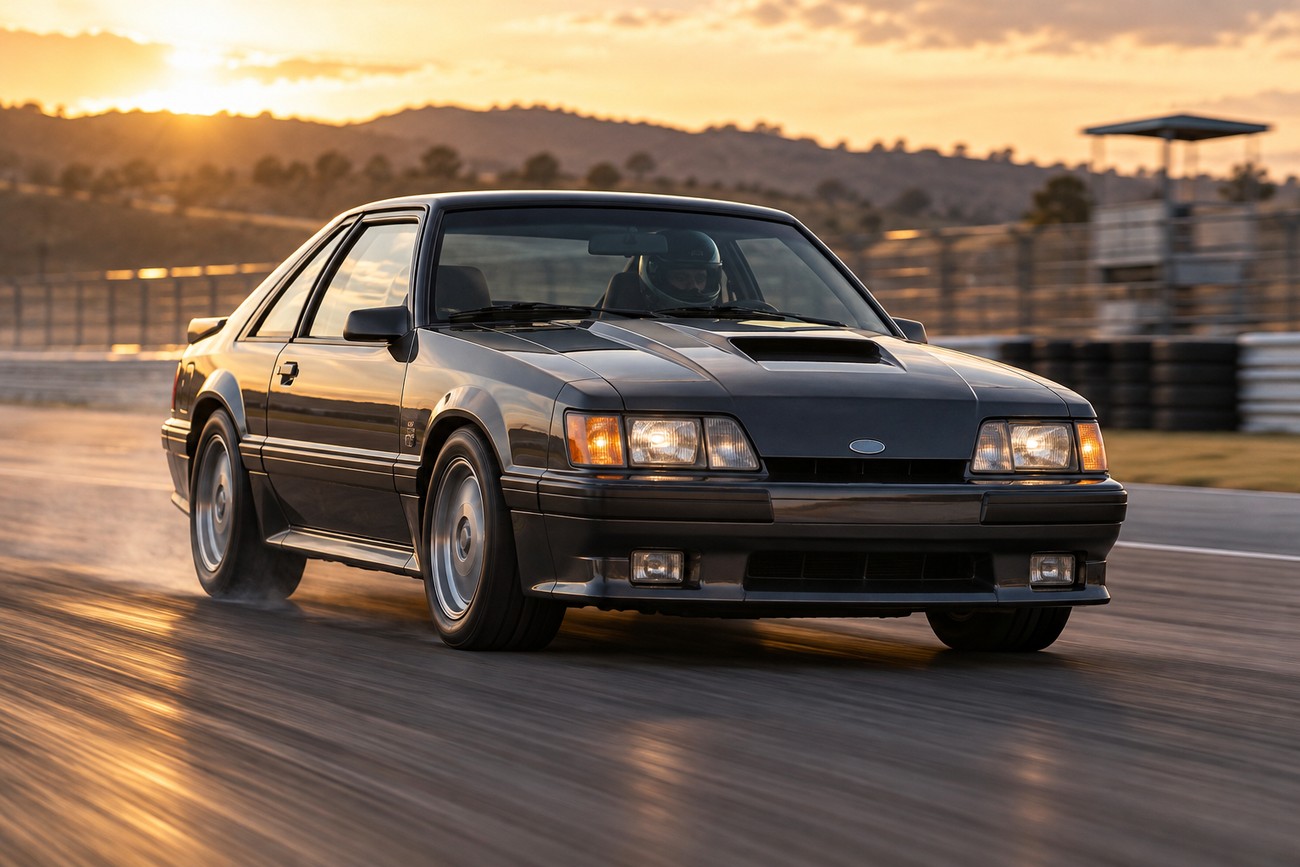
By period standards, the SVO was genuinely quick. Car and Driver recorded 0–60 mph in 6.8 seconds and a quarter mile in 15.1 seconds at 90 mph with a 1985 SVO. Those figures placed the car in serious performance territory even though its engine had four cylinders.
The experience depended on how the turbocharged Lima engine built its power. The car’s electronic control strategy, intercooling, manual transmission, and gearing allowed the driver to work with the engine’s torque rather than simply relying on large displacement. The Hurst-shifted five-speed Borg-Warner T-5 made that process central to the car’s character.
Factory output was 175 hp and 210 lb-ft for 1984. After the mid-1985 update, published figures rose to a disputed 200–205 hp and 240–248 lb-ft. The exact rating matters for historical accuracy, although the condition of an individual engine matters more during a road test.
An aged SVO may have reduced compression, tired injectors, inaccurate sensors, ignition faults, vacuum leaks, or a worn turbocharger. A car that feels slow may therefore be suffering from degraded systems rather than an inherent limitation of the turbo four. Period test numbers describe a correctly functioning car under factory conditions, not every surviving example.
The Chassis Details That Make an SVO More Than a Badge
The SVO’s five-bolt hubs, 16-inch wheels, and 225/50R16 tires were functional parts of the specification. They supported the car’s broader chassis goals and helped distinguish it from an ordinary Mustang GT. Their importance is easy to miss when attention stays fixed on horsepower.
Wheel and tire dimensions influence steering response, grip, ride behavior, and the way the car communicates through corners. The five-bolt hubs also provide a useful identification clue, although individual cars may have been modified during decades of use. Replacement parts should therefore be assessed for both correctness and condition.
Transmission and gearing complete the package. Every SVO used a five-speed Borg-Warner T-5 manual with a Hurst shifter, while 1984 used a 3.45:1 final drive and 1985 and later models used 3.73:1 gearing with the World-Class T-5.
These details explain why an SVO should be judged as a complete vehicle. A rebuilt engine cannot recreate the intended driving balance if the car has incorrect wheels, damaged hubs, unsuitable gearing, or missing chassis components. Conversely, an original-looking car with a tired engine may still possess valuable evidence of its proper specification.
Buying a Mustang SVO: Inspect the Structure Before the Turbo
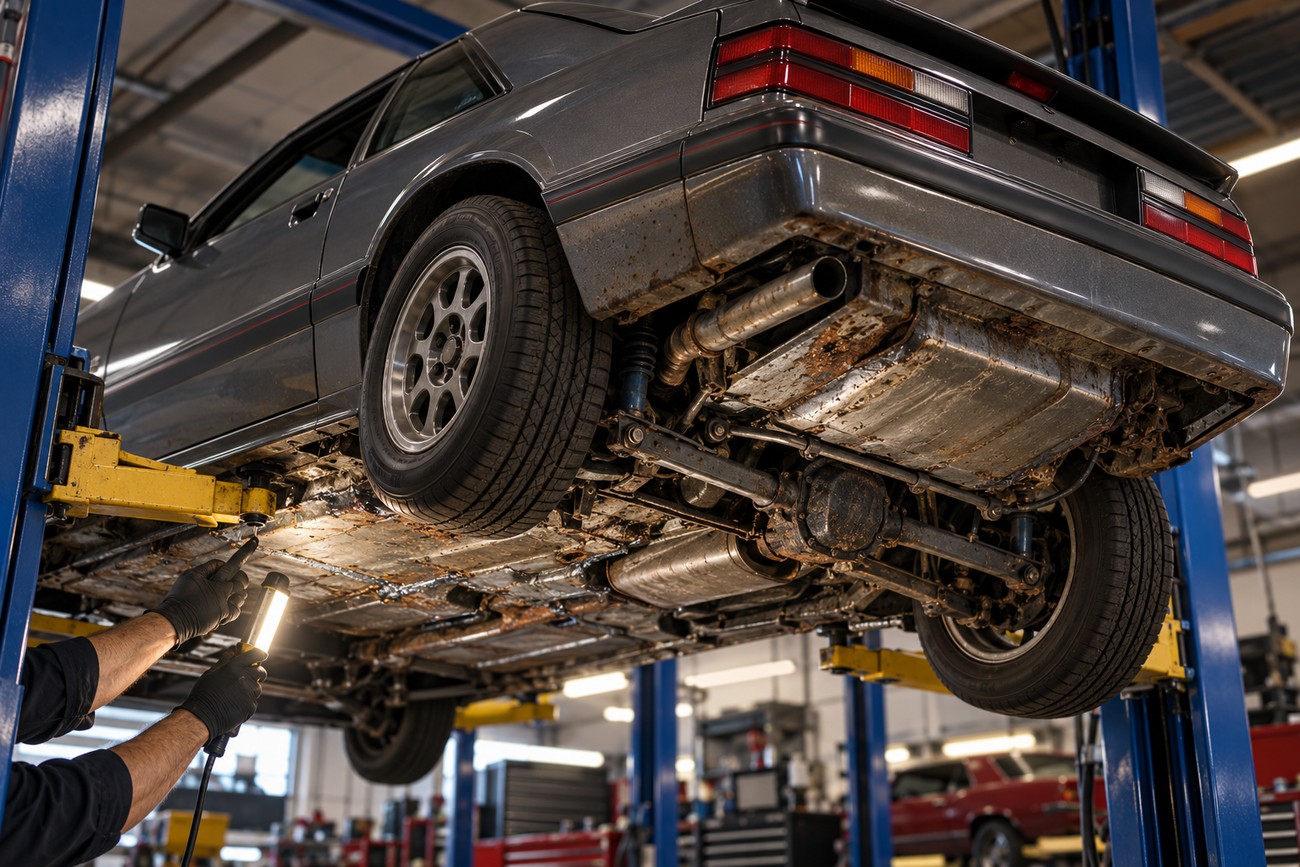
Start beneath the car. Floorpan rust, damaged frame structure, hidden corrosion, and weakened torque boxes can create a larger restoration problem than a tired turbocharger. Torque boxes transfer suspension loads into the body, so damage there deserves careful inspection rather than cosmetic treatment.
Look for repairs that conceal corrosion, distorted metal around suspension mounting areas, and evidence of prolonged water exposure. A clean-running engine does little to offset serious structural deterioration. The body shell should establish the purchase decision before a buyer becomes distracted by boost response or a fresh-looking engine bay.
Torque boxes, floor structure, grounds, fuel pressure, and EEC-IV codes should be checked before condemning the turbo or buying rare replacement trim. Those checks often separate a repairable fault from a restoration bill.
Confirm the VIN and compare the car with its claimed model-year specification. A restomod may have useful upgrades, yet missing SVO-specific body or interior parts can be difficult and costly to replace. Rare trim, seats, wheels, gauges, and other dedicated components are harder to source than ordinary Fox-body Mustang GT parts.
Electrical and ignition condition also belongs in the initial inspection. Starting problems commonly involve wiring, grounds, fuel pressure, sensors, vacuum leaks, ignition components, or EEC-IV diagnosis. A buyer who verifies these systems early gains a more accurate picture of the car’s mechanical value.
The difference between 200 and 205 hp is usually less important than a solid floor, intact torque boxes, complete SVO trim, and credible documentation. Structure and originality determine how much of the car can be preserved without major fabrication or parts hunting.
Common SVO Problems and the Diagnostic Traps Behind Them
Older SVOs frequently develop starting faults, electrical problems, and difficult EEC-IV troubleshooting. Age affects connectors, grounds, sensors, vacuum hoses, and wiring, while previous repairs may add undocumented changes. These faults can imitate fuel, ignition, or turbocharger failure.
A disciplined no-start sequence begins with battery power and grounds, followed by fuel pressure, vacuum condition, ignition components, and stored EEC-IV codes. This order prevents expensive parts replacement based on symptoms alone. A weak ground or inadequate fuel pressure can produce a convincing impression of a failed control system.
Regular checks should include spark plugs, the distributor cap, the rotor, and high-voltage wires. These parts are simple compared with the turbo system, yet their condition strongly affects starting, idle quality, and boost behavior. Ignition breakdown under load may be mistaken for a turbo problem because it appears during acceleration.
Vacuum leaks, failed sensors, wiring faults, and boost-control problems can also change the car’s response without indicating mechanical turbocharger damage. The SVO’s specialized specification does not remove the age-related weaknesses shared by Fox-body cars. It makes accurate diagnosis more important because replacement parts and original documentation are less readily available.
Boost, Tuning, and the Myth of Unlimited Turbo Strength
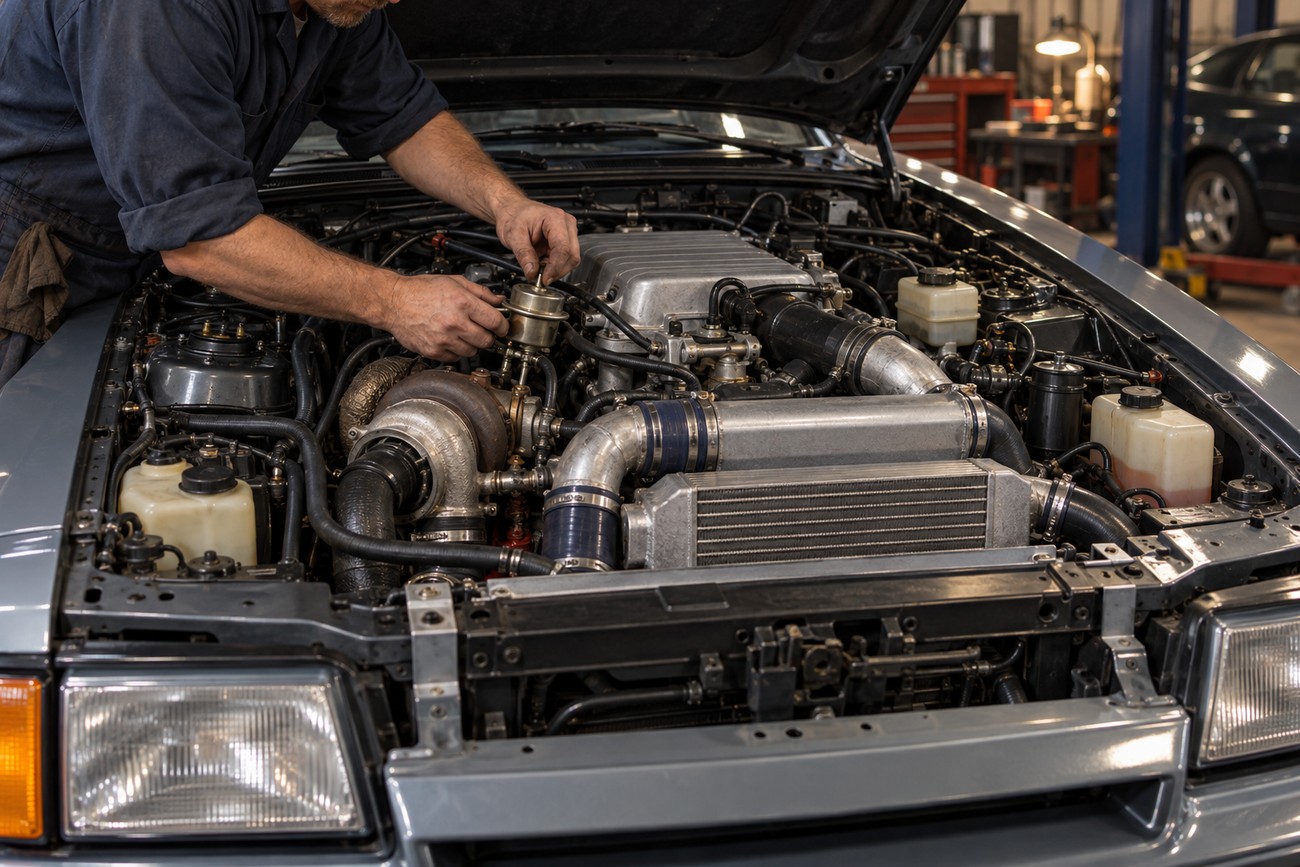
The factory system electronically controlled boost, limiting it at low rpm and increasing it progressively toward the advertised limit. For the 1984 car, that advertised limit was up to 14 psi. This strategy was intended to coordinate airflow, fuel delivery, ignition control, and engine protection.
Additional boost changes the thermal and fueling demands quickly. The factory fuel system and cooling system can become limiting factors, especially in an engine with uncertain compression, aging injectors, inaccurate sensors, or restricted intercooling. Boost pressure alone says little about whether the engine is operating safely.
A lean mixture, detonation, or excessive heat can damage pistons and the head gasket. The risk increases when a modern boost controller is installed without confirming fuel pressure, injector capacity, intercooler condition, cooling performance, sensor accuracy, and engine health.
Safe modified-car power depends on the entire system: fuel delivery, injector capacity, intercooling, temperature control, compression, sensors, and the condition of the engine. A stock turbocharger is not a guarantee of unlimited strength, and a larger boost number is not a substitute for measured diagnostics.
Frequently asked questions
The SVO occupies a specific place in Mustang history. Its collector appeal depends on technical distinction, documented specification, and condition, so broad Mustang mythology does not provide a reliable shortcut for judging an individual car.
What is the holy grail of Mustangs, and does the SVO qualify?
There is no single Mustang that universally qualifies as the “holy grail.” That label usually refers to especially rare, historically significant, or highly desirable versions across the entire Mustang family.
The SVO has a narrower appeal. It is a technically distinctive, condition-sensitive Fox-body built around a turbocharged four-cylinder, intercooling, EEC-IV control, and a dedicated chassis specification. A complete, correctly documented example can be highly significant to enthusiasts who value engineering and period performance, even though every SVO is not automatically a concours collector car.
Was the Mustang SVO fast by 1980s standards?
Yes. Car and Driver recorded 0–60 mph in 6.8 seconds and a quarter mile in 15.1 seconds at 90 mph with a 1985 SVO. Those results made the car competitive in its period, especially given its four-cylinder engine.
The broader importance was its demonstration that turbocharged four-cylinder performance could combine meaningful acceleration with a lighter front end and chassis balance. The SVO’s significance therefore rests on the way its engine, gearing, manual transmission, and handling specification worked together, rather than on a horsepower comparison alone.
What is a Mustang SVO worth today?
Its value depends on structural condition, originality, completeness, model-year specification, and mechanical condition. A solid body with intact torque boxes, correct SVO equipment, credible documentation, and a functioning powertrain generally provides a stronger foundation than a heavily modified car with impressive claimed output.
Running condition still matters, although a non-running car can retain value when its structure and rare components are complete. The correct approach is to evaluate the whole vehicle: verify the VIN, identify the transition-year specification, inspect the body shell, inventory SVO-specific parts, and then assess the engine and turbo system.







