
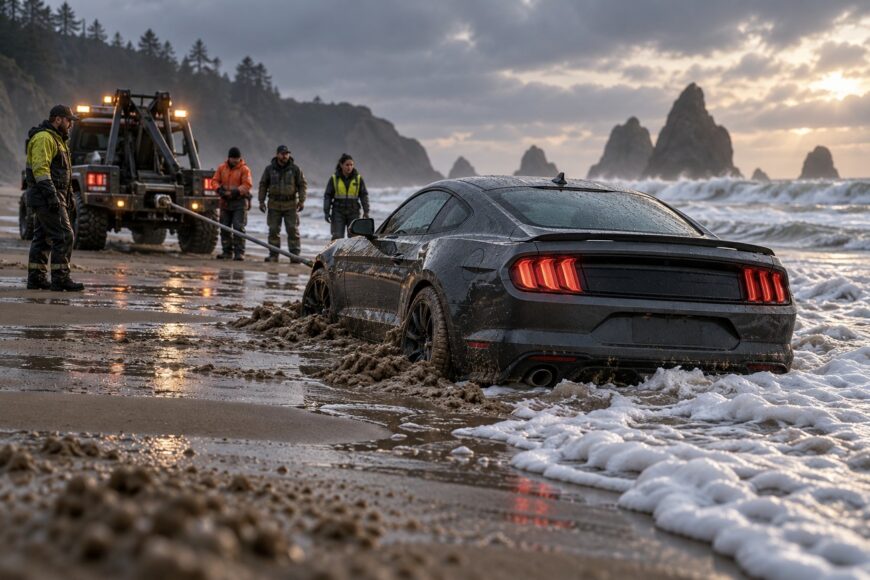
A low, rear-wheel-drive Ford Mustang can sink quickly as the tide removes the recovery window. Extra throttle usually makes the outcome worse by burying the driven wheels while the underside settles deeper into wet sand.
Protect people first. Move occupants away from incoming water, unstable sand, and recovery lines, then stop the vehicle from taking in more seawater. A calm stop-assess-recover sequence gives you a better chance of saving the car without turning a beach recovery into a mechanical and electrical failure.
Keep clear of the waterline while you assess the tide, the vehicle’s position, and the available exit path. Call suitable recovery help early if the sand is soft, the car is sinking, or the tide is advancing. A few careful minutes can matter more than a forceful pull.
- First: stop the damage and read the tide
- Why a Ford Mustang sinks into beach sand so quickly
- How to get it unstuck without digging it deeper
- The safe way to tow a Mustang off the beach
- After extraction: saltwater, sand, and the no-restart rule
- What may fail later even if the Mustang drives away
- Beach-recovery myths that make the damage worse
- How to avoid repeating the recovery
- Frequently asked questions
- What should I do if only the Mustang’s cabin was flooded?
- How can I tell whether sand or seawater reached the differential or transmission?
- What should I document before the beach recovery and cleanup?
First: stop the damage and read the tide
Release the accelerator and stop wheelspin immediately. High-rpm wheelspin usually digs the driven wheels deeper rather than creating useful forward traction, especially when the rear axle is sitting in loose or saturated sand. Apply the parking brake only if the vehicle is stable and safe to leave; avoid unnecessary movement while you assess the ground.
Get everyone clear of the incoming water and away from any tow strap, winch line, or recovery vehicle. Check the direction and speed of the tide instead of judging risk from the water level alone. Tide height can change by meters, and in a tidal zone, the safe recovery window may be measured in minutes rather than hours.
Dense wet sand can hold a vehicle like a suction cup. As the car settles, the underside can become supported by sand while the wheels lose their ability to climb out. Contact a beach recovery operator or towing service that has suitable equipment and understands soft sand, tidal access, and controlled extraction.
Waiting for the ebb can be wiser than attempting a destructive pull, provided the vehicle and occupants can remain safely above the advancing water. Conversely, waiting beside a rapidly rising tide is unsafe. Use the tide’s direction, the vehicle’s stability, and the available recovery equipment to decide whether an immediate controlled extraction is possible.
Why a Ford Mustang sinks into beach sand so quickly

A road-going Mustang is designed for paved surfaces, with relatively low ground clearance and a long front overhang. The front end can contact a sand ridge before the tires reach firmer ground, and the underside may begin to carry part of the vehicle’s weight. Once that happens, tire grip alone becomes much less useful.
The long wheelbase increases the chance of high-centering on soft sand. A Mustang can bridge a depression with its underside while the tires sit in separate holes, leaving the chassis supported by the ground. More engine power cannot overcome that loss of effective tire loading.
Rear-wheel drive adds a second problem. The rear tires are the driven wheels, so poor traction can make them bury themselves while the front tires remain on a different surface. Weight distribution, tire condition, and the angle of the vehicle all affect the result, especially if the car is sitting in a rut or pointing across a slope.
This explains why a Mustang may appear to have enough engine power yet move only deeper into the beach. The recovery plan must free the underside, give the rear tires a firm route, and follow the vehicle’s existing track where possible. Trying to force the car sideways usually increases resistance in loose sand.
How to get it unstuck without digging it deeper
Begin by clearing sand from in front of the driven tires and from beneath the lowest points of the underbody. Make a gradual ramp toward the intended exit rather than removing sand randomly. Clear enough space for the tires to climb, while keeping people away from areas where the vehicle could roll or shift.
Improve the route along the compacted track made by the Mustang. Pulling along that track generally creates less resistance than dragging the car sideways through loose sand. If the vehicle is high-centered, digging around the underside and reducing the support beneath the chassis may be more important than clearing a long path ahead.
Lowering tire pressure temporarily can enlarge the contact patch on sand. Use this only when you have a safe way to reinflate the tires and can avoid sharp debris, abrupt steering, and high speed. Restore the vehicle’s specified road pressure immediately after recovery; driving with reduced pressure increases the risk of overheating or a tire leaving the rim.
Traction boards help only when the Mustang’s tires can reach a sufficiently firm base and there is enough room to place the boards in line with the intended exit. Forcing them into a sideways extraction path can add resistance and expose the recovery equipment to damaging loads.
A shovel and traction boards are useful when the tires can sit on a firm foundation and there is room to position the equipment safely. They are ineffective when the car is floating on deep, wet sand, the underside is fully supported, or the tide has removed the working space. Stop and call for specialized recovery rather than repeatedly spinning the wheels.
The safe way to tow a Mustang off the beach
The attachment point matters more than the pulling vehicle’s power. Use the Mustang’s designated tow eye or recovery loop, following the vehicle’s instructions for access and installation. Confirm that the point is fully engaged before applying load, and keep everyone outside the line of pull.
Do not attach a strap to suspension arms, steering parts, stabilizer bars, ball joints, radiator supports, or random bodywork. These components can bend, tear, or transfer force into parts that were never designed for recovery loads. Damage may include a distorted subframe, broken mounting hardware, or a damaged front structure.
A stronger tow vehicle does not make an unsuitable attachment point safe. The recovery operator should remove slack gradually and use a controlled, steady pull. Violent jerks can shock-load the tow eye, strap, chassis, and buried vehicle, especially when wet sand is holding the car in place.
Keep the extraction aligned with the Mustang’s compacted track whenever possible. If the car must change direction, clear the route first and use small, controlled movements. Stop immediately if the vehicle shifts sideways, the attachment point moves, or the strap and recovery hardware show abnormal loading.
After extraction: saltwater, sand, and the no-restart rule
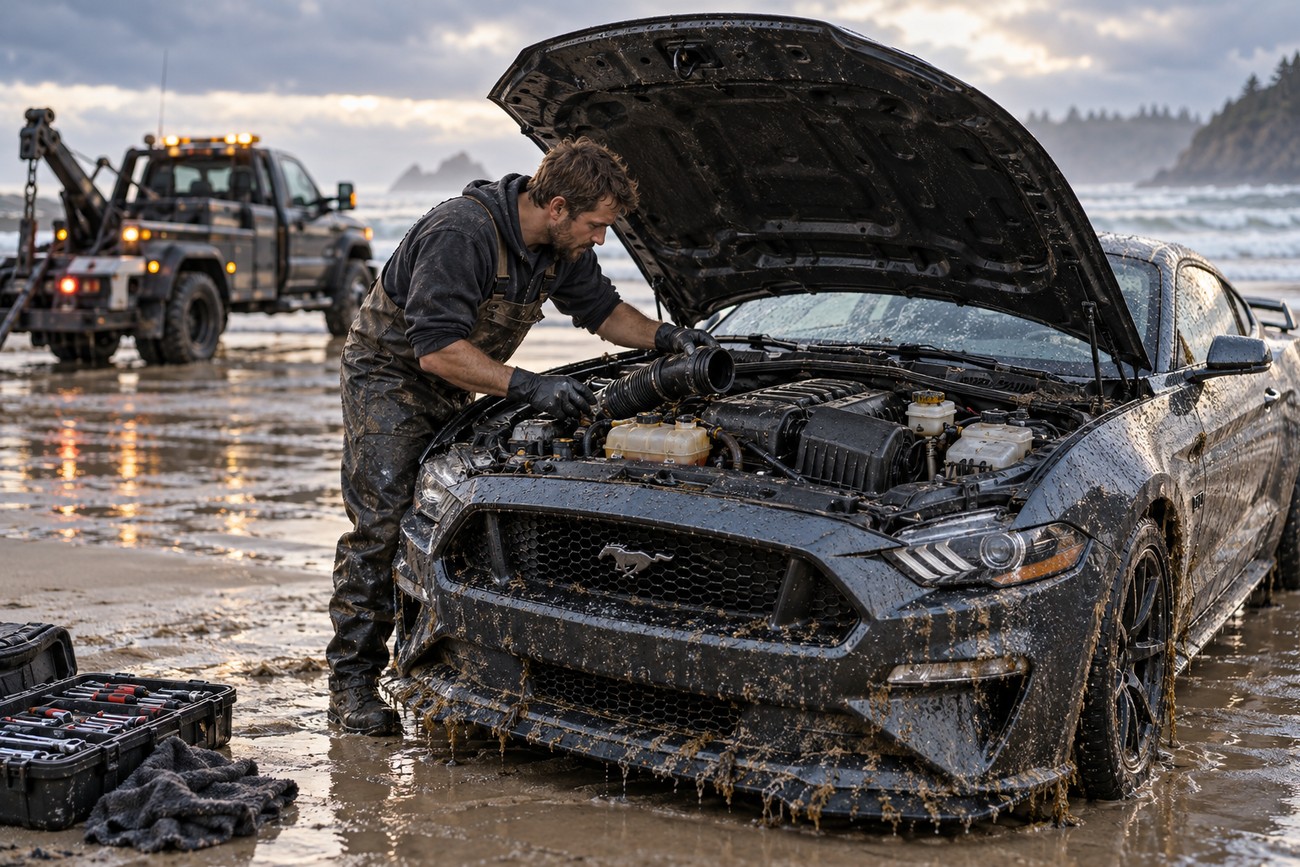
If the engine stalled or water may have reached the air intake, cylinders, or exhaust, do not restart it. Water in the cylinders can cause hydrolock and severe engine damage during a restart. Neutral is the usual automatic-transmission towing position, but Neutral does not make restarting a water-exposed vehicle safe.
Have the intake, cylinders, exhaust, fluid levels, and affected systems checked before attempting to run the engine. A vehicle that cranks, starts, or moves a short distance can still contain water in a critical location. The apparent success of a restart is not a reliable safety test.
Saltwater accelerates electrochemical corrosion and can damage electrical contacts more aggressively than fresh water. Rinse the underside, brakes, suspension, wheel wells, and radiators with fresh water, not only the painted exterior. Remove visible sand from brake areas, cooling surfaces, belts, pulleys, and accessible connectors without forcing debris deeper into them.
If the cabin was flooded, lift or remove the carpet and insulation promptly. These materials can retain salt and moisture beneath visible trim, where wiring, fasteners, and floor panels may remain wet long after the surface appears dry. Professional interior drying and electrical inspection may be appropriate after significant water entry.
Do not delay the rinse while waiting to see whether symptoms appear. Salt residue continues to attract moisture and accelerate corrosion after the vehicle leaves the beach. Record the exposure and tell the repair facility that the car contacted seawater, since that detail changes the inspection priorities.
What may fail later even if the Mustang drives away
The first damage may begin after a single tidal cycle of saltwater and sand exposure. Wheel bearings, brake hardware, hubs, ABS sensors, connectors, belts, and pulleys can suffer corrosion or abrasive wear even when the vehicle initially drives normally. Squealing, grinding, warning lights, or stiff controls may appear later.
Sand can remain inside brake mechanisms, wheel areas, seals, and moving components. A brake that feels acceptable on the first drive may later drag or develop uneven operation as trapped grit and salt affect the hardware. Wheel bearings and hubs deserve attention because contamination may be hidden behind seals.
Electrical problems can also be delayed. ABS sensors, connectors, and other low-mounted wiring may work while wet and then develop poor contacts as corrosion progresses. Intermittent warning lights, window, multimedia, or unexplained dashboard faults should be treated as possible water exposure rather than dismissed as temporary glitches.
Water can enter the differential, transmission, intake, or cabin unevenly when the Mustang is angled or sitting in a rut. Fluid-level and fluid-condition checks are therefore important even when there is no obvious external damage. A proper inspection should account for the vehicle’s position in the sand, the depth of immersion, and the duration of exposure.
Beach-recovery myths that make the damage worse
The idea that more throttle will free a buried Mustang is usually wrong. More throttle commonly increases wheelspin and buries the rear tires deeper. Clearing sand, creating a firm path, reducing pressure temporarily when appropriate, and using a controlled pull produce more useful traction than high engine speed.
Brief seawater contact is also not harmless. Saltwater and abrasive sand can begin damaging contacts, bearings, brakes, sensors, and connectors after a single tidal cycle. A short exposure still warrants a thorough fresh-water rinse and a targeted inspection.
Any tow strap is not automatically suitable. A strap connected to an unintended suspension, steering, radiator-support, or body component can bend recovery hardware or damage the subframe and body structure. Use the designated tow eye or recovery loop and match the recovery method to the attachment point.
A successful restart proves only that the engine operated at that moment. It does not rule out water in the intake, contaminated fluids, trapped sand, delayed bearing damage, or corrosion in electrical connectors. Treat the vehicle as water-exposed until the relevant systems have been checked.
How to avoid repeating the recovery
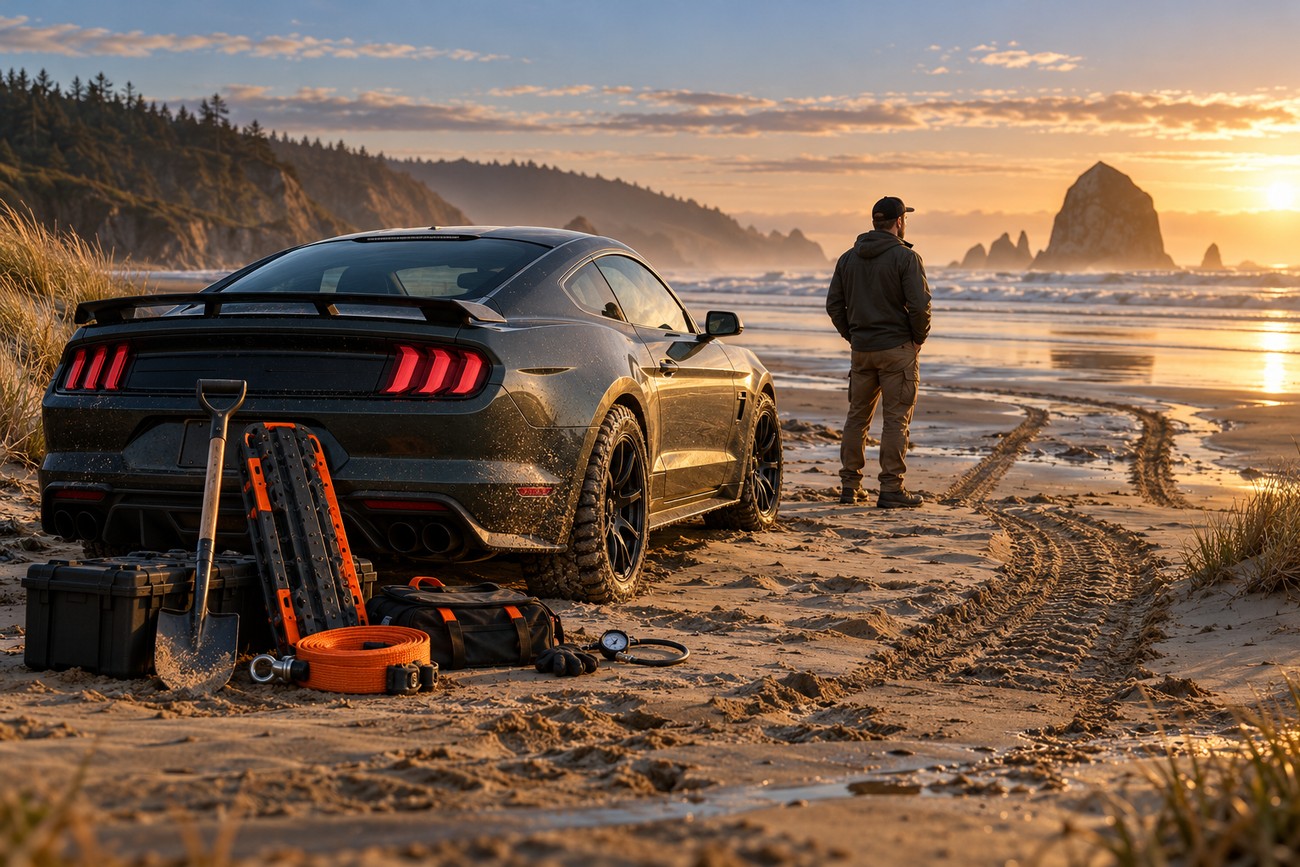
Check tide timing, beach access rules, and the firmness of the intended route before driving onto sand. A normal Mustang has low clearance and rear-wheel drive, so preparation matters more than aggressive throttle. Identify a firm exit route before the tires leave pavement.
Carry a shovel and suitable traction equipment where local rules permit it. Their usefulness depends on working room and firm support beneath the tires, so keep enough space to place them in line with the planned exit. Recovery equipment cannot compensate for an incoming tide or a vehicle resting on its underbody.
Drivers familiar with sand often reduce tire pressure before entering soft sections to enlarge the contact patch. Do this only when you can reinflate the tires before returning to the road, and avoid treating reduced pressure as permission for speed or sharp steering. Restore the specified road pressure immediately after leaving the sand.
Keep the car moving gently on firm, compacted ground and avoid stopping in soft depressions. If the surface begins to feel loose, stop before the rear tires dig in. A short retreat along the existing track is usually easier to manage than an ambitious turn into untouched sand.
Frequently asked questions
These decisions usually arise after the immediate danger has passed. The details matter because water and salt can remain hidden in the cabin, drivetrain, and electrical system.
What should I do if only the Mustang’s cabin was flooded?
Disconnecting the battery may be appropriate if it can be done safely, then lift or remove the carpet and insulation as soon as possible. Visible upholstery can feel nearly dry while the layers beneath it retain saltwater against the floor, wiring, connectors, and trim fasteners.
Do not rely on air drying alone. Rinse contaminated removable materials as appropriate, dry the floor and wiring area thoroughly, and arrange an electrical inspection if water reached connectors or modules. Document the water level because a cabin-only flood can still affect systems mounted low in the interior.
How can I tell whether sand or seawater reached the differential or transmission?
You usually cannot confirm this from the outside. The vehicle’s angle, water depth, and the location of vents and seals determine exposure, so a visual check may miss contaminated fluid. A technician should check fluid level, color, odor, and contamination, and compare the findings with the vehicle’s exposure position.
Unusual noise, difficult shifting, leaks, or a change in driveline behavior strengthens the need for inspection, though the absence of symptoms does not clear the assemblies. Fluid checks are important because water can enter unevenly when the Mustang is in a rut or sitting at an angle.
What should I document before the beach recovery and cleanup?
Take clear photographs of the tide line, water level, the Mustang’s position, its angle in the sand, and the visible depth of immersion. Photograph the intended attachment point before the strap is installed, along with any existing damage, damaged recovery hardware, and sand or water around the vehicle.
Record the time, location, and basic recovery actions, including whether the engine stalled or was restarted. These details help a repair facility target fluid, electrical, drivetrain, and corrosion inspections, and they may also support an insurance or roadside-assistance claim.







