
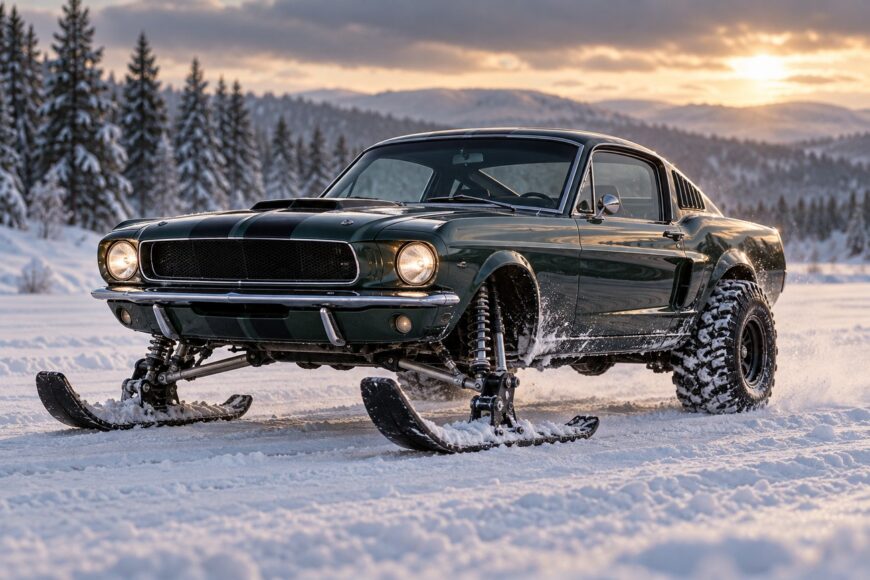
A Ford Mustang on ski runners has an appeal that is easy to see: a familiar pony car gliding across a white landscape instead of rolling on pavement. A short run over packed snow can make the idea look surprisingly workable. Yet moving forward is only the first test of a snow vehicle.
Turning without sliding wide, stopping where intended, and keeping the nose from burying itself demand more than skis at the front. The Mustang’s mass, low body, and road-car steering and suspension all remain part of the equation. For the conversion to work beyond a brief demonstration, the driven contact points, load distribution, clearance, and attachment strength need as much attention as the runners.
- What a Mustang-on-skis conversion actually changes
- Why flotation, clearance, and weight beat horsepower
- The harder test: turning and stopping
- Front skis, rear tracks, and winter tires: what each setup can and cannot do
- Where DIY builds fail beyond the first snow run
- Where can a ski-equipped Mustang actually be used?
- Frequently asked questions
- How bad is an unmodified Mustang in the snow?
- How should a stuck ski-equipped Mustang be recovered?
- Why was the Ford Mustang called a pony car?
What a Mustang-on-skis conversion actually changes
In a basic layout, front ski runners support the nose and steer; driven wheels or tracks must provide propulsion. The skis replace the front tires’ contact with the surface, changing how the car carries weight and responds to steering input. They do not give the rear axle a way to push through snow it cannot grip.
Builds can differ substantially behind that simple outline. Some retain driven rear wheels, while others use track units to spread the driven load over a larger area. A photograph of a Mustang on skis therefore says little about its rear hardware, mounting design, or ability to repeat a run in changing snow.
A showpiece may cross a prepared, packed surface while encountering few obstacles and little loose snow. Repeatable use asks more of the conversion: it must tolerate ruts, uneven loading, accumulating snow, and repeated turns and stops without losing clearance or developing play in its attachments. A successful straight-line pass does not establish those qualities.
A ski-equipped Mustang remains a heavy, modified car, not a purpose-built snowmobile. Its wheelbase, bodywork, suspension, and original control systems were designed around tires on roads. Keeping that distinction clear makes the spectacle easier to appreciate without mistaking it for proof of dependable snow travel.
Why flotation, clearance, and weight beat horsepower
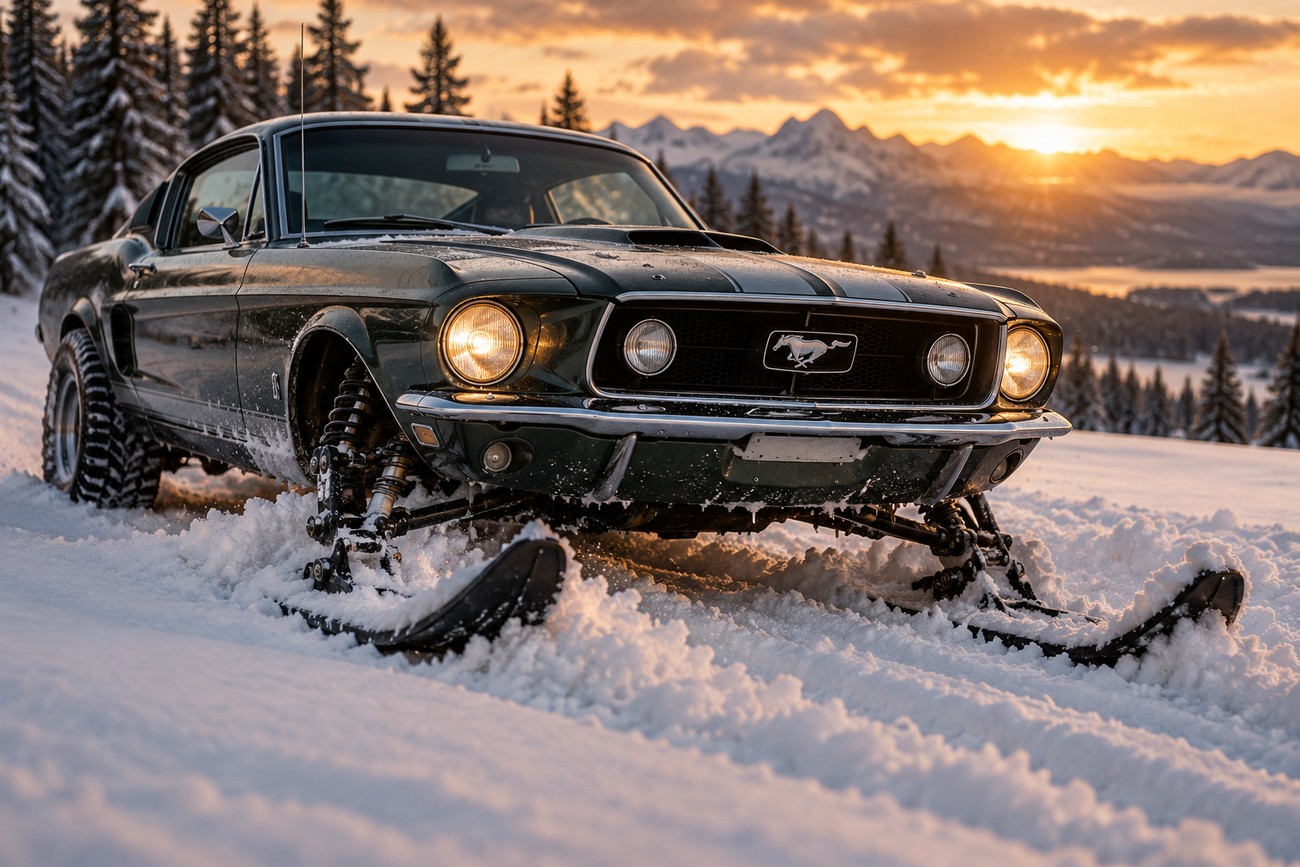
Snow supports a vehicle through its contact patches. More contact area reduces pressure on snow but does not eliminate sinking under a heavy car. Skis that are too short or narrow can cut into soft snow, while wider runners may improve support at the cost of harder steering and greater loads on the hardware holding them.
Front-engine Mustangs commonly place substantial load over the front axle; distribution varies by model and build. That load matters when the front skis meet powder: the nose can sink even if the driven rear contact points still have traction. Choosing runners by appearance alone misses the load each one must carry.
Clearance can become the limit before engine output does. Low ground clearance and the front overhang can limit travel in deep snow before power does. Once the underside or nose pushes a mound ahead of the car, adding throttle may dig the driven wheels or tracks deeper rather than move the body over it.
Packed snow may hold the car higher and let it travel where loose powder would stop it, but a firmer surface introduces its own grip problems. Crust, ruts, and uneven patches can change how the skis load from one moment to the next. Neither a run on packed snow nor a larger engine says much about how the same build will behave in deeper conditions.
Before choosing ski or track hardware, the useful engineering questions concern the expected load on each contact point, available clearance, and space needed to turn. Smoother throttle inputs can sometimes preserve momentum better than a burst of power that spins the driven contact points. Those considerations are less dramatic than horsepower and more relevant to keeping a heavy car moving.
The harder test: turning and stopping
Forward traction, steering control, and braking are separate performance tests. A rear setup that pushes a Mustang across snow may still leave the front runners struggling to change its direction. That mismatch helps explain the delayed response and understeer often described as the car “turning like a sled.”
A ski has to develop sideways force against the surface to steer. On soft snow, it may plow; on hard snow or ice, it may slide, depending on its design and the conditions. Wider runners can support more weight, yet their added contact and leverage can raise steering effort and the loads passed into links and mounts.
Stopping adds another demand. Brake hardware can slow a driven wheel or track, but the available grip between the vehicle and snow still governs how quickly it loses speed. A build’s stopping behavior needs to be assessed on its actual surface; there is no sound basis for assuming skis or tracks will deliver a particular braking distance.
Ski attachments change suspension and steering loads beyond the stock geometry’s intended use. An impact at a ski tip can feed force through the mounting point into steering links and suspension parts, while altered ride height or hardware placement may restrict usable travel. A car that steers acceptably on a smooth pass may react differently when one runner catches a rut.
Packed snow or ice can be easier to traverse than deep powder without making handling predictable. A Mustang’s width and long wheelbase also leave less room to correct a slide or turn around in a narrow snowy area. Any assessment of control has to include turns, braking, and uneven surfaces, not merely whether the car can accelerate.
Front skis, rear tracks, and winter tires: what each setup can and cannot do
These layouts serve different purposes; none of the modified setups shown here is, by itself, a recommendation for public-road use.
| Setup | Front support | Propulsion | Principal limitation | Intended setting |
|---|---|---|---|---|
| Front skis with rear driven wheels | Steering runners spread the front load on snow. | Rear tires must find enough grip to move the car. | Rear wheels can spin or sink, while the low body can plow snow. | A controlled demonstration on suitable, prepared snow. |
| Front skis with rear tracks | Steering runners carry the front load. | Driven tracks increase rear contact area. | Tracks alone cannot prevent front-end sinking or solve low clearance. | Controlled off-road testing, subject to engineering review and site permission. |
| Unconverted Mustang on winter tires | Conventional front tires retain the road-car layout. | Driven rear tires provide propulsion. | Snow depth, clearance, and available tire grip still limit travel. | Road use where conditions, local rules, and the vehicle allow it. |
Where DIY builds fail beyond the first snow run
Undersized skis may seem adequate on a firm surface, then sink when the snow softens or the front end loads up during a turn. Mounts face a similar gap between a first pass and repeated use. Vibration, ruts, and impacts can loosen an attachment that appeared secure while the car was stationary.
Those forces can reach steering links, suspension arms, and their mounting points. Hardware added around the wheel openings may also interfere with steering movement or reduce suspension travel. Attachment strength, load paths, and clearance throughout that movement deserve engineering review rather than a judgment based on whether the parts fit.
After an impact or a run through accumulating snow, check for new attachment play and lost clearance around steering links before another pass. An intact-looking ski does not show what has shifted behind it.
Snow packing into arches and around linkages can gradually narrow the space that moving parts need. It may also collect beneath the car, reducing already limited ground clearance. Repeated inspection matters because a setup that clears its own hardware at the start of a run may no longer do so later.
Stock ABS and stability-control calibration may not suit a ski-and-track or ski-and-wheel layout. Those systems were developed around the vehicle’s original rolling contact points, so their responses may no longer match what the modified car is doing on snow. Control behavior, braking, mounting integrity, and component clearance all need assessment under the conditions in which the build is actually used.
Where can a ski-equipped Mustang actually be used?
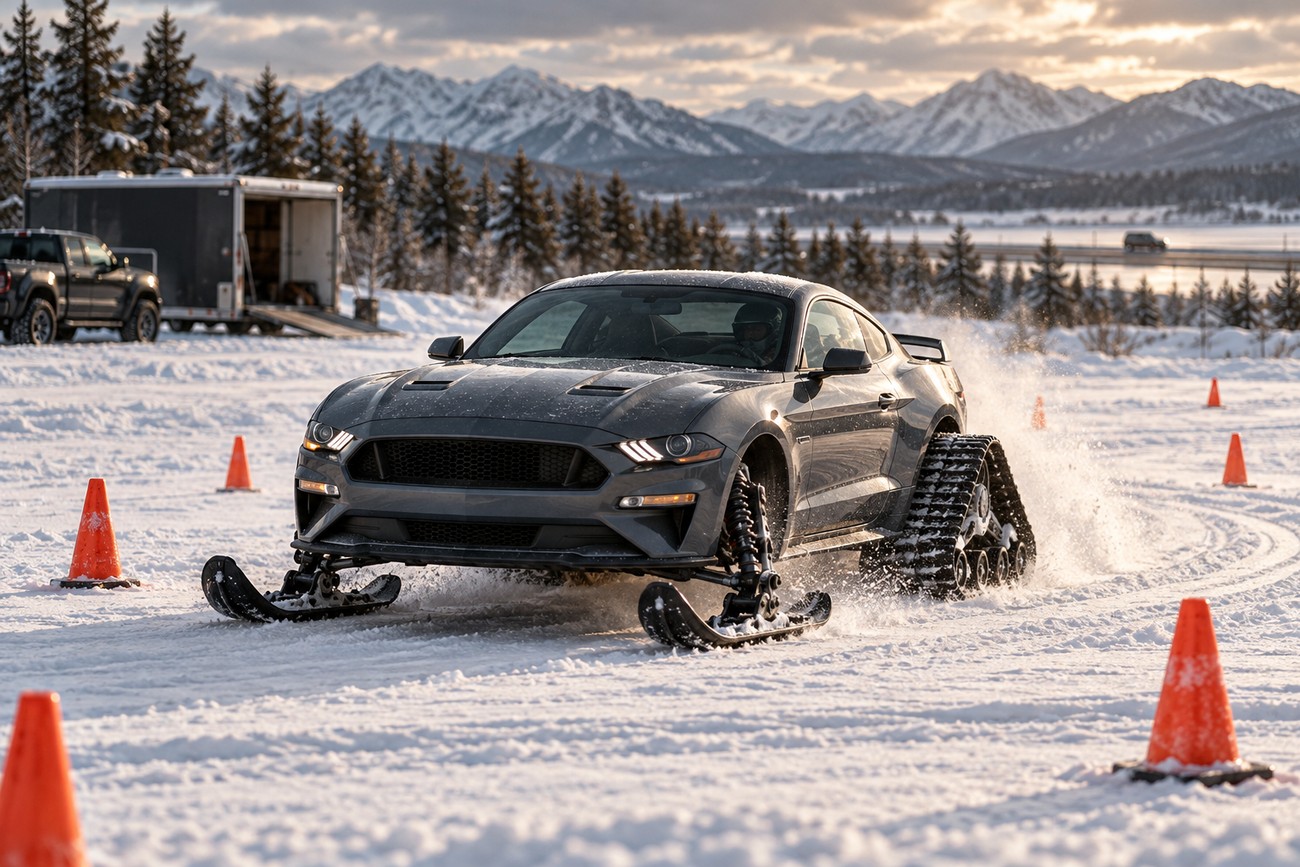
A controlled off-road demonstration is different from driving a converted car on a public road. A closed area can limit exposure to other traffic and provide space to assess stopping and turning, but it still calls for permission, suitable conditions, and a plan for a stuck or damaged vehicle. Access to a snow-covered site should not be assumed simply because it is away from a road.
Roadworthiness approval for a converted Mustang depends on jurisdiction; ski runners are not a universally accepted replacement for road tires. An approval process may examine steering, braking, lighting, and the integrity of the attachments. Checking local requirements before a build is more useful than discovering afterward that its layout cannot be registered for the intended use.
Permission to enter a snow area is a separate issue. Trail rules and land access may restrict vehicle types even where a modification has some form of road approval. A permitted demonstration site does not automatically permit travel on nearby trails or roads.
The realistic appeal is an inventive, entertaining machine for carefully controlled conditions. A ski-equipped Mustang remains a heavy, modified car, not a purpose-built snowmobile. It should not be presented as a dependable winter commuter on the strength of a few successful snow runs.
Frequently asked questions
A ski-equipped Mustang must be assessed as a modified road car, not as a purpose-built snowmobile. Its performance depends on the snow surface, the conversion’s contact points, and the condition of its attachments. Turning, braking, clearance, and recovery all matter alongside forward traction.
How bad is an unmodified Mustang in the snow?
An unmodified Mustang’s behavior depends heavily on its tires, the depth and condition of the snow, and how gently it is driven. Suitable winter tires can improve grip for starting, steering, and braking on winter roads, while cautious throttle and steering inputs help avoid sudden loss of traction. Deep snow can still stop the car when its low underside meets the surface, regardless of tire choice.
How should a stuck ski-equipped Mustang be recovered?
First, stop trying to drive out if the car is digging in or a runner appears trapped. Assess what is buried, including skis, driven wheels or tracks, steering parts, and the underside, before arranging recovery. Pulling on a ski runner or steering component can add damaging loads; recovery loads should go through verified recovery points, with a suitable recovery professional involved if those points or the vehicle’s condition are uncertain.
Why was the Ford Mustang called a pony car?
“Pony car” is the category name that grew from the Mustang’s name and the type of car it popularized: a sporty, relatively compact car with a long hood and short rear deck. In this article, the term identifies the Mustang’s road-car origins. Ski runners change its contact with snow, not the design purpose behind the original car.







