
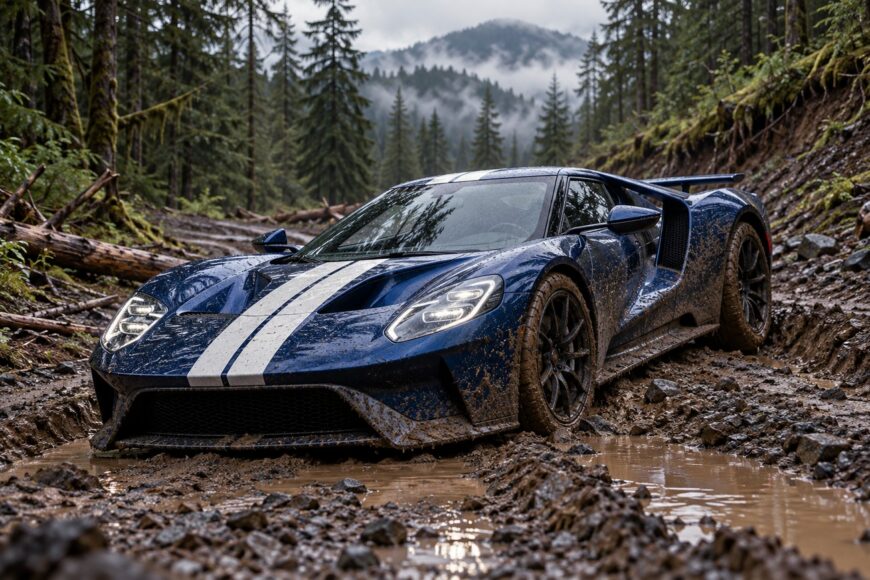
The Ford GT carries Le Mans authority onto a narrow, rutted logging road, where that reputation meets a different set of limits. This is a physical assessment of the second-generation road car, not a report of a particular drive. The choice is to inspect the route and turn back if it cannot be cleared, or risk contact with parts designed for smooth pavement.
Its mid-engine layout, carbon-fiber body, low clearance, wide track, and road tires define the limits. Power is plentiful; clearance, tire grip, and body protection are not.
- A Le Mans Name on the Wrong Surface
- Where Ruts Catch the Body Before the Wheels
- Why 647 hp Cannot Create Grip in Mud
- The Sensible Decision Before Damage
- Frequently asked questions
- What should you check after the Ford GT scrapes its underside?
- How should a Ford GT be recovered if it gets stuck?
- Was Carroll Shelby at the track when Ken Miles died?
- How much is the Le Mans Ford GT worth?
- How fast did the Ford GT40 reach its top speed at Le Mans?
A Le Mans Name on the Wrong Surface
The second-generation road Ford GT is a mid-engine supercar, while the Le Mans race versions were separately prepared vehicles. Their suspension, aerodynamics, and operating environment were different. Racing heritage therefore says little about how the road car will handle a muddy logging track.
The road GT’s 3.5-liter EcoBoost V6 was rated at 647 hp and approximately 746 Nm. That output is useful on clean pavement, where the tires can transmit it and the suspension can work within its design range. Loose gravel and wet clay remove much of that advantage.
A low, aerodynamically shaped car needs a smooth surface and predictable transitions. Ruts, washboard ridges, and sharp stones impose impacts and sudden changes in load. Track-capable describes the GT’s paved-surface heritage; it does not establish suitability for mud or deep ruts.
Where Ruts Catch the Body Before the Wheels
The first danger appears at the entrance to a rut. The low nose and front splitter can meet the edge before the tires reach the bottom. Limited approach geometry then makes a slow, careful arrival more important than momentum.
At the crest or a diagonal crossing, the underside can become the lowest point. A long wheelbase and limited breakover geometry make the car vulnerable where a road changes angle. Diagonal loading may also reduce contact at a driven wheel, even when the obstacle itself looks modest.
Width leaves little room between banks, branches, and loose stone. Poor downward sightlines make wheel placement harder, while dry gravel can abrade lower body surfaces without a dramatic impact. A gentle pass can still damage the splitter, underside, or other aerodynamic parts.
Why 647 hp Cannot Create Grip in Mud

The road GT’s 3.5-liter EcoBoost V6 produces 647 hp and approximately 746 Nm, yet the surface determines how much of that can reach the ground. Road-oriented, low-profile tires offer less purchase in mud than tires designed for loose terrain. Wet clay can make steering and braking feel uncertain within a short distance.
Gentle throttle helps preserve the grip that remains. A sharp opening of the accelerator can spin the rear tires, polishing the surface and reducing forward progress. More torque then increases wheelspin rather than creating traction.
Electronic aids can moderate slip and help the driver manage available grip. They cannot create grip that the mud, gravel, and tires lack. On washboard ground, speed also adds suspension impact and makes braking less predictable, so maintaining control matters more than preserving momentum.
The Sensible Decision Before Damage
A common mistake is to straddle a deep rut as an SUV would. The GT’s low center section, nose, and limited approach and breakover geometry may leave it resting on the ground. Carrying speed over sharp gravel adds risk to low-profile tires, wheels, and lower body surfaces.
Wheelspin is another poor recovery plan. It can dig the driven tires into soft ground while throwing stones at vulnerable panels. Track settings and racing associations do not change the basic clearance problem.
Assess the whole route first, including the far side of each depression. Turn back when the nose, center of the car, or tires cannot clear the surface with margin. A Le Mans racing heritage does not make the road GT suitable for a rutted logging road.
Frequently asked questions
The questions below cover what to check after a scrape and how to handle a stuck GT. They also address distinctions between the road car and Ford’s race cars. Those distinctions matter when discussing Le Mans history and value.
What should you check after the Ford GT scrapes its underside?
Stop safely and inspect for fluid leaks, loose panels, exposed or cracked aerodynamic parts, and tire or wheel damage. A scrape that looks cosmetic may have disturbed a mounting point or underbody component. If anything is loose, leaking, or unclear, arrange a qualified inspection before driving farther.
How should a Ford GT be recovered if it gets stuck?
Consult the owner’s guidance and use appropriate professional recovery assistance. Do not attach a strap to the splitter, suspension component, or any unverified point; fragile aerodynamic parts are not recovery equipment. A suitable method must protect the low body and keep loads controlled.
Was Carroll Shelby at the track when Ken Miles died?
No. Ken Miles died during testing of the Ford J-car at Riverside International Raceway in August 1966, and Carroll Shelby was not at that test session. The accident concerned a development race car, separate from the later road Ford GT.
How much is the Le Mans Ford GT worth?
There is no single value. A Le Mans Ford GT’s worth depends on the exact chassis, race history, originality, documentation, and auction conditions. A road-going second-generation Ford GT belongs to a different market and should not be valued as a race car.
How fast did the Ford GT40 reach its top speed at Le Mans?
The GT40 is commonly associated with a top speed of about 210 mph on the Mulsanne Straight. The exact figure varied with engine, gearing, aerodynamics, and circuit conditions, so it should be treated as an approximate racing-era figure rather than a universal specification.







