
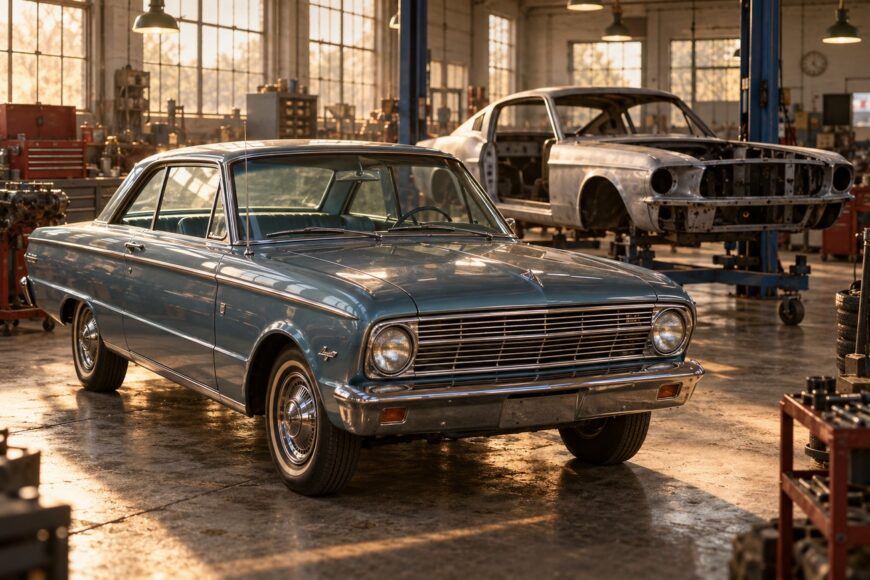
The claim that the Ford Falcon launched the Mustang is familiar, and it is broadly correct. The 1960 Falcon gave Ford a compact unibody platform, proven running gear, and a practical package that could be adapted for a new kind of sporty car. Yet the Mustang was not simply a Falcon Futura with different styling: it also used Fairlane components, a new body, and a slightly shorter wheelbase.
That distinction matters if you are considering a Falcon Futura today. It may be an overlooked piece of Mustang history, or it may be an expensive substitute with structural rust, weak brakes, incorrect identification, and scarce body parts. The badge, paint, and engine bay tell only part of the story. Model year, body style, documentation, and the condition of the unibody must be judged together.
- The Falcon Futura’s Place in the Mustang Story
- What the Futura Name Actually Meant
- From Falcon Sprint to Mustang: Similar Hardware, Different Car
- Why Ford Put Falcon Hardware Under the Mustang
- The Ownership Reality: Rust, Brakes, Power and Parts
- Buying and Restoring a Futura Without Chasing the Mustang Myth
- Frequently asked questions
- What makes a Falcon a Futura?
- What is the holy grail of Mustangs?
- Was every Falcon Futura equipped with a V8?
The Falcon Futura’s Place in the Mustang Story
The Ford Falcon debuted for the 1960 model year as a compact Ford. Its job was practical rather than glamorous: provide economical transportation in a smaller package while retaining the familiar Ford service network. The car’s compact dimensions and simple construction made it useful to Ford’s product planners as well as to ordinary owners.
That usefulness became important when Ford began shaping the Mustang. A clean-sheet new car was estimated to cost approximately $400 million, a figure that encouraged the company to reuse proven compact-car hardware. The Falcon platform and many Falcon components could support a new body and a more expressive sales concept without forcing Ford to develop every mechanical system from the ground up.
Calling the Mustang a rebodied Futura is therefore too simple. The Mustang used the Falcon platform and many of its components, while also drawing on Fairlane components and receiving a new body. Its wheelbase was slightly shorter than the Falcon’s, and its suspension, trim, packaging, and market positioning were developed for a different purpose.
The historical connection is strongest when understood as an engineering strategy. Falcon hardware gave Ford a reliable starting point; the Mustang added visual drama and a carefully targeted lifestyle package. That combination helped create a new model without abandoning the cost and service advantages of existing Ford production.
What the Futura Name Actually Meant
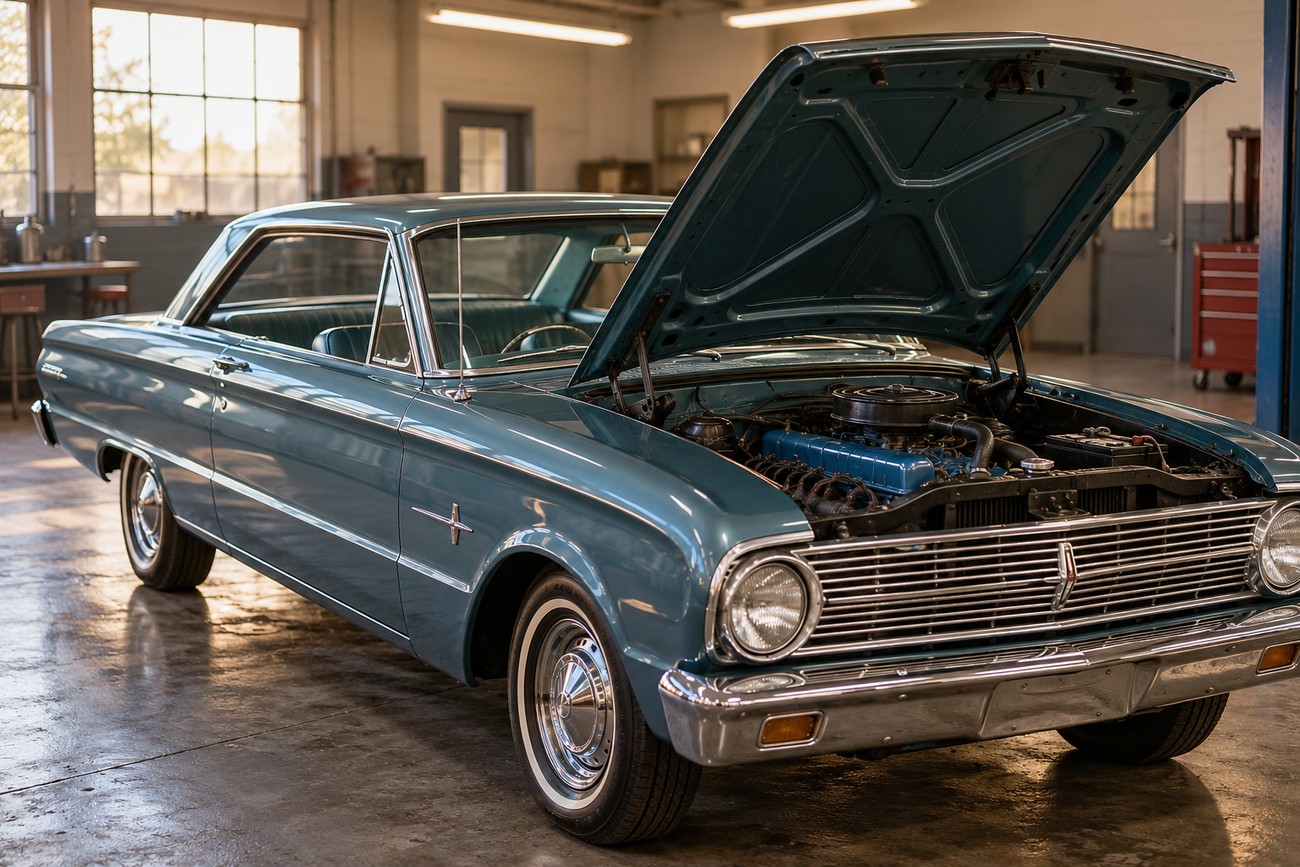
Futura was a better-equipped, more stylish Falcon version, not a synonym for V8, Sprint, or Mustang. It was offered as a hardtop and a four-door sedan, giving buyers a more distinctive Falcon without requiring the mechanical specification associated with the later Mustang connection.
Not every Futura was equipped with a V8. The Falcon first received a V8 in 1963½, so earlier Futura cars could be six-cylinder automobiles. Even after the V8 became available, engine choice remained a separate question from the Futura trim and body-style designation.
Badges and bright trim are useful clues, but they are not proof of an original specification. A replacement emblem, a repaint, or a transplanted engine can make an ordinary car appear to be a rare version. A serious identification process checks the model year, body style, engine, factory documentation, and surviving equipment together.
Year-specific research is essential before ordering parts. Falcon body panels, brakes, wiring, and suspension details changed across model years, and a part listed for a similar-looking car may still be wrong. This is one reason a glossy project can become difficult quickly: its visible identity may be clearer than its actual production history.
From Falcon Sprint to Mustang: Similar Hardware, Different Car
The mechanical bridge to the early Mustang is closer in the 1963½ Falcon Sprint than in an ordinary Futura. That was when the Falcon first received a V8, specifically the 260-cubic-inch engine. The Sprint was offered as a hardtop and convertible, giving Ford a compact car with a more direct performance-oriented specification.
Approximately 15,000 Falcon Sprints were produced. Their importance is greater than their numbers suggest because the Sprint assembled the compact Falcon architecture with the V8 configuration that most clearly anticipated the early Mustang formula. An ordinary six-cylinder Futura remains historically relevant, but it is a less direct mechanical reference.
The Mustang debuted on April 17, 1964. It used the Falcon platform and many Falcon components, along with Fairlane components and an entirely new body. Its slightly shorter wheelbase, different body structure, revised settings, and model-specific details mean that shared architecture does not make the two cars mechanically identical.
This distinction matters during restoration. A Falcon Sprint and an early Mustang may share an engine family or broad suspension ideas, while differing in brackets, geometry, wiring, sheet metal, and trim. Assuming interchangeability because two parts look related is a reliable way to waste money.
The Sprint is best viewed as a close evolutionary reference, not a hidden Mustang. It shows how Ford tested the ingredients that later made the Mustang commercially compelling. The Futura belongs in that story, but its trim identity should not be confused with the Sprint’s performance configuration.
Why Ford Put Falcon Hardware Under the Mustang
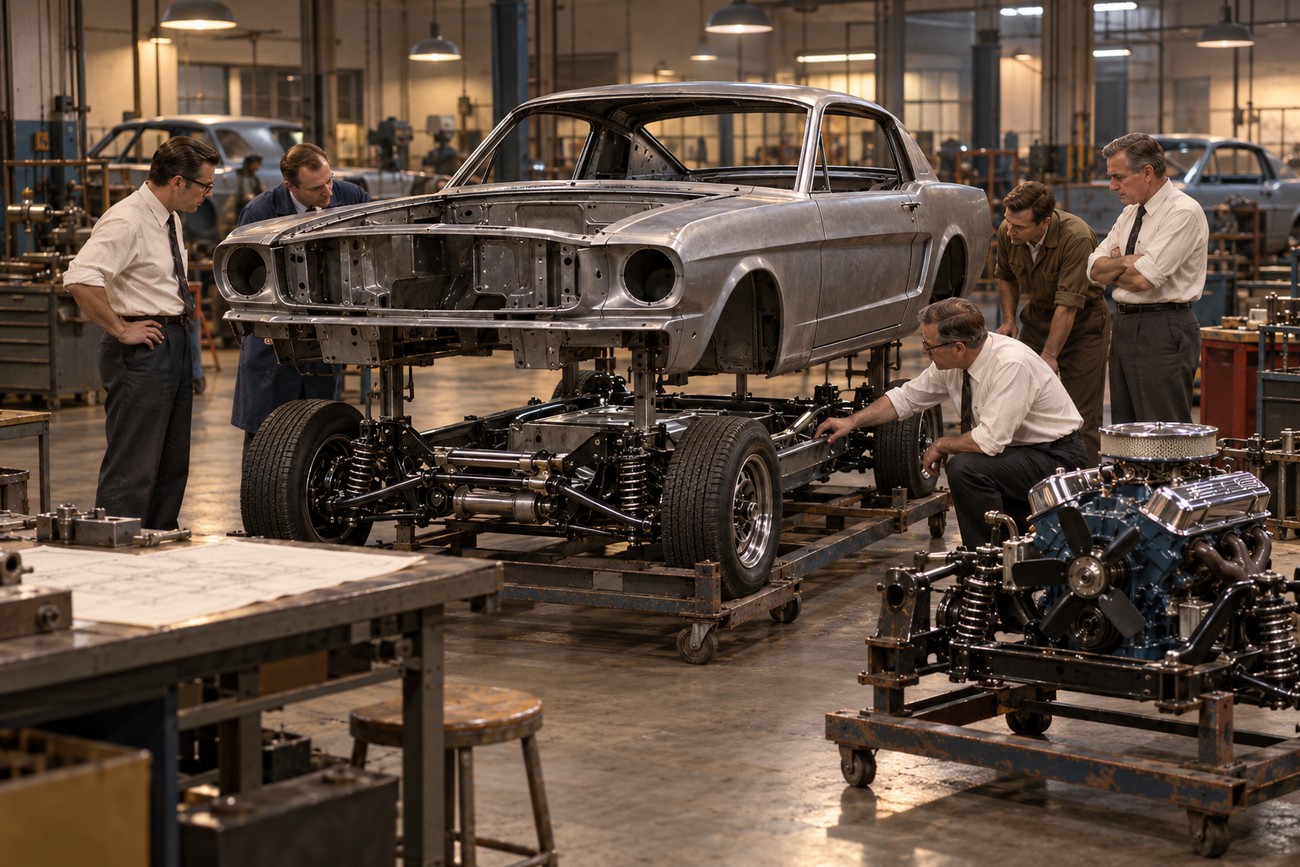
Ford’s reuse strategy matched the Mustang’s intended package: four seats, a trunk, weight below 2,500 pounds, and a price below $2,500. Those targets demanded practical proportions and controlled production costs. Falcon hardware made the project easier to manufacture and service while leaving the designers room to create a fresh-looking body.
Ford’s 1964 brochure listed 164 horsepower for the specified 260 V8. That figure applies to that particular 260 V8 specification; it does not describe every Falcon Futura. A six-cylinder Futura and a V8-equipped car should never be represented as equivalent simply because both carry the same trim name.
Falcon-era equipment could also include power steering, power brakes, and air conditioning. Such options help explain why two cars with similar external appearance can have very different ownership value. Factory equipment, correct documentation, and originality often matter more than a later engine upgrade when the car is being assessed historically.
The Mustang’s success came from combining familiar engineering with a new identity. Ford did not need to make the car completely new underneath to make it feel new to buyers. That was the commercial strength of the approach, and it is also why the phrase “built from a Falcon” is useful only when it is accompanied by the Fairlane and new-body qualifications.
The Ownership Reality: Rust, Brakes, Power and Parts
The Falcon uses a unibody structure rather than a separate full frame. Rust in the rockers, suspension towers, subframe attachment areas, or floor panels can therefore affect body geometry. Repairing corrosion in those areas is substantially more involved than replacing a damaged panel on a car with a separate frame.
A shiny exterior can conceal a car that has lost structural accuracy. Before judging paint, upholstery, or engine presentation, inspect the load-bearing areas and look for previous repairs, uneven gaps, distorted mounting points, and evidence of water retention. A structurally compromised project can absorb the budget intended for mechanical improvements.
Structural alignment and attachment points deserve inspection before cosmetic parts are purchased or a V8 conversion is planned. A car that is difficult to square on a lift will remain difficult to restore, regardless of how complete its trim appears.
Stock drum brakes and the original rear axle can feel inadequate to drivers accustomed to modern cars. Six-cylinder Falcons are generally regarded as dependable, yet they can feel underpowered, particularly with an automatic transmission. Early economy-oriented versions also offered limited sound insulation and basic ventilation, so long-distance comfort may be more demanding than the car’s appearance suggests.
Parts availability is another practical constraint. Mechanical service items are usually easier to source than correct body panels and trim, while restoration parts may require club networks, dismantles, and specialist searches. Available technical archive material confirms some Futura specifications for 1961–63, but it does not provide complete failure statistics; it should not be treated as a comprehensive reliability survey.
Buying and Restoring a Futura Without Chasing the Mustang Myth
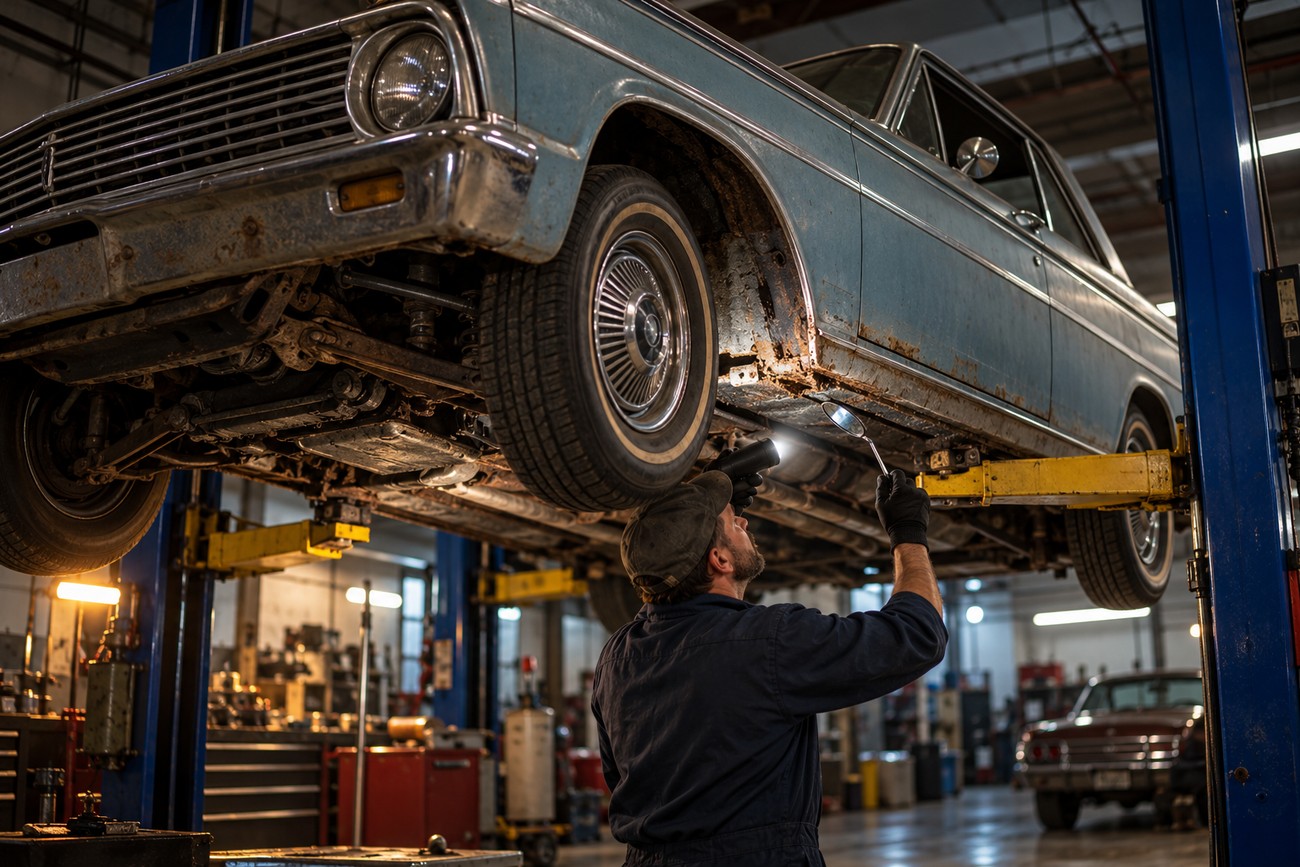
Begin with the structure, not the story. Inspect the rockers, suspension towers, subframe attachment areas, and floor panels before deciding that a car is a bargain. Rust in those locations can change the repair plan from routine restoration to major unibody reconstruction.
Next, verify the car’s identity. A Futura badge alone cannot establish Sprint or V8 specification, and a replacement engine cannot prove what the car carried when new. Record the model year, body style, engine, transmission, option evidence, and surviving paperwork before ordering parts or assigning collector value.
Parts research should follow the model year rather than a broad internet search. Body panels, brakes, wiring, and suspension parts changed over the Falcon’s production life. Confirming the exact application first is cheaper than modifying an incorrect part or discovering that several supposedly interchangeable components require different mounting details.
A V8 conversion requires coordinated attention to brakes, steering, cooling, and related systems. Leaving unsuitable stock equipment in place can create an unpleasant or unsafe combination, even if the engine itself runs well. Disc brakes and power steering may improve usability, but they can reduce originality and may require further changes to preserve correct geometry and balance.
Falcon values are usually lower and less liquid than Mustang values, although a strong original car may be overlooked. Compare a Futura with a Mustang only after accounting for specification, condition, documentation, originality, and equipment. A cheaper purchase price does not automatically mean a cheaper restoration, especially when rare body parts and unibody work are involved.
Frequently asked questions
The Falcon connection is easiest to understand when trim, engine specification, and historical importance are kept separate. These answers address the identification and enthusiast terminology that most often causes confusion.
What makes a Falcon a Futura?
Futura identifies a Falcon trim and body-style designation, not an automatic V8 specification. Practical identification requires checking the model year, whether the car is a hardtop or four-door sedan, the engine, factory equipment, and surviving documentation. Badges and appearance can support that assessment, but they cannot replace it.
Pay particular attention to changes between model years. Panels, brakes, wiring, and suspension components may differ even when two cars look closely related. A documented, structurally sound six-cylinder Futura can be more credible and useful than a modified car wearing more impressive badges.
What is the holy grail of Mustangs?
Enthusiasts usually use “holy grail” for a Mustang that is especially rare, historically significant, or focused on competition. The phrase does not apply automatically to every Mustang connected to the Falcon platform, and it does not turn a Falcon Futura into a Mustang.
The Futura’s importance is different: it represents the compact Ford engineering and market strategy that helped make the Mustang possible. The 1963½ Falcon Sprint is the closer Falcon reference for the early Mustang’s V8 configuration, while the Mustang itself remains a separate car using Falcon and Fairlane components with its own body and specifications.
Was every Falcon Futura equipped with a V8?
No. Futura was a trim and body-style designation, while engine choice was a separate specification. Earlier Futura models could use a six-cylinder engine, and the Falcon did not receive a V8 until 1963½.
To establish whether a particular car originally had a V8, check its model year, factory documentation, surviving equipment, and engine details rather than relying on badges or a later engine swap.







