
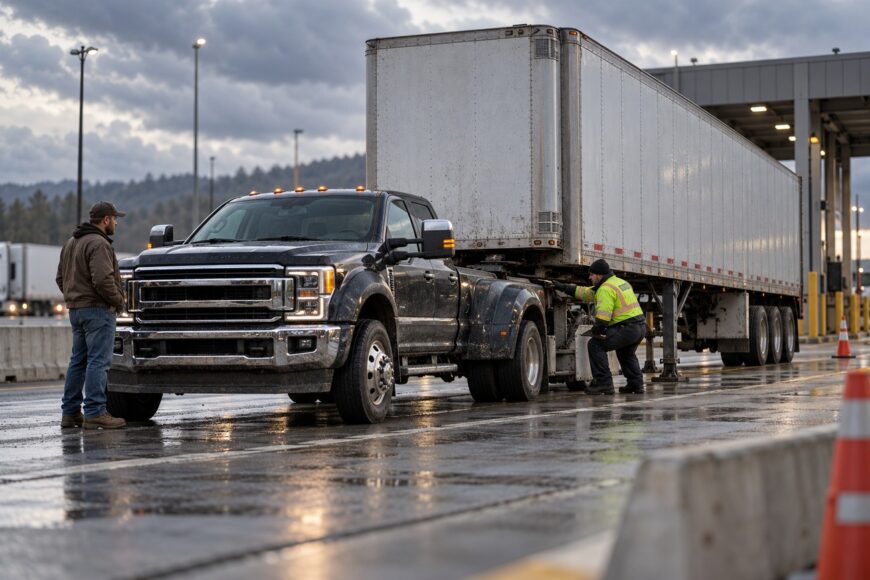
An F-450 may move a semi trailer and still fail a roadside inspection or fall outside its insurance coverage. Engine power and an advertised tow rating do not establish that the truck can legally or safely operate with that trailer on a public road.
In the United States, the answer is conditional: the specific truck, trailer, driver, use, and route must satisfy applicable weight ratings, equipment rules, licensing, registration, and road restrictions. A trailer built for a highway tractor raises questions that ordinary pickup towing figures cannot answer.
- Is It Legal for a Ford F-450 to Pull a Semi Trailer?
- How Much Can an F-450 Legally Tow? Read Every Rating
- Why the Fifth-Wheel Connection and Air Brakes Matter
- When CDL and Commercial-Use Rules Apply
- The Roadside Problems a Tow Rating Cannot Solve
- Check This Exact Combination Before You Buy or Tow
- Frequently asked questions
- What documents should I have available at a roadside inspection?
- Does a semi trailer need a periodic DOT inspection when an F-450 tows it?
- How much can an F-450 legally tow?
Is It Legal for a Ford F-450 to Pull a Semi Trailer?
Sometimes. There is no blanket rule that makes every F-450–semi trailer combination legal, and the F-450 name, diesel engine, or dual rear wheels confer no special towing authority. The legal answer starts with the exact vehicles and the trip you intend to make.
A commercial semi trailer is typically designed to carry part of its weight on a tractor through a kingpin and fifth-wheel connection. That differs from a pickup-oriented fifth-wheel trailer, whose coupling height, electrical system, and brakes are generally designed around pickup equipment. A truck that can pull one type may be unsuitable for the other.
The combination must pass separate tests: vehicle and component ratings, a secure coupling and functional brakes, a properly qualified driver, and applicable registration and operating rules. Personal use can change which rules apply, but it is not an automatic exemption. The same trailer may also face different restrictions on different routes or across state lines.
How Much Can an F-450 Legally Tow? Read Every Rating
Ford specifications commonly cite up to approximately 30,000 lb for conventional towing and 40,000 lb for fifth-wheel or gooseneck towing. Those are configuration-dependent reference points, not permissions for every F-450 or every trailer. Model year, drivetrain, cab, equipment, and towing method can change the applicable figure.
Start with the truck’s model-year towing guide and its vehicle labels. Compare gross combination weight rating (GCWR) with the loaded truck and trailer together; then check the truck’s gross vehicle weight rating (GVWR) and front and rear axle ratings. Pin weight, passengers, cargo, and installed equipment all count against the truck’s limits, even when the trailer remains below a published tow maximum.
The hitch, its installation, and the tires must also be rated for the loads they carry. Weighing the loaded combination helps establish actual loads, but it does not replace a check of rated weights. Some licensing and operating thresholds can depend on ratings rather than what an empty trailer happens to weigh that day.
Why the Fifth-Wheel Connection and Air Brakes Matter
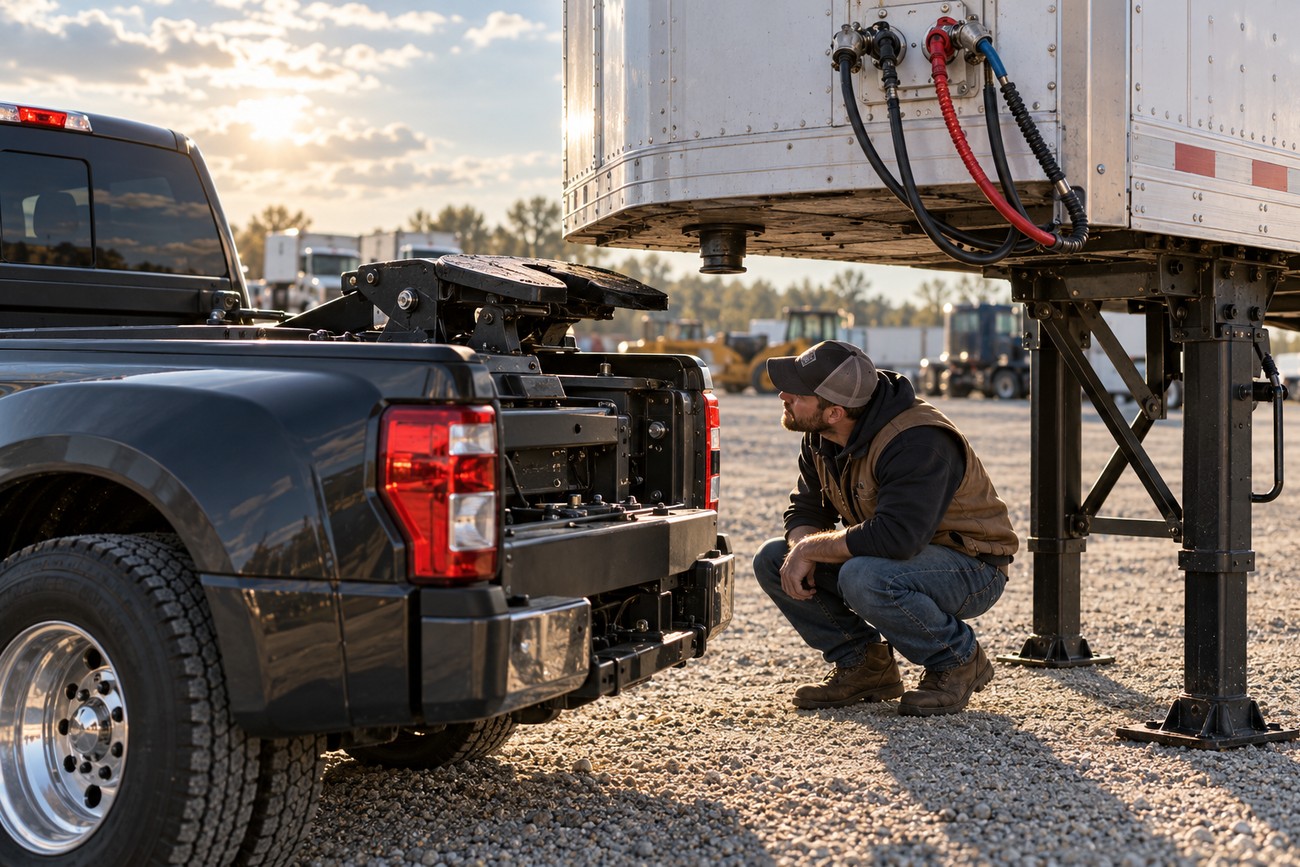
A tractor-oriented trailer may have a kingpin, plate height, and operating geometry that do not suit a pickup fifth-wheel installation. Verify that the coupling and its mounting are designed for the trailer’s pin load and that the trailer can turn without striking the cab or bed. Adequate clearance must remain as the truck and trailer move over uneven ground.
Coupling successfully in a yard proves less than it appears to. A trailer can latch to a hitch while sitting at an unsuitable ride height, leaving too little clearance or shifting load between its axles. Check kingpin engagement, ride height, and axle loading before specifying any adapter or hitch change.
Many commercial semi trailers use air brakes, which need a compatible, functional air supply and control system. A standard pickup electric brake controller does not provide that system by itself. Lighting and electrical connections must work as required, too; a stronger hitch cannot compensate for inoperative trailer brakes or mismatched interfaces.
When CDL and Commercial-Use Rules Apply
Where federal commercial driver’s license (CDL) rules apply, the general Class A framework covers a combination with a GCWR or actual gross combination weight of at least 26,001 lb and a towed unit with a GVWR or actual gross vehicle weight greater than 10,000 lb. The applicable rated or actual weight matters under the rule, so unloading the trailer does not necessarily change the licensing result. Exemptions, the nature of the operation, and state rules still need review.
Federal CDL rules and state driver-licensing rules are related, but they are not interchangeable. A state may set requirements for intrastate or noncommercial driving that differ from the federal commercial framework. Confirm the license class for the intended use with the relevant licensing authority before relying on a private-use assumption.
The phrase “air-brake endorsement” is often used loosely. Under federal CDL rules, air-brake qualification is generally addressed through an air-brake restriction on the license, rather than a standalone federal endorsement. Driver qualification does not cure an incompatible brake system: the truck must still be equipped to operate the trailer’s brakes correctly.
Registration and operating obligations require their own check. Depending on the jurisdiction and operation, commercial registration, apportioned plates, permits, medical qualification, or other commercial-vehicle rules may apply; a semi trailer does not trigger all of them in every case. Neither an empty trailer nor personal use automatically removes licensing, equipment, or registration duties.
The Roadside Problems a Tow Rating Cannot Solve
A combination can meet its weight ratings yet exceed a route’s width, length, or weight limits. State rules, posted roads, and permit conditions may determine where it can travel. Check the entire route, especially if the trip crosses state lines or uses local roads to reach a loading site.
Insurance deserves a separate call before the trailer is attached. A policy written around ordinary pickup towing may treat a commercial semi trailer, its cargo, or modifications to the truck differently. Describe the actual trailer, connection, and use to the insurer, and obtain confirmation of the coverage that applies.
Roadside inspection also exposes faults that a tow-rating calculation cannot: brake operation, lights, coupling security, tires, and documentation. Long descents and emergency stops test the braking system; tight turns and uneven entrances test clearance. These are checks for the proposed combination, not claims that every F-450 is incapable of towing it.
Check This Exact Combination Before You Buy or Tow
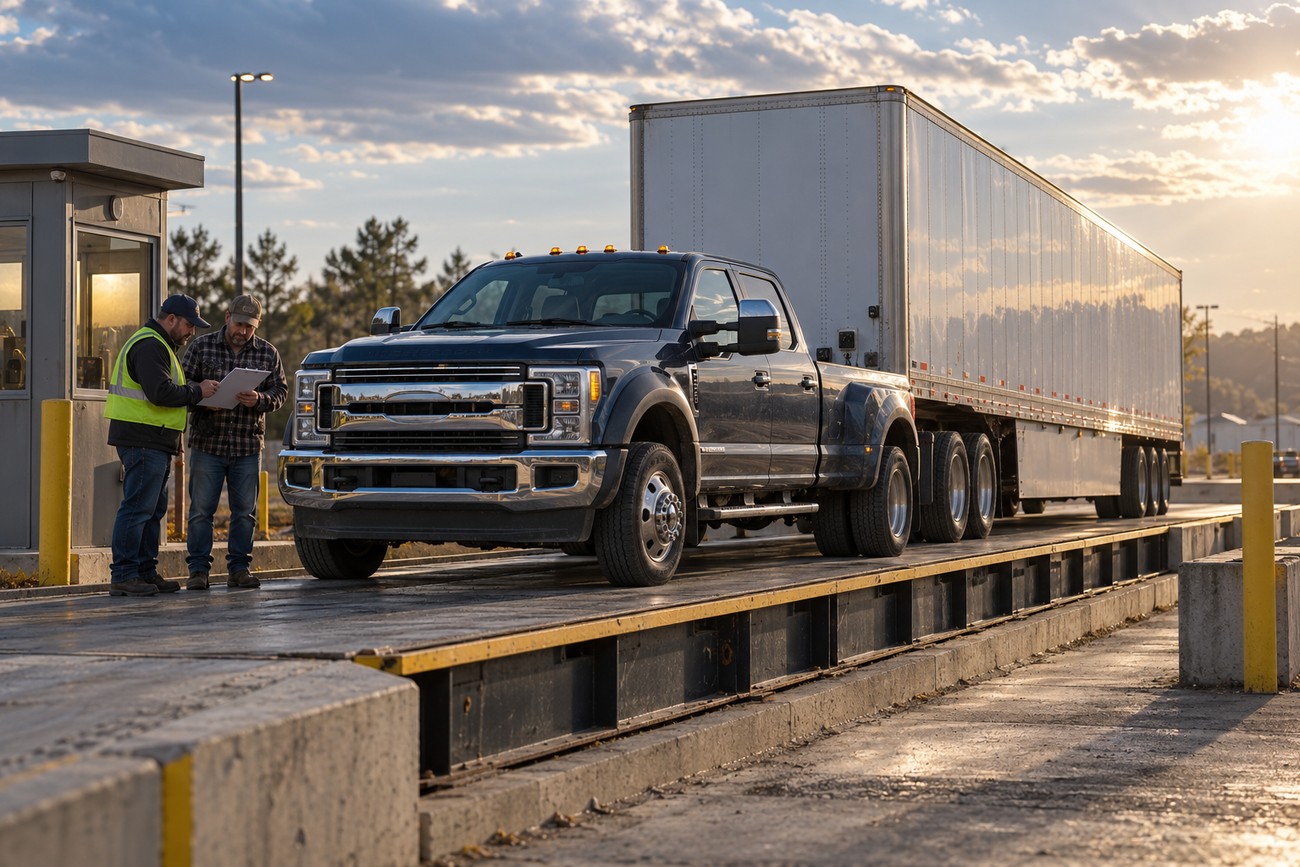
Collect the truck’s model-year towing guide, door-label ratings, and details of any installed towing equipment. Obtain the trailer’s identification, rated weights, and specifications for its kingpin, brakes, electrical connections, axles, and tires. This establishes what you need to verify before paying for a hitch or other modifications.
Next, calculate the expected loaded weights and pin load, then check each rating and the physical connection. Where possible, weigh the loaded truck and trailer to confirm the actual combination and axle loads. A workable weight calculation is only one checkpoint; the brakes, coupling geometry, lights, and tires must also suit the trip.
Give the relevant DMV or DOT the truck and trailer details, intended use, and route so it can address licensing, registration, inspection, and permit questions. Describe the same setup to your insurer before entering a public road. Proceed only when every applicable rating, equipment requirement, and legal obligation checks out; a hitch upgrade alone cannot override the rest.
Frequently asked questions
Roadside paperwork, periodic inspections, and towing limits each require a separate check. What you need to carry or document depends on the truck, trailer, and operation. The answers below distinguish published towing figures from requirements for a specific trip.
What documents should I have available at a roadside inspection?
Have the truck and trailer registrations, proof of applicable insurance, your required license, and any permits the trip requires. Trailer identification and weight records can help an officer verify the combination, particularly where rated and actual weights differ. A towing guide or scale ticket may be useful evidence, but neither is a universally required substitute for legally required documents.
Does a semi trailer need a periodic DOT inspection when an F-450 tows it?
It may, if the operation falls under commercial-motor-vehicle rules that require periodic inspection. The pickup model alone does not decide that question, and state inspection rules can impose separate duties. Confirm whether the specific operation is covered and what inspection records must be carried or retained before the trailer goes on the road.
How much can an F-450 legally tow?
There is no single legal towing weight for every F-450. Ford’s approximate published maxima reach 30,000 lb for conventional towing and 40,000 lb for fifth-wheel or gooseneck towing in qualifying configurations, but the applicable limit is constrained by the exact truck’s ratings and the loaded combination’s hitch, axle, and tire loads. Legal road use also depends on the trailer, driver, equipment, and route.







