
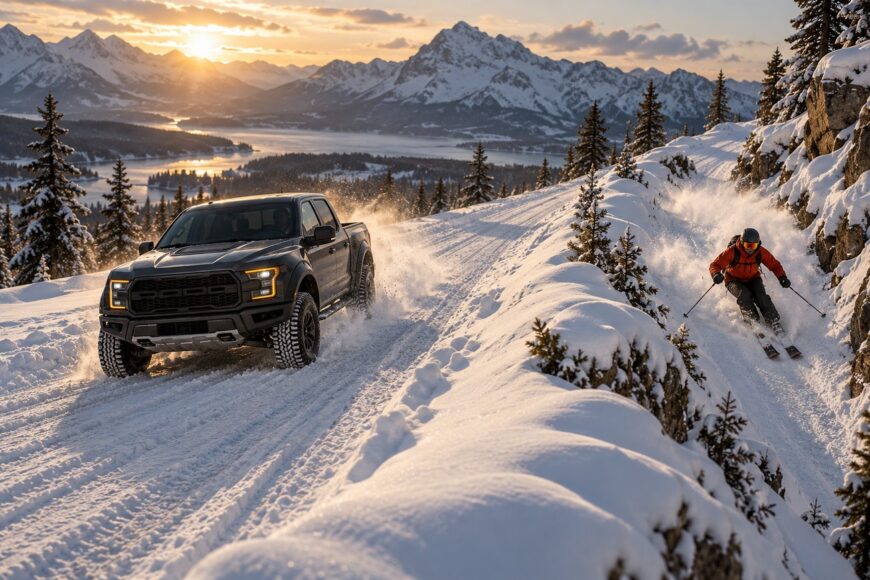
A full-size Ford F-150 Raptor dropping toward a mountain finish line alongside a downhill skier makes for a striking contest. The truck has suspension built to absorb rough ground; the skier can change direction within a fraction of the truck’s width. Once the slope turns icy or the course narrows, their advantages become much harder to compare.
Surface, slope, width, visibility, and starting method can change the result before either competitor reaches a turn. So can the distance available to brake. A ski run also has rules and safety systems intended for people on skis or snowboards, which may rule out a vehicle descent altogether. Any credible verdict needs a defined course and a controlled, legally permitted test.
- What This Mountain Descent Showdown Actually Measures
- Where the Ford F-150 Raptor Has a Real Advantage
- Why the Downhill Skier Can Win the Technical Sections
- Ford Raptor vs. Downhill Skier: Where Each Has the Edge
- Why Four-Wheel Drive, Big Tires, and Horsepower Do Not Settle It
- The Biggest Constraint Is Safety and Access, Not Speed
- The Verdict: Who Wins the Mountain Descent?
- Frequently asked questions
- Which Ford Raptor should you stay away from for a snowy descent?
- What is the Ford Raptor’s 0–60 mph time, and does it matter here?
- What truck is better than a Raptor for a mountain snow descent?
What This Mountain Descent Showdown Actually Measures
A finish time means little unless the Raptor and skier face the same slope profile, surface condition, course length, and starting conditions. Course width matters too: a broad corridor lets a pickup carry a line that would be impossible between the edges of a narrow run. Braking conditions must be specified, including where each competitor needs to slow or stop.
A start from rest tests something different from a rolling entry. Giving the truck a run-up while the skier starts stationary would favor the truck; allowing both to enter already moving would shift attention toward cornering and speed control. Even on one marked route, a line chosen by a skier may be too tight for a full-size pickup to follow.
The useful measures are acceleration, line control, turning room, braking margin, and completed descent time. Recording a peak speed alone misses the point if that speed cannot be carried through the next bend or safely shed before the finish. A completed run also requires a controlled stop, rather than simply crossing a line at speed.
The Raptor’s reputation for rapid off-road travel is relevant to broken terrain, but it cannot stand in for a snow-course result. Likewise, a skier’s speed from a separate downhill event says little about this particular slope. Both claims need the same course beneath them before they become a comparison.
Where the Ford F-150 Raptor Has a Real Advantage
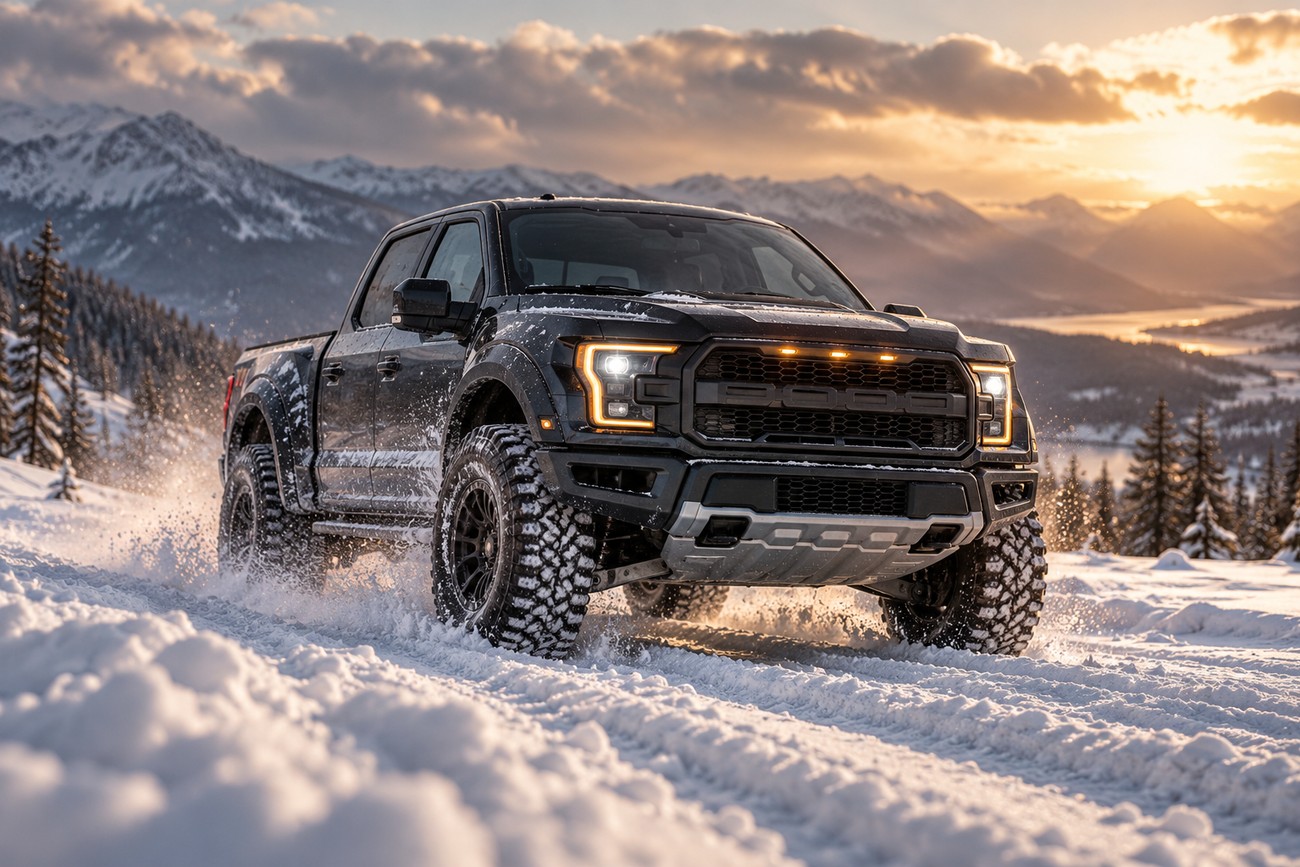
The Ford F-150 Raptor is a full-size off-road pickup with long-travel suspension, a reinforced frame, off-road tires, and a wide track. It is designed for high-speed travel over broken off-road terrain, where the suspension can keep the tires in contact as the surface changes. That makes rough, open ground a more natural setting for it than a marked ski run.
Ground clearance is approximately 12-plus inches. Along with suspension travel, that gives the truck room to negotiate uneven snow and underlying bumps that might disrupt a lower vehicle. The wide track can support stability on open terrain, provided there is enough space to choose a suitable line.
The Raptor’s most plausible advantage is on a wide, smooth, prepared snow corridor where it can maintain speed without abrupt turns. There, its ability to roll over modest irregularities and sustain momentum could count. The advantage remains conditional on tires finding usable grip and on there being enough distance to brake.
Those same dimensions become liabilities as the corridor tightens. A wide truck needs more room around markers and snowbanks, while its long wheelbase limits the lines it can take through closely spaced turns. Clearance cannot make a narrow passage wider or turn hard ice into a predictable surface.
Electronic aids can help a driver manage power and vehicle motion off-road. They do not eliminate the limits of tires, brakes, geometry, or a ski course’s hard edges and safety fencing. A setting intended for broken ground should not be read as an endorsement of driving down a ski slope.
Why the Downhill Skier Can Win the Technical Sections
A skier occupies a much smaller part of the slope and can revise a line quickly as the terrain changes. On a steep, narrow, technical section, that small turning footprint may be more useful than the Raptor’s ability to carry speed across open ground. The skier can aim through a gap that offers the truck no workable path.
Skier speed varies substantially with ability, discipline, and slope. Recreational skiing commonly involves speeds in the tens of kilometers per hour; elite speed disciplines can be substantially faster. Neither description establishes how a particular skier would perform on a shared course, especially one shaped to accommodate a vehicle.
Lower mass also changes the consequences of a correction. A skier who sees a patch of different snow may be able to alter edge pressure and line within a short distance, while a heavy pickup needs room to redirect its momentum. The skier still needs grip and visibility; ice and hidden terrain can defeat a hurried correction on skis as well.
A technical course can therefore favor the skier even if the Raptor accelerates strongly on an open stretch. Width, turning requirements, and the space needed to slow the truck may set its usable pace well below its potential speed. That is a course-dependent advantage for the skier, not a claim that skis are always faster downhill.
Ford Raptor vs. Downhill Skier: Where Each Has the Edge
These are conditional advantages, assuming both can use the same controlled course.
| Factor | Ford F-150 Raptor | Downhill skier |
|---|---|---|
| Acceleration | Can build speed effectively where the surface provides traction and the route is open. | Depends on gradient, technique, and the starting method. |
| Braking | Greater mass increases inertia and reduces braking margin on low-grip snow or ice. | Can regulate speed with turns and edges, subject to snow grip and available space. |
| Loose snow | Clearance and suspension help on uneven, open terrain; tire grip still matters. | Can adjust the line, though deep or inconsistent snow can slow a skier. |
| Hard ice | Stopping and turning become difficult when the tires have little grip. | Edge hold can also deteriorate; the skier has less mass to redirect. |
| Narrow technical turns | Width and wheelbase restrict line choice. | Smaller turning footprint favors rapid line changes. |
| Wide prepared snow | May maintain speed effectively if the corridor avoids abrupt turns. | Can travel quickly, but has less advantage from a compact line. |
| Visibility | Needs a clear view far enough ahead to choose a line and brake. | Also needs sight distance, but can generally adjust within a smaller space. |
| Course restrictions | Requires explicit permission and a course made safe for vehicle use. | Standard ski runs are designed and marked for skis or snowboards. |
The table describes what each could exploit under suitable conditions. It is not a sanctioned race result, and access restrictions may prevent the comparison from being run at all.
Why Four-Wheel Drive, Big Tires, and Horsepower Do Not Settle It
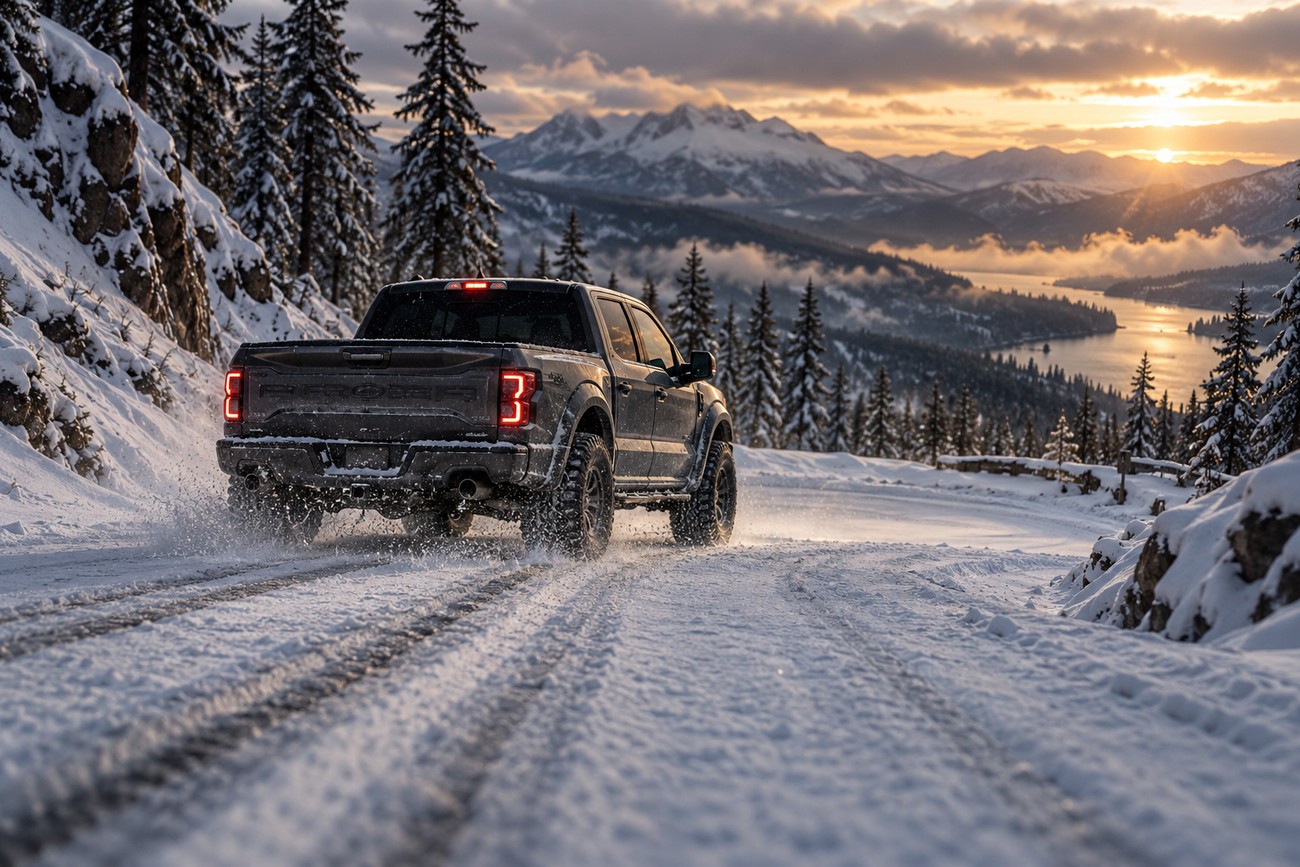
Four-wheel drive can help distribute driving force, but it does not guarantee control on snow or ice. Tires, surface condition, mass, and available friction remain decisive when the driver turns or brakes. Adding power cannot restore grip that the surface will not provide.
The Raptor’s greater mass increases inertia and reduces braking margin on a slippery descent. A truck that feels settled while accelerating may require much more space than expected to slow for a bend. On a downhill route, speed gained early has to be managed for every corner and for the final stop.
Wide tires and a long wheelbase help the Raptor on loose, open terrain, yet they can complicate line control in a narrow snow corridor. A tire that reaches a firm edge or snowbank may pull the truck away from the intended path. Its size also leaves less room to correct before another edge, marker, or fence comes into play.
Snow grip can change within one descent. Ice crust, wet snow, and changing snow density may give the tires different friction levels from one turn to the next. Electronic assistance may intervene as traction changes, but off-road settings cannot remove the limits imposed by the surface, the brakes, the vehicle’s geometry, or operating rules.
The Biggest Constraint Is Safety and Access, Not Speed
Standard ski runs are designed and marked for skis or snowboards, not automobiles. Their width, fencing, and course features reflect the needs of people who can pass through spaces a pickup cannot. Driving an active slope would introduce a collision risk for other users and slope staff before anyone could assess a finish time.
Permission is a separate requirement from vehicle capability. Resort rules, local regulations, rescue access, and evacuation plans may prohibit a descent even where the truck physically fits. A production Raptor is not designed to strike ski fencing, course markers, terrain features, or slope-service equipment.
A controlled closed-course demonstration would need to keep other slope users out, provide a suitable vehicle corridor, and plan how the truck will stop or be recovered. Those arrangements could substantially change the course a skier would otherwise use. A demonstration on that modified route should be described on its own terms.
In a practical descent, the useful question is whether the driver can see the next turn, fit through it, and retain enough braking distance afterward. Peak horsepower offers little comfort if any one of those margins disappears. The safe decision may be to leave the vehicle off the slope.
The Verdict: Who Wins the Mountain Descent?
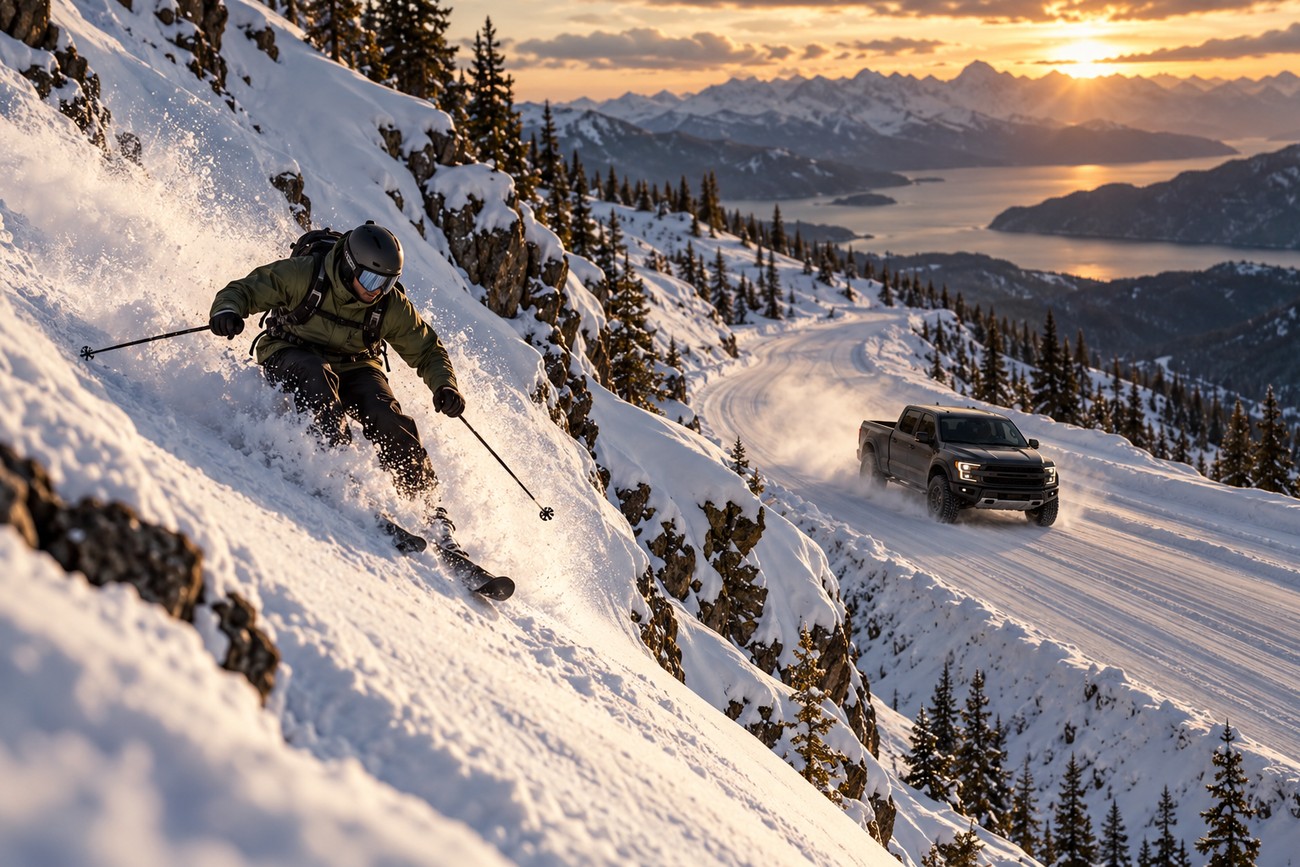
The skier is generally favored on steep, narrow, technical terrain. Lower mass, a smaller turning footprint, and greater freedom to change line allow the skier to use space the Raptor cannot. That advantage still depends on the skier’s skill and the grip available underfoot.
The Raptor can be favored on a wide, smooth, prepared snow corridor where it can maintain speed without abrupt turns. Its suspension and off-road capability have room to work there, although tire grip and the distance needed to stop remain limits. A corridor built for the truck is a different test from an ordinary ski run.
Marketing language about a fast off-road or desert pickup does not establish superiority on every mountain descent. Nor does an elite skier’s speed on a dedicated racecourse settle a contest against a truck elsewhere. Course design can favor either competitor long before the start.
There is no universal winner without a defined course, matched conditions, controlled testing, and legal permission. If those conditions cannot be met, the honest result is a conditional comparison, not a race verdict.
Frequently asked questions
Choosing a vehicle for snow calls for a different judgment from predicting a race result. These answers address the Raptor models, acceleration figure, and truck-selection claims that often get attached to this comparison.
Which Ford Raptor should you stay away from for a snowy descent?
The available evidence does not identify one Raptor generation as universally unsuitable. For any specific truck, check that its tires suit the snow and ice expected, its brakes are in sound condition, and its overall condition supports a controlled descent. An unsuitable course or lack of permission rules out the attempt regardless of model year.
What is the Ford Raptor’s 0–60 mph time, and does it matter here?
There is no single 0–60 mph time that applies to every Raptor configuration, and no verified figure is needed to judge this descent. A dry-surface acceleration result describes how a truck builds speed under those test conditions. It cannot predict how well its tires will turn or brake on changing snow.
What truck is better than a Raptor for a mountain snow descent?
No truck can be named as categorically better without a specified, legally accessible course. A potentially better choice would fit the available width, carry tires appropriate to the surface, and offer enough braking and turning margin for the route. More power or a stronger off-road reputation would not, by itself, lower the risk.







