
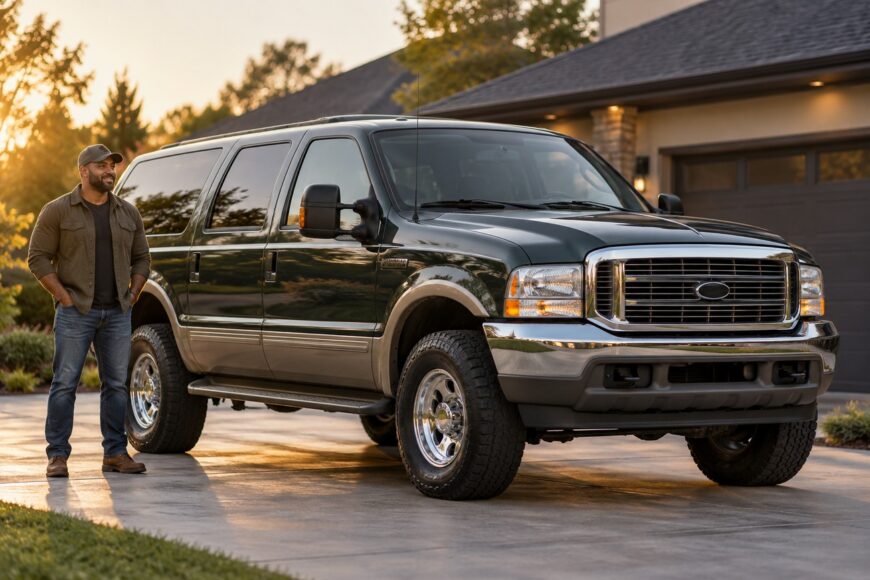
An enormous passenger SUV has an appeal that smaller vehicles cannot match: room for a large group, the commanding presence of a heavy-duty truck, and the ability to carry people and gear over long distances. The Ford Excursion delivers that scale without hiding its origins. Its size is part of the attraction.
It is also the first complication. A vehicle that looks reassuringly capable on an open road can be awkward in a parking structure, tiring on narrow streets, and expensive to fuel and maintain. Calling the Excursion the “biggest SUV ever sold” captures its reputation, but the claim needs a defined measure before it tells a buyer anything useful.
- How big was the Ford Excursion?
- The “biggest SUV ever” claim needs a yardstick
- An F-250 foundation beneath the SUV body
- Engine choices change the ownership equation
- What its size costs in everyday driving
- What to check before buying a used Excursion
- Frequently asked questions
- How can I confirm whether a modified Excursion will clear my garage?
- Which numbers should I check before towing with an Excursion?
- What is the largest Ford SUV ever created?
- Was the Excursion bigger than the Suburban?
- What was the biggest SUV ever made?
How big was the Ford Excursion?
Produced from 1999 to 2005, the Excursion measures 5,758 mm long and approximately 2,029–2,032 mm wide in catalog listings. Its wheelbase is approximately 3,480–3,482 mm. Reported height varies more noticeably, at approximately 1,948–2,037 mm depending on version and source, so a generic specification is a poor substitute for measuring a vehicle that must fit through a low entrance.
Reported curb weight ranges from approximately 3,015–3,505 kg. That is the vehicle’s weight in running condition, subject to the specification used; it differs from gross vehicle weight rating, the permitted maximum loaded weight. A gross vehicle weight rating around 4,037 kg is commonly listed, although figures can differ by version and source. Confusing the two can distort payload calculations.
In a parking lot, the long wheelbase matters at least as much as the bumper-to-bumper measurement. Some catalogs give a turning radius of around 7.15 m; that figure is a radius, not a turning-circle diameter. It helps explain why a space may look long enough while the approach still demands several corrections. Width also leaves little margin beside posts, doors, and neighboring vehicles.
The “biggest SUV ever” claim needs a yardstick
The Excursion was among the largest production SUVs sold, and it was Ford’s largest production SUV. Those are defensible descriptions. An unconditional all-brand title is harder to establish because “biggest” could mean length, width, height, curb weight, seating capacity, or a combination of them. The answer can also change with the market and era being compared.
Its 5,758 mm length makes the claim understandable, yet length alone cannot settle it. A heavier SUV need not be longer, and a taller one may be shorter. Classification matters too: the Excursion has an enclosed passenger body, but its F-250 Super Duty-based construction places it close to a heavy-duty pickup in how it is built and used.
The Chevrolet Suburban is a common comparison. To declare a winner, compare vehicles from the same model year and market using like-for-like measurements; one generation cannot stand in for every Suburban sold. For a buyer, the more useful comparison is whether each specific vehicle provides the required seats, cargo arrangement, towing capability, and clearance within the available space.
An F-250 foundation beneath the SUV body
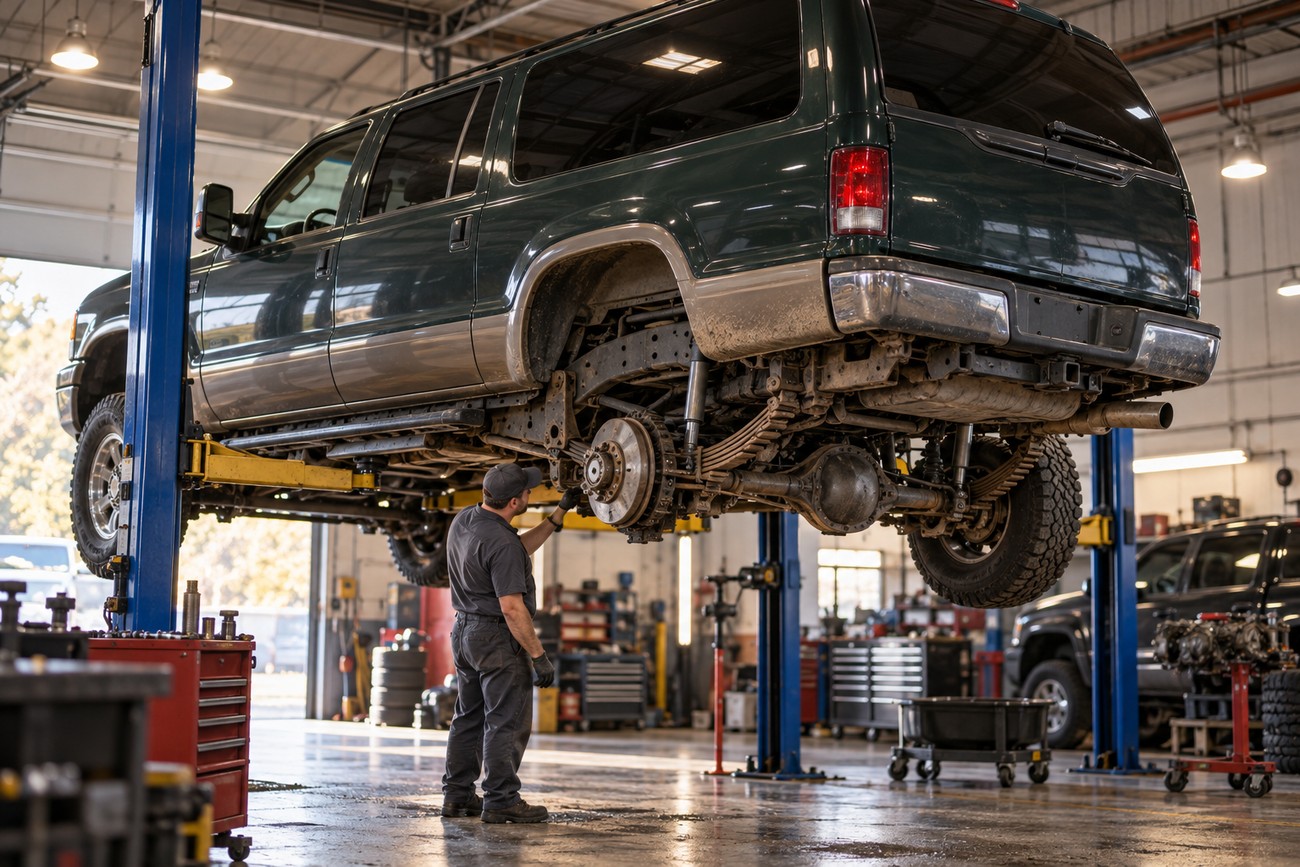
The Excursion uses F-250 Super Duty-based, body-on-frame architecture and heavy-duty truck-type suspension. That foundation suits buyers who need a large passenger vehicle with truck-like working capacity, including those who intend to tow. It also changes expectations behind the wheel: mass and wheelbase are apparent during braking, direction changes, and slow maneuvers.
Some versions and markets offered seating for eight or nine people, but layouts vary. Count usable seats and examine how the particular cabin handles passengers and luggage together. A long exterior does not guarantee that every load will fit neatly inside; seat arrangement and body geometry determine what space remains accessible when the vehicle is full.
On a rough route, sturdy hardware does not make the Excursion feel like a light SUV. Occupants may notice the truck-derived ride, while the driver has to allow room for the vehicle’s weight and slower changes of direction. Maintenance follows the same logic: brakes, suspension parts, and tires deserve attention as heavy-vehicle items, with costs assessed for the actual specification rather than a smaller family SUV.
Engine choices change the ownership equation
Documented Excursion engine options include a 5.4-liter gasoline V8, a 6.8-liter gasoline V10, and a 7.3-liter diesel V8. That list should not be treated as an exhaustive year-by-year guide. Cataloged power figures across versions vary approximately from 235 to 329 hp, so a single headline output cannot describe every Excursion on the used market.
Engine selection affects how comfortably a particular vehicle handles its intended load, how much fuel it uses, and what servicing it needs. A buyer planning regular towing should assess the complete vehicle and its ratings rather than assume that engine displacement alone establishes capability. For lighter use, the cost of fueling and maintaining a large engine still belongs in the budget.
Confirm the engine in the vehicle being offered, then check its service history and arrange an inspection suited to that powertrain. Diesel and gasoline versions present different maintenance considerations, and condition may matter more than a preferred engine badge. Local fuel availability, taxation, and access to qualified service can also alter the practical choice without changing the vehicle’s published specifications.
What its size costs in everyday driving
At 5,758 mm long, the Excursion can occupy a parking space without leaving much room to open doors or load the rear. Narrow streets and tight approaches make its width and turning behavior equally important. A turning radius of around 7.15 m appears in some catalogs, but a test drive on your usual routes gives a better sense of the space needed for a turn.
Weight is felt beyond the steering wheel. Braking and lane changes call for more planning than they do in a lighter SUV, while tires, brakes, and chassis components must cope with a heavy-duty, F-250 Super Duty-based vehicle. Their replacement costs can make an inexpensive purchase costly to run, particularly if neglected work has accumulated.
Some owners report roughly 18–20 L/100 km on the highway and 25–30 L/100 km in town. These are anecdotal examples, not standardized consumption ratings, and conditions and vehicle specification can change the result. The fuel tank is commonly listed at approximately 167 L; its capacity can extend the distance between stops, but it does not make the Excursion economical.
Passengers may also find that sheer exterior volume overstates everyday convenience. The cabin’s usefulness depends on its seating layout and the shape of the cargo space left behind those seats. Before accepting the running costs in exchange for space, try the actual combination of people, bags, and equipment the vehicle would carry.
What to check before buying a used Excursion
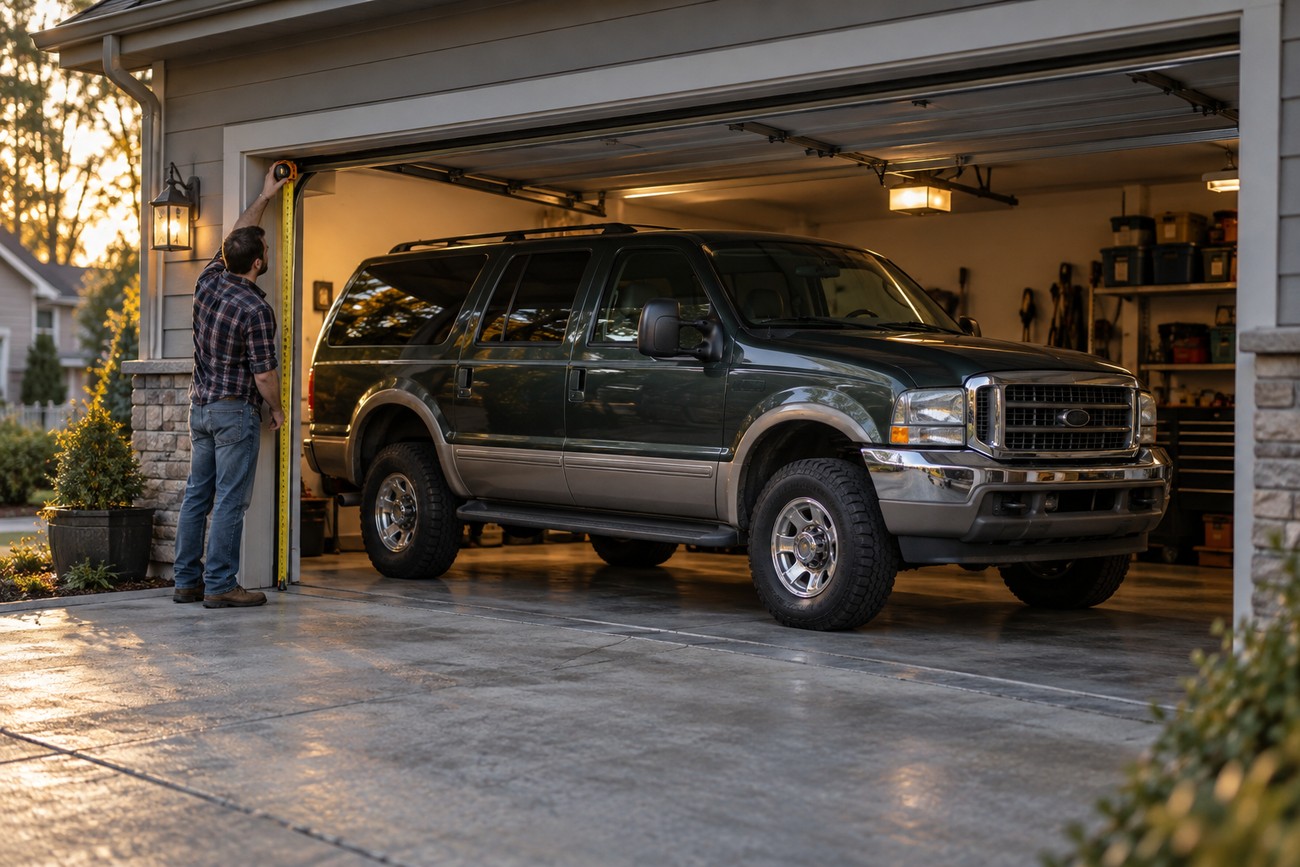
Start with the places the vehicle must go. Measure the garage opening, check parking-space length and width, and consider gates, ramps, and restricted routes. Cataloged height ranges from approximately 1,948–2,037 mm, while accessories, tires, or suspension changes can alter the clearance of an individual example.
Next, establish its exact engine, seating configuration, and vehicle-specific ratings. Cataloged curb weight spans approximately 3,015–3,505 kg, and a gross vehicle weight rating around 4,037 kg is commonly cited, though it is not universal. Read the vehicle’s labels and documentation before calculating what it can carry or tow.
Inspect the frame, suspension, tires, and brakes with its weight in mind, looking for corrosion, damage, uneven wear, and signs of deferred maintenance. A road test should include braking, low-speed turns, and the sort of uneven surface the vehicle will regularly encounter. Have a qualified inspector assess concerns rather than assuming truck-based construction makes wear inconsequential.
Finally, compare the condition and service records with the work you expect it to do. F-250 Super Duty-based architecture does not guarantee that a pickup part fits every Excursion, so confirm parts by the specific vehicle before budgeting repairs. A well-documented example that fits your routes is more useful than one chosen for its size claim alone.
Frequently asked questions
The most useful answers depend on the individual Excursion. Modifications, labels, and local rules can matter more than a general catalog entry, especially where clearance or loaded weight is close to a limit.
How can I confirm whether a modified Excursion will clear my garage?
Measure the lowest point of the actual opening and the highest point of the vehicle on its current tires, including roof accessories. Check the approach as well: a ramp or uneven threshold can change the vehicle’s angle. Leave a sensible margin, and remeasure after any tire, suspension, or roof-equipment change.
Which numbers should I check before towing with an Excursion?
Check the vehicle-specific tow rating, gross combined weight rating, payload allowance, and gross vehicle weight rating, then account for passengers, cargo, and trailer tongue weight. Confirm the hitch and its components have suitable ratings too. The lowest applicable limit governs, and local licensing or towing rules may add requirements.
What is the largest Ford SUV ever created?
The Excursion is Ford’s largest production SUV. “Created” could also include prototypes or one-off vehicles, which are a different comparison from SUVs offered to buyers. For a production-vehicle answer, the Excursion is the relevant model.
Was the Excursion bigger than the Suburban?
It depends on the model years and the dimension being compared. The Excursion’s length is 5,758 mm, but a fair answer needs the measurements of a specified Suburban from a comparable year and market. Neither nameplate has one unchanging set of dimensions across its history.
What was the biggest SUV ever made?
There is no unconditional winner without defining “SUV,” the markets included, and whether biggest means length, height, or weight. The Excursion belongs among the largest production SUVs sold. Claims that it outranks every SUV ever made require a stated measure and a like-for-like comparison.







