
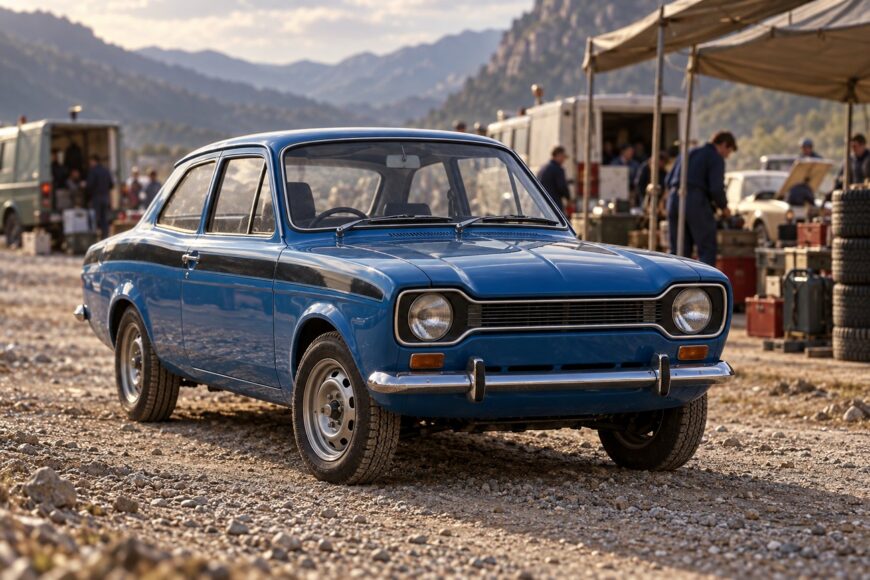
The Ford Escort Mexico sounds like a competition car, yet it was a road-going special edition. Its name commemorated Ford’s victory in the 1970 London–Mexico World Cup Rally, where Hannu Mikkola and Gunnar Palm drove their works Escort to victory in Mexico City.
That history gives the car unusual appeal, while also creating a predictable expectation gap. The production Mexico was more sporting than an ordinary Escort, but it was slower than the RS1600 and Twin Cam. Its real interest lies in the combination of rally-era character, accessible performance, limited production, and the practical risks attached to finding an original car today.
- The Rally Win Behind the Mexico Name
- What the Mk1 Escort Mexico Actually Was
- Engine, Performance, and the Numbers That Matter
- Why the Rally Image Can Mislead on the Road
- Buying an Original Mexico: Condition, Identity, and Cost
- Mk1 Mexico, RS1600, and the Later RS Mexico: Avoiding the Mix-Up
- Frequently asked questions
- Was the Ford Escort Mexico the actual rally car that won in 1970?
- Why do some Ford Escort Mexico records show 1,601 cc instead of 1,599 cc?
- How much is an original Mk1 Escort Mexico worth?
The Rally Win Behind the Mexico Name
The Mexico name came directly from Ford’s result in the 1970 London–Mexico World Cup Rally. Mikkola and Palm won for Ford after an exceptionally long and difficult endurance event, giving the Escort a piece of competition history that road-car buyers could readily understand.
Published descriptions place the route at approximately 16,000 miles or 26,000 km across 24 countries. One account records 23 finishers from 70 starters, an indication of how demanding the event was. The result carried weight because the cars had to survive distance, rough surfaces, changing climates, and prolonged mechanical strain.
Ford used the victory as the basis for a production Mk1 Escort special edition. The name therefore commemorated a specific international rally rather than suggesting a connection with the Mexican market or a special sales program there.
The distinction matters for collectors. The Mexico sold to the public was a road car inspired by Ford’s competition achievement; it was not the winning works Escort driven by Mikkola and Palm. Rally styling and mechanical character helped convey the association, while the production model remained a separate, more usable specification.
What the Mk1 Escort Mexico Actually Was
The Escort Mexico occupied a deliberate middle ground in Ford’s performance range. It offered more sporting identity than an ordinary Escort and a stronger connection with competition versions, while remaining more accessible and road-oriented than the expensive RS1600.
Its construction included a Type 49 shell, along with selected components associated with sporting Escort variants. The combination gave the car a purposeful foundation without turning every Mexico into a direct replica of the rally machine. The car drew from Ford’s performance program, rather than carrying every part of the works car.
Power came from the less expensive Kent engine, a choice that helped keep the model within reach of ordinary road users. That decision also explains much of the Mexico’s character. The car delivered responsive period performance and a lively mechanical feel, while the RS1600 occupied a more serious high-performance position.
For buyers today, this positioning is more useful than the word “rally” on a badge. A sound Mexico is a sporting road Escort with meaningful competition heritage. Its value depends on how faithfully that original idea survives in the shell, specification, and history.
Engine, Performance, and the Numbers That Matter

The Mexico used a 1.6-liter Kent petrol engine, commonly listed at 1,599 cc. Profiled specifications give 85 bhp, 92 lb-ft of torque, a Weber 32/36 DGV carburetor, and a 9.0:1 compression ratio. Some catalogs list 84 hp, so the small difference in quoted output reflects source conventions rather than a fundamentally different model.
Standard-version figures include an 851 kg curb weight, a 99 mph top speed, and acceleration from 0–62 mph in 10.4 seconds. Catalogs also list average fuel consumption at 10.4 L/100 km. These numbers describe a light, energetic road car by period standards, especially on roads where the driver can make use of its modest mass.
The transmission was a four-speed manual. That layout suits the car’s direct character, but it gives the Mexico less flexibility and refinement on modern highways. Engine noise, cruising speed, and the need for more frequent driver involvement are part of the ownership experience rather than details to discover after purchase.
Performance comparisons need equal care. The Mexico was less powerful and slower than the RS1600 and Twin Cam, so its appeal does not depend on being the fastest Mk1 Escort. It works better as a lightweight, competition-flavored road car whose speed feels immediate from behind the wheel, even though its figures are modest by current standards.
Why the Rally Image Can Mislead on the Road
The rally connection creates an emotional shortcut: buyers see the Mexico name and expect a competition car for the street. In reality, the production version combines sporting intent with the compromises of an older compact car. Its appeal comes through steering, engine response, sound, and mechanical involvement rather than modern grand-touring refinement.
Noise and vibration are more prominent than in later Escort models, and long-distance comfort is limited by the older mechanical architecture. The four-speed gearbox leaves less room for relaxed high-speed cruising, while the cabin and body structure provide little insulation by contemporary standards.
That character can be rewarding on shorter drives. The low 851 kg weight helps the car feel alert, and the driver receives a clear sense of what the chassis and engine are doing. Owners who approach it as a historic sporting road car are more likely to appreciate those qualities than people expecting the pace or polish of a modern performance coupe.
The most common disappointment follows an incorrect comparison. A Mexico should not be judged as a cheaper RS1600 or as the rally-winning Escort in civilian trim. Its more modest engine and accessible positioning were central to the original concept, and the compromises in comfort were part of the price of that period character.
Buying an Original Mexico: Condition, Identity, and Cost
Production ended in January 1975, with 10,352 Mk1 Escort Mexico examples built. That total is large enough to support a strong enthusiast community, yet limited enough for genuine cars and correct parts to be difficult to locate. Scarcity affects restoration planning as much as it affects market interest.
Corrosion is a recurring concern with surviving cars. A clean-looking exterior can conceal previous repairs, replaced panels, or changes to the shell, so inspection should begin with the body structure and its history. Mechanical parts may be easier to replace than original body details, and a visually convincing restoration can still rest on the wrong shell.
Mexico-specific components can be scarce and expensive, particularly when a restoration has to return a modified car to original specification. Repainted panels, substitute trim, altered engines, and missing interior details may each appear manageable in isolation. Together, they can make a supposedly complete car substantially more expensive than its purchase condition suggests.
Badges, decals, wheels, and a rally-style appearance cannot prove that an Escort is an original Mexico. Buyers should give greater weight to the shell’s history, surviving specification, period records, and consistent documentation. A professional inspection is especially valuable where the car has been re-bodied, heavily repaired, or converted from another Escort variant.
Restoration quality also needs a precise definition. A freshly painted car with a rebuilt engine may be excellent to drive, yet still differ from an original or correctly restored Mexico. The distinction affects long-term interest, parts decisions, and the amount of work required if the owner later aims for faithful factory specification.
Mk1 Mexico, RS1600, and the Later RS Mexico: Avoiding the Mix-Up

The original Mexico was a Mk1 Escort special version. The later Mk2 RS Mexico belongs to a different generation and must be treated as a separate car. Similar naming and rally-themed presentation can blur that distinction in advertisements, club conversations, and online photographs.
The Mk1 Mexico also sits below the RS1600 in performance terms. The RS1600 and Twin Cam were the more powerful choices, while the Mexico provided a less costly route into a sporting Escort with a strong competition association. Treating all of these cars as interchangeable makes both specification and valuation harder to judge.
Demand changed after the RS2000 was launched, and interest in the Mexico declined. Surviving examples can have complicated ownership records, later modifications, and inconsistent descriptions. A car may have spent decades being used as an ordinary Escort before its historical significance became widely appreciated.
For that reason, visual identity should be checked against documentary and structural evidence. A Mk1 shell, a genuine specification, and a coherent history matter more than a set of Mexico badges. The same principle protects buyers from confusing a restored original with a replica or a later car wearing borrowed styling.
Frequently asked questions
The Mexico name, engine records, and claims of originality can each cause confusion. The answers below distinguish the road car from the rally winner and address a small discrepancy in recorded engine capacity. They also explain what to check before comparing asking prices.
Was the Ford Escort Mexico the actual rally car that won in 1970?
No. The winning car was a works Escort driven by Hannu Mikkola and Gunnar Palm in the 1970 London–Mexico World Cup Rally. The production Ford Escort Mexico was a separate road-going model named to commemorate that victory, not the rally-winning car in civilian trim.
Why do some Ford Escort Mexico records show 1,601 cc instead of 1,599 cc?
Most descriptions list the 1.6-liter engine as 1,599 cc, while some records show 1,601 cc. This small discrepancy can reflect production tolerances or differences in cataloging and documentation; it does not, by itself, prove that an engine is incorrect. Check the engine specification alongside the shell history and period records.
How much is an original Mk1 Escort Mexico worth?
There is no reliable single figure without inspecting the car. Value depends on verified Mk1 Mexico identity, shell and corrosion history, original specification, restoration quality, and supporting documentation. A convincing appearance cannot compensate for an uncertain shell or missing Mexico-specific parts, so establish authenticity and condition before comparing prices.







