
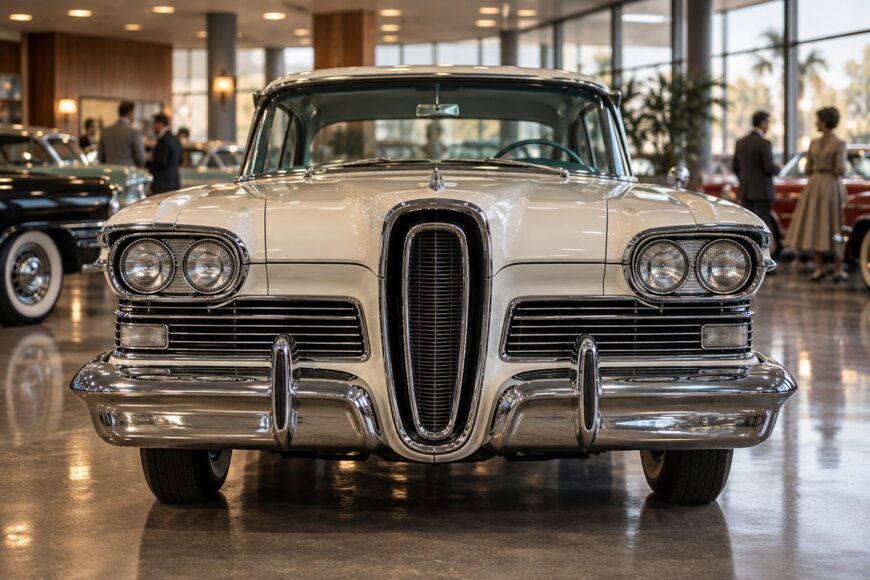
Edsel was not radically inferior mechanically, yet its front end became a public symbol of failure and made the car socially difficult to own. The vertical-oval “horse-collar” grille gave every Edsel an unmistakable face, ensuring that buyers encountered the brand’s controversy before they experienced its engineering.
That grille did not cause the collapse alone. Unclear positioning, the 1958 recession, weak dealer execution, and confused marketing had already made the launch difficult. The grille amplified those problems by turning an ordinary product disappointment into a highly visible emotional reaction.
- How the Horse-Collar Grille Became Edsel’s Identity
- Ford Designed a Family Face—Then Pushed It Too Far
- Why the Grille Failed as Part of a Larger Business Mistake
- The Ownership Cost of a Controversial Face
- The 1960 Retreat: When Edsel Abandoned Its Own Signature
- What the Edsel Myths Get Wrong
- What Collectors Should Preserve—and What They Should Not “Fix”
- Frequently asked questions
- Was the Edsel a bad car mechanically, or mainly a bad product strategy?
- Why is a rare Edsel not automatically a valuable Edsel?
- Why do some collectors prefer the original horse-collar grille?
- Why is Edsel still called Ford’s biggest flop?
How the Horse-Collar Grille Became Edsel’s Identity
The horse-collar grille was a vertical oval positioned at the center of the Edsel’s front end. Ford’s internal design guides treated it as the defining family-look element, intended to distinguish the new marque from Ford and Mercury. Because the shape occupied such a large and visually prominent area, it became easier to remember than the car’s body engineering, equipment, or model range.
Period surveys and press descriptions included words such as “strange,” “aggressive,” and “ugly.” Negative reactions were especially strong among women buyers, a significant problem for a product that needed broad household acceptance. The grille communicated a confrontational personality before a salesperson could explain the car’s features or pricing.
Its effect also came from the way it organized the entire face. The tall opening drew the eye inward and downward, making the surrounding fenders and lamps seem secondary. A buyer who disliked the grille could therefore reject the whole car at a glance, without separating the styling decision from the rest of the vehicle.
Later retellings often attach sexual or anatomical meanings to the design. Those interpretations became influential in retrospective storytelling, yet official launch-era surveys and contemporary press do not establish them as the dominant documented reaction. The stronger evidence points to discomfort with the grille’s strangeness and aggression, making it a powerful amplifier of negative perception rather than the sole cause of failure.
Ford Designed a Family Face—Then Pushed It Too Far
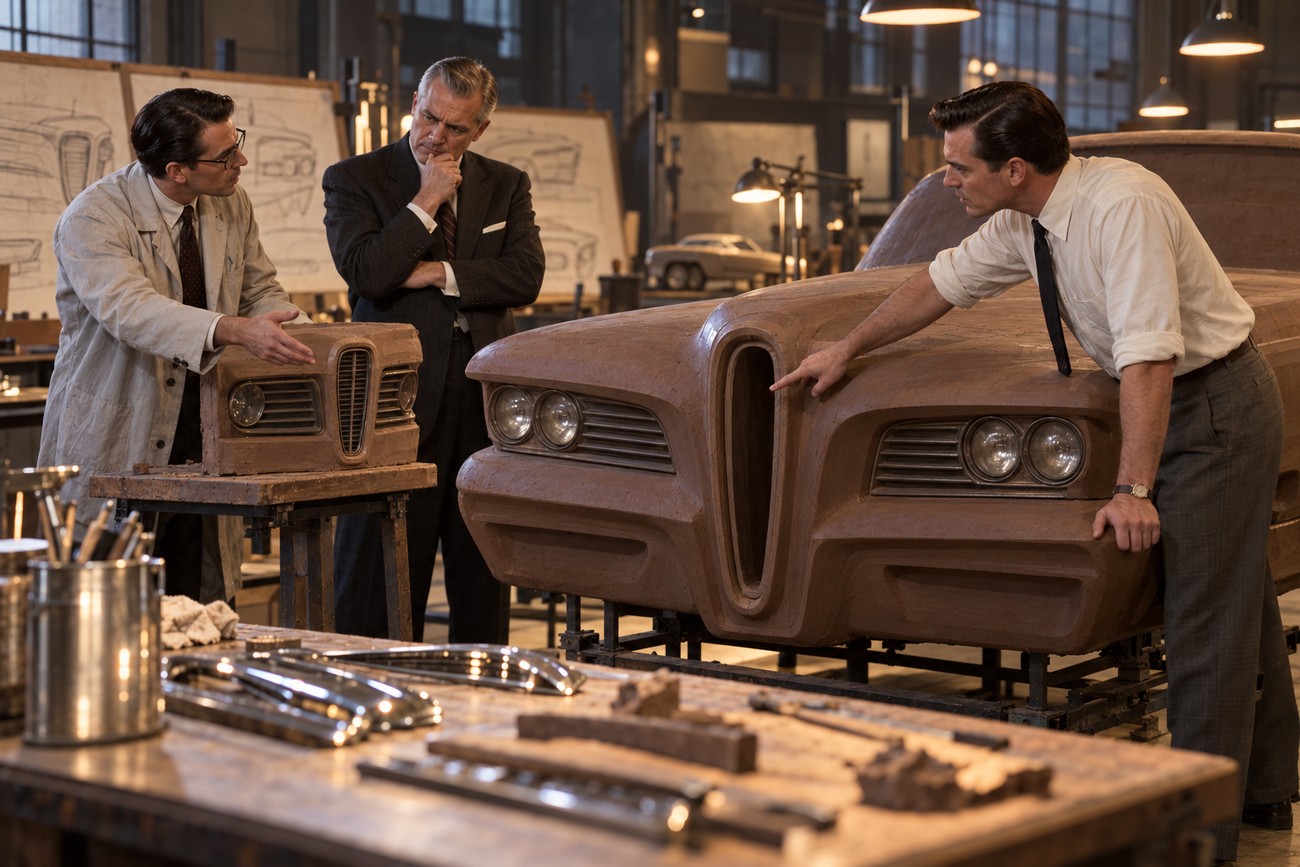
Ford wanted Edsel to occupy a prestige position between its existing mass-market and near-luxury products. A new family face was supposed to make the marque instantly recognizable and prevent it from being mistaken for another Ford or Mercury. The horse-collar grille therefore carried a strategic responsibility far beyond decoration.
That ambition produced disagreement inside the company. Designers and marketers differed over how radical the grille should be, with some designers favoring a more conservative treatment. Management also pressed for strong differentiation, since a restrained front end risked making the new brand look like a lightly modified Ford.
Earlier sketches and clay models reportedly presented more harmonious proportions than the production design. Manufacturing requirements changed the relationship between the grille, bumper, lamps, and surrounding sheet metal. Safety considerations, stamping limitations, and cost pressures all influenced the final form, leaving the production grille less balanced than some earlier studies.
The result was a familiar industrial-design problem: a distinctive idea survived the development process, while some of the visual relationships that made it persuasive were weakened. Edsel achieved recognition immediately, yet recognition became inseparable from rejection.
Why the Grille Failed as Part of a Larger Business Mistake
Edsel ran for three model years, from 1958 through 1960. Total sales reached approximately 118,000 vehicles, against Ford planning assumptions of roughly 200,000–300,000 vehicles annually. Ford’s initial investment is estimated at approximately $250–400 million in late-1950s dollars, giving the failure financial weight far beyond a weak product launch.
The timing was damaging. The 1958 recession reduced demand for new cars, especially for an expensive new brand whose place in the market was difficult to explain. Customers could find familiar Ford and Mercury products nearby, while dealers had to sell a marque without an established reputation or clearly defined customer.
Internal reports identified several connected causes: unclear brand positioning, the recession, dealer-network problems, marketing missteps, and negative design perception. The launch also created expectations that the new car could not fulfill simply through styling and equipment. Once interest fell, the unusual grille made the decline visible and easy for newspapers and commentators to summarize.
Contemporary reporting did not treat Edsel as radically worse mechanically than its competitors. The car’s technical competence could not overcome a weak market proposition, uneven dealer execution, and a front-end design that many potential buyers found difficult to accept.
The business lesson lies in the interaction of these factors. A controversial grille can reduce the number of people willing to consider a car, while recession and poor positioning reduce the number of people who encounter it in the first place. Edsel’s collapse became a systems failure, with the grille serving as its most memorable public evidence.
The Ownership Cost of a Controversial Face
For owners, the grille’s consequences extend beyond its period reputation. Collectors and forum participants often describe Edsel as mechanically acceptable while admitting that the original face can feel difficult to display or explain. A car that attracts jokes before admiration may have a smaller pool of willing buyers at resale.
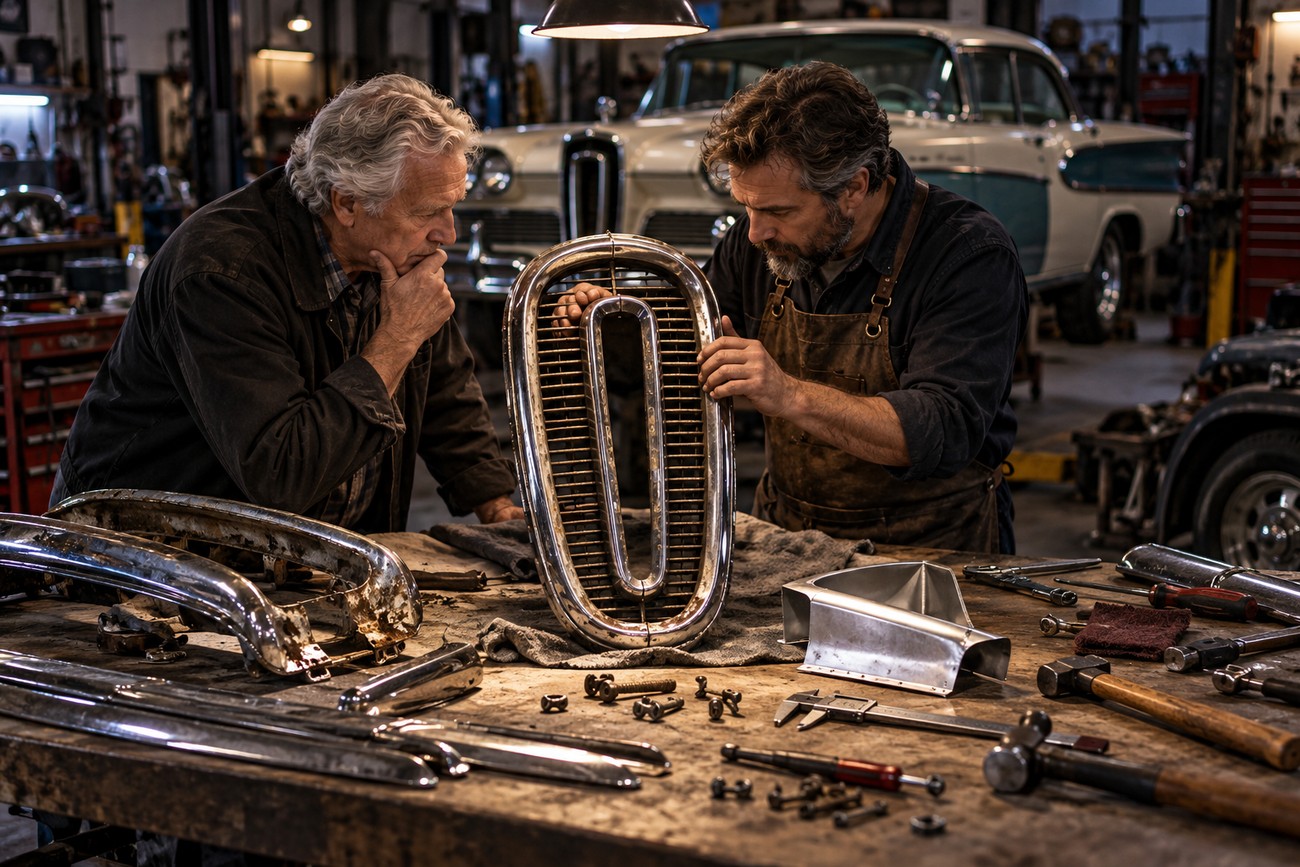
Original grille components can also be difficult and expensive to source. The unusual shape, limited production, and lack of a broad aftermarket mean that owners may need rare original stock, careful repair, or custom fabrication. Availability varies by model and condition, so a damaged front end deserves close inspection before purchase.
The central vertical composition makes chips, scratches, and poor repairs conspicuous. Damage in that area sits directly in the viewer’s line of sight, and an inaccurate reproduction can alter the car’s entire expression. Restoration errors may also be harder to identify because few modern replacement parts provide a widely accepted reference standard.
These issues can narrow market liquidity without proving that every Edsel is mechanically unreliable or impossible to insure. Historical value depends on condition, documentation, model, originality, and buyer interest. The controversial face may reduce the audience while also attracting collectors who specifically want the most recognizable version.
The 1960 Retreat: When Edsel Abandoned Its Own Signature
By model year 1960, the signature oval grille was effectively abandoned. Edsel moved toward a more neutral front end that sat visually closer to Ford and Mercury styling. The change reduced the intensity of the original identity and made the car less dependent on a single controversial graphic statement.
This retreat suggests that Ford recognized the need for visual normalization. A calmer front end could make the car easier to approach, compare, and accept in a dealer showroom. It also acknowledged that the original family-look strategy had become a liability in public perception.
The redesign does not prove that the grille alone caused the earlier failure. By 1960, the recession, damaged reputation, weak positioning, and dealer difficulties had already shaped the market’s response. A revised face could soften the message without repairing the larger business strategy.
Edsel lasted only three model years, from 1958 through 1960. The rapid abandonment of its signature grille is therefore valuable evidence of corporate correction, while the short production run shows how little time Ford had to rebuild confidence.
What the Edsel Myths Get Wrong
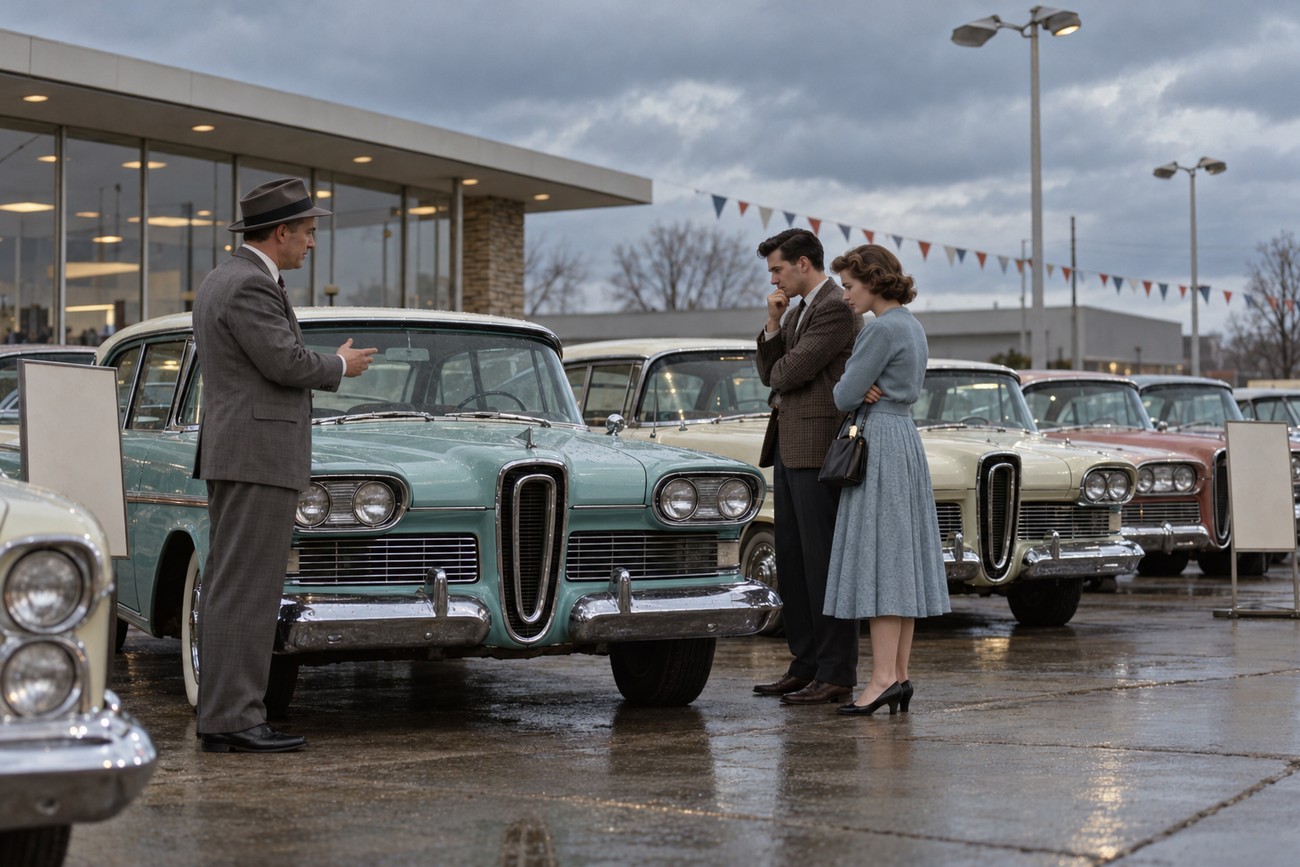
The claim that the grille alone killed Edsel is too simple. The car entered a recessionary market with unclear positioning, uneven dealer execution, and marketing that struggled to explain why the new brand deserved attention. The grille amplified negative sentiment because it was visible, memorable, and difficult to ignore.
The idea that 1950s buyers rejected bold styling altogether is equally weak. The period embraced fins, heavy chrome, and Jet Age themes. Edsel’s problem was the combination of an ambitious shape, a difficult market position, and a product message that did not give the styling enough support.
Popular stories also overstate the evidence for a dominant sexual or anatomical reaction at launch. Contemporary surveys and press coverage more consistently describe the grille as strange, aggressive, or ugly. Later interpretations helped turn the design into cultural shorthand, yet they should not be treated as a complete record of buyer opinion in 1957 and 1958.
Edsel was intended as a prestige mid-market brand, not as a deliberate design provocation. Its planners believed a strong visual identity would create recognition and separation from existing Ford products. The failure came from overbranding in a wider strategic context, where distinctive form could not compensate for weak positioning and unfavorable economic conditions.
The enduring lesson is therefore about proportion. Recognition is useful only when the audience connects it with desirable qualities. Edsel achieved immediate recognition, but the grille made the brand’s uncertainty visible before Ford had established a convincing reason to choose it.
What Collectors Should Preserve—and What They Should Not “Fix”
Rarity does not automatically make an Edsel valuable or liquid. Production rarity, condition, documentation, model desirability, and the size of the interested buyer pool all matter. Cars retaining the original horse-collar face may attract fewer conventional buyers, even as they appeal strongly to specialists in automotive history.
Replacing the original grille with a modernized or non-original unit usually harms historical authenticity. It may make the car easier for one owner to live with cosmetically, yet it removes the feature that defines the model’s design history. Any alteration should therefore be recorded clearly and distinguished from factory specification.
Authentic replacement parts should be judged by mounting points, material, surface details, and period-correct construction before a smoother reproduction is accepted. A cleaner appearance can conceal a permanent loss of originality.
Unusual grille geometry makes restoration verification more difficult. Reproductions may copy the broad outline while missing the correct depth, trim relationship, or finish, and errors can pass unnoticed until the car is compared with documented examples. Preserving damaged original components, photographing removed parts, and keeping restoration records can protect both historical credibility and future value.
Some collectors specifically value the original front as a cultural artifact of failed branding. In that context, the controversial face is the subject of preservation, not an embarrassment requiring correction. Historical preservation and personal cosmetic preference are legitimate aims, but they should not be confused when a car’s originality is being assessed.
Frequently asked questions
Was the Edsel a bad car mechanically, or mainly a bad product strategy?
Edsel was mainly a product-strategy and market-positioning failure rather than a car that contemporary reporting treated as uniquely defective. Its mechanical specification was not radically worse than that of its competitors, while its unclear identity, the 1958 recession, dealer-network problems, marketing missteps, and controversial styling weakened demand.
That distinction matters to buyers today. A mechanically sound Edsel can still be difficult to sell if its condition, documentation, and styling appeal do not match the expectations of a narrow collector audience.
Why is a rare Edsel not automatically a valuable Edsel?
Rarity describes supply, while value also depends on condition, originality, desirability, and buyer liquidity. The horse-collar grille can narrow the audience because some buyers reject the original appearance, even though other collectors consider it essential to the car’s identity.
A prospective buyer should inspect the grille, trim, documentation, and restoration quality closely. A scarce car with an inaccurate front-end repair may be less desirable than a more complete example with documented original components.
Why do some collectors prefer the original horse-collar grille?
They value it as the clearest physical record of Edsel’s design experiment and its failure in the marketplace. Removing the grille removes the feature that connects the car to the period debate over branding, recognition, and visual excess.
The original face also has cultural importance. For specialists, preserving an unpopular design can be more historically meaningful than making the car resemble a conventional Ford or Mercury.
Why is Edsel still called Ford’s biggest flop?
The reputation comes from the combination of unusually high investment, strong public visibility, a major sales shortfall, and the project’s lasting place in business and design history. Ford invested approximately $250–400 million in late-1950s dollars, while Edsel sold approximately 118,000 vehicles across three model years.
The nickname does not mean Edsel was Ford’s worst vehicle mechanically. It reflects how clearly the project demonstrates the risks of overbranding when market positioning, economic timing, dealer execution, marketing, and design all fail to support one another.







