
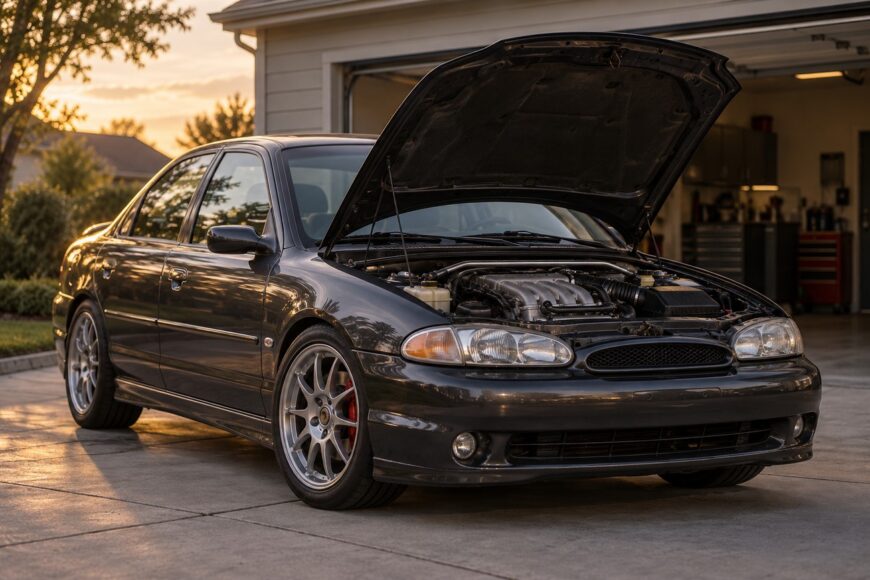
The Ford Contour SVT was a restrained American sedan with an unusually European mechanical character. Its appeal came from a high-revving V6, Mondeo-derived braking hardware, and careful chassis tuning rather than dramatic styling or a radically altered body.
That also makes the car difficult to judge from a specification sheet. Power figures range from the factory manual’s 195 hp to independent claims of 197–203 hp, while reported top speeds include both 230 km/h and 175 km/h. A genuine SVT can also be mistaken for an ordinary Contour fitted with badges and aftermarket parts, so the useful starting point is verified hardware rather than folklore.
- What the Ford Contour SVT Actually Was
- Ford Contour SVT: Factory Specs vs. Common Catalog Claims
- Why the SVT Feels Hand-Tuned
- The Numbers That Keep Getting Mixed Up
- How to Identify a Genuine SVT Before Buying
- The Ownership Reality of a Rare Performance Sedan
- Frequently asked questions
- How many Ford Contour SVT cars were made?
- What did Extrude Hone Powerflow change on the Contour SVT?
- Why should the 175 km/h top-speed figure be treated cautiously?
What the Ford Contour SVT Actually Was
The Ford Contour SVT was a factory Special Vehicles Team version of the front-wheel-drive Contour sedan sold in the United States in the late 1990s. It remained a midsize sedan built around a transverse engine and front-drive layout, but Ford gave it a dedicated powertrain, firmer chassis calibration, and upgraded braking hardware.
That distinction matters because the SVT was more than a cosmetic package. Its engine, suspension tuning, and brakes were part of the factory specification, giving the car a different mechanical identity from a regular Contour even though the basic body and platform remained familiar.
The architecture also sets a limit on the car’s character. This was a relatively heavy front-wheel-drive sedan, not a lightweight sports car with a purpose-built rear-drive chassis. Its performance came from combining available grip, engine response, braking, and calibration within a practical four-door package.
The result is best understood as a midsize performance sedan with compromises intact. It can feel considerably more focused than a standard Contour, yet its front-drive layout, mass, and firm ride remain apparent when the road becomes rough or the pace rises.
Ford Contour SVT: Factory Specs vs. Common Catalog Claims
The factory manual provides the clearest baseline, while independent catalogs often repeat different power and top-speed figures. The table keeps those source types separate rather than presenting disputed numbers as one definitive specification.
| Specification | Factory manual, factory test, or published specification | Independent catalog claims |
|---|---|---|
| Engine | Transversely mounted 2,544 cm³ Duratec V6 with an aluminum block and aluminum heads | Usually described as a 2.5-liter V6 |
| Compression ratio | 10.0:1 | Generally repeated without a different verified value |
| Power | 195 hp at 6,625 rpm | 197–203 hp in independent catalogs and reviews |
| Torque | 165 lb-ft at 5,625 rpm | Often repeated as the same general specification, but source details vary |
| Fuel cut-off | 7,000 rpm | Often omitted from abbreviated listings |
| Front brakes | 10.94-inch ventilated discs | Described as Mondeo-derived or adapted European hardware |
| Factory braking result | 134 ft from 60 mph in Ford’s factory test | May be omitted or confused with later independent testing |
| Length | Approximately 4.67–4.69 m in published dimensions | Approximately 4.67–4.69 m |
| Width | Approximately 1.76 m | Approximately 1.76 m |
| Height | Approximately 1.38 m | Approximately 1.38 m |
| Wheelbase | 2,710 mm | Usually listed as 2,710 mm |
| Top speed | No single universally definitive figure established in the supplied sources | Sources report both 230 km/h and 175 km/h |
Why the SVT Feels Hand-Tuned
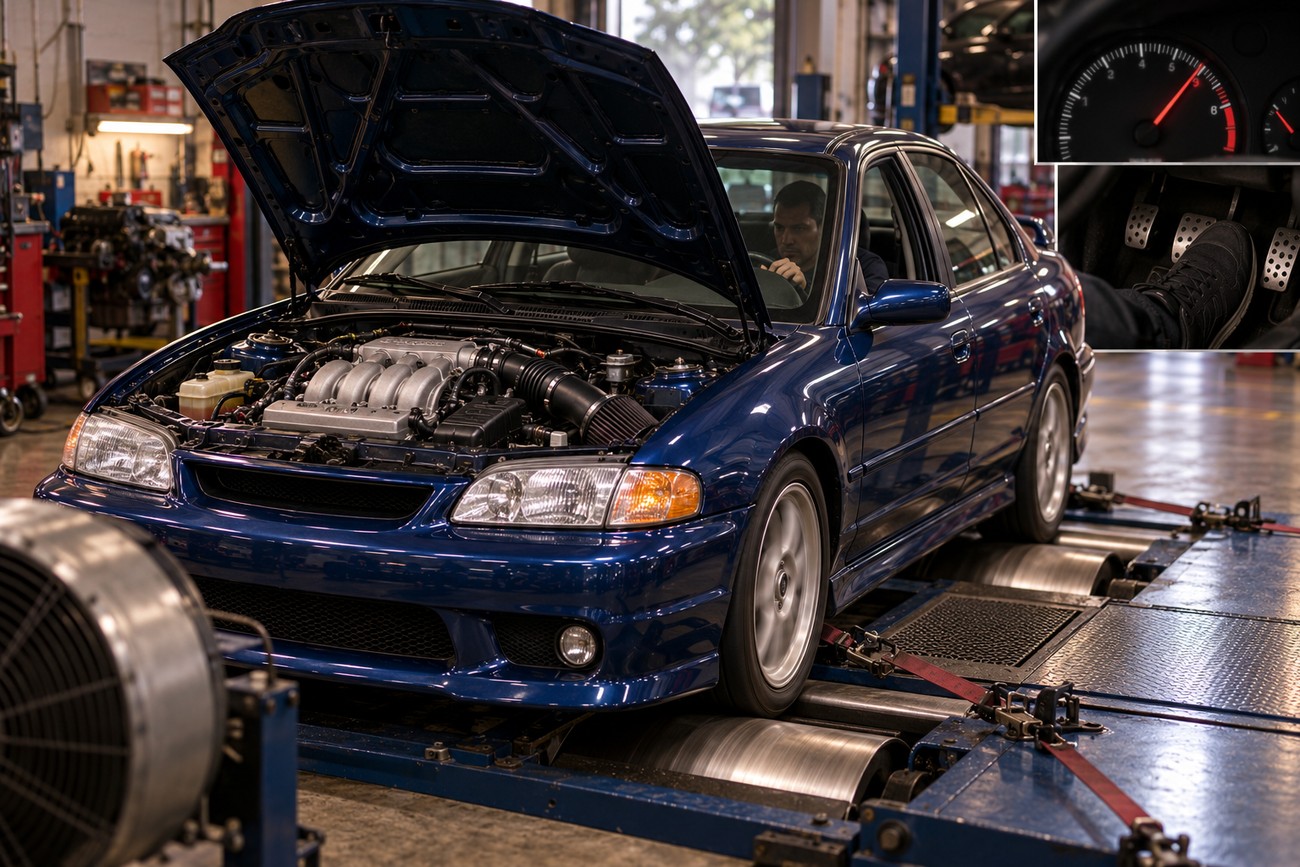
The engine’s character is defined by how high it is willing to rev. The factory manual lists a fuel cut-off at 7,000 rpm, with the red zone beginning at 6,750 rpm. That encourages the driver to use the upper part of the rev range, where an atmospheric V6 can feel more alive than its torque figure alone suggests.
Reviews also mention Extrude Hone Powerflow as an intake-flow improvement intended to improve cylinder filling. That detail matters because the engine’s response was not simply the result of an electronic calibration or louder exhaust. Airflow development formed part of the broader effort to make the V6 work at high engine speed.
Ford’s front brakes used 10.94-inch ventilated discs derived from or adapted from the European Ford Mondeo. Ford’s factory test recorded 134 feet from 60 mph, although that result describes the test car and its condition, not every surviving used example.
The suspension was firmer than that of a regular Contour, improving control at the cost of compliance. On smooth pavement, the calibration gives the sedan a more deliberate feel; on poor roads, it can seem too dense for relaxed daily driving. The overall character is a compromise between control and comfort, within the limits of a front-wheel-drive sedan.
The Numbers That Keep Getting Mixed Up
The factory manual states 195 hp at 6,625 rpm and 165 lb-ft at 5,625 rpm. Independent catalogs and reviews commonly quote 197–203 hp. Those figures should be labeled as independent claims rather than silently substituted for the factory-manual figure.
Small differences between sources can result from market specification, model-year details, rounding, or the way a publication transcribed its data. They can also survive through repeated catalog copying, where one old figure becomes the apparent consensus without a clear test or factory reference behind it.
Top speed is an even clearer warning. Sources report both 230 km/h and 175 km/h, a conflict too large to resolve by simple rounding. The figures may reflect different specifications, markets, test methods, or catalog errors, but the supplied source set does not establish one universally definitive value.
The practical rule is simple: keep the number and its source together. “195 hp according to the factory manual” is useful information; “203 hp” without identifying the catalog or test context is a claim that needs verification. The same discipline applies to acceleration and top speed.
How to Identify a Genuine SVT Before Buying
A badge does not prove factory SVT status. Sellers can add an SVT emblem to an ordinary Contour, and a modified car may contain some genuine performance parts without being an original factory example. Start with the VIN and factory equipment, then compare the engine identity, brakes, and suspension-specific components with the claimed specification.
The inspection should distinguish original SVT hardware from later modifications. Check whether the braking system and suspension match the SVT configuration, and look for documentation that connects the car’s identity to its equipment. A test drive can reveal whether the car feels unusually firm, but it cannot establish provenance.
A VIN and component audit should come before the test drive because a regular Contour body can carry aftermarket badges, while the rare SVT suspension and brake hardware are usually the most expensive parts to replace.
That order of work also protects the budget. A car advertised as a cheap Ford sedan may require scarce SVT-specific parts to return to its proper specification. The purchase price can look attractive until missing brakes, worn suspension components, or incorrect engine hardware are added to the restoration bill.
Inspect the car as a system rather than collecting isolated clues. A credible VIN, correct engine, appropriate brakes, matching suspension components, and coherent service records are more persuasive than an emblem or a seller’s description.
The Ownership Reality of a Rare Performance Sedan

Age and rarity change the ownership equation. The pool of usable SVT examples is smaller than the supply of ordinary Contours, so the used market offers fewer cars with complete documentation and original mechanical equipment. That makes condition more important than finding the lowest asking price.
SVT-specific suspension and brake components can be difficult or expensive to source. Common Contour or Mondeo-platform parts may keep a neglected car moving, but they do not automatically restore the SVT’s intended specification or behavior.
Older cars from this platform may also develop electrical faults and ordinary wear-related problems when maintenance has been neglected. These concerns should be treated as age and condition risks rather than universal defects. A careful inspection of wiring, service items, brakes, and suspension is more useful than relying on the model’s reputation alone.
A well-documented, mechanically healthy example can therefore make more sense than a cheaper car with an uncertain identity. The SVT is most rewarding when its special parts are present and serviceable; otherwise, ownership can become an exercise in locating rare components for a sedan that was bought as a bargain.
Frequently asked questions
The SVT’s identity depends on documented equipment, not appearance or isolated catalog figures. Its performance specifications also need to be read with their source and test context. The following answers address the main production, engineering, and verification questions.
How many Ford Contour SVT cars were made?
The supplied source set does not provide a verified production total. An unattributed number should therefore not be treated as definitive, especially when surviving examples are often described through incomplete listings and recycled specifications.
For buyers, production totals matter less than proving the identity and condition of the individual car. VIN documentation, factory equipment, and the presence of correct SVT-specific components provide stronger evidence than a claimed rarity figure.
What did Extrude Hone Powerflow change on the Contour SVT?
Extrude Hone Powerflow refers to intake-flow improvement intended to help cylinder filling. It describes engineering work on the intake path rather than merely a software tune or an exhaust change.
That helps explain why the SVT’s engine character is tied to high-rpm breathing and a 7,000-rpm fuel cut-off. The modification belongs to the engine’s airflow development, not to a simple cosmetic or electronic upgrade.
Why should the 175 km/h top-speed figure be treated cautiously?
The 175 km/h figure conflicts with another catalog value of 230 km/h, so it should be retained only with its source and test context. It should not be repeated as the universal top speed of every Ford Contour SVT.
The discrepancy may involve market specification, measurement method, or catalog error, but the available information does not identify a single verified explanation. Reporting both figures with their source types is more accurate than selecting one without evidence.







