

The Ford Capri 2.8i has the right ingredients for the “European Mustang” image: a long bonnet, a compact rear-drive coupe body, a V6, and enough performance to make ordinary traffic feel unimportant. Its appeal is immediate, especially when the car is wearing the correct trim and sitting on period-style wheels.
The reality is more demanding. A Capri 2.8i is now an old performance car with a complex history of repairs, conversions, storage, and improvised upgrades. The sensible purchase is a documented, usable, largely original example. The expensive mistake is an attractive shell hiding corrosion, tired Bosch K-Jetronic hardware, poor structural repairs, and an uncertain identity.
- Why the Capri 2.8i Earned the “European Mustang” Label
- Capri 2.8i Specifications: The Numbers That Need Context
- How the 2.8i Actually Drives Today
- The Body Shell Comes Before the Engine
- K-Jetronic, Cooling and the Cost of Making One Reliable
- Originality, Identity and Whether a Capri 2.8i Is Worth It
- Frequently asked questions
- How can I tell whether a Capri is a genuine 2.8i or a conversion?
- What should happen before a Capri 2.8i returns to the road after long storage?
Why the Capri 2.8i Earned the “European Mustang” Label
The comparison works at the level of image and purpose. The Capri was a relatively accessible sporting coupe designed for everyday roads, with rear-wheel drive, a front-mounted engine, a long bonnet, and a strong visual identity. It offered a more dramatic alternative to an ordinary family car without requiring the size or cost of a full-scale grand tourer.
Its American counterpart was the relationship. “European Mustang” is a marketing and cultural analogy based on the idea of a mass-market coupe with sporting intent. The Capri 2.8i is a specifically European design with its own chassis, suspension arrangement, engines, and market history.
The 2.8i sharpened that image through its 2.8-litre Cologne V6, injection system, distinctive trim, and stronger performance than most Capri versions. Rear-wheel drive remains central to the experience, while the live, non-independent rear axle gives the car a mechanical character that modern independent suspensions usually filter out.
Appearance alone proves little. Badges, bodywork, wheels, a sport interior, and a replacement engine can make an ordinary Capri resemble a 2.8i. Verification should include the documentation, identification numbers, engine details, fuel-injection equipment, factory trim, and evidence that the chassis and body match the claimed market specification.
Capri 2.8i Specifications: The Numbers That Need Context
The Mk III 2.8i used the 2.8-litre Cologne V6 with Bosch K-Jetronic mechanical fuel injection. The figures below are useful reference points, provided they are treated as market- and condition-dependent rather than as universal specifications.
| Item | Typical Mk III 2.8i information |
|---|---|
| Engine | 2.8-litre Cologne V6 |
| Fuel system | Bosch K-Jetronic mechanical fuel injection |
| Commonly quoted power | About 160 hp DIN for later European-specification versions |
| 0–100 km/h | Approximately 7.8–8.4 seconds |
| Top speed | Approximately 210–215 km/h |
| Transmission | Four-speed manual on earlier versions; five-speed manual on later or market-specific cars |
| Drivetrain | Rear-wheel drive with a live, non-independent rear axle |
Published figures differ because market, model year, equipment, weight, gearing, and measurement standards differ. Later European-specification cars are commonly listed at about 160 hp DIN, while some references give roughly 150-plus hp for certain early or export cars. Those figures should not be applied to every car carrying a 2.8i badge.
Acceleration and top-speed claims also describe a healthy, correctly specified car. A neglected engine with poor fuel delivery, weak ignition, intake leaks, dragging brakes, incorrect tyres, or extra equipment can feel much slower. Reviews that mix Mk II and Mk III data create further confusion, so the exact model year and market should be established before comparing specifications.
How the 2.8i Actually Drives Today
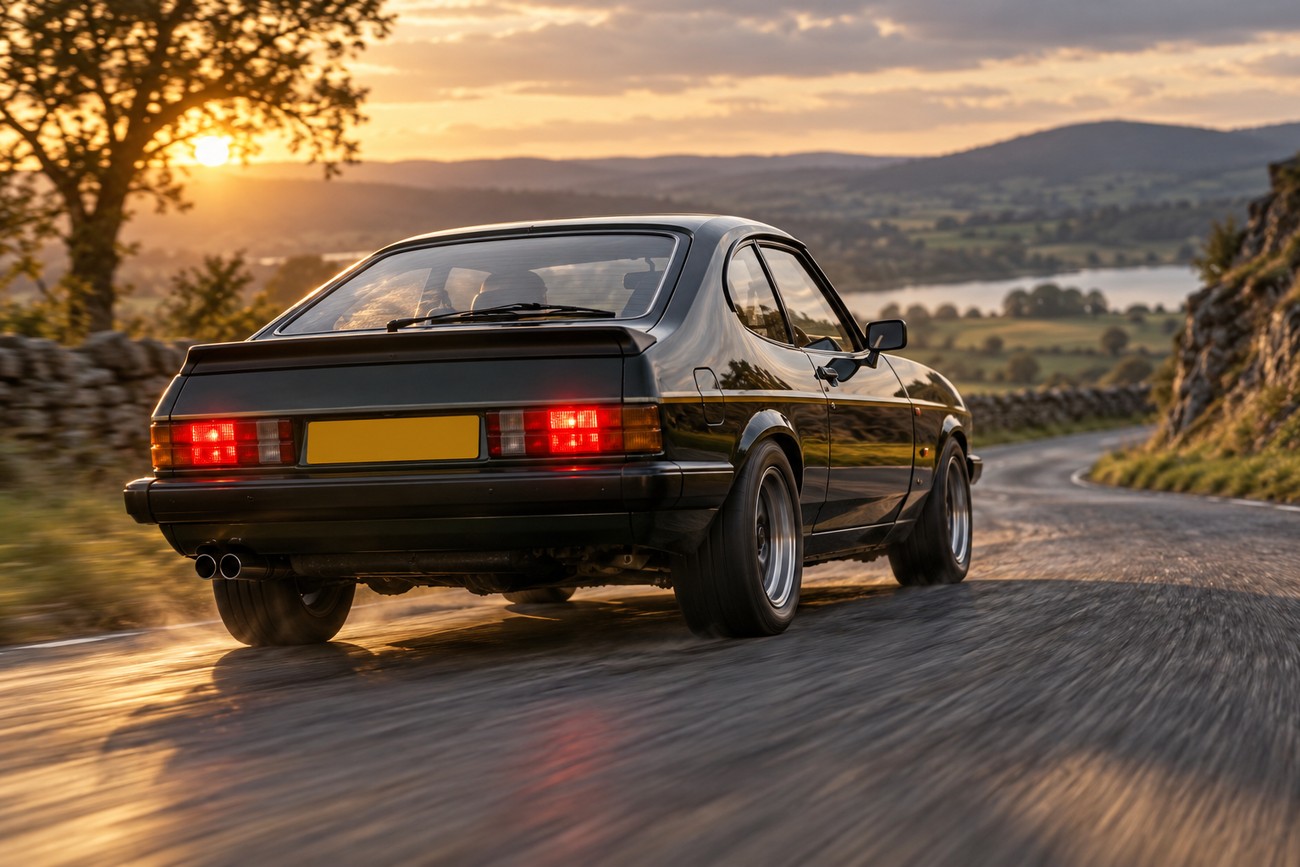
A healthy 2.8i has a useful spread of V6 torque and a direct, old-fashioned relationship between throttle, rear wheels, and road. The engine’s character is more important than the headline numbers: it provides a muscular soundtrack, relaxed progress in higher gears, and enough response to make the Capri enjoyable on a winding road.
The live rear axle shapes the car’s behavior on launches and through corners. It can provide strong traction on a suitable surface, yet its mass and limited independence over uneven roads can make the rear of the car feel busy. The result is a car that rewards smooth inputs and exposes poor suspension maintenance quickly.
Age changes the experience. Worn bushes, dampers, rear-axle components, tyres, steering joints, ignition parts, and fuel-delivery components can turn a precise-feeling coupe into a loose and hesitant one. An uneven idle or a flat response may be mistaken for an inherently weak engine when the real fault lies in air leaks, fuel pressure, ignition timing, or neglected service work.
Rear-axle condition deserves the same attention as the engine during a road test. Correcting worn bushes and dampers can change the steering accuracy and stability so substantially that the car appears to have gained power, even though the engine has not been modified.
The standard car is often less aggressive than the “European Mustang” image suggests. That is part of the ownership lesson: a good Capri feels lively and communicative, while a tired one feels noisy, imprecise, and slower than its period figures. A suspension and axle inspection should therefore precede performance upgrades.
The Body Shell Comes Before the Engine
Rust is the first serious inspection priority. Examine the sills, wheel arches, floor sections, underside, suspension mounting areas or towers, and lower door edges. These locations affect both structural strength and the cost of repair, so a sound-looking exterior cannot compensate for corrosion in load-bearing areas.
Lift the car and inspect it properly. Fresh paint, thick anti-corrosion coating, seam sealer, and underseal can conceal perforation or low-quality welding. Pay attention to uneven textures, abrupt changes in metal, trapped moisture, and repair seams that do not follow the original construction. A magnet and a bright inspection light are useful, though neither replaces access to the underside.
Door gaps, panel alignment, and paint consistency can reveal previous accident repairs, yet they are only clues. Some Capri examples have been rebuilt after collisions using economical methods that left the geometry compromised. Uneven tyre wear, a steering wheel that sits off-center, persistent pulling, or a car that feels nervous under braking should prompt a professional alignment and chassis assessment.
Documentation matters alongside the physical inspection. A lift inspection should be matched with the VIN or other identification evidence, registration history where available, photographs of earlier repairs, and invoices for structural work. A polished exterior can be purchased quickly; correcting hidden shell corrosion or distorted mounting points can consume the project budget before mechanical work begins.
Inspect the spare-wheel well, floor edges, inner arches, battery area, and drainage points as well. Water ingress and previous repairs often meet in these less visible spaces. The most attractive car at a gathering may be the least rational purchase if its underside has never been exposed.
K-Jetronic, Cooling and the Cost of Making One Reliable
The Bosch K-Jetronic mechanical fuel-injection system is a major part of the 2.8i’s identity and one of its ownership risks. The metering hardware, injectors, fuel lines, hoses, and related components are increasingly difficult to source in correct condition. A replacement part may be refurbished, modified, or of uncertain quality rather than a genuine original component.
Uneven idle and poor hot starting are common warning signs. They can be associated with tired fuel-system components, incorrect fuel pressure, leaking injectors, deteriorated hoses, or air leaks. A car that starts from cold and then refuses to restart when warm needs diagnosis before purchase, especially if the seller describes the fault as a minor adjustment.
Test fuel pressure, air leaks, and hot-start behavior before replacing the injection metering unit. Indiscriminate parts swapping can waste scarce components while leaving the original fault untouched.
Cooling deserves its own inspection. Old hoses, a tired radiator, blocked passages, an ineffective fan arrangement, and neglected coolant can create overheating risk after long storage. The engine should reach operating temperature without alarming behavior, and the cooling system should be checked for leaks, pressure problems, and evidence of repeated overheating.
Recommissioning also includes the systems that determine whether the car is safe. Worn suspension bushes and dampers, aged brake hoses, seized calipers, contaminated fluid, and old tyres can make a good-running Capri dangerous. Non-standard wiring deserves careful attention because improvised electrical repairs may affect the fuel pump, ignition, lighting, charging system, or safety equipment.
The financial mistake is to budget only for making the engine run. A stored 2.8i may need fluids, fuel-system cleaning, cooling work, brakes, tyres, suspension components, electrical repairs, and careful road testing before it becomes dependable. Parts scarcity makes diagnosis particularly valuable: replacing several rare components on suspicion is an inefficient way to restore the car.
Originality, Identity and Whether a Capri 2.8i Is Worth It
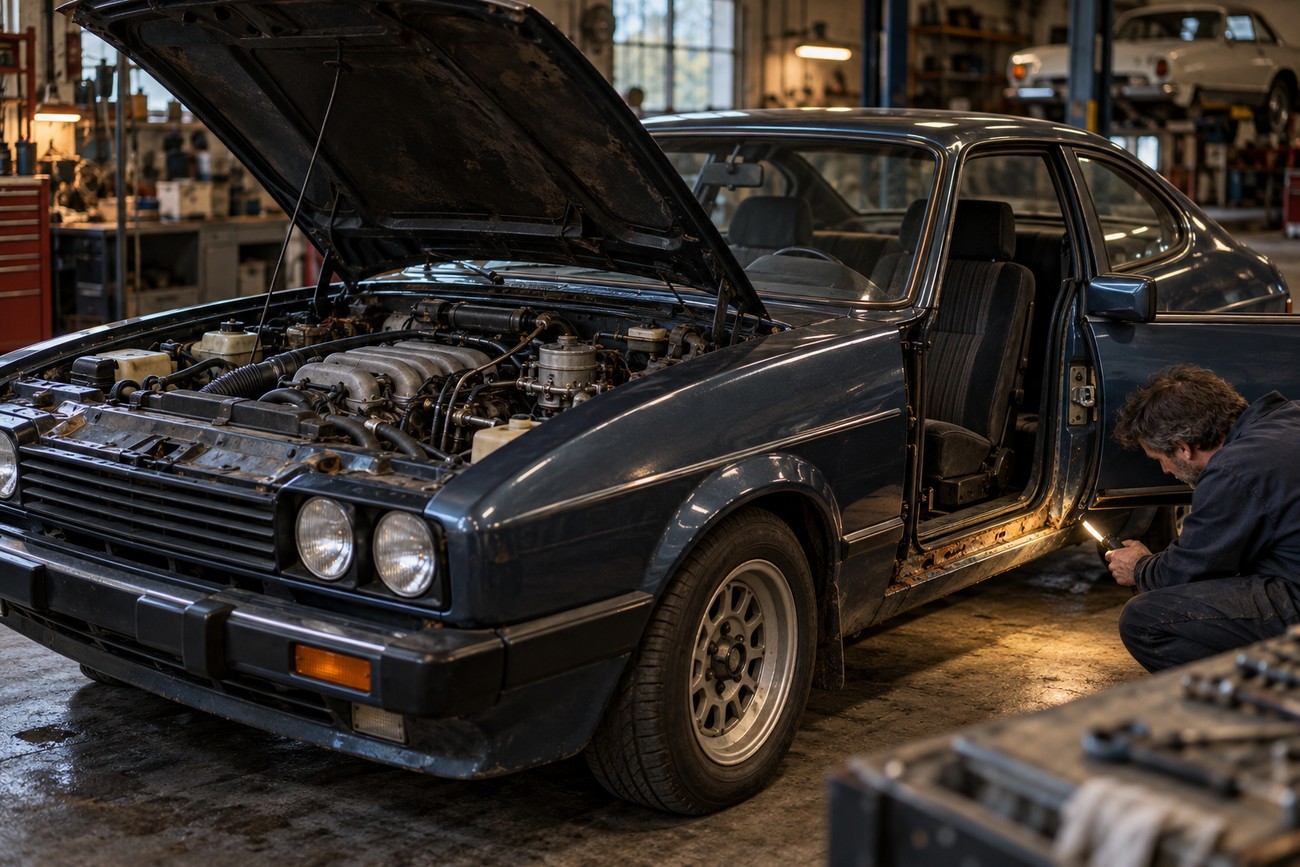
The strongest cars are defined by completeness as much as by power. Market of origin, model year, factory specification, documented history, original injection equipment, body trim, interior components, and surviving chassis evidence all influence desirability. A freshly repainted car with missing 2.8i parts may be less valuable as a classic than a less glossy car that retains its correct systems.
Common modifications include non-standard wiring, replacement seats, aftermarket exhausts, altered fuel systems, and engine swaps. Some changes improve usability, yet they also complicate verification and can make a return to factory specification expensive. The more unusual the car’s claimed history, the more important it becomes to compare documents with physical evidence.
A conversion can still be an enjoyable V6 coupe, provided it is described honestly and priced as such. The problem begins when a modified ordinary Capri is presented as a genuine 2.8i. Buyers should be cautious with cars identified mainly by badges, replica trim, or a seller’s explanation that the original paperwork was lost.
The 2.8i is no longer reliably cheap or simple to maintain. Age, rust, scarce injection components, uncertain repairs, and safety-related recommissioning dominate ownership costs. It becomes worthwhile for an enthusiast who values the complete period specification, understands the inspection process, and can support the car without treating the purchase price as the total cost.
Frequently asked questions
The questions below focus on verification and recommissioning, where a Capri 2.8i purchase is most often decided. They also separate an authentic, usable car from a visually convincing project.
How can I tell whether a Capri is a genuine 2.8i or a conversion?
Start with the documentation and identification numbers, then compare the claimed market and model year with the car’s physical specification. Confirm the engine details, inspect for the correct Bosch K-Jetronic hardware and fuel-system layout, and examine the chassis for evidence of replacement sections or a substituted shell.
Use trim, interior parts, body details, and factory-style equipment as supporting evidence rather than proof. A badge or body kit can be changed in an afternoon. A consistent history, matching identification evidence, original fuel system, and coherent chassis and trim specification provide a much stronger case.
What should happen before a Capri 2.8i returns to the road after long storage?
Recommission it in stages. Begin with the fluids, battery and electrical inspection, fuel tank and lines, and a careful check for leaks. Then address the cooling system, hoses, belts, brakes, wheel cylinders or calipers, suspension joints, bushes, dampers, and tyres before attempting normal road use.
Once the fuel and ignition systems are confirmed, check cold and hot starting, idle quality, charging, coolant temperature, and brake behavior at low speed. Early road tests should be short and close to the workshop, followed by another inspection for leaks, overheating, loose fasteners, and abnormal tyre wear.







