
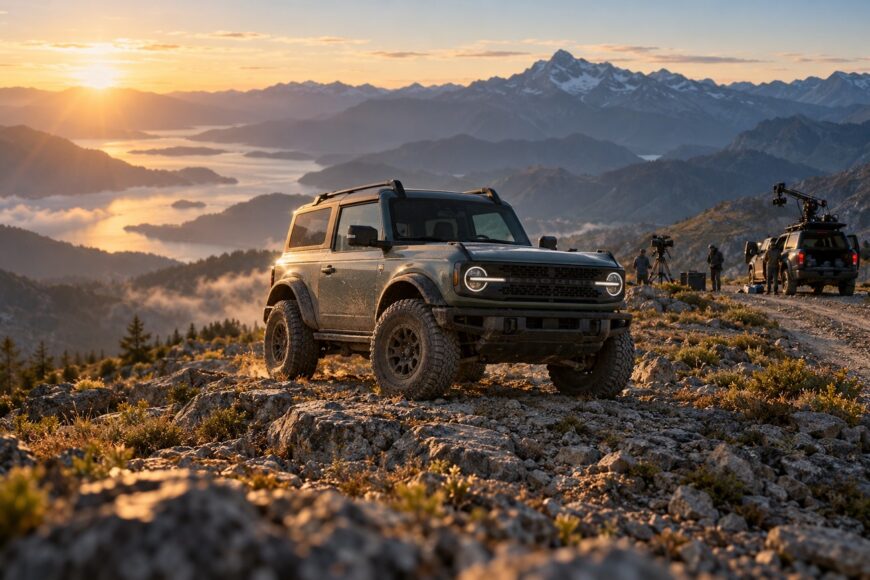
A Ford Bronco resting high above a mountain road can look almost effortless on screen: the vehicle climbs, the camera sweeps past, and the landscape supplies the drama. Making that image required a compact production, remote-location planning, permits, equipment movement, and enough flexibility to absorb mountain weather.
The finished commercial also leaves an important point unresolved. An edited sequence can suggest a complete ascent without establishing that the Bronco drove every visible stretch of terrain under its own power. The available production account documents how the shoot was organized, while the commercial itself provides only a selective view of the route.
- What Is Known About the Bronco Mountain Shoot
- Why Finding the Shot Is Harder Than Finding the View
- The Crew, Camera Rig and Weather Behind the Image
- 2026 Bronco Approach Angles by Configuration
- What the Commercial Cannot Prove About the Climb
- Planning a Mountain Vehicle Shot Without Copying the Ad
- Frequently asked questions
- Who made Ford’s 2020 Bronco film series?
- What would verify that the Bronco drove the entire route shown?
- How can I identify the Bronco’s trim and tires in the footage?
What Is Known About the Bronco Mountain Shoot
Ford’s 2020 Bronco campaign comprised three films featuring Jimmy Chin, Brooke Raboutou, and Kip Moore. Stept Studios and Riverside Entertainment produced the series, which used outdoor settings to connect the vehicle with climbing, exploration, and off-road travel.
The remote mountain details available for this article concern the Kip Moore film. According to a Frame.io production account, that film used three remote locations over three shooting days. The account describes location choices in terms of terrain, equipment access, and crew size rather than identifying a specific publicly accessible summit.
The production account is a behind-the-scenes source, not an official Ford production report. It is useful for understanding the practical work behind the images, including the schedule and remote-site demands, while leaving some questions about the filmed vehicle and its exact route unanswered.
That distinction matters because the commercial compresses several locations, camera positions, and driving moments into a short visual story. The result can feel like one uninterrupted mountain climb even though the available production information does not establish a continuous drive along every route implied by the edit.
Why Finding the Shot Is Harder Than Finding the View
A mountain location earns its place in a commercial through more than a striking skyline. It must provide usable ground for the Bronco, room for the camera vehicle, safe positions for the crew, and an exit route if the weather or vehicle conditions change. A narrow ridge may look ideal from a distance while offering nowhere to turn around or stage equipment.
The production had approximately two weeks to cover storyboards, locations, crew, permissions, and remote-site logistics. That is a compressed preparation window for a project involving multiple locations and difficult access. The Kip Moore film then used three remote locations over three shooting days, so each site had to work quickly once the crew arrived.
Route planning also has two separate layers. The Bronco needs a viable line over the terrain, while the crew needs a way to reach camera positions with batteries, lenses, support equipment, fuel, recovery gear, and safety supplies. Treating the vehicle route as the whole access plan can leave the camera team stranded below the shot or force unsafe improvisation.
Permissions and evacuation planning belong in the same conversation as composition. A location may support one spectacular pass yet fail as a working set because vehicles cannot leave safely, equipment cannot be moved between positions, or the crew has no protected area during a change in conditions.
The Crew, Camera Rig and Weather Behind the Image
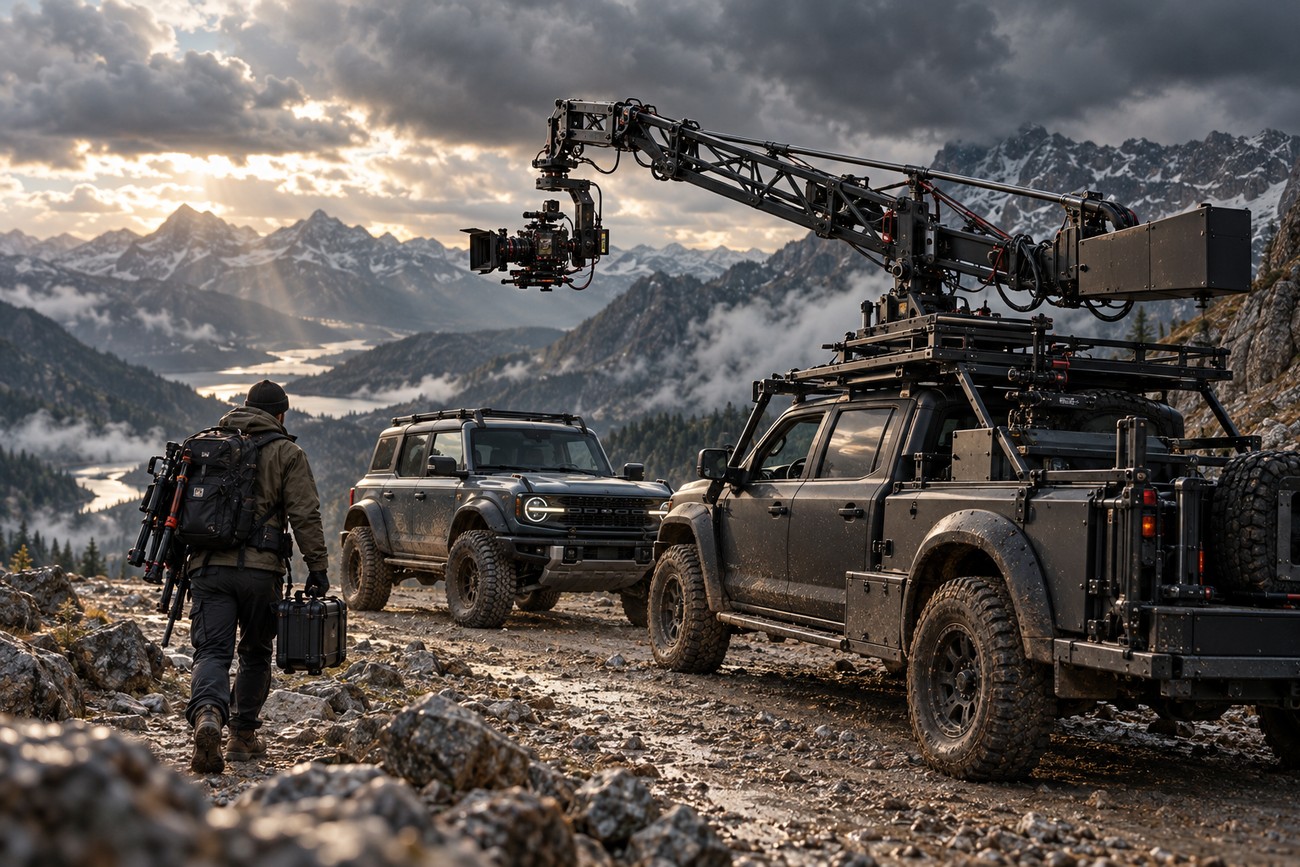
The production used a compact crew, but compact did not mean weightless. One crew member carried approximately 90 pounds, or about 41 kilograms, of equipment over rocky terrain. That load affects how quickly a team can reposition, how many camera options it can carry, and how much energy remains for repeated takes.
Vehicle shots used MotoCrane, a purpose-built camera rig for moving-vehicle work. Its presence explains the controlled, dynamic relationship between the Bronco and the camera. It does not establish that the footage came from a drone or helicopter.
The image also depended on weather cooperation. One shooting day was canceled and rescheduled because of weather, showing why a mountain schedule needs room for interruption. A clear forecast at the planning stage cannot guarantee usable wind, visibility, traction, or safe access on the day.
These constraints help explain the visual economy of the commercial. A small team can reach difficult terrain, but every additional lens, support system, or camera position increases the carrying burden and the number of decisions that must be made on exposed ground.
2026 Bronco Approach Angles by Configuration
Ford’s stated 2026 figures vary by configuration. They describe approach geometry for 2026 models and do not identify the Bronco filmed in 2020 or prove how that vehicle reached a location.
| 2026 configuration | Ford-stated approach angle | Configuration-specific details |
|---|---|---|
| Standard Ford Bronco | 35.7° | Standard 2026 specification |
| Bronco with Sasquatch package | 43.3° | Sasquatch-equipped configuration |
| Ford Bronco Raptor | Up to 47.2° | 37-inch tires, 13.1 inches of ground clearance, and a 40.5° departure angle |
The Raptor figures apply specifically to the Bronco Raptor, while the Sasquatch figure applies to a Bronco equipped with that package. Ford’s figures differ by model year and configuration, so neither figure should be assigned to every Bronco. Approach angle describes front-end clearance at an obstacle; it does not measure traction, side-slope stability, braking, or overall safety.
What the Commercial Cannot Prove About the Climb
The documented shoot used three remote locations over three days, but that fact does not establish a continuous, self-powered drive along the route suggested by the edit. The available production account and the finished commercial do not identify every connection between the visible driving shots and the mountain-top views.
Editing can remove pauses, repositioning, route sections, and changes in camera setup. Separate vehicle shots can then be arranged to create a clear visual progression. That is a normal commercial technique, and it does not by itself show that the Bronco failed to make a climb or that the vehicle was transported.
MotoCrane confirms the camera method documented for the vehicle shots. It does not establish how the Bronco reached any particular camera position, whether each view came from the same location, or whether the filmed vehicle followed the entire visible route.
Vehicle capability also depends on configuration and conditions. Tires, pressure, suspension, vehicle weight, surface quality, loose rock, mud, visibility, and the angle across the slope all affect performance. A high approach-angle figure can help clear a steep obstacle at the front of the vehicle while saying little about grip or stability farther along the climb.
Planning a Mountain Vehicle Shot Without Copying the Ad
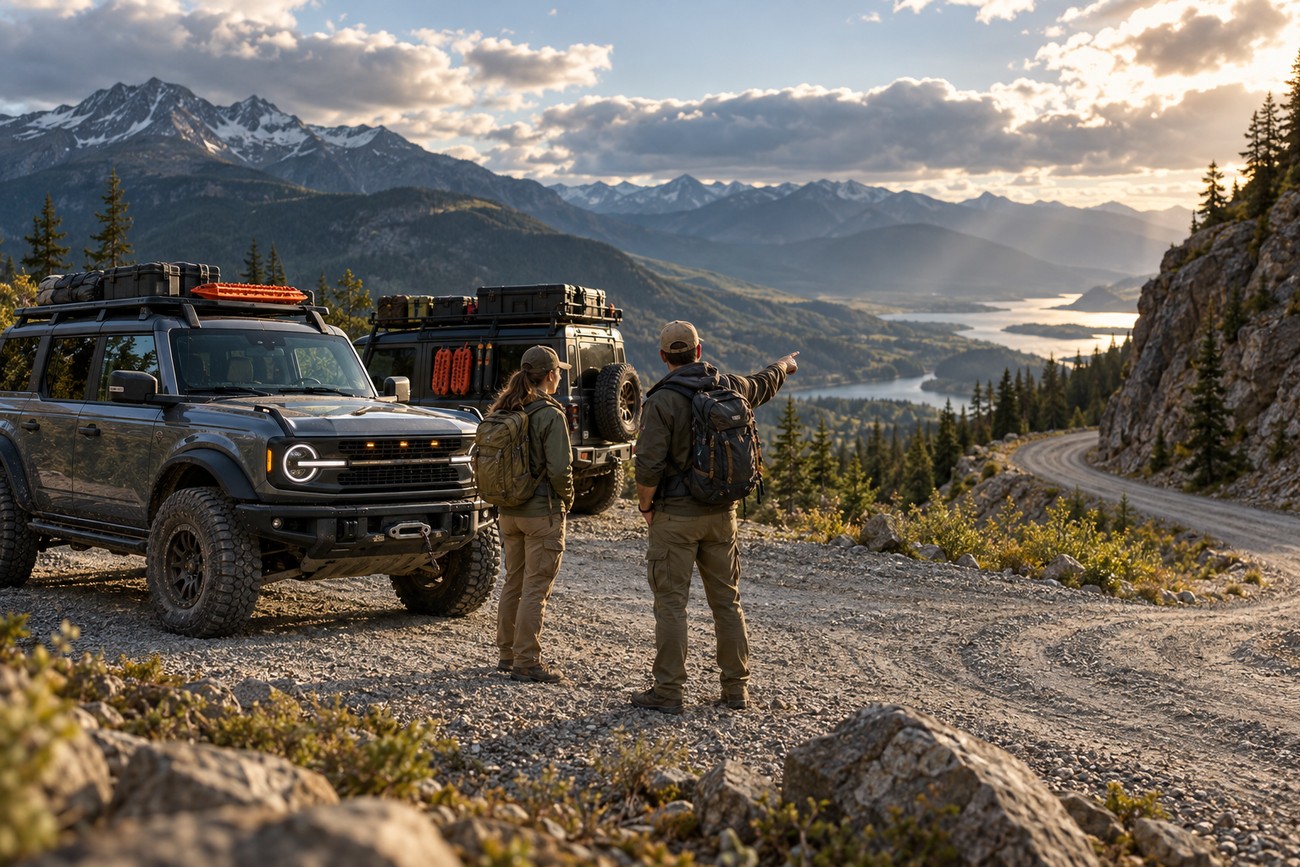
Start with access and permissions before judging the composition. Confirm how the Bronco, camera vehicle, crew, fuel, recovery equipment, and emergency supplies will reach the site, and identify a route out. The documented production allowed approximately two weeks for locations, permissions, crew, and remote-site logistics, which shows how much work sits behind a short finished sequence.
Scout for repeatable passes rather than a single dramatic attempt. Mark where the camera vehicle can turn around, where the crew can stand safely, and where the Bronco can stop without sliding or blocking the exit. A shot that can be repeated gives the director and operator control over framing, timing, and continuity.
Assess the actual surface in addition to the headline slope. Loose rock, changing grip, cross-slopes, blind crests, and limited stopping space can matter more than the advertised approach angle. Vehicle specifications should inform the assessment, never replace a site-specific check of the terrain and the particular tires and configuration being used.
Recovery planning should be visible on the location map before the first take. A safe extraction point, usable turnaround, and crew refuge are part of the shot design, especially when a compact team is moving heavy equipment over rocks.
Build weather and recovery contingencies into the schedule. One shooting day in this production was canceled and rescheduled because of weather, while the reported 90-pound equipment load shows why a quick relocation may be difficult. A controlled, repeatable pass is more useful than a one-off ascent that leaves no safe option for a second take or an exit.
Frequently asked questions
Who made Ford’s 2020 Bronco film series?
Stept Studios and Riverside Entertainment produced Ford’s 2020 three-film Bronco series. The films featured Jimmy Chin, Brooke Raboutou, and Kip Moore.
The remote mountain production details discussed here concern the Kip Moore film. A Frame.io production account describes its locations, schedule, equipment movement, and weather disruption; it is not an official Ford production report.
What would verify that the Bronco drove the entire route shown?
Continuous footage covering the route, supported by consistent landmarks and uninterrupted vehicle movement, would provide stronger evidence than an edited commercial. A reliable production account identifying the route, vehicle, and shooting method could also clarify the claim.
The available account does not establish a continuous drive along every stretch implied on screen. Separate shots, multiple locations, and editing leave that specific conclusion unverified.
How can I identify the Bronco’s trim and tires in the footage?
Production records, vehicle call sheets, build information, or clear identifiers visible on the vehicle would be the most reliable sources. Tire size, wheel design, fender treatment, suspension height, and body details may provide clues, but appearance alone can be misleading.
Ford’s 2026 specifications cannot identify a Bronco filmed in 2020. The filmed vehicle’s trim and tires require contemporaneous production documentation or sufficiently clear vehicle evidence; later model-year figures should not be applied automatically.







