
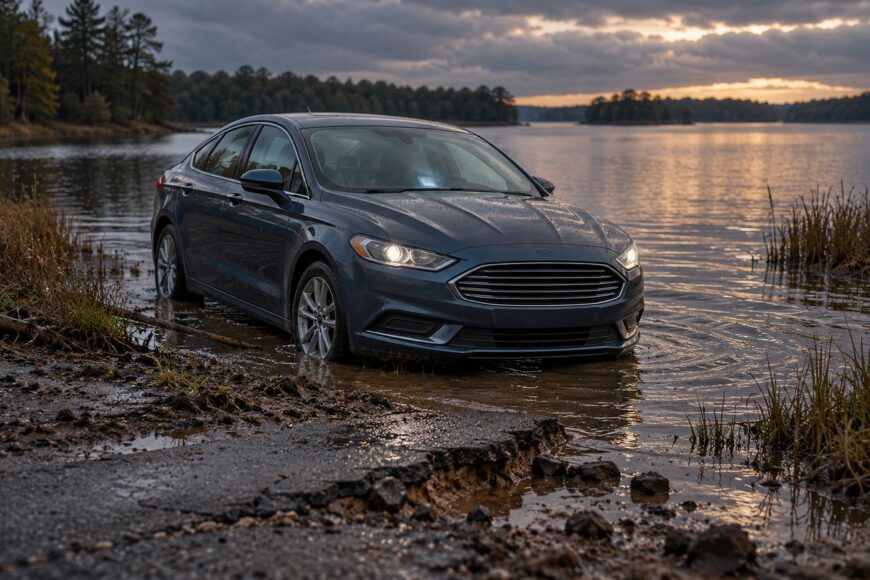
A Ford Fusion apparently following GPS straight toward a lake is a disturbing image. The specific claim that GPS directed a Ford Fusion straight into a lake is not confirmed by the available official materials.
The real danger is easier to verify: drivers can mistake a calculated route for proof that a road is open and safe. GPS supplies location and route calculations; it does not verify road access, water depth, current, road integrity, private ownership, or a safe shoreline. That distinction matters both before entering water and during the short window available for escape.
- Why GPS Can Lead a Ford Fusion Toward Water
- How Much Water Can a Ford Fusion Handle?
- What to Do If the Car Enters Deep Water
- The Mistakes That Turn a Navigation Error Into a Disaster
- Frequently asked questions
- How do I turn off Ford location tracking?
- How can I tell if my car is being tracked by GPS?
- What are some hidden features in the Ford Fusion?
- What year should I stay away from when buying a Ford Fusion?
Why GPS Can Lead a Ford Fusion Toward Water
Navigation software connects mapped roads and calculates a route between points. It may continue drawing a line across a crossing, along a private access road, or toward a shoreline even when the physical route has changed. A route line is therefore a calculation, not an inspection.
Maps may miss flooding, a washed-out bridge, a blocked private road, a damaged approach, or a changed shoreline. Seasonal roads and informal tracks are especially difficult to verify. A calm stretch of water may conceal a missing road surface, a steep drop, or soft ground beyond the visible edge.
Drivers commonly continue because the screen says “straight” and the road appears to continue ahead. Stop when signs, barriers, pavement, or the terrain disagree with the display. Check the surface from a safe position, and treat an unmarked crossing as an obstruction until its access and depth are independently clear.
How Much Water Can a Ford Fusion Handle?
Ford warns against driving through standing water above the lower edge of the front portion of the rocker panel or door sill. This is an avoidance limit, not a promise that the car can safely cross deep water. A normal Ford Fusion is not designed as a deep-water or off-road vehicle.
Some earlier Fusion manuals cite 200 mm and 10 km/h only for an emergency situation. That model-year-specific guidance should not be treated as general deep-wading capability or permission to approach a flooded road deliberately. Water depth can change quickly, and the visible surface gives little useful information about the bottom.
Water entering the air intake can damage the engine, while a wet ignition system can stop the engine. A stalled vehicle may also suffer damage to electronics, sensors, connectors, and control modules. Do not assume that slow speed makes a deep crossing safe.
Water that looks still can conceal a current, an eroded shoulder, or a drop where the road used to be. If the route is flooded or the shoreline is uncertain, turn around before the tires enter. The costliest mistake is treating the vehicle’s apparent momentum as evidence that the road continues.
What to Do If the Car Enters Deep Water
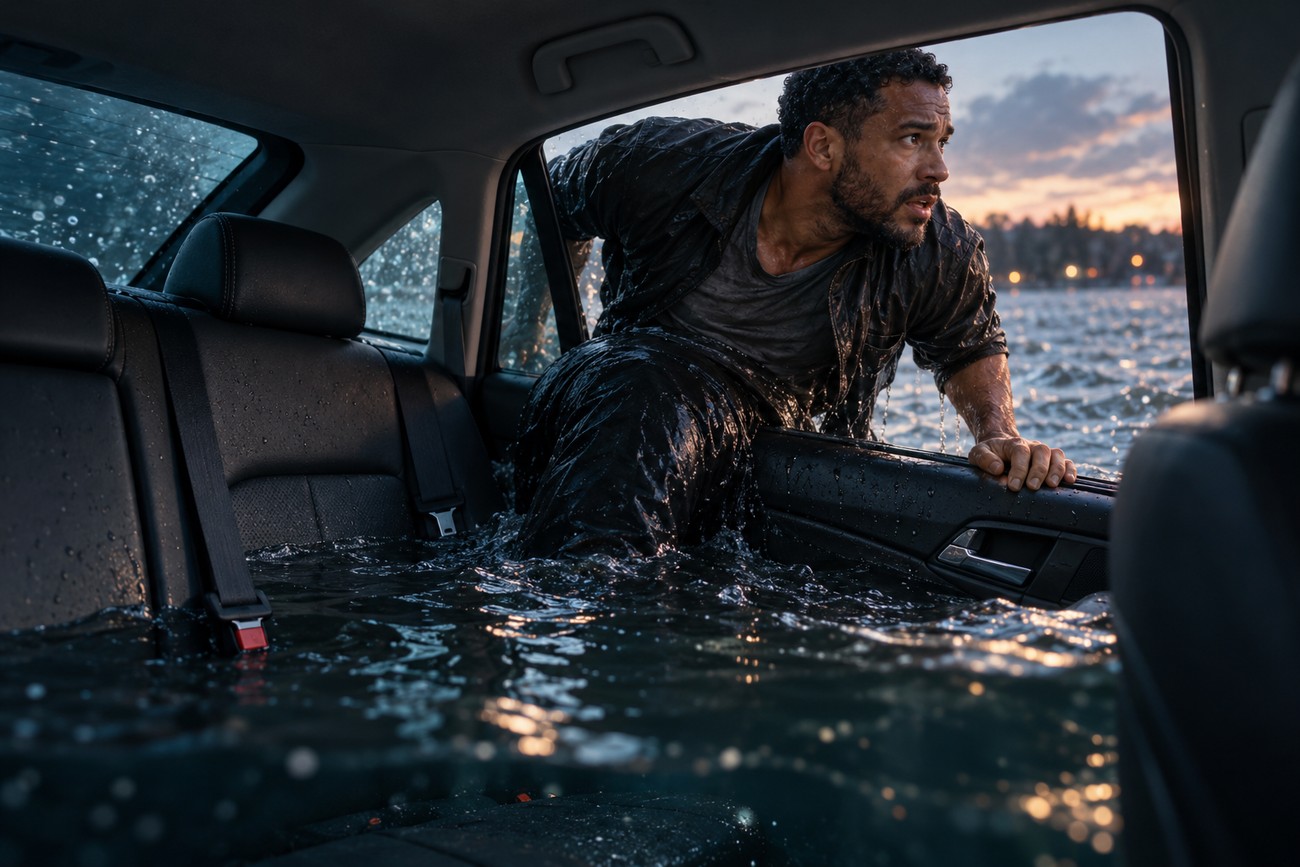
If the car enters deep water, act immediately. Technical NHTSA materials indicate that a vehicle may float briefly, often for no more than about one minute. That short phase is the best opportunity to create an exit before water pressure and electrical failure restrict your options.
Use the SWOC sequence: unbuckle seat belts, open windows, immediately get out, and get children out first. Open a side window as early as possible, while it is still above the water. If the window is open, leave through it rather than spending the first moments pulling at a door.
Secure the escape path before reaching for a phone, luggage, or a window-breaking tool. The first minute is the critical working window, and every delay reduces the number of usable exits.
Hydrostatic pressure can make the doors difficult or impossible to open soon after immersion. Waiting for the cabin to fill is dangerous because it gives you less time, visibility, and coordination. If an electric window no longer works, follow your prepared alternative; advice about breaking windows depends on the glass type and the escape tool, so there is no reliable universal claim that every window is easy to break.
Once people are out, move away from the vehicle and toward safety. Leave belongings behind, and do not try to restart or drive a car that stalled or was substantially immersed until it has been professionally inspected. Restarting can increase the risk of hydrolock and electronic damage.
The Mistakes That Turn a Navigation Error Into a Disaster
The first mistake is treating the route line as evidence that a crossing remains drivable. A displayed path does not confirm a road, bridge, private entrance, or shoreline approach. The second is continuing because the water looks shallow; depth, current, and a missing road may be hidden from the driver’s position.
The third is trying the door first. Outside water pressure can hold it shut almost immediately, even while the vehicle is still partly afloat. Opening a side window is generally the better first exit, provided it is done before water reaches the lower edge and disables the electrical mechanism.
A fourth mistake is focusing on rescue calls or possessions before creating an escape route. Children should be moved first, followed by other occupants; phones and documents can wait. Afterward, a flooded Fusion may have damage beyond the engine, including sensors, control modules, connectors, seat belts, and cabin wiring.
Dry carpets do not prove that the problem is over. Moisture inside connectors and restraint systems can cause corrosion and delayed electrical failures. Myth: a car that starts after drying is safe to drive. Reality: a vehicle that was flooded or stalled in water needs professional inspection before any restart or road use.
Frequently asked questions
These questions address privacy, vehicle recovery, and features that are often confused with navigation safety.
How do I turn off Ford location tracking?
Review the Ford connected-service settings and account permissions, then check location access for the Ford app on your phone. The exact controls vary by vehicle, subscription, and market, so the owner’s manual and account portal provide the applicable steps.
Disabling connected services does not make a mapped road physically verified, and it does not correct stale map data. The navigation route, Ford service data, and phone location permissions are separate functions.
How can I tell if my car is being tracked by GPS?
Check connected accounts, active vehicle services, phone permissions, and any unfamiliar aftermarket device attached to the vehicle or diagnostic port. Ask the vehicle manufacturer or service provider which connected features are active. Ordinary GPS navigation alone does not prove surveillance; it may simply be receiving location data to calculate a route.
What are some hidden features in the Ford Fusion?
Depending on model year and trim, a Fusion may include configurable driver-information displays, programmable door-lock behavior, remote-start settings, and service or vehicle-status menus. The exact features differ substantially, so check the model-year owner’s manual rather than assuming every Fusion has the same controls.
What year should I stay away from when buying a Ford Fusion?
There is no single year that every buyer should automatically avoid. Reliability concerns can vary by engine, transmission, trim, maintenance history, and recall status, so inspect the specific vehicle’s service records and check its outstanding recalls before buying.







