
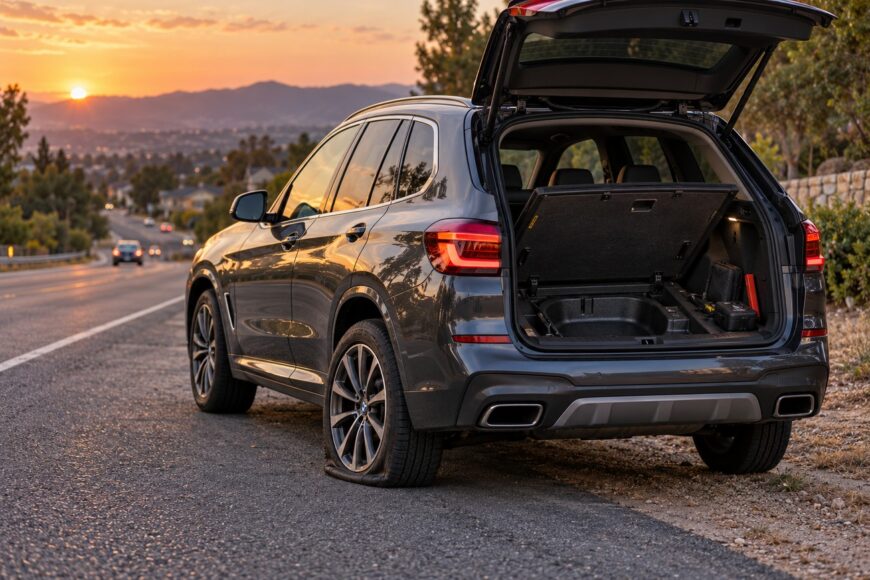
Finding a flat tire on a BMW X3 is unsettling enough; finding it with no spare wheel adds a second problem immediately. The car may appear fully stranded, yet an X3 fitted with BMW RSC Run-Flat tires can retain limited mobility after complete pressure loss. That capability is designed to help you reach a safe stopping place or tire facility, not to make a damaged tire suitable for normal driving.
BMW’s conservative operating rule is up to 80 km at up to 80 km/h after pressure loss. The usable distance can be substantially shorter because of vehicle load, temperature, road surface, speed, and the severity of the damage. A flat run-flat is an emergency window, not a permanent replacement for roadside assistance, a correctly specified replacement tire, or a spare-wheel solution.
- Why a BMW X3 May Have No Spare Tire
- What to Do When the X3 Tire Goes Flat
- The Run-Flat Trade-Off: Ride, Noise, Cost, and Repairability
- Choosing the Correct Replacement for a BMW X3
- BMW X3 Run-Flat Versus Conventional Tires
- Common BMW X3 Run-Flat Mistakes and Myths
- Frequently Asked Questions
- Why does my BMW X3 not have a spare tire?
- How can I tell whether a replacement tire is BMW star-spec?
- What should I check on a used BMW X3 before buying it if it has no spare?
Why a BMW X3 May Have No Spare Tire
BMW’s no-spare strategy is built around Run-Flat technology. RSC tires use reinforced sidewalls designed to preserve limited mobility and controllability after pressure is lost, including complete pressure loss. This allows the vehicle to continue for a limited distance without carrying a full-size spare wheel and tire.
Removing the spare assembly also reduces the space required beneath or inside the cargo area. That can leave more usable room for luggage and avoid carrying a wheel that may rarely be used. The trade-off appears when a puncture occurs far from a tire shop: a minor tire problem can become a logistics problem involving a replacement tire, roadside assistance, or a tow.
Equipment varies by specific X3 configuration. Some vehicles may have a repair kit or compressor, while others rely primarily on run-flat tires and the owner’s roadside-support arrangements. Check the cargo area, under-floor storage, and vehicle equipment list rather than assuming that every X3 has the same emergency equipment.
A common ownership mistake happens before the purchase. Buyers confirm the engine, trim, and options but never lift the cargo-floor panel to check for a spare, repair kit, or compressor. That inspection takes little time and can reveal whether the car’s emergency plan depends entirely on the condition and correct specification of its tires.
What to Do When the X3 Tire Goes Flat

When the tire-pressure warning appears or the vehicle begins to pull, reduce speed smoothly and avoid sudden steering, braking, or lane changes. Keep both hands on the wheel and move toward a safe location with suitable road clearance. Read the warning carefully, because a pressure-monitoring alert may identify pressure loss without showing whether the tire has suffered a puncture, sidewall damage, or another failure.
BMW’s conservative RSC limit after pressure loss is up to 80 km at up to 80 km/h. Treat that as a maximum emergency operating allowance, not as permission to continue at normal speed or complete a long journey. If the tire is visibly damaged, the vehicle feels unstable, or road conditions are poor, stop sooner and arrange assistance.
Practical range depends on the vehicle load, temperature, road surface, speed, and extent of the damage. A heavily loaded X3 on a hot day and rough pavement places more stress and heat into the tire than a lightly loaded vehicle on a smooth road. These conditions can reduce the distance available before the reinforced structure becomes unsafe or unusable.
Run-flat technology does not remove the need to monitor tire pressure. The system creates time to reach safety, while the tire-pressure monitoring system helps identify that the emergency mode has begun. Once stopped, have the tire inspected by a qualified tire professional, even if it appears to have reached the destination without further symptoms.
The Run-Flat Trade-Off: Ride, Noise, Cost, and Repairability
Run-flat tires are commonly perceived as firmer than comparable conventional tires. Their reinforced sidewalls resist collapse after pressure loss, but that construction can transmit more impact from potholes, expansion joints, and coarse pavement into the cabin. Some X3 owners accept the sharper response, while others find the ride less comfortable on uneven roads.
Rolling noise is another common owner complaint. The difference depends on the tire model, tread pattern, wheel size, road surface, and vehicle insulation, so it is not universal. A tire that sounds acceptable on smooth asphalt may be noticeably louder on concrete or worn pavement.
Replacement cost is generally higher, and less common X3 fitments can be harder to source. Representative G01 sizes include 225/60 R18, 245/50 R19, 245/45 R20, 275/40 R20, and 275/35 R21, depending on the version. Availability in a matching size does not guarantee that the tire has the required run-flat construction or BMW-approved specification.
Zero-pressure driving can damage the internal structure even when the puncture itself looks simple from the outside. Inspection must consider the heat and flexing endured by the sidewalls, so replacement may be preferable or necessary after extended driving without pressure.
Run-flat construction is typically heavier than conventional construction. That extra unstrung and rotating mass can affect ride comfort, efficiency, and steering response. These trade-offs explain why some owners prefer conventional tires after checking the vehicle’s approved configuration, while others value the ability to leave a dangerous roadside location after a puncture.
Choosing the Correct Replacement for a BMW X3
The numbers on the sidewall are only the starting point. A replacement must match the exact X3 generation, vehicle configuration, wheel, axle fitment, load requirements, and intended tire technology. One nominal size may be available as both a run-flat and a conventional tire, with different handling and pressure-loss behavior.
BMW uses the RSC designation for its run-flat system. Other brands may use labels such as SSR, RFT, ZP, EMT, ROF, or HRS. These are brand-specific labels, so seeing a run-flat term on a product page does not by itself confirm that the tire is the correct BMW specification for the vehicle.
Verify the BMW star marking and the complete tire-wheel-vehicle combination before approving a replacement. Size numbers alone cannot confirm the correct load capability, run-flat construction, or clearance for a particular X3 configuration.
BMW says that a star-marked tire has been tested and tuned for a specific BMW model. The star marking should be checked on the tire sidewall and against the product documentation or invoice. A seller’s statement that a factory size is available may describe only the dimensions, not a BMW star-spec tire.
For a G01 X3, catalog sizes can include 225/60 R18, 245/50 R19, 245/45 R20, 275/40 R20, and 275/35 R21, depending on the version. These examples do not mean that every size fits every X3, or that front and rear fitments are interchangeable. Confirm the vehicle’s original specification, wheel width, axle position, and load requirements before ordering.
BMW X3 Run-Flat Versus Conventional Tires
Neither construction is automatically safer in every situation. Run-flat tires provide limited mobility after pressure loss, while conventional tires generally require immediate inflation, repair, or replacement; speed, vehicle mass, road condition, and driver response remain decisive.
| Consideration | Run-flat tires | Conventional tires |
|---|---|---|
| Mobility after a puncture | Limited mobility after pressure loss, within BMW’s conservative allowance of up to 80 km at up to 80 km/h | Usually requires immediate repair, inflation, replacement, or roadside assistance |
| Ride comfort | Typically firmer because of reinforced sidewalls | Often more compliant, depending on tire model and pressure |
| Road noise | Commonly perceived as noisier, although results vary by tire and road surface | May produce less rolling noise in a comparable application |
| Purchase cost | Generally higher | Often lower for a comparable size and category |
| Weight | Typically heavier, which can affect comfort, efficiency, and response | Typically lighter, subject to the specific tire design |
| Repair prospects | Extended zero-pressure driving can damage the internal structure and make replacement necessary | A small tread puncture may be repairable if the tire was not driven damaged and the injury meets professional repair criteria |
| Roadside dependence | Lower immediately after a qualifying puncture, because limited mobility may remain | Higher unless the vehicle carries a spare, compressor, sealant, or another approved solution |
Switching from run-flats to conventional tires can change steering response, ride behavior, pressure-loss response, and the practical roadside plan. The decision should account for the vehicle’s approved configuration and handling expectations, rather than focusing only on price or comfort.
Conversely, fitting run-flats to a vehicle or wheel combination that was not specified for them does not automatically reproduce the original BMW behavior. Wheel compatibility, load capacity, pressure settings, and the complete tire specification still need to be checked.
Common BMW X3 Run-Flat Mistakes and Myths
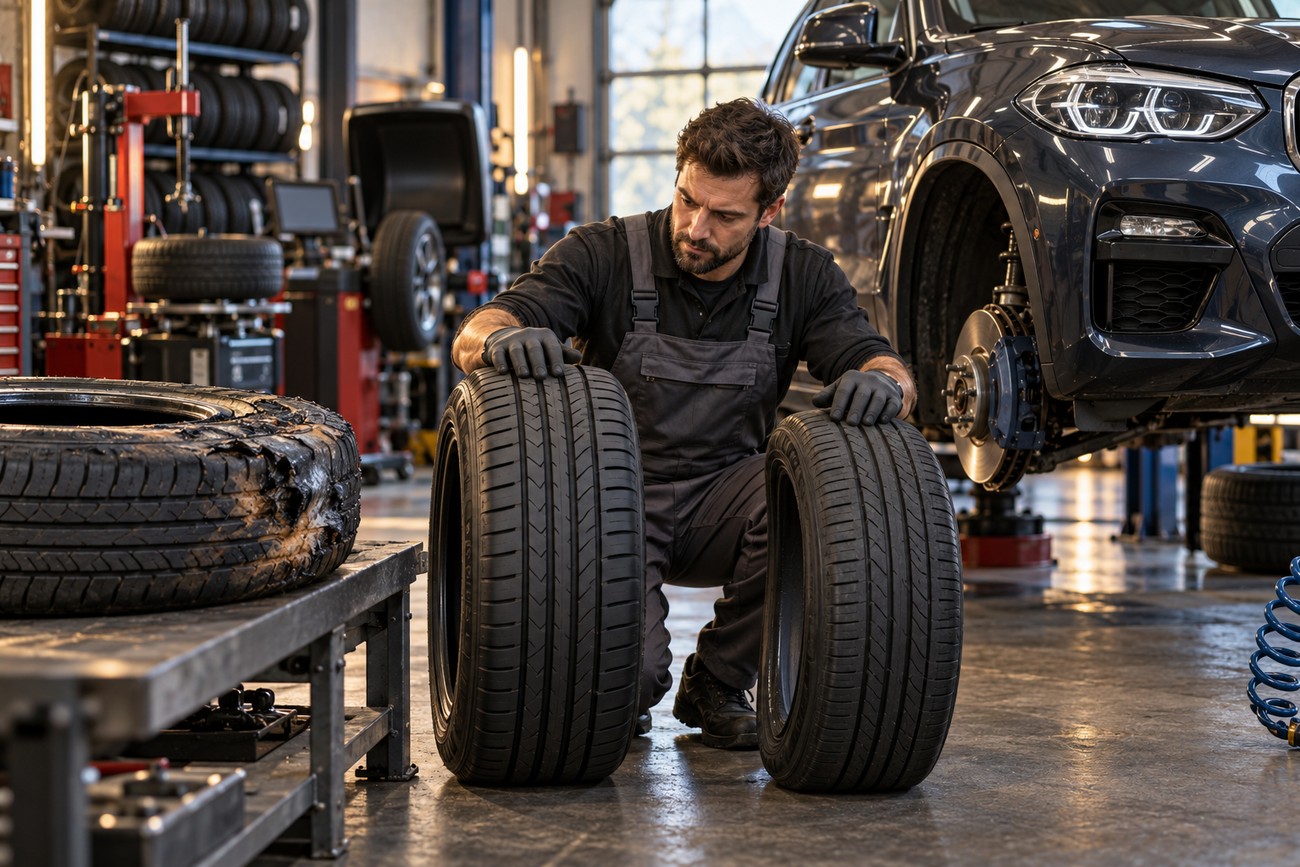
The first myth is that a run-flat can travel indefinitely after a puncture. BMW’s conservative allowance is up to 80 km at up to 80 km/h after pressure loss. Driving farther or faster can generate damaging heat and destroy the tire’s internal structure, even if the vehicle initially feels stable.
A second mistake is treating every tire with the same dimensions as equivalent. The correct choice also depends on RSC construction, BMW star specification, wheel compatibility, load requirements, axle position, and the exact X3 configuration. A same-size tire advertised as available may be a conventional tire or a non-star aftermarket specification.
A third myth is that a punctured run-flat can always be repaired. A small tread injury may look repairable, but extended driving at zero pressure can damage areas that cannot be assessed safely from the outside. The tire must be inspected internally and replaced if its structure or repair limits make continued use unsuitable.
Replacing run-flats with conventional tires also requires more than fitting the same size. The vehicle’s approved setup, handling expectations, pressure-monitoring behavior, and emergency equipment should be reviewed first. A conventional tire may improve comfort or reduce cost, but it removes the same limited mobility after pressure loss.
Frequently Asked Questions
Why does my BMW X3 not have a spare tire?
BMW designed many X3 configurations around RSC Run-Flat tires, whose reinforced sidewalls can preserve limited mobility after complete pressure loss. Omitting a spare reduces the space and weight required for a spare wheel and tire, but it also increases dependence on tire condition, roadside assistance, or access to a correctly specified replacement.
Equipment varies by configuration. Before buying or traveling in the vehicle, inspect the cargo area and under-floor storage for a spare wheel, repair kit, and compressor. Do not assume that the presence of Run-Flat tires means a compressor or repair kit is also included.
How can I tell whether a replacement tire is BMW star-spec?
Check the tire sidewall for BMW’s star marking and confirm that the product documentation or invoice identifies the same specification. Also verify the RSC designation, exact size, load requirements, wheel fitment, and the relevant X3 generation and configuration. The star marking is important because BMW describes star-marked tires as tested and tuned for a specific model.
Do not approve a tire solely because its dimensions match the old one. Ask the seller to confirm the complete specification in writing, especially when the product page lists several versions of the same size. A run-flat label from another brand does not by itself prove BMW star-spec compatibility.
What should I check on a used BMW X3 before buying it if it has no spare?
Inspect all tires for tread condition, sidewall damage, uneven wear, and age markings, then confirm that the tire specification matches the vehicle. Check that the tire-pressure monitoring system operates correctly and that no warning remains stored after the tires are inflated to the specified pressures.
Open the cargo-area storage compartments and confirm whether the car has a spare, repair kit, compressor, or none of these. Finally, compare the sidewall markings with the vehicle’s original tire specification, including size, RSC construction, BMW star marking, load capability, and axle fitment. This confirms the actual roadside plan before the first long trip.







