
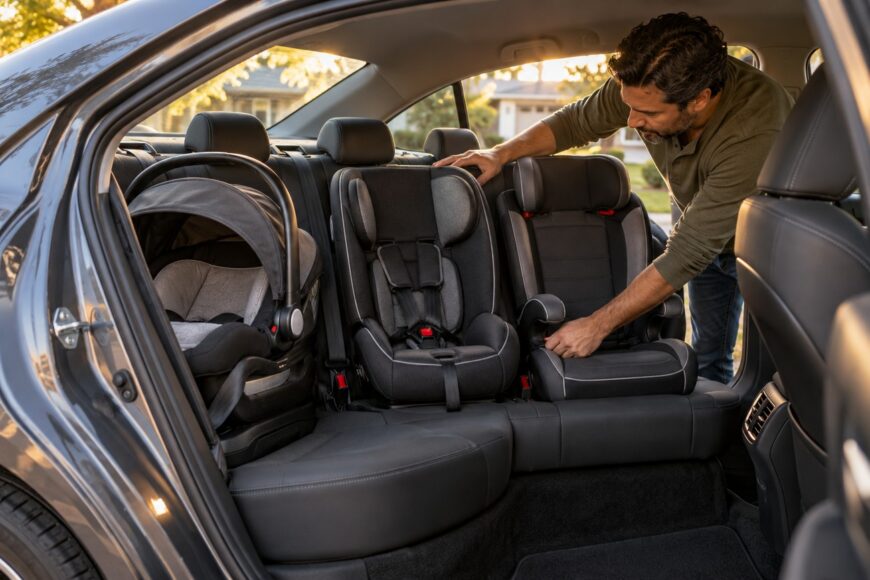
Three car seats can appear to fit across a rear bench until someone tries to reach the middle buckle. In a Toyota Camry, the useful test is whether each child can ride in an appropriate restraint, with every seat installed correctly and every child buckled properly on an ordinary day.
That takes more than adding up seat widths. The Camry’s center seating position, buckle locations, and available anchors vary by model year and configuration. A layout that works with one set of restraints may fail with another, even if all three seats seem to fit between the doors.
- Can Three Car Seats Fit in a Toyota Camry?
- Where the Camry’s Rear Bench Makes Space Tight
- Seat Belts, LATCH, and Top Tethers: Check Each Position
- Camry Three-Across Seat Combinations to Test
- How to Test the Fit Before You Commit
- When It Fits on Paper but Fails Every Day
- Frequently asked questions
- Which Toyota car is more likely to fit three car seats?
- What happens when a child outgrows the narrow seat that made the layout work?
- Which Toyota car can fit three car seats?
- How do you fit three car seats in a sedan?
Can Three Car Seats Fit in a Toyota Camry?
Three-across is possible in some Camrys, but no configuration is guaranteed across model years, trims, and restraint combinations. The answer for your car depends on the children’s ages and sizes, the restraints they need, and whether those restraints can be installed and used together in the exact vehicle.
A rear-facing infant seat, a convertible seat, and a booster present different shapes and daily tasks. A booster may leave room at shoulder height yet place its buckle under the neighboring seat. Three larger harnessed restraints may run out of space around their bases before their upper shells meet.
Published widths help narrow a shopping list, but they cannot establish compatibility. FMVSS 213 regulates child restraints; it does not certify a seat as narrow or guarantee a three-across fit in a Camry. Treat a “fits three across” claim as a reason to arrange a trial, rather than proof that a particular installation is approved.
Begin with what each child needs, then look for restraints that meet those needs and can be tested together. Moving a child into a booster early simply to make the row fit is not an appropriate shortcut.
Where the Camry’s Rear Bench Makes Space Tight
The center position is often the hardest place to work, although its geometry and buckle access vary by Camry model year and configuration. A center restraint may sit close to an outboard buckle or leave too little room to reach its own. The shape of the seat cushion and floor area can also affect how easily an adult reaches in to secure a child.
Measuring from door to door misses the tightest points. Usable space depends on restraint bases and widest points, buckle stalks, head restraints, and how adjacent seats meet—not just published shell width. Armrests, cupholders, and a broad base can consume room exactly where the neighboring restraint needs to sit.
The upper part of a seat matters, too. A vehicle head restraint may affect how a child restraint or booster sits, while adjacent shells can push an installation off-center or make it lean. Follow both manuals for any head-restraint adjustment; do not remove one solely to gain space unless the instructions allow it.
Seats touching is not, by itself, evidence of a problem or proof of a sound installation. The important checks are whether each restraint occupies an approved position, meets its installation instructions, and leaves the next child’s buckle accessible.
Seat Belts, LATCH, and Top Tethers: Check Each Position
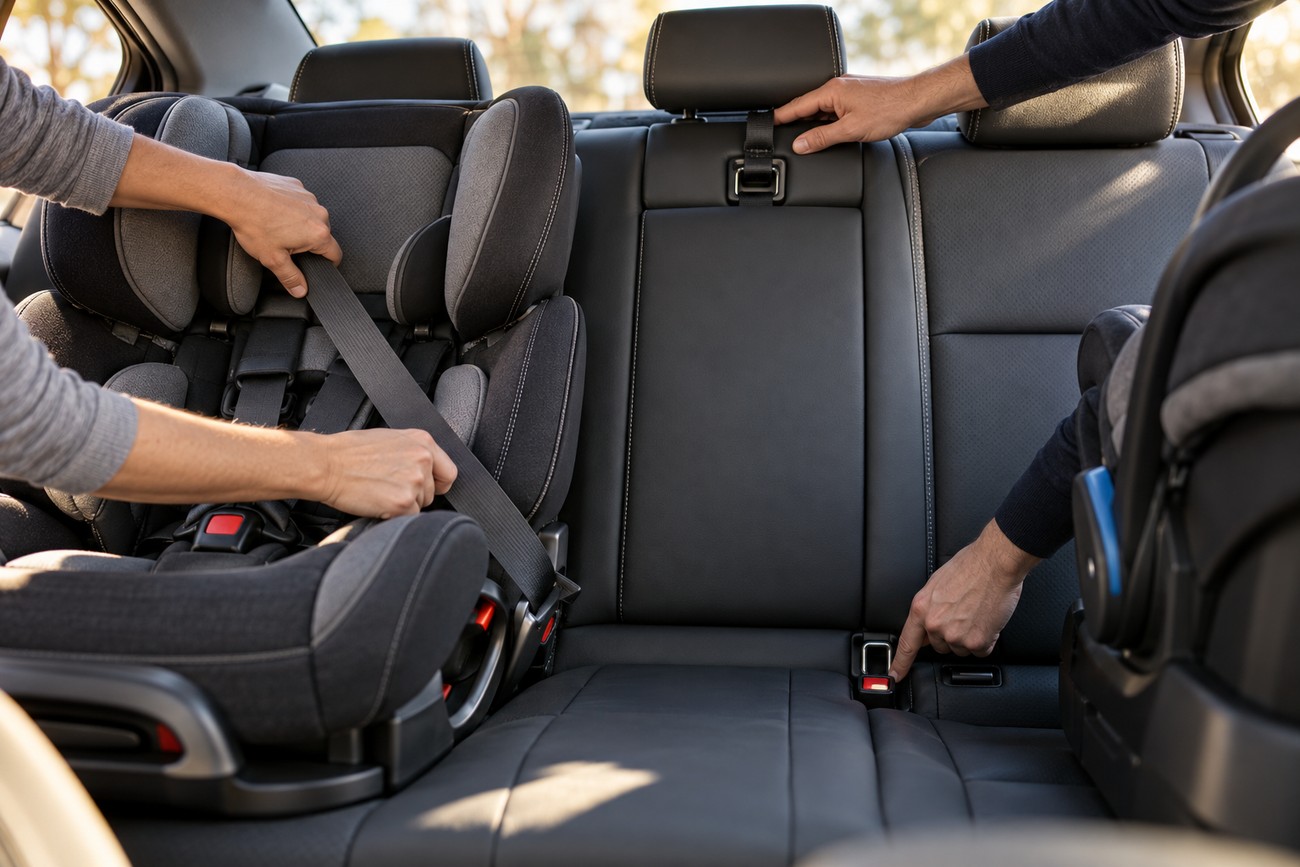
A vehicle seat belt can provide useful positioning flexibility in a crowded row. A correctly installed vehicle-belt restraint is a valid option when both manuals allow it; a lower-anchor installation is not inherently the safer choice. Check the required belt routing and locking method for each restraint before deciding which method works better.
Lower LATCH anchors commonly serve the two outboard positions. Do not borrow anchors from those positions for a center installation, or share an anchor between seats, unless both the Camry manual and the child-restraint manual explicitly permit that arrangement. Visible anchor hardware near the center does not establish approval for center use.
Forward-facing harnessed restraints also require a check of top-tether locations and instructions for the exact Camry model year and restraint. Confirm the approved tether anchor for the seating position you intend to use, rather than choosing a point that merely looks reachable.
Make a position-by-position plan before installing anything: seating location, restraint orientation, approved installation method, and tether instructions where applicable. This prevents a workable-looking center seat from depending on anchors its manuals do not authorize.
Camry Three-Across Seat Combinations to Test
These are trial layouts, not guaranteed fits. Use only restraint types appropriate for the children riding in them.
| Combination to test | Potential space advantage | Constraint to verify |
|---|---|---|
| Rear-facing infant seat, convertible seat, and booster | Different shell shapes may fit beside one another. | Reach the booster buckle and check the infant seat’s required clearance and recline. |
| Three narrow harnessed restraints | Compact bases may leave more room at buckle height. | Install each seat independently; check belt paths, buckles, and forward-facing tether instructions. |
| Two rear-facing restraints and one suitable third restraint | Staggered shell shapes may reduce overlap. | Check front-seat clearance, rear-facing recline, and access to every harness. |
How to Test the Fit Before You Commit
First, confirm the appropriate restraint for each child’s size and stage. Read the Camry manual for approved seating positions and attachment points, then check each restraint manual for its installation methods and space requirements. This rules out layouts that rely on an unapproved center-anchor arrangement before you spend time wrestling with the seats.
Start with the hardest center placement, often a narrow restraint whose base and buckle path you can access there. Add the outboard restraints one at a time, using approved installation methods. A narrow center seat may free room at the sides, but the center position and buckle access still need testing.
Remove the neighboring restraints when checking an installation. A seat that seemed secure in a crowded row may reveal movement once the adjacent seat is no longer bracing it.
Assess each installation at the point and in the manner its manual specifies, then reinstall the full row and repeat the checks. Buckle each child, reach the harness adjustments, and close both doors without forcing them against a restraint. Complete this trial in your exact Camry with the actual seats before a purchase return window closes; measurements and marketing claims cannot replace it.
When It Fits on Paper but Fails Every Day
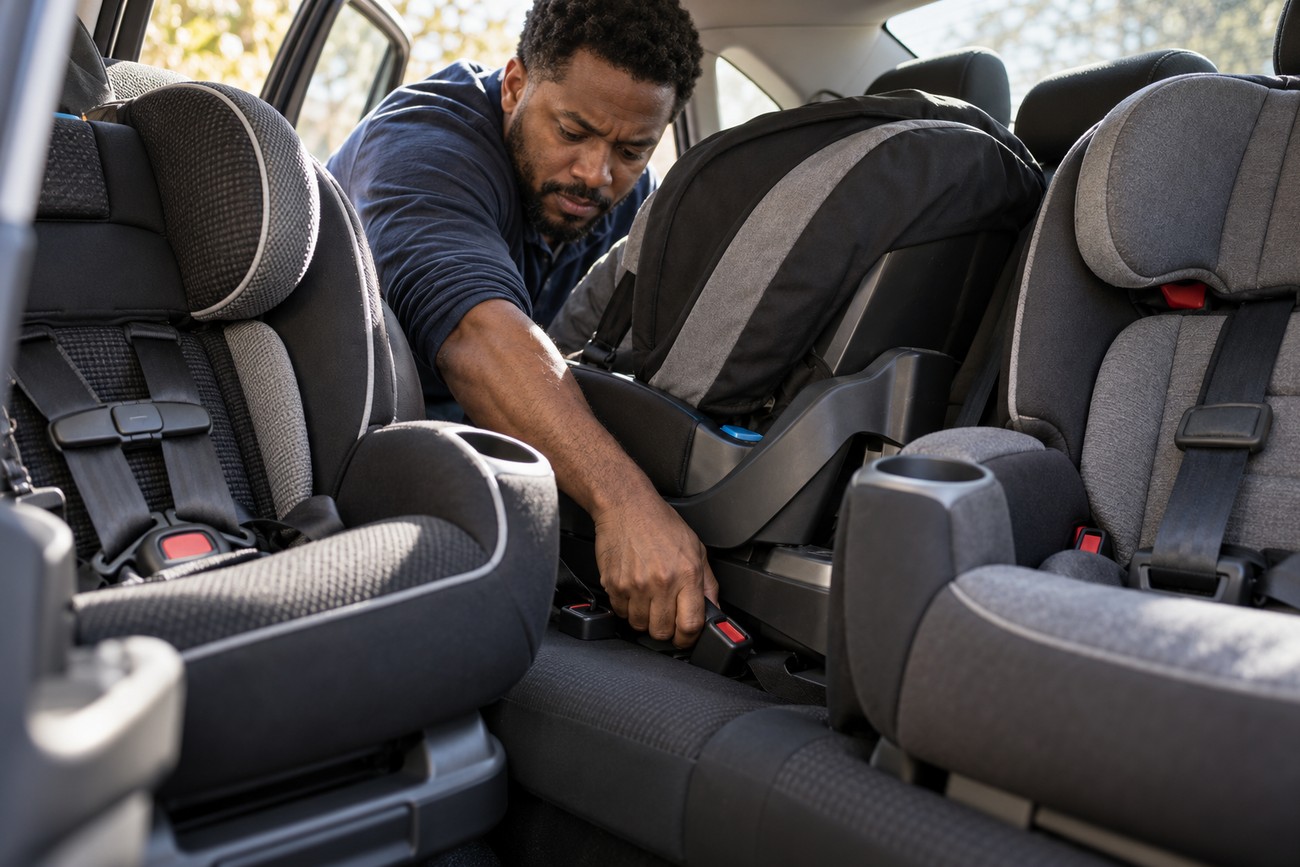
A row of seats can occupy the bench and still be impractical. A booster buckle trapped beneath another base may be difficult to fasten correctly on every trip. An inaccessible harness adjuster can create the same problem, especially when the person buckling the child cannot see or reach it clearly.
Watch for a restraint that shifts, leans, or changes position after the neighboring seats go in. Crowding can hide a weak installation, and a door should not have to press a seat into place. Recheck the individual installation under its manual’s instructions if the completed row looks different from the single-seat trial.
Daily access is part of the fit test. Have the adults who normally load the children buckle them in the intended order, including the child in the center. If a buckle stalk disappears between bases or a harness cannot be adjusted as directed, the arrangement needs another solution even if the door closes.
Change the approved seating arrangement or choose a different appropriate restraint, then test the whole row again. Keep each child’s age, size, and restraint requirements ahead of space savings; a child should not move to a booster merely to preserve a three-across layout.
Frequently asked questions
These answers help with the next decision, whether you are shopping for a vehicle or adapting a layout as your children grow. In each case, the exact vehicle and restraints still need a hands-on check.
Which Toyota car is more likely to fit three car seats?
Compare candidate vehicles by their approved seating positions and the space your actual restraints need, rather than relying on a model name or overall vehicle width. Bring the restraints to a vehicle trial where possible, and check installation, buckle access, and the ability to load each child without disturbing another seat.
What happens when a child outgrows the narrow seat that made the layout work?
Follow that restraint’s height, weight, and other stated limits, then choose the next appropriate restraint for the child. Its base, shell, or buckle position may differ, so repeat the complete three-across installation and daily-use test. The original arrangement is not permanent simply because it once worked.
Which Toyota car can fit three car seats?
Some individual Toyota vehicles may accommodate three appropriate restraints, but a model name alone cannot establish which ones will work for your family. For any vehicle under consideration, confirm that all intended seating positions and installation methods are permitted, then test the three actual restraints together before deciding.
How do you fit three car seats in a sedan?
Start with restraints appropriate for all three children, then identify the sedan’s approved rear seating positions in its manual. Trial the most difficult center position first and install the remaining seats using methods allowed by both manuals. Keep the layout only if every installation checks out independently and all buckles, harnesses, and doors remain usable.







