
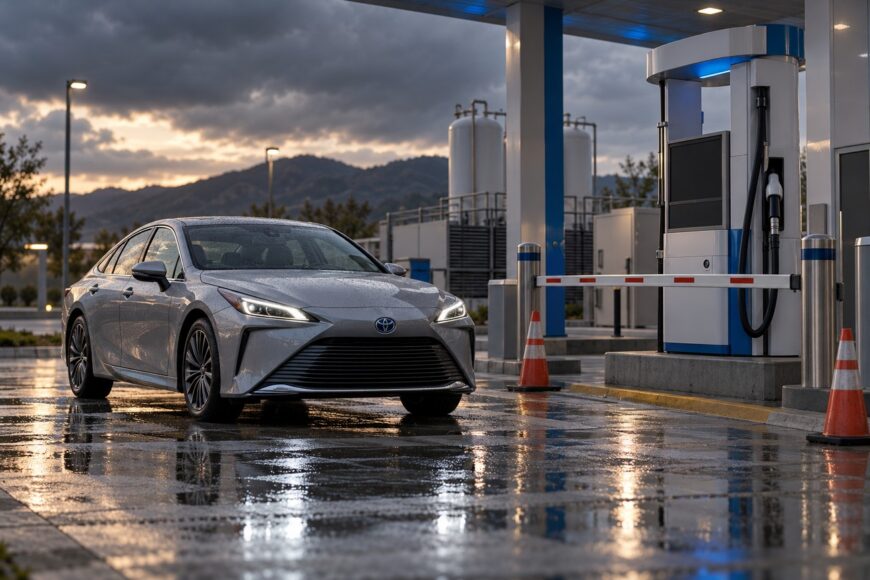
A Toyota Mirai can take on hydrogen in about three to five minutes, yet a closed or malfunctioning station can disrupt an entire route. The vehicle may be mechanically sound and still become difficult to use if the next compatible dispenser is too far away or unavailable.
Mirai refueling transfers compressed hydrogen through a standard 700 bar/70 MPa-class vehicle interface. It is refueling rather than battery charging, and the process depends on equipment that must maintain pressure, temperature, and communication with the car.
For that reason, a closed station is usually an infrastructure problem rather than a vehicle failure. Safe travel depends on checking station status immediately before departure, keeping a meaningful range buffer, and treating every alternative as a verified operating point rather than a pin on a map.
- Why a Closed Station Is a Bigger Problem for a Mirai
- Check More Than the Map Before You Leave
- What to Do When the Station Closes on Your Route
- Why an Open Station May Still Fail to Fill the Mirai
- How to Build a More Reliable Mirai Refueling Plan
- Common Myths and the Ownership Trade-Off
- Frequently asked questions
- Where can you fill a Toyota Mirai if your usual hydrogen station is unavailable?
- Why are some owners getting rid of their Toyota Mirai?
- How much does it cost to refuel a Toyota Mirai with hydrogen?
Why a Closed Station Is a Bigger Problem for a Mirai
The Mirai’s quick refueling can resemble a gasoline stop when the station is working normally. Hydrogen is dispensed through a 700 bar/70 MPa-class interface, and a typical session takes about three to five minutes under normal pressure and temperature conditions. That timing says little about whether a usable station will be available along the route.
Hydrogen stations for passenger vehicles are often limited in number and unevenly distributed. A gasoline driver can usually choose among several nearby sites; a Mirai driver may have one practical station on a long corridor. If that location closes for maintenance, runs short of hydrogen, or develops a compressor or dispenser fault, the route may lose its only realistic refueling point.
This changes the planning problem. The question is not simply how far the car can travel on its rated range, but whether a compatible station will be operating before the remaining hydrogen becomes too low. A short detour can become a major route change when the surrounding network has large gaps.
Check More Than the Map Before You Leave
Begin with the current operating status, opening hours, and any same-day outage notice. Check the access method, payment type, and whether the site serves passenger vehicles such as the Mirai. Some listings provide an address and a nominal opening status while omitting restrictions that determine whether you can start a session.
An “open” label is useful evidence, but it is not proof of immediate dispensing. The station may have a hydrogen shortage, a technical fault, a queue, a per-vehicle limit, or access rules that differ from the assumptions in a general navigation app. Official data can also lag behind an unannounced closure.
Use more than one current source where possible, especially for a long trip. Look for recent operator notices, local station updates, and information about recent downtime. If the station requires a membership, account, or particular payment program, confirm that arrangement before leaving rather than discovering the restriction at the dispenser.
Leave with enough remaining range to handle a failed stop and a reasonable detour. Planning to arrive with only a small hydrogen reserve makes every delay consequential, particularly in cold weather, at higher speeds, or on a route where the next station is far away.
What to Do When the Station Closes on Your Route
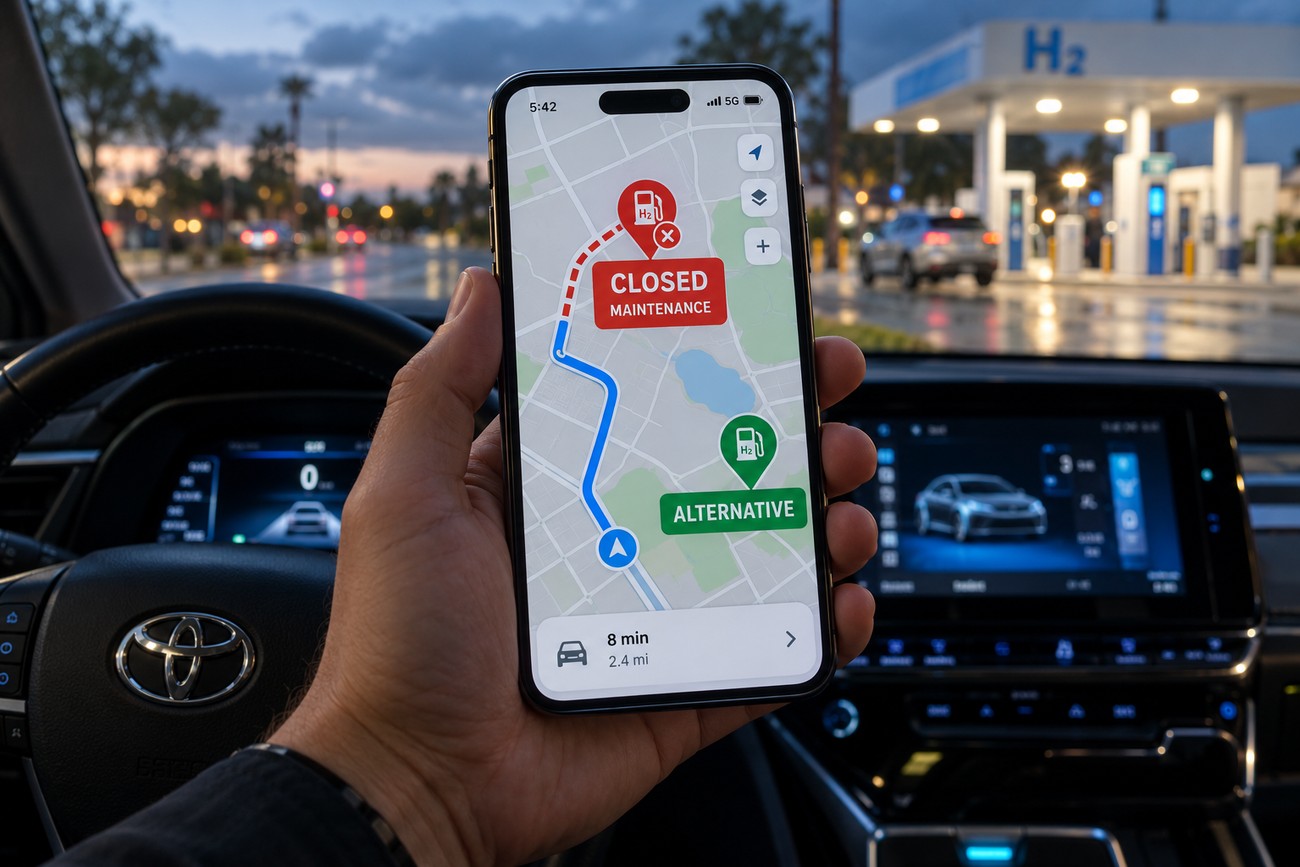
First, confirm the closure using the most current source available. A station may be closed for scheduled maintenance, a hydrogen supply problem, a compressor failure, or a dispenser fault. Treat an unclear status as a risk until the operator confirms that passenger-vehicle dispensing is active.
Next, estimate the remaining range conservatively. The Mirai’s actual range varies with temperature, speed, driving conditions, and driving mode, so a dashboard estimate should not be treated as a fixed promise. Account for the distance to the alternative station, possible waiting time, and the return route if access fails again.
Search for the next compatible and operating hydrogen station. A site shown on a map is insufficient if it serves a different vehicle category, requires unavailable access credentials, or has no confirmed current dispensing. Contact the operator when the status is uncertain and ask specifically whether the dispenser is working, whether hydrogen is available, and whether any limits apply.
A detour is often safer than continuing blindly toward a listed location. If no verified station lies within a conservative range, stop making the trip longer in the hope that the original site will reopen. There is no dependable roadside workaround that turns a closed hydrogen station into an available one, so the prudent decision may be to shorten or postpone the journey.
Why an Open Station May Still Fail to Fill the Mirai
A station can be open and still fail to complete a fill. Reliable dispensing depends on station pressure, hydrogen precooling, and correct communication between the Mirai and the dispenser. If one part of that sequence fails, the session may stop before it begins or partway through.
Low buffer or station pressure can produce a partial fill, a slower session, or a refusal to dispense. The result may be less hydrogen than expected even though the station appears operational. Card errors, account restrictions, access permissions, queues, and per-vehicle dispensing limits create additional failure points.
Station conditions can also change during the day. After repeated refueling sessions, the available buffer pressure may be lower, and later visits may produce a partial fill or a longer wait. Temperature limits and the station’s control system can further affect the flow and final result.
Record recent uptime, access rules, payment behavior, and any pattern of partial fills alongside the station address. That history can reveal a practical risk that a simple open-or-closed label does not show.
If a session stops, follow the dispenser’s instructions and retry only when the system indicates that it is safe to do so. Check the payment or access message, and contact the operator if the cause is unclear. Do not assume that repeated attempts will restore pressure or remove a station-imposed limit.
How to Build a More Reliable Mirai Refueling Plan
The Mirai’s typical range is approximately 500–650 km under WLTP or equivalent market testing. That figure is a broad reference, not a route guarantee. Temperature, speed, driving mode, traffic, and terrain can reduce the usable distance, while a station closure can force a detour that consumes part of the reserve.
Build the journey around confirmed working hydrogen-station corridors. Treat the next station as an operational checkpoint to verify near departure, rather than assuming it will be available based on its location. In regions with a small network, the route may be determined by the stations that reliably dispense hydrogen rather than by the shortest road.
A practical pre-departure check should cover:
- Primary station status, operating hours, and recent outage information.
- Fallback station compatibility, current access, and distance from the primary site.
- Payment method, membership requirements, and any dispensing limits.
- Expected remaining range after reaching the primary station.
- Additional reserve for a detour, queue, partial fill, or failed session.
Refuel earlier when the corridor is uncertain and reliable alternatives are limited. Arriving at the final workable station with a large reserve gives you more choices if the next site is closed. It also reduces pressure to accept an unfamiliar access arrangement or continue toward a station with an unverified status.
Common Myths and the Ownership Trade-Off
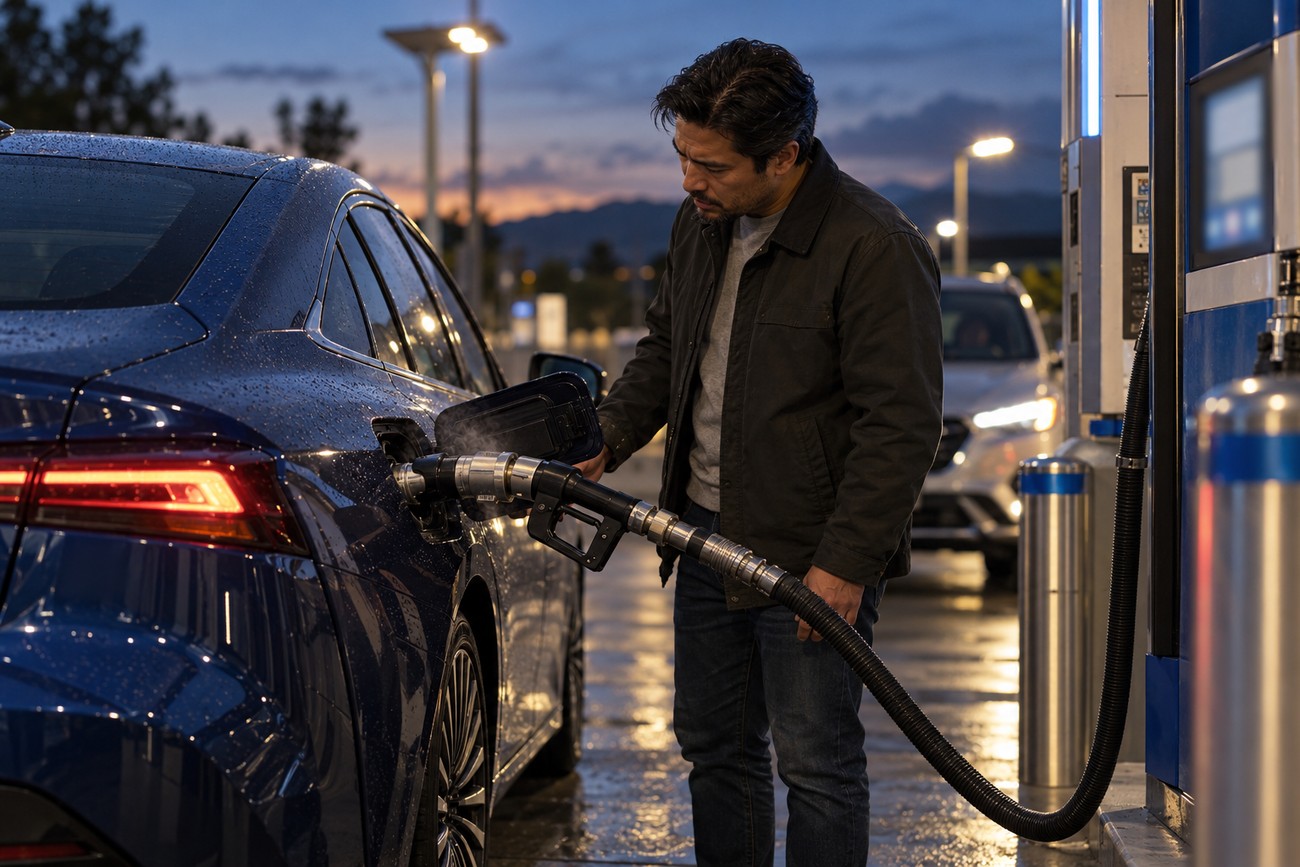
A station shown on a map is not automatically usable. The listing may be outdated, or the site may be dispensing only under restricted conditions. Access rules, technical faults, hydrogen availability, payment failures, queues, and dispensing limits can all make an apparently open station unusable on arrival.
The three-to-five-minute figure applies to a functioning station with normal pressure and temperature conditions. Low pressure, interrupted communication, a queue, or a fault can make the session slower, partial, or unsuccessful. The same Mirai may therefore refuel quickly one day and leave with a different result later.
Operationally, a Mirai cannot be treated exactly like a gasoline Toyota in a region with sparse hydrogen coverage. The propulsion system may work correctly while the surrounding network creates detours, waiting, and repeated route checks. The main limitation is often the infrastructure around the vehicle.
Dependence on a small number of stations can also add membership or program costs, depending on the market. Some owners decide to leave the vehicle because recurring downtime, route dependence, and access friction outweigh the benefits of quick refueling. That decision does not necessarily indicate that the Mirai itself is unreliable; it may reflect a poor match between the car and the local hydrogen network.
Frequently asked questions
Hydrogen access varies by country, operator, and station program. The guidance below separates the general rule from conditions that require local confirmation.
Where can you fill a Toyota Mirai if your usual hydrogen station is unavailable?
Use another compatible passenger-vehicle hydrogen station with confirmed current access and active dispensing. A map listing alone is insufficient: the site may serve a different vehicle category, require a membership, have a payment restriction, or be temporarily unable to dispense.
Check operating status, access rules, payment method, and recent outage information before committing to the detour. The alternative should also be within a conservative remaining-range estimate, with enough reserve for another failed session.
Why are some owners getting rid of their Toyota Mirai?
Some owners leave the Mirai because station scarcity, recurring downtime, route dependence, and access friction make ordinary travel difficult in their area. A station closure can remove the practical refueling option for an entire trip, especially where there is only one workable corridor.
This choice does not necessarily mean the vehicle has a mechanical problem. The car can operate correctly while the local hydrogen network remains too limited or unpredictable for the owner’s routes.
How much does it cost to refuel a Toyota Mirai with hydrogen?
There is no single dependable price for Mirai refueling across markets. Cost varies by region, station operator, payment program, and access arrangement, while availability can change if the station is restricted or temporarily offline.
Verify the current price directly with the relevant operator or program before traveling. Confirm whether the displayed rate applies to your account, payment method, and vehicle access, because a listed station may still impose conditions that affect both availability and cost.







