
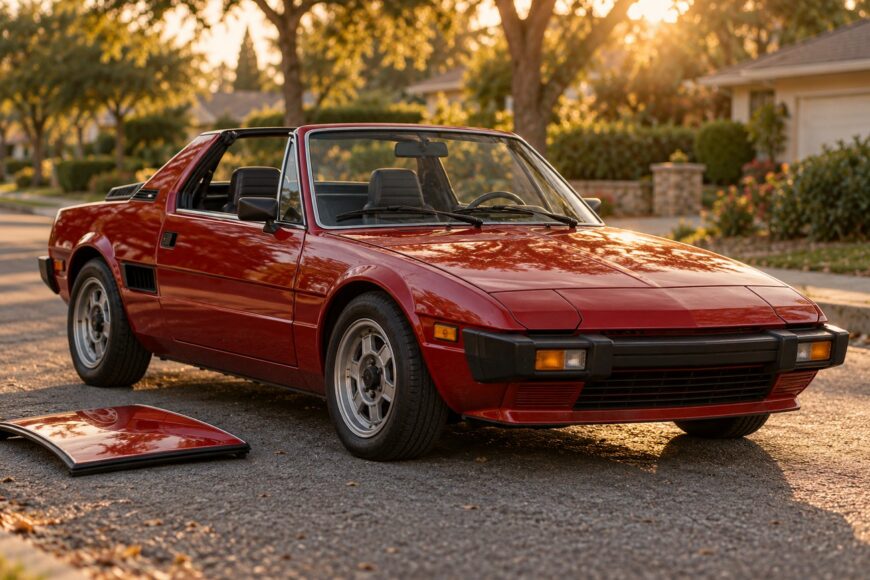
The Fiat X1/9 looks like a junior exotic: a two-seat targa with its engine behind the cabin, a low wedge-shaped body, and rear-wheel drive. Its proportions promise more speed than the modest four-cylinder engine can deliver. That mismatch is central to the car’s appeal. The X1/9 feels special because of its layout and balance, not because it overwhelms a modern hot hatch in a straight line.
Ownership therefore depends on buying the right example. A solid, usable car can deliver sharp handling, open-air driving, and simple mechanical character. A cheap cosmetic project can instead bring structural rust, awkward engine access, electrical faults, missing trim, and a restoration bill that quickly exceeds the car’s apparent value.
- What the Fiat X1/9 Actually Was
- Fiat X1/9 1.3 vs. 1.5: The Numbers That Matter
- Why the X1/9 Handles Better Than It Accelerates
- Living With a Tiny Mid-Engined Targa
- Buying an X1/9: Rust Matters More Than Mileage
- Maintenance, Parts and the Mid-Engine Compromise
- Frequently asked questions
- How much is a Fiat X1/9 worth today?
- Was the Fiat X1/9 sold in the USA?
- How much horsepower did a Fiat X1/9 have?
What the Fiat X1/9 Actually Was
The X1/9 was a two-seat mid-engine targa with a transversely mounted engine near the center of the car and rear-wheel drive. Fiat used a unibody structure and a carbureted inline SOHC four-cylinder, drawing on mass-market mechanical ideas rather than developing a costly bespoke sports-car powertrain. That combination made the car compact, relatively light, and technically distinctive without making it exotic to manufacture.
Fiat-badged production ran approximately from 1972 to 1982. After the Fiat period, the same basic model was sold as the Bertone X1/9 through approximately the end of the 1980s. The often-quoted 1972–1989 range treats Fiat and Bertone production as one continuous model line; it does not mean Fiat continued building the car under its own badge until 1989.
Bertone’s role matters when buying parts and assessing originality. Later cars can have specific trim, plastic, lighting, and body details that are harder to replace than ordinary mechanical components. A catalog listing that says “X1/9” may still require careful checking against the car’s market, production period, and exact specification.
The cleverness of the design lies in its mixed ancestry. The engine and some transmission-related components share roots with the Fiat 128 and other mass-market Fiat models, while the packaging gives the car the visual drama of a much more serious sports car. That makes the X1/9 easier to understand: it is an affordable mid-engine driving tool rather than a small supercar in disguise.
Fiat X1/9 1.3 vs. 1.5: The Numbers That Matter
The figures below are reference ranges rather than laboratory guarantees. Market, equipment, emissions specification, and the car’s condition affect the result, especially after decades of repairs or modifications.
| Version | Engine and power | Transmission | Typical period | Performance | Dimensions and weight |
|---|---|---|---|---|---|
| 1.3 | 1290 cc, 75 hp | Four-speed manual | Generally before 1978 | Overall stock range: approximately 170–180 km/h; 0–100 km/h approximately 11.7–12.3 seconds | Approximately 3970 mm long, 1570 mm wide, 1180 mm high; wheelbase 2200–2202 mm; typical kerb weight 880–920 kg |
| 1.5 | 1499 cc, 85 hp | Five-speed manual | Generally from 1978 | Overall stock range: approximately 170–180 km/h; 0–100 km/h approximately 11.7–12.3 seconds | Approximately 3970 mm long, 1570 mm wide, 1180 mm high; wheelbase 2200–2202 mm; some versions up to approximately 1020 kg |
The 1.3 uses a carbureted inline SOHC four-cylinder with two valves per cylinder; its base compression ratio is 8.9:1. The 1.5 adds displacement and a fifth gear, which makes cruising more relaxed and gives the later car a more usable spread of ratios. Neither version turns the X1/9 into a powerful car by modern standards.
Weight is a major part of the explanation. A typical stock car falls around 880–920 kg, although some versions reach approximately 1020 kg. That difference can be felt in steering response, braking, and willingness to change direction, while the advertised top speed and acceleration figures should be treated as period reference points rather than promises for an old, imperfect example.
Why the X1/9 Handles Better Than It Accelerates
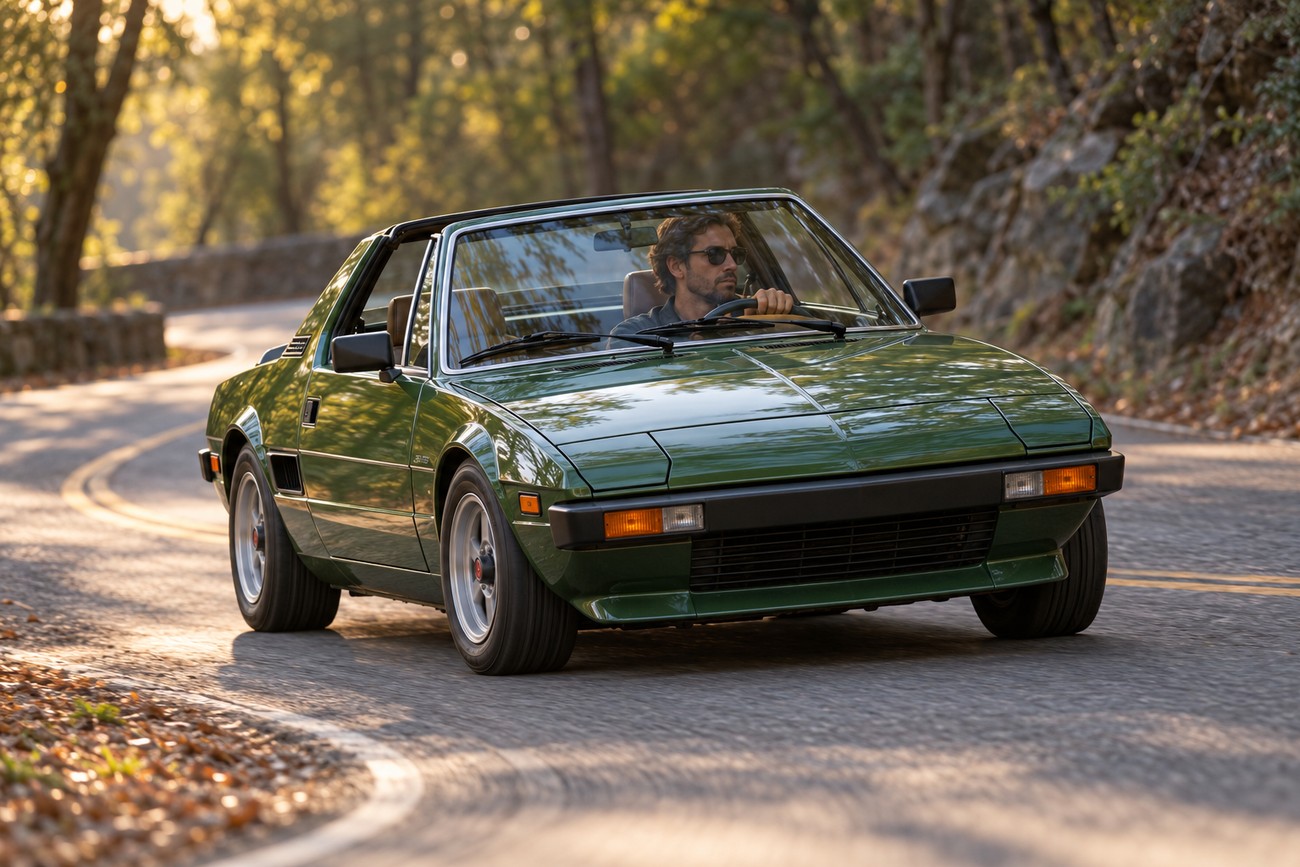
The engine sits transversely near the center of the car, keeping the main mass between the axles. Combined with low weight, rear-wheel drive, and compact dimensions, this gives the X1/9 a naturally balanced character. On narrow roads, the car can feel immediate and agile, with the driver responding to the chassis rather than waiting for a large engine to build speed.
That is where the X1/9 earns its sporting reputation. Steering, turn-in, and the ability to place the car accurately are more impressive than the engine’s output. A well-sorted example can feel almost kart-like at sensible road speeds, particularly where a larger sports car would be constrained by width, visibility, or excess power.
The straight-line figures tell a less glamorous story. Stock versions are generally quoted at approximately 170–180 km/h, with 0–100 km/h taking about 11.7–12.3 seconds. In period terms, that was respectable for a light small car, but the acceleration is closer to an ordinary performance-oriented compact than to a serious sports car.
That distinction matters during a test drive. If you buy the X1/9 expecting dramatic acceleration, the car may feel disappointing; if you value balance and feedback, the same performance can feel adequate. Engine swaps and aggressive suspension modifications exist, but poorly judged changes can damage the geometry, braking balance, and reliability that make the original car worthwhile.
Living With a Tiny Mid-Engined Targa
The cabin is intimate in every sense. The driver sits low, the roofline is close, and taller occupants may find legroom, steering-wheel position, and headroom restrictive. A test drive should include enough time to check whether you can enter, operate the pedals, and see clearly without treating discomfort as part of the car’s charm.
The removable targa panel has a dedicated storage location, and the car has separate front and rear luggage compartments. That sounds more practical than the dimensions suggest. Both compartments are limited and awkwardly shaped, so two-person trips are possible only with disciplined packing, soft bags, and a clear plan for where the roof panel and bulky items will go.
Heat and noise are more serious than the small exterior implies. The engine bay is close to the cabin, and vibration, mechanical noise, and warmth can become tiring on a long journey. Better insulation can help, but a proper heat- and sound-control job takes time, materials, and careful attention to ventilation rather than a quick layer of generic matting.
Passive safety is also limited by modern standards. The low seating position and rigid-looking body do not provide the crash protection expected from a contemporary vehicle. Use the car with that limitation in mind, and check that previous owners have not removed structural reinforcement or made careless changes around the suspension and braking systems.
Buying an X1/9: Rust Matters More Than Mileage
Structural condition should dominate the inspection. Rust can develop inside cavities, sills, roof-storage areas, seal joints, and mounting points while the paint still presents well. Fresh underseal, new-looking bodywork, or a low odometer reading cannot substitute for access to the underside and a close examination of the shell.
Inspect the sills, floor sections, suspension mounting zones, bulkheads, and the areas around the targa seals. Probe suspicious repairs and look for uneven seams, trapped moisture, mismatched paint, and corrosion emerging from the inside of a panel. The roof-storage area deserves particular attention because water and debris can remain hidden where a casual inspection sees only clean trim.
Clean paint is weak evidence on an X1/9. Inspectors need to see inside cavities and underneath mounting areas because rust often advances behind seals, repairs, and underseal before it becomes visible on the outer skin.
Previous restoration quality is as important as the amount of rust. A car may have been repaired several times, with filler or thin patches concealing movement and moisture. Ask for photographs of bare-metal work where possible, and budget on the assumption that incomplete body repairs will need to be opened rather than simply polished.
Original body panels, plastic parts, and Bertone-specific trim can be difficult to source. A missing bumper insert or damaged interior piece may take longer to find than an engine component. The cheapest car is often the most expensive purchase once bodywork, suspension, brakes, fuel-system cleaning, and electrical repairs are added together.
Mileage is useful only after the shell passes inspection. A higher-mileage car with documented structural work and functioning systems can be a better buy than a low-mileage example stored poorly. Treat any bargain as a project until the underside, roof-storage cavities, and mounting points prove otherwise.
Maintenance, Parts and the Mid-Engine Compromise
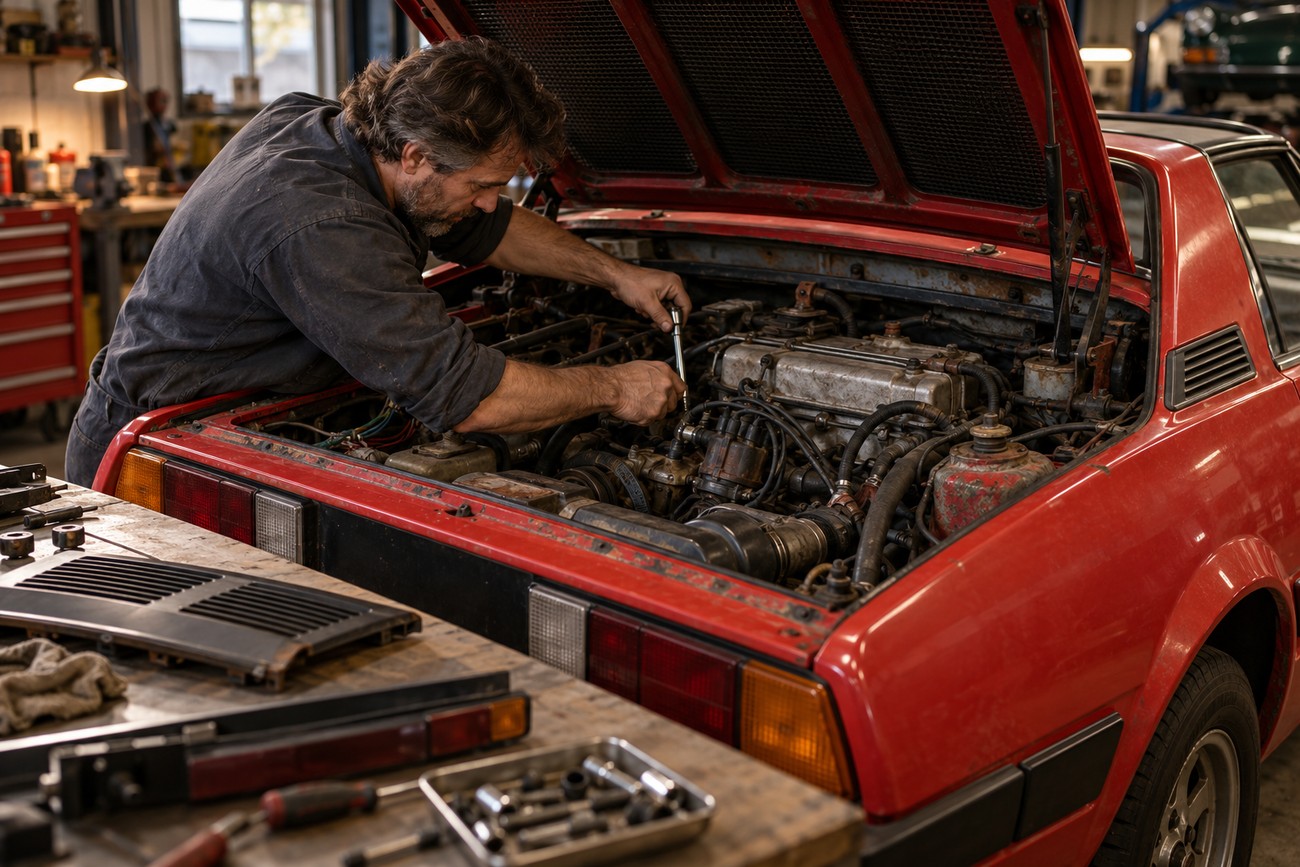
The X1/9 is mechanically familiar in several important areas. Engine and some transmission-related components share roots with the Fiat 128 and other mass-market Fiat models, which can make basic service parts easier to identify than the car’s appearance suggests. That advantage does not remove the need to verify the exact version and market specification before ordering.
Access is the compromise. The mid-engine layout leaves less room around the powertrain, so routine jobs can involve awkward angles, restricted tool movement, and additional dismantling. A small repair that would be straightforward in a front-engine Fiat may become slow and frustrating in an X1/9, especially when fasteners and hoses have aged together.
Age-related electrical faults deserve their own inspection. Corroded contacts, tired grounds, damaged wiring, unreliable lights, and inaccurate instruments can produce intermittent problems that are difficult to diagnose from a quick road test. Check every switch and gauge, and inspect repairs for household connectors, twisted wires, and other temporary solutions.
Body, trim, and plastic parts are the real supply challenge. Clubs, owner forums, reproduction suppliers, and alternative-parts catalogues can be as valuable as conventional parts stores. A specialist who knows the model can also save time by recognizing its wiring, cooling, and access problems before an ordinary repair shop begins learning on your car.
Frequently asked questions
The X1/9’s price, specification, and suitability depend heavily on condition and market. These answers separate the car’s basic identity from the assumptions that often lead buyers into expensive projects.
How much is a Fiat X1/9 worth today?
There is no responsible single price without knowing the market, condition, originality, and structural quality. A usable car with sound sills, sound mounting points, working systems, and complete trim belongs to a different category from a cosmetically attractive shell with hidden rust.
Inspect the underside and cavities before comparing asking prices. A running engine cannot compensate for major corrosion, missing Bertone-specific parts, or incomplete repairs. The most meaningful value distinction is whether the car can be enjoyed after recommissioning or requires a full body and mechanical restoration.
Was the Fiat X1/9 sold in the USA?
Yes, the X1/9 was sold in the United States. US-market cars can have different bumpers, lighting, and suspension-related specifications, which may affect appearance, weight, performance, and parts compatibility.
Those differences matter when sourcing trim or comparing cars from photographs. A US-specification example may need market-specific components, and its heavier equipment can change the way it looks and drives compared with a lighter European version.
How much horsepower did a Fiat X1/9 have?
The 1.3-litre version used a 1290 cc engine rated at 75 hp and generally paired with a four-speed manual. The later 1.5-litre version used a 1499 cc engine rated at 85 hp and generally paired with a five-speed manual.
The additional gear is as relevant to ownership as the extra power. It makes the later car more relaxed at cruising speeds, while neither version delivers modern hot-hatch acceleration. The X1/9’s appeal remains its balanced mid-engine chassis and direct responses.







