
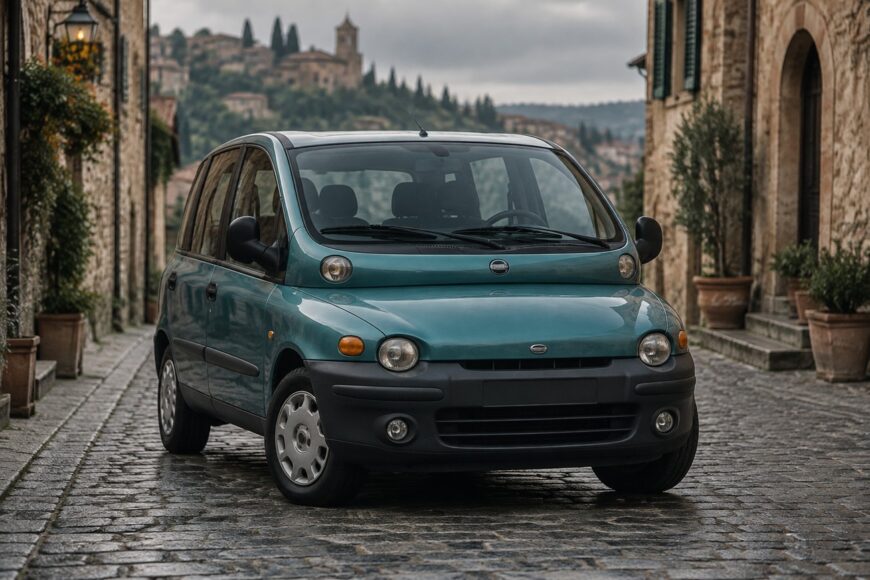
The Fiat Multipla Mk1 is famous for a face that seems to have been assembled by committee after the committee lost a bet. Its cabin, however, is one of the most rational pieces of family-car packaging of its era. Six individual seats fit inside a vehicle barely over four meters long, which gives the car a practical argument far stronger than its styling.
That argument still matters on the used market, though age changes the calculation. A Multipla today has to justify its width, unusual driving environment, limited luggage space when fully occupied, and the risks attached to an old car. The real question is whether you need the layout enough to accept those compromises.
The answer begins with the seating plan: three individual seats in the front and three behind, arranged 3+3. This was a genuine attempt to carry six people in a compact footprint, rather than a conventional five-seater with a token middle position.
- Why the Multipla looks the way it does
- The clever bit: six individual seats in two rows
- Fiat Multipla Mk1 dimensions and engines at a glance
- Where the packaging stops feeling ingenious
- Buying one used: condition before the punchline
- Ugly duckling or packaging genius? The honest verdict
- Frequently asked questions
- What should you check on the paperwork before buying a six-seat Multipla?
- How can you tell whether a Multipla will fit your parking space?
- What extra checks does a CNG Multipla need?
Why the Multipla looks the way it does
The production Multipla emerged in the late 1990s as a production model based on the Fiat Bravo/Brava platform. Its design followed a clear priority: create as much usable cabin volume as possible without stretching the car into a larger vehicle class. The tall body, upright front section, and broad stance all served that purpose.
Those priorities produced the familiar two-level visual effect, with the main windshield and a raised lighting section above the front end. The result was distinctive from every angle and divisive from most of them. A styling decision can be technically rational and still be a genuine deal-breaker for a buyer who has to live with it every day.
The Multipla was produced from around 1998/1999 to 2010, with a mid-cycle facelift. The original cars and facelifted versions have noticeably different front-end styling, so a photograph in a listing matters more than a generic model description. “Mk1” covers a long production run rather than one identical-looking car.
The visual oddness also helps explain the car’s appeal in retrospect. It was designed around people and space first, then given an exterior that made those priorities impossible to miss. That does not make every design decision successful, but it does mean the appearance has a purpose beyond simple eccentricity.
The clever bit: six individual seats in two rows
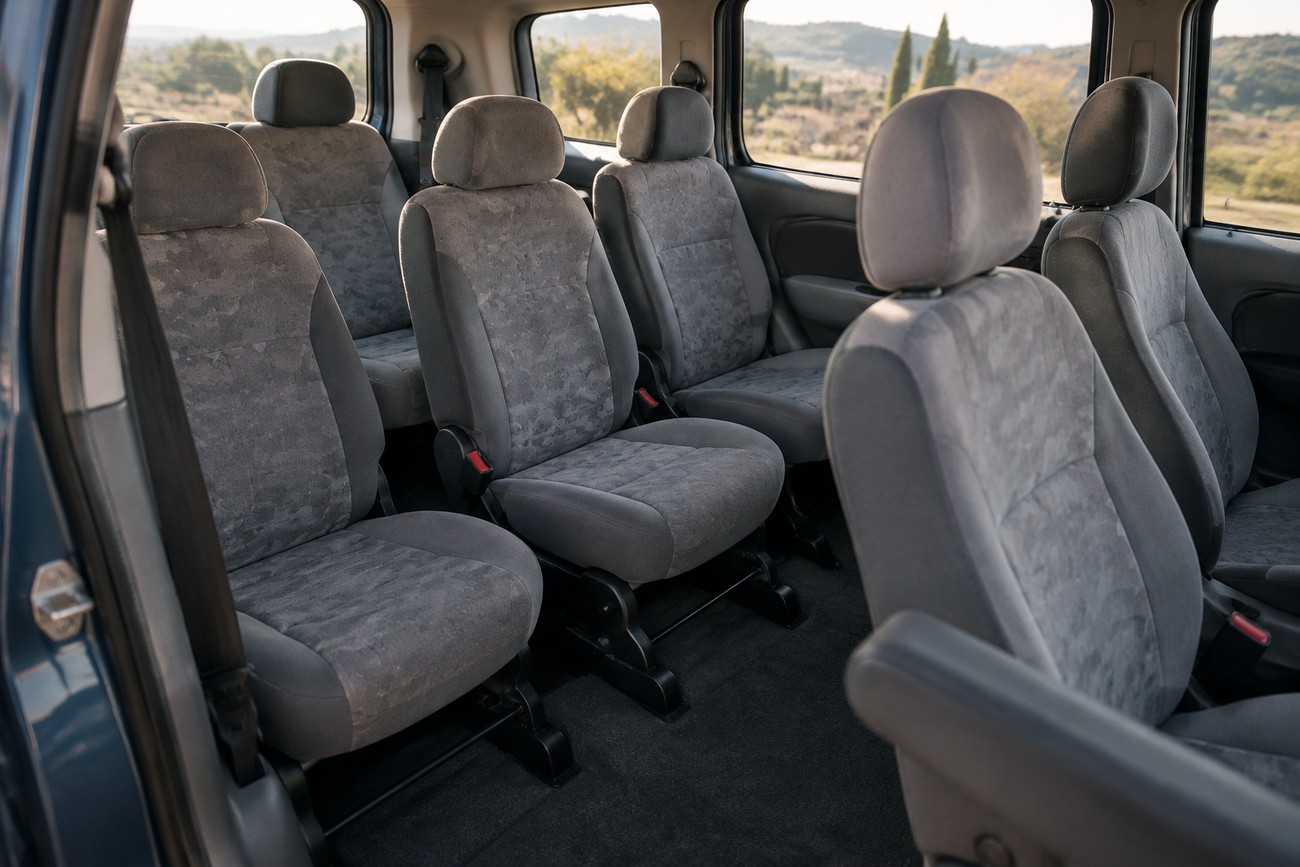
The Multipla’s defining feature is its 3+3 layout: six individual seats in two rows of three. Each occupant gets an individual seat, rather than relying on a narrow central cushion in the rear. For a family with three children, a passenger-carrying business, or anyone who regularly moves several adults, that difference is substantial.
Individual chairs also make the cabin more adaptable. The relatively flat floor supports easier movement and loading, while separate seats allow the interior to be treated as a set of useful positions rather than one fixed bench. That flexibility is the practical genius behind the strange shape.
There is a limit, though. Six seats do not create unlimited volume. Once every position is occupied, luggage capacity and personal space become more constrained, especially compared with a larger people carrier. The Multipla is efficient at fitting people into a short body; it cannot make the laws of volume disappear.
The layout works best when the owner regularly uses the extra capacity. If the car usually carries one or two people, the third front seat becomes an unusual feature rather than a daily benefit. In that case, a more conventional compact vehicle may deliver a quieter ownership experience with fewer compromises.
Fiat Multipla Mk1 dimensions and engines at a glance
These figures are approximate, and engine output varied by version and market. The short body helps urban maneuvering, while the notably wide body can complicate parking.
| Item | Fiat Multipla Mk1 |
|---|---|
| Length | Approximately 4,090 mm |
| Width | Approximately 1,871 mm |
| Height | Approximately 1,670 mm |
| Wheelbase | Approximately 2,666 mm |
| Seating | 3+3: six individual seats in two rows |
| Petrol option | 1.6 petrol |
| Diesel option | 1.9 JTD/diesel |
| Alternative fuel | CNG versions in some markets |
| Quoted output for common versions | Approximately 95–120 hp, depending on version and market |
Where the packaging stops feeling ingenious
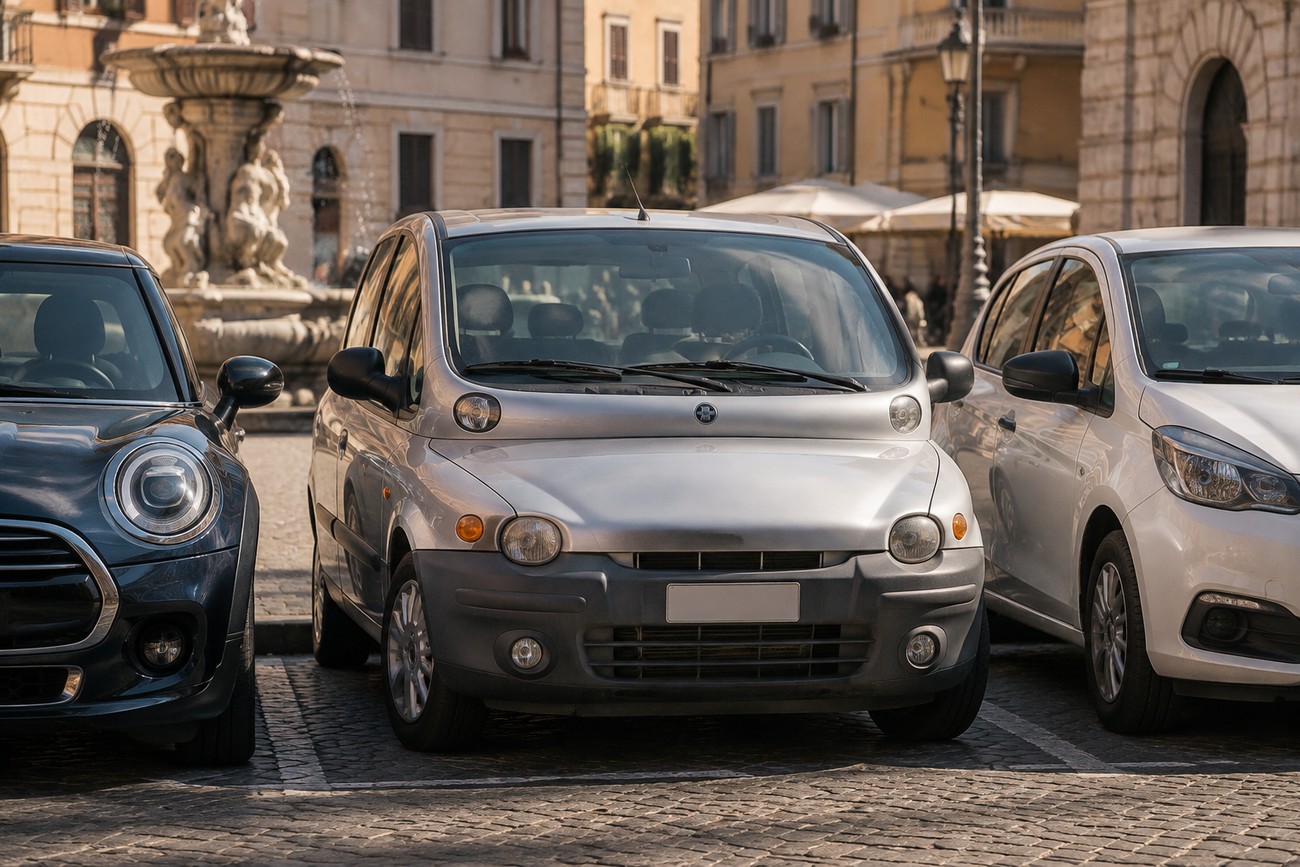
The Multipla is approximately 4,090 mm long and approximately 1,871 mm wide. That combination is central to its character. The short length is useful in city streets and makes the car easier to place longitudinally, while the width can become the limiting factor in parking bays, narrow garages, and tight residential lanes.
Owners should check the actual space rather than relying on the length alone. A car that fits into a bay may still leave little room to open the doors or clear the mirrors. The width also changes the feel of narrow roads, particularly for drivers accustomed to a conventional compact hatchback.
The third front seat is valuable when a third front passenger is genuinely part of the routine. With only two people aboard, it can make the front row feel less like a normal car and more like a deliberately widened cabin. Reactions to the driving posture and ergonomics vary, so a proper test drive matters more than a general reputation.
Full occupancy changes the luggage equation as well. Six people can be carried in a compact footprint, though their bags and personal space have to share the same finite cabin. The Multipla rewards realistic planning: it is excellent at solving a people problem, less impressive when that people problem arrives with substantial luggage.
Buying one used: condition before the punchline
A used Multipla should be assessed as an old car first and a design icon second. The model’s packaging remains clever, but age, maintenance history, and the condition of the individual example determine whether that cleverness is usable. A neglected car can turn a brilliant cabin into an expensive storage area.
The 1.6 petrol may appeal to buyers seeking a simpler, familiar powertrain and a car suited to ordinary mileage. The 1.9 JTD/diesel is often valued for its torque and relaxed family-car performance, especially when the vehicle is regularly loaded. Older diesel ownership brings its own maintenance concerns, and those should be separated from the Multipla’s seating concept rather than treated as proof that the layout is flawed.
CNG versions existed in some markets and require market-specific consideration. Fuel availability, system inspection, and local servicing support can matter more than the badge on the tailgate. A version that makes sense in one region may be awkward to own in another.
Check every individual seat, its fittings, and its seatbelt before placing a value on the flexible cabin. Missing Multipla-specific interior parts can undermine the main reason to buy the car.
Interior condition deserves unusually close attention. Multipla-specific seats, trim pieces, and fittings may be harder to replace than parts shared with more common Fiat models. Confirm that all six seats are present, correctly mounted, and usable before treating the car as a six-seater bargain.
Study the listing photographs for the original front end or the facelifted design, then make sure the advertised equipment matches the actual car. The model ran from around 1998/1999 to 2010, so age-related wear and specification differences are inevitable. A documented maintenance history is worth more than a clever seller’s description of the car as a cult classic.
Ugly duckling or packaging genius? The honest verdict
The Multipla is a packaging genius for the right user. A family that needs six individual seats, or an operator carrying several passengers in a short vehicle, can gain something genuinely useful from its 3+3 layout. The compact length and flexible cabin explain why it found practical family and taxi use in Italy.
That practicality does not erase the drawbacks. The approximately 1,871 mm width can make tight spaces inconvenient, and the full six-seat arrangement leaves less room for luggage and personal space. Someone who rarely carries more than four people may be accepting the styling and width without receiving enough benefit in return.
The car was never pointless simply because it looked unusual. Its design solved a real transport problem, even if it solved it with an exterior many buyers cannot tolerate. Nor should the reputation for clever packaging make a tired example desirable by default.
Buy the layout, inspect the condition, and treat the styling as a serious ownership decision rather than a joke. A sound Multipla can be an unusually effective family tool. A poor one is an old, wide Fiat with hard-to-source cabin parts and a very memorable face.
Frequently asked questions
The questions below focus on the Multipla’s six-seat configuration, its unusual width, and the additional considerations for CNG versions. The same priorities apply when checking the paperwork, measuring a parking space, or inspecting a specific car.
Because equipment and requirements can vary by market, confirm the details for the exact vehicle and location before buying.
A careful inspection should support the configuration you intend to use.
What should you check on the paperwork before buying a six-seat Multipla?
Match the registered seating capacity with the seats actually fitted in the car. A six-seat Multipla should have its complete 3+3 arrangement, including the relevant seatbelts and fittings, rather than an incomplete or altered interior.
Also verify local registration and inspection requirements before completing the purchase. Rules can vary by market, particularly if the vehicle has been modified, imported, or converted. The paperwork should support the configuration you intend to use.
How can you tell whether a Multipla will fit your parking space?
Measure the actual parking space, its entrance, and the clearance available around the mirrors. The Multipla is approximately 1,871 mm wide, so a space that looks adequate on a plan may feel restrictive once the doors need to open.
If possible, take the specific car to the garage or parking area before buying. Check the approach, mirror clearance, door opening, and room for passengers to get out. Its short overall length does not compensate for every narrow entrance.
What extra checks does a CNG Multipla need?
Confirm that suitable CNG refueling is available along your regular routes and that local workshops can inspect the fuel system. CNG versions existed in some markets, so equipment, support, and inspection requirements may differ by region.
Ask for clear maintenance documentation and arrange an inspection appropriate to the fuel system before committing. The purchase only makes practical sense if the car’s fuel supply and servicing arrangements fit your location.







