
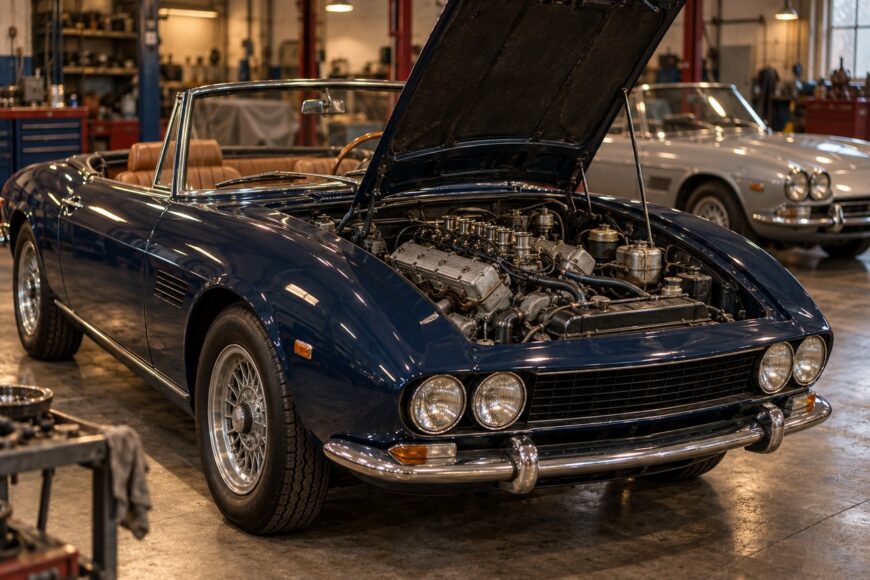
The Fiat Dino Spider carries a Ferrari-developed V6 under a Fiat badge, which makes it easy to misread. Its sound, rarity, and engine heritage suggest a cheap Ferrari, while its body, assembly, and most of its chassis belong to Fiat. The car is therefore more complex than either a discounted Ferrari or an ordinary Fiat convertible.
That distinction matters when buying one today. You are choosing between enjoying a rare open sports car and proving that its chassis, engine, and restoration quality justify the asking price. Paint and exhaust noise provide a starting impression; corrosion, originality, and mechanical inspection determine the real cost.
- Why the Fiat Dino Spider Was Built
- 2.0 vs 2.4: The Two Dino Spiders Are Not the Same Car
- The Ownership Problems Hidden Behind the Ferrari V6
- Buying and Restoring a Fiat Dino Spider Without Buying the Badge
- Frequently asked questions
- Which Fiat had a Ferrari engine?
- Why did Ferrari need the Dino engine for Formula 2?
- Which car is called poor man’s Ferrari?
- What color does Ferrari not allow?
- How much is a real Ferrari badge?
Why the Fiat Dino Spider Was Built
The Dino name refers to Ferrari’s V6 program and to the Formula 2 homologation requirements surrounding it. Ferrari needed a production-based V6 program, and the Fiat Dino gave that engine a road-car application in sufficient numbers. The arrangement also allowed Fiat to offer an unusual sports car without becoming Ferrari.
The early Spider used a 1,986.6 cc aluminum 65-degree V6, with DOHC on each cylinder bank and a 9:1 compression ratio. It was an advanced engine for its period, and its compact architecture helped give the car its distinctive character. Ferrari developed the engine family; Fiat produced the car wearing its own badge.
Fiat was responsible for the body, assembly, and most of the chassis. The suspension, trim, structure, and production decisions should therefore be assessed as Fiat components, with the usual age-related concerns of a low-volume Italian car. Calling the Spider “a Ferrari in another body” overstates the connection and creates unrealistic expectations about finish, rust protection, and parts supply.
2.0 vs 2.4: The Two Dino Spiders Are Not the Same Car
The early 2.0-liter Spider combined three twin-choke Weber carburetors, a five-speed manual gearbox, rear-wheel drive, and independent front suspension. Its output is commonly quoted as approximately 158–160 hp at 7,200 rpm. The range reflects different measurement methods and market specifications, so period figures should not be compared without context.
The later 2.4-liter used a cast-iron block and is variously listed at 2,418–2,419 cc, with approximately 178–180 hp. It also received a ZF gearbox and independent rear suspension related to the Fiat 130. Those changes affect traction, ride, and the car’s mechanical identity; the 2.4 is more than a 2.0 with extra displacement.
Estimated production is approximately 1,163 2.0-liter Spiders and about 420 2.4-liter Spiders, although catalogs can differ. Rarity supports historical interest, yet it does not prove condition or originality. A car with the wrong engine or gearbox can be rarer in surviving numbers while being less valuable to a concours-minded buyer.
The Ownership Problems Hidden Behind the Ferrari V6
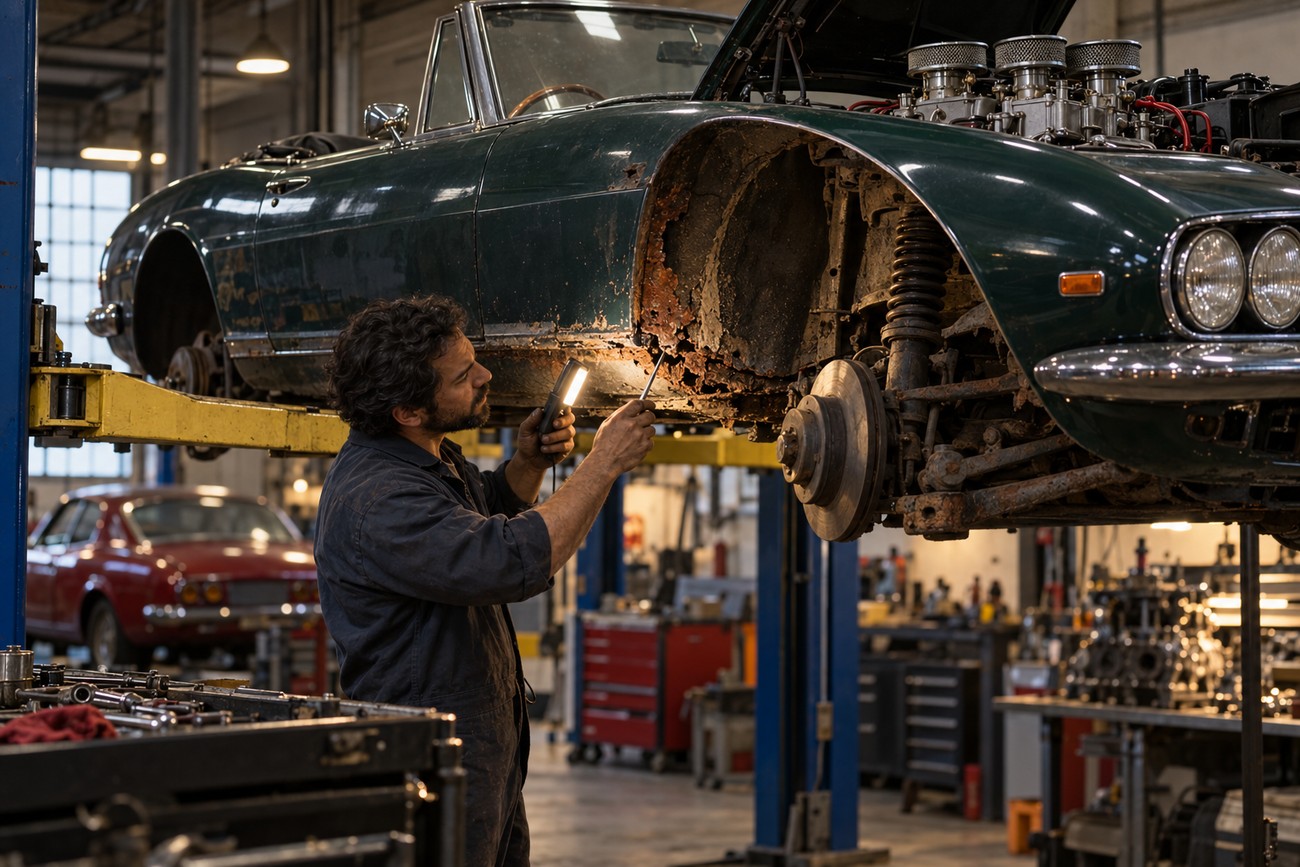
Corrosion is usually the first serious risk. Inspect the sills, floors, wheel arches, suspension mounting points, and concealed structural areas from underneath and inside the cabin. Fresh paint can hide thin metal and poor repairs, while a weak mounting point may affect safety, alignment, and the cost of any later restoration.
Three Weber carburetors require specialist balancing. Hesitation, an unstable idle, or overheating may result from synchronization, air leaks, valve settings, ignition timing, or a lean mixture. The cooling system deserves equal attention: an old radiator and blocked passages can create trouble that is blamed unfairly on the V6 itself.
Overheating is best diagnosed as a system problem first: cooling flow, ignition timing, mixture, and carburetor synchronization must be checked before the engine design is condemned.
The original Dinoplex and factory ignition systems are frequently replaced by modern electronic ignition. That can improve reliability, though the conversion affects originality and should be documented. Worn chains, tensioners, camshafts, or cylinders can turn an apparently affordable car into an expensive engine rebuild.
On a 2.4-liter engine, inspect the sodium-filled exhaust valves specifically. A failed valve can damage a cylinder and cylinder head. Compression testing, oil-pressure checks, and a borescope examination provide more useful evidence than a polished engine bay or a dramatic cold-start video.
Buying and Restoring a Fiat Dino Spider Without Buying the Badge
Begin with the body, using paint-depth readings, a lift inspection, and close examination of welds and panel geometry. Confirm that repairs follow the structure rather than covering it. A sound chassis with imperfect cosmetics is usually a safer foundation than a glossy car with concealed sills, floors, or suspension mounts.
Then verify the mechanical specification. Matching displacement and a Dino badge do not prove originality; engines, carburetors, gearboxes, and ignition systems may have been replaced. Record casting and identification details, check compression and oil pressure, inspect the bores with a scope, and establish the condition of the timing gear before agreeing on value.
Parts availability changes the restoration calculation. Spider-specific body panels, interior trim, chrome, instruments, and soft-top components are harder to source than parts for common Fiat models. Their replacement cost can rival major mechanical work, especially when a restoration requires correct details rather than serviceable substitutes.
Production totals also vary among catalogs, so confirm the individual car against factory records and identification data. Historical value depends on the originality of the engine, carburetors, gearbox, ignition, and body details. A rare Spider with corrosion, incorrect parts, or poor workmanship can cost more to rescue than its market position supports.
Frequently asked questions
The Ferrari connection is significant, though it applies chiefly to the engine program rather than to the complete car.
Which Fiat had a Ferrari engine?
The Fiat Dino used the Ferrari-developed Dino V6. Fiat built and badge the car, while Ferrari’s primary contribution was the engine family; the body, assembly, and most of the chassis were Fiat work. This makes the Spider a genuine Fiat-Ferrari collaboration rather than a Ferrari powertrain placed wholesale into a Fiat body.
Why did Ferrari need the Dino engine for Formula 2?
Formula 2 regulations required a production-based engine program for homologation. Ferrari therefore needed a road-car route for its V6, and the Fiat Dino helped establish that production relationship. The Fiat badge was part of the practical solution to a racing-regulation problem, rather than evidence that Fiat had become a Ferrari subsidiary.
Which car is called poor man’s Ferrari?
The Fiat Dino is often given that informal description because it offers Ferrari-developed V6 character at a Fiat price and with Fiat construction. The phrase is useful only as shorthand for the engine connection. It should not guide inspection, since the car’s rust risk, parts supply, and restoration costs remain those of a rare Fiat-based sports car.
What color does Ferrari not allow?
There is no reliable universal “forbidden color” rule that defines Ferrari ownership or authenticity. Ferrari has used many factory and competition colors over time, while individual models and periods had specific palettes. On a Dino Spider, an unusual color should be checked against trim records and identification evidence rather than judged by a blanket claim.
How much is a real Ferrari badge?
A Ferrari badge has no fixed value independent of the car carrying it. On a Fiat Dino Spider, adding or substituting Ferrari badges misrepresents the car and can reduce historical credibility. Provenance, correct mechanical components, body condition, and documented restoration matter substantially more than a badge.







