

A jet engine protruding from a tiny Fiat 500 makes for an arresting image: a city car apparently equipped to chase land-speed records. The visual contrast also makes the claim easy to overhead. An engine can produce formidable thrust while the vehicle around it remains incapable of a controlled, measured run at 300 mph (482.8 km/h).
The available evidence confirms that purpose-built jet cars have exceeded that speed. It does not confirm a certified 300-mph Fiat 500. The distinction matters because a land-speed result belongs to a particular vehicle, measured on a particular course under a defined set of rules. A Fiat-shaped machine might eventually meet that standard, but its badge, body panels, and engine rating cannot establish that it has.
- The 300-mph Claim: What Is Actually Verified?
- Why 300 mph Is Not Just a Bigger Engine Problem
- A Fiat 500 Body Is Not a 300-mph Record Car
- What Earlier Jet Cars Reveal About Stability
- What a Credible 300-mph Fiat Build Would Need
- How to Test the Claim Without Being Fooled by a Video
- Frequently asked questions
- What is the fastest a Fiat 500 can go?
- What is the fastest car with a jet engine?
- Why don’t people like Fiat 500s?
- What was the top speed of the Fiat 500 Topolino?
The 300-mph Claim: What Is Actually Verified?
“Fiat 500 with a jet engine” can describe several different things: a proposed conversion, a running vehicle, or a custom record car wearing Fiat panels. Each is a more specific claim than the last, yet none independently establishes a speed. For a 300-mph claim, the useful starting point is an identified vehicle and a documented, measured run at 300 mph (482.8 km/h).
A dramatic video may show acceleration without revealing the vehicle’s speed through a measured course. A GPS display offers a reading, though it does not by itself establish the timing method, course, or record procedure. Likewise, a quoted thrust figure describes an engine under stated conditions; it is not a verified top speed for the complete car.
Classification adds another layer. FIA record classes differ by factors including engine type, mass, body form, and method of power transmission. In a jet car, thrust is produced directly by the jet engine; the wheels do not transmit engine power to the ground. Its result therefore cannot be treated as interchangeable with a wheel-driven production-car record, even if both machines carry familiar automotive names.
The supplied evidence confirms separate jet-powered record cars but does not confirm a certified 300-mph Fiat 500. That is a limit on what can presently be established, rather than proof that no such machine could ever be built. Before calling one a record holder, a reader needs both the measured result and the category in which it was accepted.
Why 300 mph Is Not Just a Bigger Engine Problem
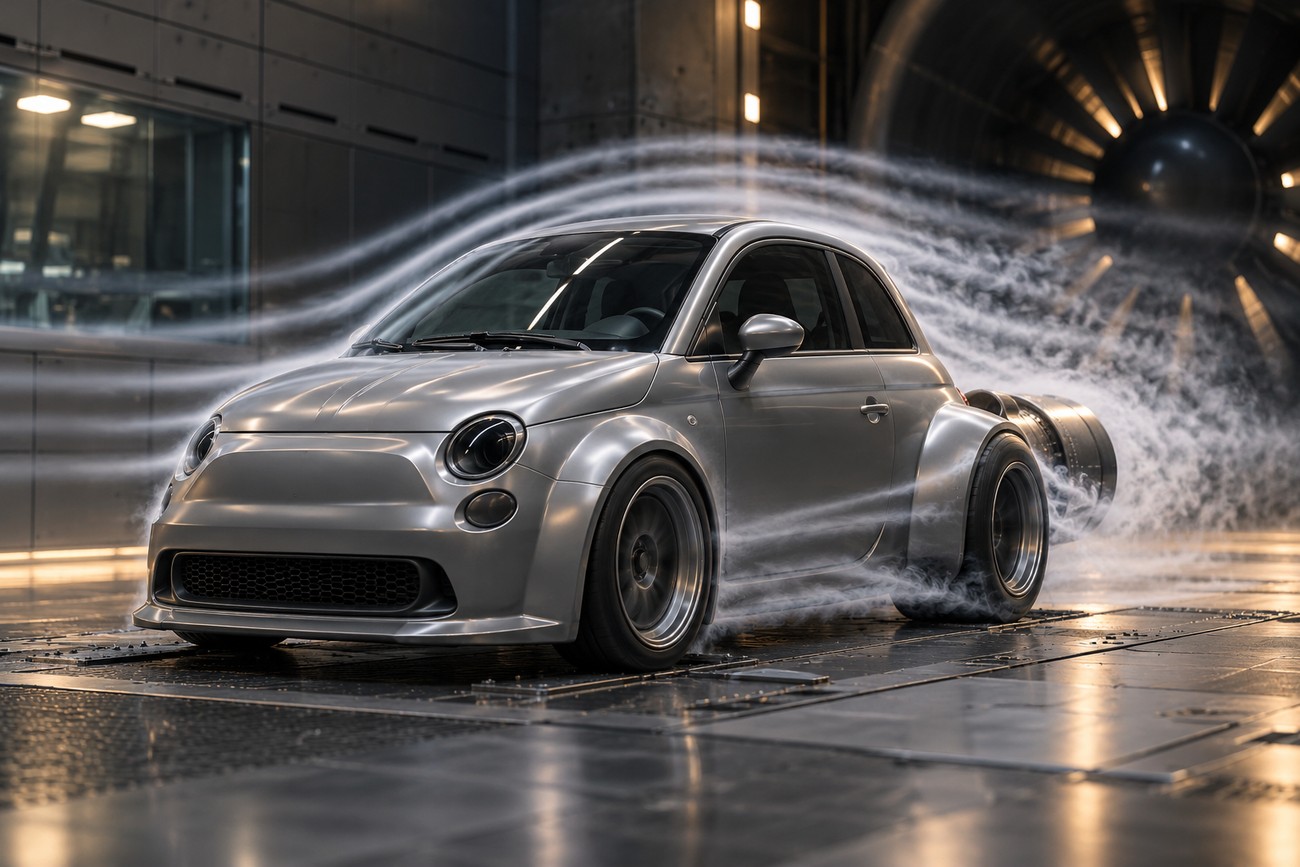
As speed rises, the air becomes a progressively harder obstacle. Aerodynamic resistance rises approximately with the square of speed, while the power required to overcome that resistance rises approximately with the cube of speed. Those relationships explain why improving a moderately fast car is a different task from making it sustain 300 mph (482.8 km/h).
For a jet car, engine thrust is the direct propulsive force, so a quoted horsepower figure cannot simply be matched against the car’s road speed. The vehicle must have enough effective thrust to overcome drag and other resistance at the target speed, with room to accelerate along the available course. A short burst of acceleration says little about whether it can reach a stable maximum before the braking zone begins.
Effective thrust also changes with nozzle shape, engine operating mode, air density, altitude, and temperature. Air density influences the drag the vehicle encounters as well. A performance estimate made for one set of conditions cannot be carried unexamined to a different venue or weather forecast; the engine and the body must be evaluated together.
Even a favorable thrust-versus-drag calculation would leave a serious gap. It predicts something about straight-line acceleration under its assumptions, not how the car responds to a steering input, a crosswind, or a change in wheel loading. A credible speed estimate has to survive those questions before the figure on a screen becomes a plausible run.
A Fiat 500 Body Is Not a 300-mph Record Car
The classic Fiat 500 was approximately 2,970 mm long, used a 479 cc two-cylinder engine, and could exceed 65 mph. Those details describe a small road car designed for a fundamentally different job. Its compact shape may make a jet conversion memorable, but it offers little inherent evidence that the original structure, suspension, or controls suit record speeds.
Packaging is the immediate conflict. A jet installation needs space for the engine and fuel system, plus heat shielding, fire protection, and access to critical components. Cramming equipment into a short shell can make inspection and maintenance harder precisely where a failure would matter most. Keeping the outer proportions does not make those requirements disappear.
A serious conversion might retain recognizable Fiat exterior panels while using a substantially custom chassis and load-bearing structure. That distinction changes the meaning of “Fiat 500”: it may identify the silhouette rather than the mechanical basis of the vehicle. Photographs of the body cannot show how engine loads reach the chassis or how the driver’s compartment is protected.
The running gear and controls need the same scrutiny. Steering, suspension, wheels, and panel attachments must remain predictable under loads far outside the production car’s intended use. Calling the project a reinforced Fiat is insufficient unless its underlying structure has been designed and assessed as part of the complete high-speed vehicle.
What Earlier Jet Cars Reveal About Stability
The 300-mph barrier predates jet-powered land-speed cars. Campbell-Railton Blue Bird first exceeded 300 mph in 1935, using an aviation V12 producing approximately 2,800 hp. It demonstrates how long the threshold has challenged dedicated record machinery; its engine and method of putting power to the ground also make it a poor direct specification for a jet Fiat.
Jet propulsion removed the need to transmit engine power through driven wheels, but it did not remove aerodynamic and directional problems. Flying Caduceus reached 359.7 mph in 1963; high-speed stability problems led to a later tail-stabilizer addition. That history is a useful warning against treating an achieved speed as evidence that a design had no handling issues.
At the other end of the scale, the FIA-recognized absolute land-speed record is 763.035 mph (1,227.985 km/h), set by the two-jet ThrustSSC in 1997. ThrustSSC was a purpose-built record vehicle, not a road car fitted with a large engine. Its result establishes what that particular machine achieved under record conditions, not a transferable capability for every jet-powered body.
These examples answer different questions. Blue Bird marks a historical 300-mph milestone, Flying Caduceus illustrates the persistence of stability problems, and ThrustSSC holds the absolute record. Jet-powered cars and wheel-driven cars belong to different power-transmission categories; none of these results certifies a Fiat 500 by resemblance or association.
What a Credible 300-mph Fiat Build Would Need
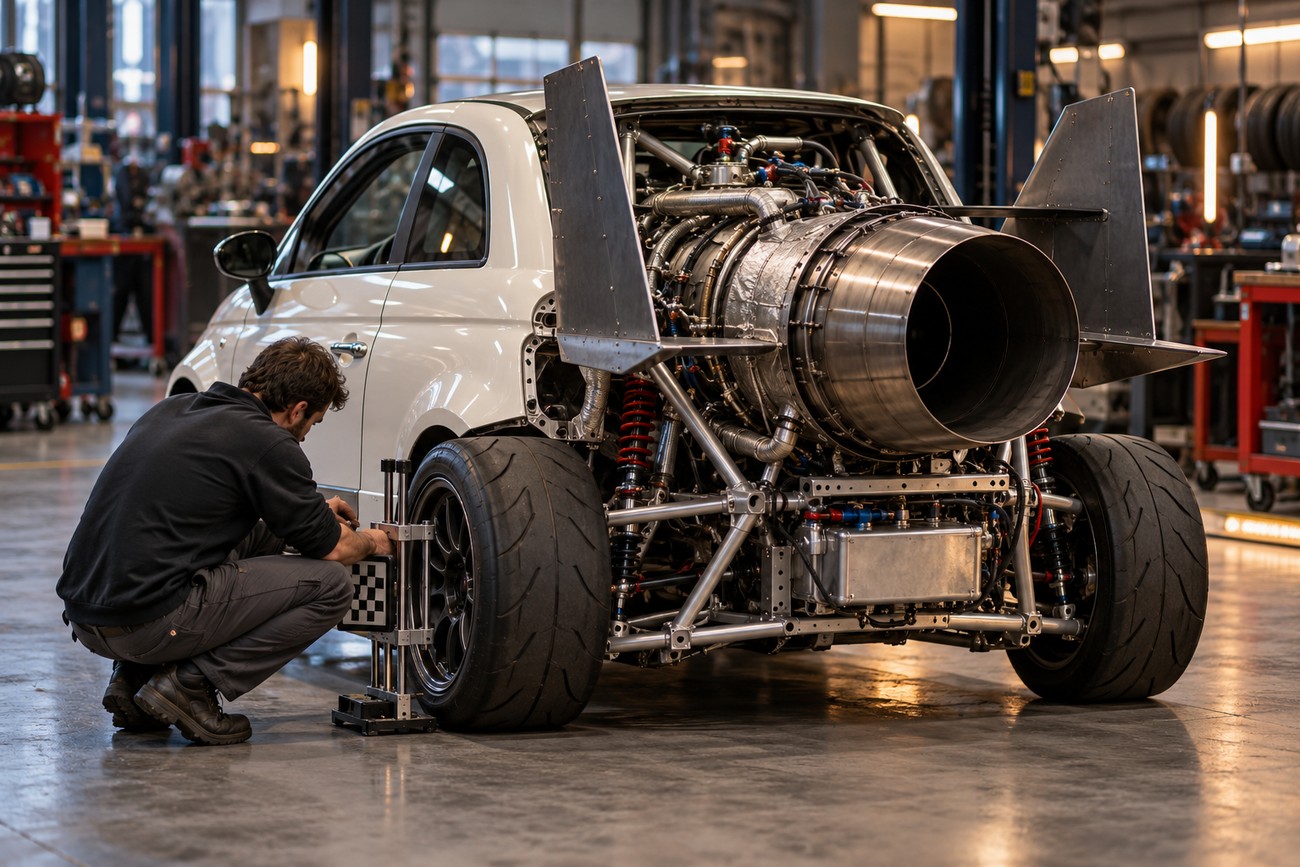
A credible attempt would begin with a purpose-designed load-bearing structure, driver protection, and a layout that keeps the jet installation serviceable and isolated from vulnerable parts of the car. Fiat panels could provide the recognizable outline, provided their mounting and behavior at speed were addressed. The engineering claim would then rest on the vehicle underneath, not on how much of the original shell appeared in photographs.
Aerodynamics would need to produce predictable behavior as well as manageable drag. A body that looks streamlined can generate lift or unload its wheels, reducing the contact needed for steering and stability. The Fiat 500’s approximately 2,970-mm length and compact width and wheelbase make yaw response, crosswinds, and small steering errors particularly important areas to examine.
Wheel loading, yaw response, and control of the exhaust zone require separate validation. A successful stationary engine test establishes none of the three.
Wheels, suspension, and controls would have to remain dependable throughout acceleration and deceleration, while shielding and fire systems would have to account for heat near the engine and exhaust. The jet plume creates a hazardous area behind the vehicle, so an ordinary road, circuit, or spectator position is unsuitable merely because it offers a long straight. The venue is part of the safety case.
Finally, shutting down the engine does not make the speed disappear. The vehicle retains substantial kinetic energy, demanding an effective braking system and a long, suitable stopping area beyond the timed section. A layout that leaves enough room to accelerate yet too little room to slow safely would fail the practical test before it ever challenged a record.
How to Test the Claim Without Being Fooled by a Video

Start by identifying the exact vehicle. Find out whether it is a classic Fiat 500 with its production structure, a custom chassis with Fiat panels, or another model described loosely as a 500. That distinction helps you assess the engineering claim and prevents a familiar badge from standing in for a documented vehicle specification.
Next, look for the course and measurement method: where the run occurred, what distance was timed, and who recorded the result. Independent timing or documented telemetry is more informative than an isolated GPS screenshot. A single pass can show that a vehicle ran, but a recognized speed record generally depends on the applicable timed, two-direction process rather than one promotional run.
For an FIA claim, check the relevant record class, approved measurement procedure, applicable two-pass process, and official documentation. The class matters because engine type, mass, body form, and power transmission affect what a result can legitimately be compared with. An engine thrust rating or a high-speed video cannot fill gaps in that record.
The benchmark for the absolute record remains 763.035 mph (1,227.985 km/h), set by the two-jet ThrustSSC in 1997. It gives useful context, though a Fiat-bodied entrant would need its own properly classified result. On the supplied evidence, a certified 300-mph Fiat 500 remains unverified; the compelling image is ahead of the documented speed.
Frequently asked questions
Model names and record labels can make straightforward speed figures misleading. These answers keep production Fiats, one-off conversions, and officially measured record cars separate.
What is the fastest a Fiat 500 can go?
The classic production Fiat 500 could exceed 65 mph. That documented figure describes the classic car with its 479 cc two-cylinder engine; it is not a universal top-speed limit for later Fiat 500 variants or heavily modified examples. A one-off jet conversion would need its own measured result before its speed could be stated as fact.
What is the fastest car with a jet engine?
ThrustSSC holds the FIA-recognized absolute land-speed record at 763.035 mph (1,227.985 km/h), set in 1997 using two jet engines. It was built for that attempt, so its result says nothing definitive about the speed a Fiat-bodied jet car could achieve. The vehicle, course, and verification belong to the record together.
Why don’t people like Fiat 500s?
People may differ on a Fiat 500’s cabin space, practicality, comfort, or image. Those are consumer preferences, not evidence about a jet-powered record vehicle. Whether a Fiat-bodied machine is safe or fast depends on its structure, aerodynamics, running gear, and documented tests, regardless of anyone’s opinion of the road car.
What was the top speed of the Fiat 500 Topolino?
The supplied evidence does not establish a top-speed figure for the Fiat 500 Topolino. It should not be assigned the classic Fiat 500’s documented speed of more than 65 mph: the Topolino and the later classic Nuova 500 are different models. A reliable answer needs a period specification for the particular Topolino version being discussed.







