
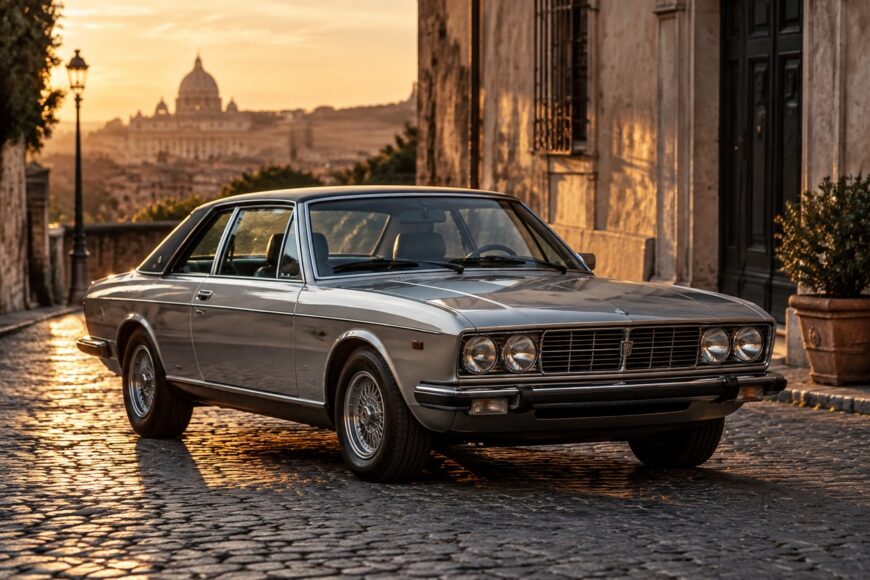
The Fiat 130 Coupe was an elegant, technically serious Italian flagship that sold in tiny numbers. Built from 1971 to 1977, it combined a large Lampredi V6, sophisticated independent suspension, generous equipment, and Pininfarina-associated design with the badge of a manufacturer better known for practical family cars. Its rarity today is therefore partly the result of ambition that arrived in an awkward place in the market.
The car did not fail because its engine was fundamentally poor. Expensive positioning, a soft grand-touring character, heavy fuel consumption, and a difficult afterlife all worked against it. A surviving 130 Coupe can deliver quiet authority and superb period atmosphere, yet ownership demands more patience than its polished appearance suggests. The right example is a rare Italian GT; the wrong one is a long-term body, electrical, and transmission project.
- The Fiat 130 Coupe’s Place in Fiat’s Range
- A Flagship That Looked Too Expensive to Buy
- Elegant Design, Heavy GT Character
- What Ownership Actually Demands
- How to Inspect One Before Buying
- Frequently Asked Questions
- How many Fiat 130 Coupes were made?
- What is the price of a Fiat 130 Coupe today?
- Why does FIAT have a bad reputation?
The Fiat 130 Coupe’s Place in Fiat’s Range
Fiat built the 130 Coupe to occupy the top of its range, giving the company a flagship with the physical presence and mechanical substance expected of an executive grand tourer. This was a deliberate move above Fiat’s ordinary compact and family cars. The coupe shared the model name and corporate identity of the 130 saloon, yet its purpose was more exclusive: long-distance travel, formal style, and a clear demonstration of what Fiat could produce at the upper end of the market.
Production ran from 1971 to 1977, with approximately 4,500–4,900 coupes built. That figure refers to the coupe body rather than the broader Fiat 130 family, and the limited output explains why the model is now encountered so rarely. Only a few cars are typically offered at one time in Europe, which makes condition and provenance more important than a simple model-year comparison.
The body was developed through Centro Stile Fiat and Pininfarina. Its disciplined three-box form, long nose, and horizontal front lighting gave the car a restrained authority rather than the visual drama associated with a mid-engined or aggressively shaped sports car. The design has aged particularly well because its main lines are architectural. It looks expensive without relying on excessive decoration.
Historically, the 130 Coupe was Fiat’s flagship coupe and an ambitious Italian luxury GT. That description should be kept in proportion. The car occupied a prestige position within Fiat, but it was not the contemporary equivalent of a Mercedes S-Class or Jaguar in status, dealer support, or social meaning. Its later collector appeal comes from rarity, design, and character, while its original market position was more complicated.
A Flagship That Looked Too Expensive to Buy
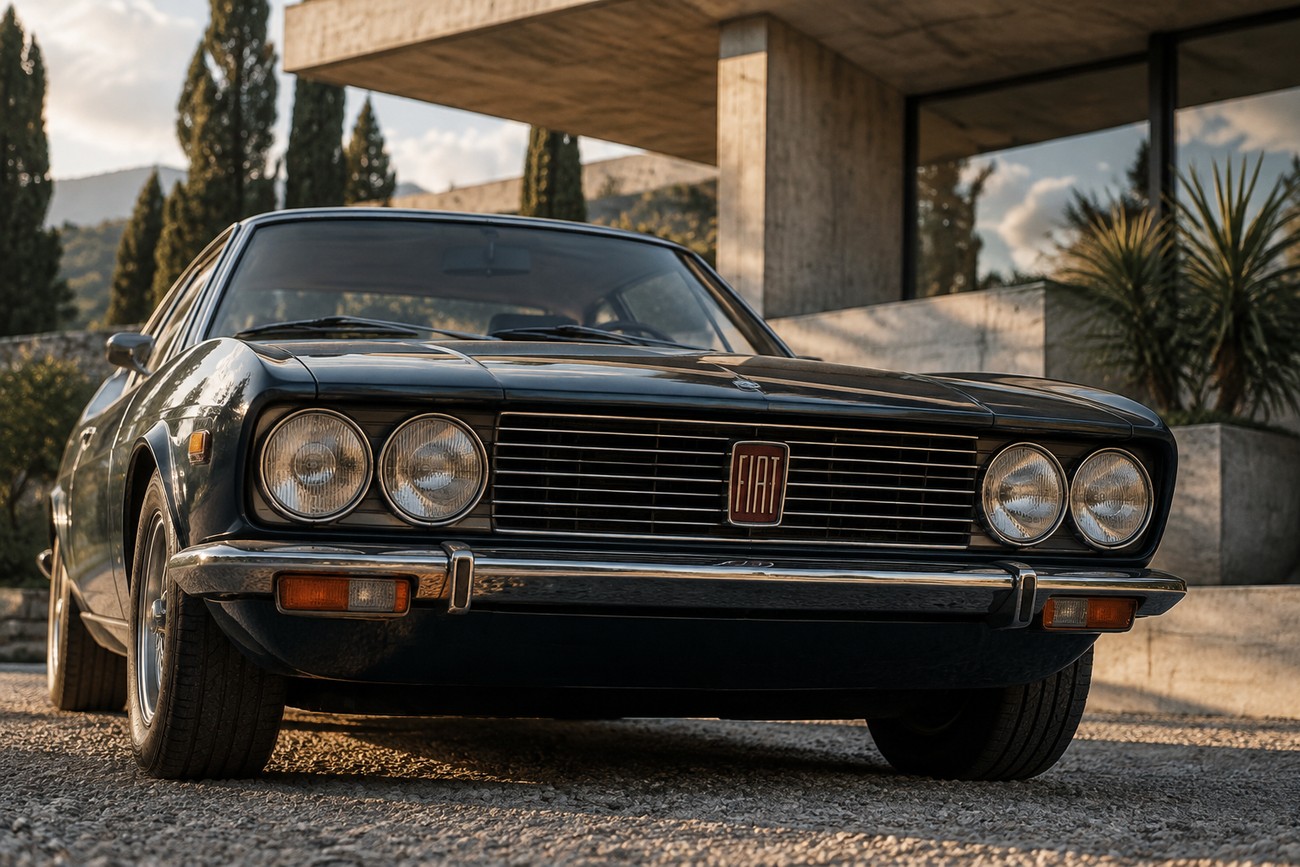
The commercial problem was rooted in identity. Fiat had broad recognition and enormous production experience, yet the 130 Coupe asked buyers to spend at a level associated with more prestigious luxury marques. The badge did not automatically communicate the exclusivity promised by the car’s size, equipment, and V6. Buyers considering a large grand tourer could choose a more established luxury name or a more overtly sporting coupe, depending on which kind of status they valued.
Its character also made the sales proposition harder to explain. The 130 Coupe was marketed as an Italian luxury grand tourer, with comfort and refinement taking priority over sharp responses. That made sense on a fast road, where its supple ride and quiet V6 suited sustained travel. In a showroom, however, a buyer expecting a dramatic sports coupe could see the weight, relaxed automatic transmission, and understated styling as evidence that the car lacked excitement.
The market of the 1970s added further pressure. A large, thirsty European coupe was difficult to justify beside smaller, more economical cars, while fuel concerns made the running costs increasingly conspicuous. The Fiat 130 Coupe also occupied an uncomfortable middle ground: too expensive to feel like an ordinary Fiat, yet too modestly prestigious to defeat the established luxury brands on image alone.
Low sales therefore say more about positioning, price, and image than about engineering quality. Calling the car an “Italian S-Class” can be useful as shorthand for Fiat’s ambition, provided the comparison stops there. The description does not establish equal prestige or technical status. Today, the collector reputation is stronger than the original market reputation because rarity has finally become an advantage.
Elegant Design, Heavy GT Character
The 130 Coupe’s design is one of its strongest arguments. The three-box silhouette is formal without being stiff, and the horizontal front lighting gives the nose a distinctive width. The restrained surfaces allow the proportions to do the work. A good car still appears substantial from every angle, while the cabin and glass area preserve the visual lightness expected of a grand tourer.
Power comes from a 3,235 cm³ Lampredi V6 producing approximately 165–180 hp, depending on specification. Its delivery is smooth and torquey, with enough reserve to make the car feel effortless during ordinary high-speed cruising. The engine’s character is more important than a headline performance claim: it supplies calm, continuous thrust and suits the car’s long-legged personality.
Most coupes used a three-speed Borg-Warner automatic. A five-speed manual was substantially rarer and is generally more desirable to experienced collectors because it gives the engine a livelier connection to the road. The automatic can suit relaxed driving when correctly maintained, yet its leisurely shifts reinforce the car’s grand-touring brief. It does not turn the 130 into a hard-edged sports coupe.
Underneath, the specification was serious for Fiat. The car has independent suspension on all four wheels, front double wishbones, rear trailing or diagonal arms, and disc brakes all around. That hardware gives a sound chassis a composed ride and credible stability, especially on imperfect roads. The approximately 1,500–1,600 kg mass, depending on equipment, remains present in every maneuver.
On a narrow, twisting road, the heavy nose and soft setup can produce front-end understeer. The steering and suspension communicate a comfortable, settled GT rather than a lightweight attack car. Owners who approach it as a fast, elegant cruiser usually appreciate the balance; those expecting Maserati-like aggression tend to find the responses too deliberate.
What Ownership Actually Demands
Fuel is an immediate part of the ownership calculation. Real-world city consumption is commonly reported at approximately 18–22 L/100 km, making the 130 Coupe better suited to weekend use and longer open-road trips than daily commuting. The consumption reflects the V6, the vehicle’s mass, and the relaxed automatic transmission. A prospective owner should budget for the car’s appetite before becoming attached to its appearance.
The engine itself is generally durable when lubrication and cooling are maintained correctly. Neglect is a greater threat than an inherent design weakness. Cooling-system condition, correct oil servicing, and evidence of regular mechanical care deserve more attention than a vague claim that the engine is “strong.” A neglected V6 can still become expensive, especially when poor maintenance has been allowed to affect several related systems.
Electrical faults are among the more frustrating age-related problems. Aging wiring and corroded contacts can produce intermittent issues with instruments, lighting, and window mechanisms. These faults may appear mysterious when approached as isolated failures, though the underlying cause is often deterioration in connections or harnesses. Small interior mechanisms, including buttons, switches, and seat-adjustment hardware, can also wear faster than the luxurious cabin suggests.
Corrosion requires a more suspicious inspection than the glossy exterior encourages. Sills, structural mounting areas, suspension attachment points, and boot edges can be substantially worse than the visible panels. Body, glass, molding, and specific interior parts are much harder to source than many mechanical components, so rust repair or missing trim can dominate the budget.
The three-speed Borg-Warner automatic is another major ownership risk. It is criticized for lazy shifting, slipping, leaks, and expensive repairs after poor servicing. A smooth first impression proves little if the test drive is brief or the transmission is cold. The car’s scarcity also makes diagnosis harder because many general repair shops are uncomfortable with a rare Italian V6 paired with an older hydraulic automatic.
How to Inspect One Before Buying
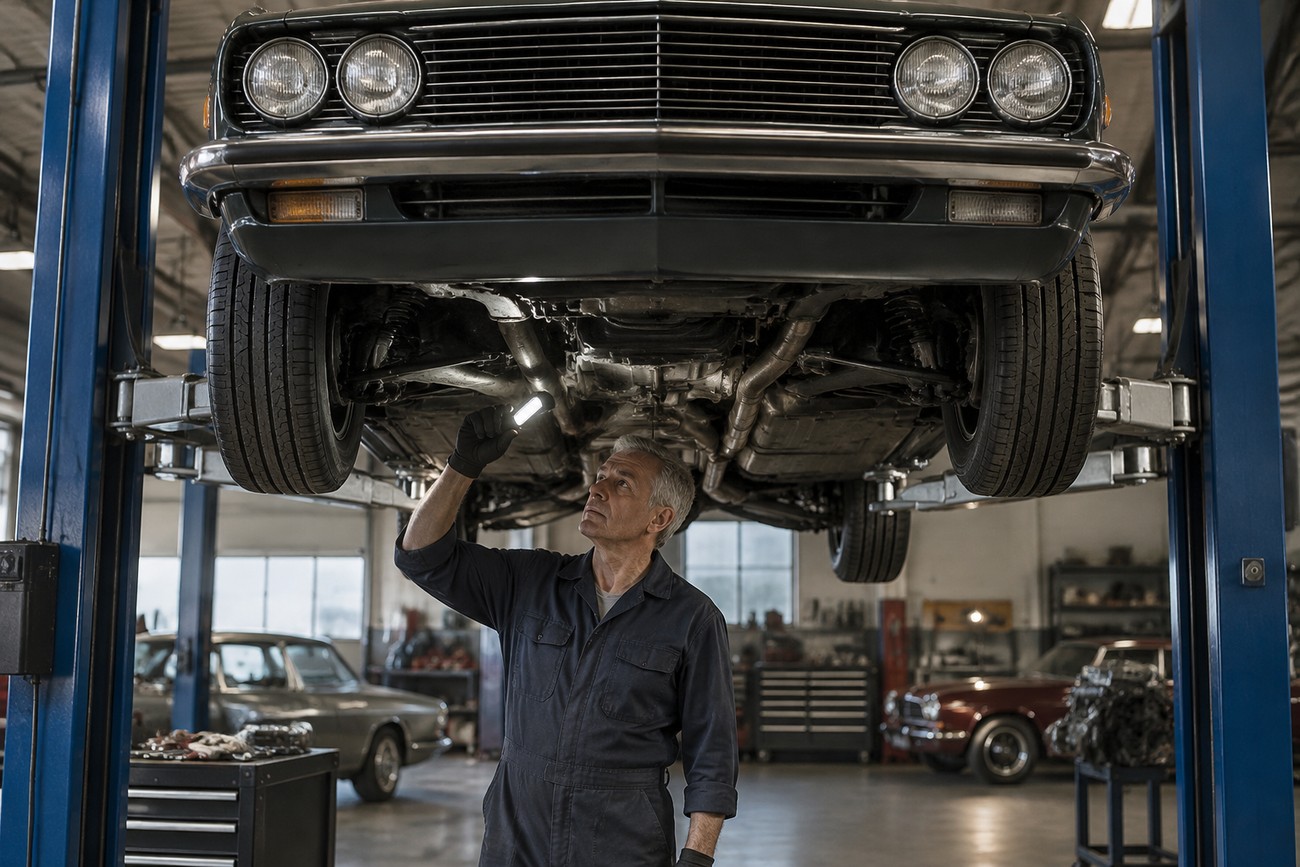
Begin underneath the car, even if the paint and brightwork look exceptional. Inspect the sills, floor structure, longitudinal areas, suspension mounting points, and the edges of the trunk for corrosion or evidence of extensive welding. A shiny restoration can conceal major structural work beneath fresh paint, and cosmetic presentation should never replace access to the underside.
Check the suspension and braking components for correct specification, wear, and improvised repairs. Some brake and suspension items may cross-reference with contemporary Fiat and Lancia applications, which can make mechanical servicing possible. Correct identification remains essential because a cheap substitute or unsuitable universal part can alter geometry, braking behavior, or the load placed on neighboring components.
Test the Borg-Warner automatic once it is fully warm, and inspect the fluid, cooler lines, and gearbox mounting areas before trusting a smooth road test. A cold transmission can conceal slipping, harsh engagement, or a leak that becomes obvious only after heat and load have built up.
Drive an automatic through the full operating cycle. Check engagement from rest, changes under light and heavy throttle, kickdown, load changes, slipping, harsh shifts, and reverse selection. Look for leaks after the drive rather than relying on a clean driveway. A five-speed manual is much rarer, so its presence may add appeal, yet the condition of the individual car still matters more than transmission type alone.
Electrical testing should include the instruments, exterior lighting, switches, and window mechanisms, with attention to intermittent behavior. Inspect original trim, emblems, wood veneer, seat mechanisms, and model-specific fittings carefully. Reproducing the original appearance can require donor parts or hand fabrication, and a missing molding may be harder to replace than a service item hidden beneath the car.
Plan the ownership support before committing to the purchase. Specialist knowledge is scarce, and a generalist workshop may apply incorrect settings or select parts merely because they appear similar. The narrow buyer pool also matters at the other end of ownership: even a good example can take time to sell, while an inaccurately insured car may be assigned a value that fails to reflect its rarity.
Frequently Asked Questions
The Fiat 130 Coupe attracts interest because its scarcity changes nearly every normal classic-car assumption. Production numbers, valuation, and parts supply all require careful interpretation. The answers below separate the model’s genuine strengths from the risks created by age and limited support.
How many Fiat 130 Coupes were made?
Approximately 4,500–4,900 Fiat 130 Coupes were built. This commonly cited figure applies to the coupe body, rather than the broader Fiat 130 family that also included the saloon.
References vary because production totals are not always presented with the same scope or counting method. For a buyer, the practical result is clearer than the exact final number: the coupe is a genuinely low-volume model, and the small surviving market makes original trim, documentation, and structural condition unusually important.
What is the price of a Fiat 130 Coupe today?
There is no reliable single price for a Fiat 130 Coupe. Condition, rust repair, originality, documentation, gearbox type, and market location dominate valuation, while the thin European market means that a few available cars cannot establish a stable universal guide value.
A manual-transmission car is substantially rarer and may attract stronger interest, though a sound automatic is still preferable to a cosmetically impressive project. Insurance valuations can also understate the car because databases do not always classify the model accurately. An independent appraisal with photographs of the structure and details of originality is sensible where agreed-value cover is available.
Why does FIAT have a bad reputation?
General perceptions of Fiat were formed largely around mass-market cars and their ordinary age-related reliability issues. A Fiat 130 Coupe presents a different ownership problem: scarcity, neglected wiring, hidden corrosion, fragile trim, and limited specialist support can make repairs difficult even when the Lampredi V6 itself is fundamentally sound.
The distinction matters during inspection. Mechanical, brake, and suspension items can sometimes be sourced or cross-referenced, while unique body, glass, molding, and interior parts may require donors or fabrication. The model’s reputation is therefore shaped as much by its rare and poorly supported afterlife as by the durability of its core engine design.







