
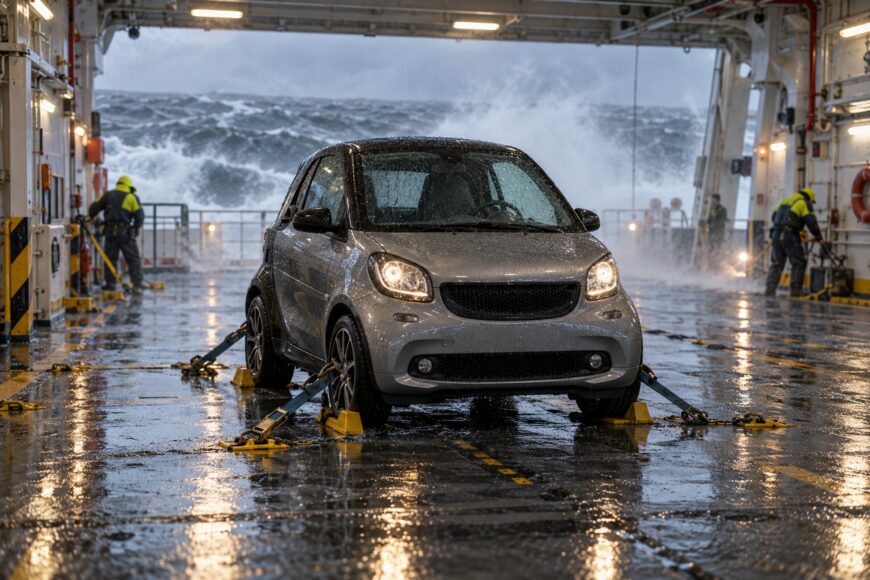
A very light, short Smart Fortwo sitting on wet steel can look vulnerable as a ferry rolls in heavy seas. Salt water, painted metal, and a brief sideways lurch create a far more alarming picture than an ordinary road journey, especially in a car weighing approximately 800–900 kg.
The Fortwo is not inherently unsafe on a ferry. Noticeable movement is unlikely when the vehicle is correctly positioned and mechanically secured. The decisive factors are tire-to-deck friction, parking direction, wheel chocks, and crew-installed tie-downs. A handbrake, transmission setting, or crash-test rating cannot replace those measures.
- The Short Answer: Can a Smart Fortwo Slide on a Ferry?
- Why This Tiny Car Feels More Vulnerable in Heavy Seas
- What Actually Keeps a Fortwo in Place on a Stormy Deck
- The Mistakes That Make a Small Car More Likely to Move
- How to Ask the Ferry Crew for the Right Protection
- Safety Ratings Do Not Answer the Ferry-Deck Question
- Myths About a Smart Fortwo Being a Floating Toy
- Frequently asked questions
- At what wind speed do ferries stop running?
The Short Answer: Can a Smart Fortwo Slide on a Ferry?
Yes, a Smart Fortwo can move slightly on a ferry if it is left inadequately secured on a slippery deck. Wet painted steel contaminated with salt water or fuel can provide substantially less grip than ordinary asphalt. During strong rolling or yawing, even a small movement may be noticeable in a short, light car.
That risk should be kept in proportion. A properly positioned and mechanically secured Fortwo has minimal risk of noticeable movement under normal ferry restraint procedures. Reports of cars shifting generally point to poor friction, inadequate chocking, weak restraint, or an unsuitable loading arrangement rather than to the Smart model alone.
Its mass is well within the nominal range handled by most European and Scandinavian passenger-car restraints, which are designed for vehicles up to 3.5 tonnes. The important question is whether the crew has applied the operator’s procedure for the actual sea conditions and loading plan.
Do not treat an anecdotal account of a car moving a few centimeters as controlled testing, and do not assume that a small car is automatically ignored. Ask the crew to check the Fortwo’s securing if the deck is wet, the forecast is severe, or the restraint appears incomplete.
Why This Tiny Car Feels More Vulnerable in Heavy Seas
The Fortwo is approximately 2.7 m long and 1.66 m wide, with a very short wheelbase. Its compact proportions make the car feel lively when the deck moves beneath it. A longer vehicle may spread its contact points over a greater distance, while the Fortwo responds quickly to a sudden roll, pitch, or yaw.
At approximately 800–900 kg, depending on generation, the Fortwo has less inertia than a heavier sedan. If tire-deck friction is poor, a lateral force can start a lighter vehicle moving more readily. That does not mean the car is unstable on the road; it means a stationary vehicle on a moving ship is being exposed to a different problem.
The rear-mounted engine and rear-wheel drive place more load on the rear axle and can improve traction at the driven wheels. This helps explain reports in which the rear tires appear to hold while the front of the car shifts slightly. It is an advantage in one part of the traction equation, not a substitute for tie-downs.
Approximately 160 mm of ground clearance and a low body also reduce body-motion amplitude compared with taller crossovers. Road stability and parked-deck security must still be separated: ESP can assist a moving car on a road, but it does not control a switched-off vehicle on a ferry.
What Actually Keeps a Fortwo in Place on a Stormy Deck
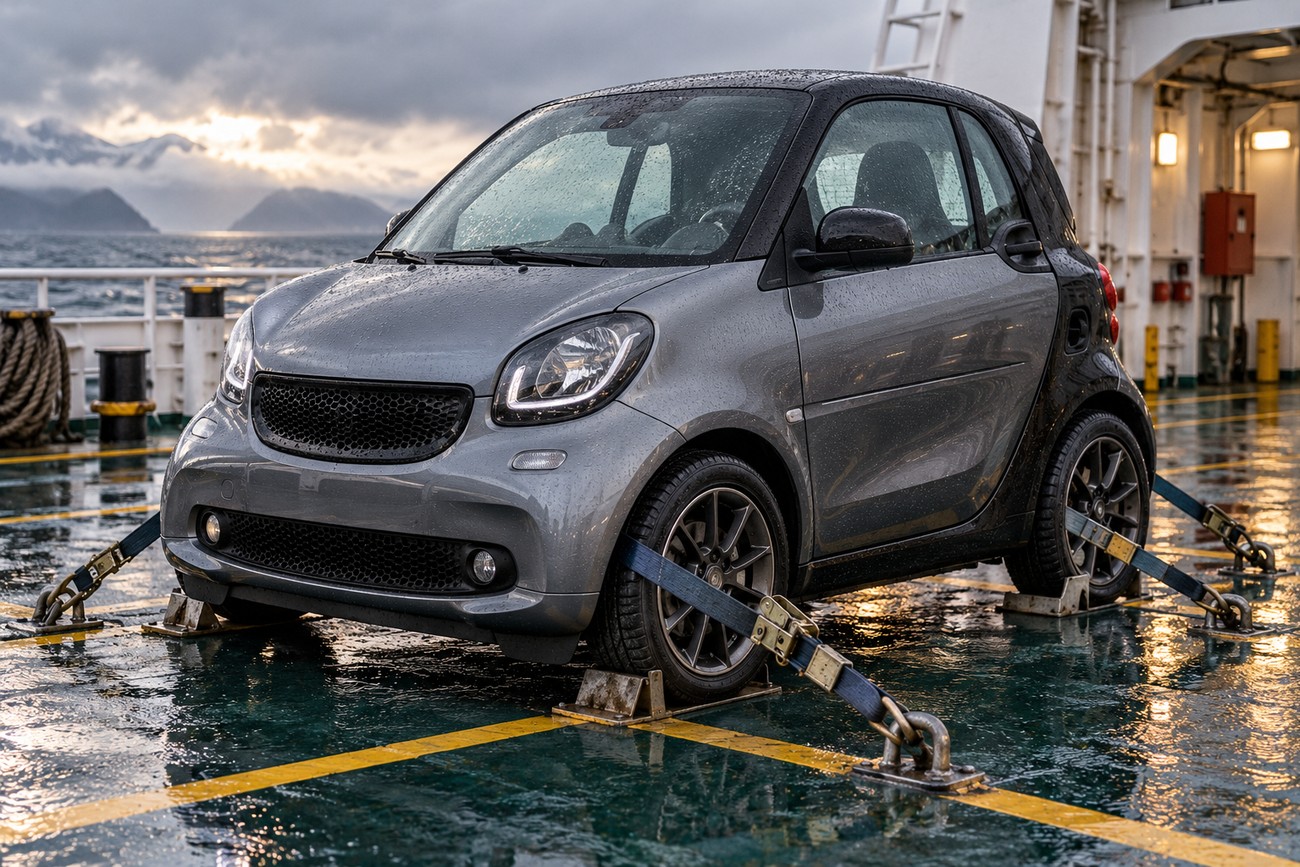
Grip begins at the contact between the tires and the deck. A dry, rough surface generally provides higher friction. Wet painted steel contaminated with salt water or fuel can become substantially more slippery, so the handbrake may be holding the wheels while the tires themselves have little resistance to sideways movement.
Most European and Scandinavian ferry vehicle restraints are designed for passenger cars up to 3.5 tonnes, placing a Fortwo comfortably within the nominal mass range. The crew may use straps, chains, chocks, or a combination of these according to vessel motion and the operator’s loading procedure.
The handbrake and transmission setting are useful supporting measures, but neither should be treated as the primary storm restraint. Wheel chocks add a physical barrier against rolling, while correctly installed straps resist movement that friction alone cannot manage. A Fortwo’s ESP does not actively stabilize a switched-off parked vehicle; mechanical restraint and tire-deck friction do the work.
Operators use vehicle restraints when vessel motion reaches the level specified by their procedures. Additional securing may begin around forecasts above Beaufort Force 7, but that is not a universal threshold. Vessel design, route exposure, sea state, port conditions, and the captain’s assessment remain decisive.
Only the crew can identify approved attachment points and the correct strap geometry for that vessel. Do not attach a private strap to ship fittings or alter the car’s position without explicit crew approval.
The Mistakes That Make a Small Car More Likely to Move
Relying only on the handbrake or transmission lock is a common error. On very slippery steel, strong rolling or yawing can produce small movements even when the wheels are locked. These settings should support the ferry’s mechanical restraint, not replace it.
Another avoidable mistake is accepting weak securing without asking for clarification. If a small car appears to have been left without chocks or tie-downs while conditions are deteriorating, speak to the loading crew. Do not reposition the vehicle or install restraints yourself; the designated layout and crew instructions take priority.
Old, worn, or hardened tires can lose grip more abruptly on wet metal than on ordinary asphalt. Tire condition therefore matters even when the car has passed its usual road checks. A Fortwo should also be parked in the direction selected by the crew, since placing it across the likely roll direction can load the car across its track rather than along its axles.
Heavy luggage placed at the front can reduce the rear-axle traction advantage provided by the rear-mounted engine. Keep loading within the vehicle’s normal limits and avoid creating an unusual front-heavy arrangement. The crew’s loading plan still overrides any general positioning advice.
How to Ask the Ferry Crew for the Right Protection
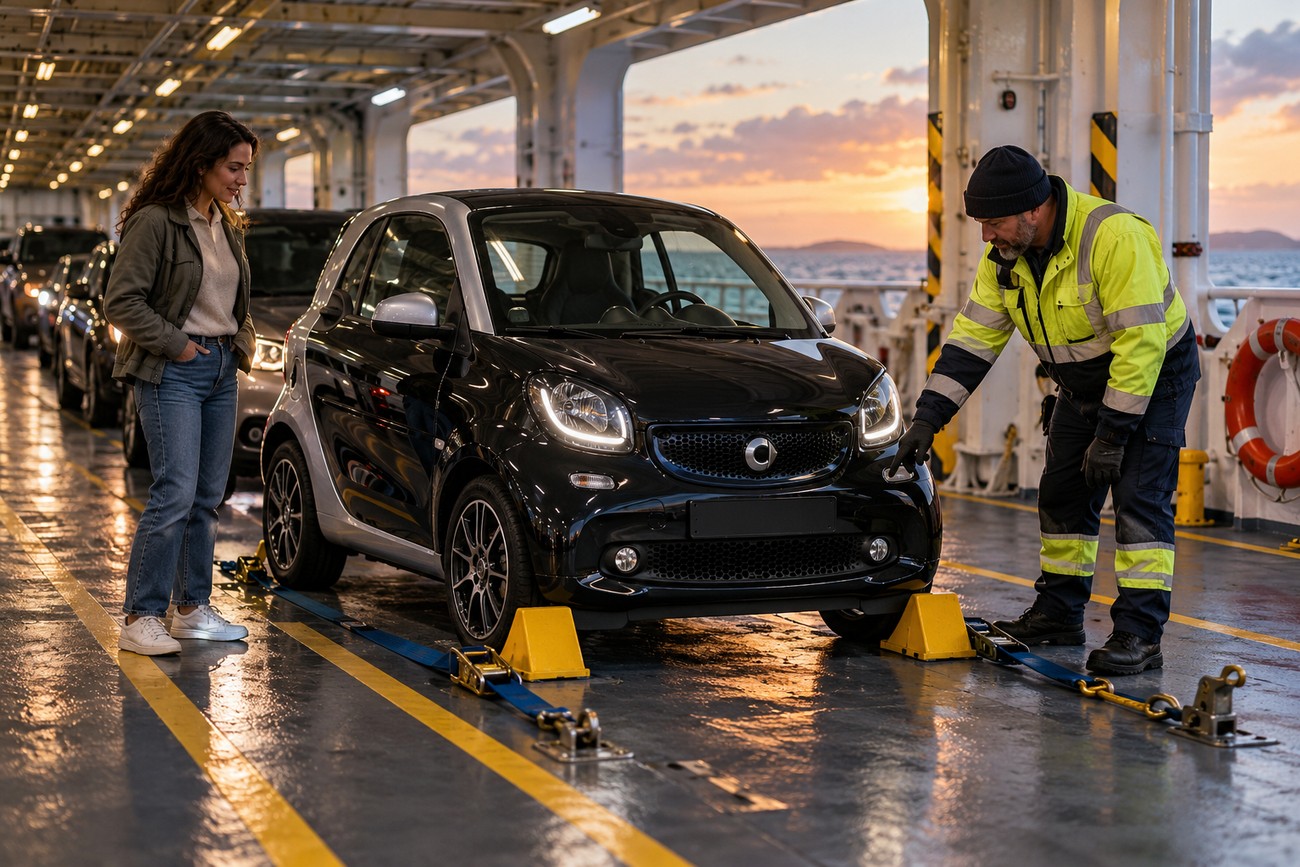
Give the ferry operator the exact Smart Fortwo model when booking, especially if severe weather is forecast. Ask whether the vehicle will receive secure tie-downs and whether any special procedure applies to a very light, short car. This gives the crew time to account for it in the loading plan rather than making the decision at the last moment.
During loading, confirm the approved parking direction and ask whether chocks, cross-straps, or chains will be used if conditions warrant them. Keep the request practical and defer to the crew’s answer. The operator’s loading plan is authoritative because it accounts for the vessel’s structure, other vehicles, and available attachment points.
Very light cars may receive chocks or cross-straps even when they fit the normal passenger-car category because their lower mass leaves less margin when deck friction falls. Owners should request this assessment from the crew rather than improvise a restraint arrangement.
Some seafarers report placing light vehicles near a structural barrier or between heavier vehicles, where surrounding vehicles can limit movement. That is a crew-dependent loading choice, not an instruction for owners to demand or arrange independently. A Smart’s Tridion safety cell is designed for high crash loads, but it does not replace correct deck restraint.
Safety Ratings Do Not Answer the Ferry-Deck Question
Euro NCAP testing addresses how occupants are protected in a road crash. Relevant modern Fortwo versions received four stars for adult occupant protection, and the Tridion structure is designed as a safety cell for high crash loads. Those are meaningful road-safety facts.
A stationary car on a moving ship faces a different set of forces. Tire-deck friction, the angle and tension of restraints, wheel chocks, parking direction, and the ferry’s procedures determine whether the vehicle stays in place. A strong passenger compartment cannot prevent a car from sliding if the deck restraint is inadequate.
GOST 31507-2025 provides useful context for road behavior. It covers handling and stability checks, including steering return, response to a steering jerk, and resistance to rollover. Compliance with road-vehicle handling and stability requirements does not guarantee security on a stormy ferry deck.
The distinction also explains why the Fortwo can be a competent road vehicle while still deserving careful attention during loading. Road certification concerns a vehicle under its own control; marine securing concerns a switched-off vehicle being carried by a moving vessel.
Myths About a Smart Fortwo Being a Floating Toy
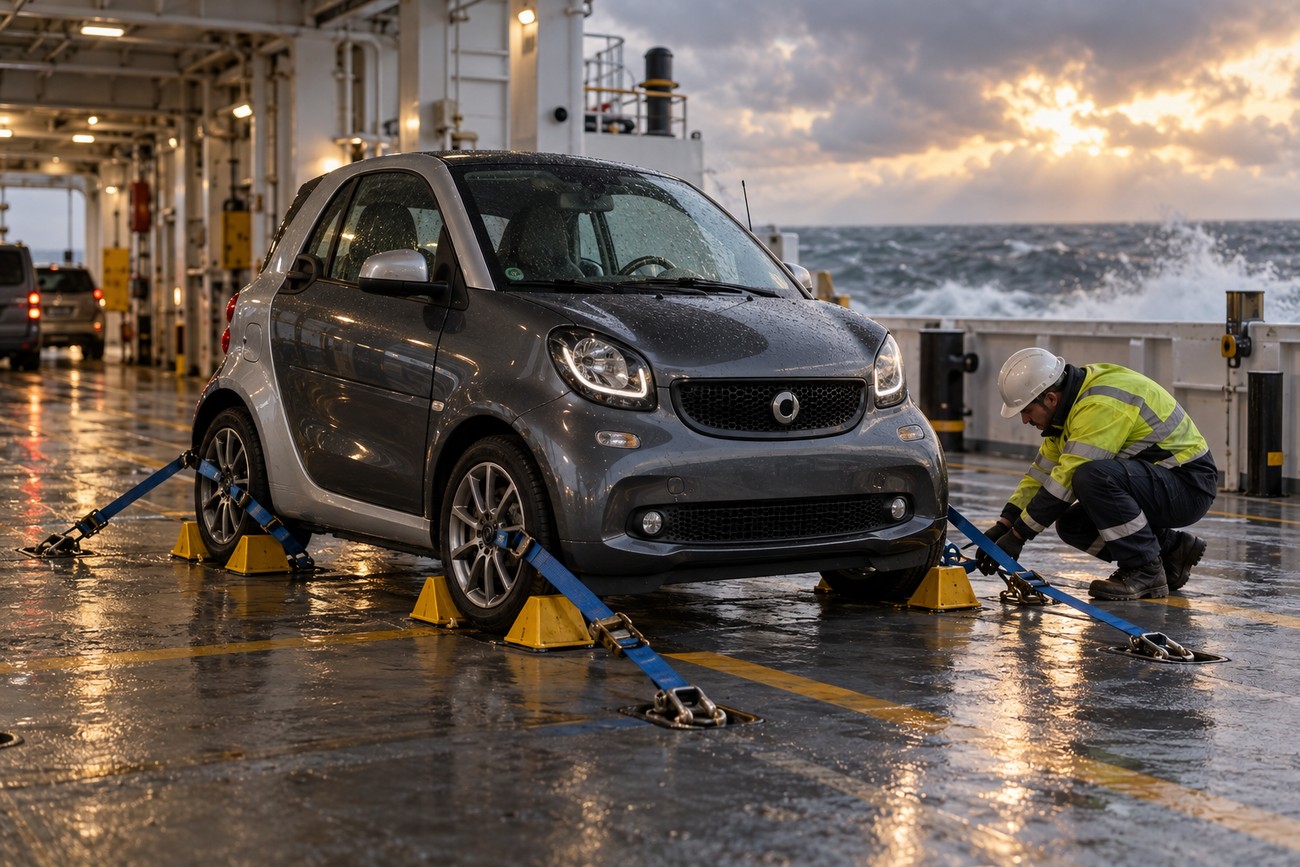
The first myth is that the Fortwo will automatically be swept across the deck because it is light. Low mass can make it easier to shift when friction is poor and the ship produces lateral or yawing loads, but correct chocks, positioning, and tie-downs make noticeable movement unlikely under normal securing procedures.
The opposite myth is that once straps are fitted, the car’s size and mass no longer matter. A short, light vehicle can place different loads on the restraint arrangement from a typical sedan. Its short wheelbase and compact track may produce a quicker response to sudden deck motion if the restraint is loose, poorly aligned, or attached incorrectly.
The Fortwo’s safety structure also does not make it immune from sliding. Crash robustness protects occupants in a collision; it does not create friction between tires and contaminated steel. The right conclusion is narrower and more useful: the model is not inherently unsafe, but it deserves correct marine handling.
Owners should therefore avoid both panic and complacency. Request a crew assessment when conditions warrant it, follow the designated loading direction, and confirm that the car has been mechanically secured before leaving the vehicle deck.
Frequently asked questions
Ferry operating decisions and vehicle-deck access are controlled by the operator and crew. General seamanship guidance cannot override their instructions.
At what wind speed do ferries stop running?
There is no universal wind-speed cutoff for ferry cancellations. The decision depends on vessel type, wave direction, port maneuvers, route exposure, and the operator’s safety limits, as well as the actual sea state.
A ferry may continue operating in strong wind on a sheltered route while another service pauses in lower wind because of exposed waters or difficult docking conditions. Follow the operator’s travel updates and crew instructions rather than relying on a single Beaufort value. A forecast above Beaufort Force 7 may prompt additional vehicle securing with some operators, but it does not establish a universal cancellation rule.







