
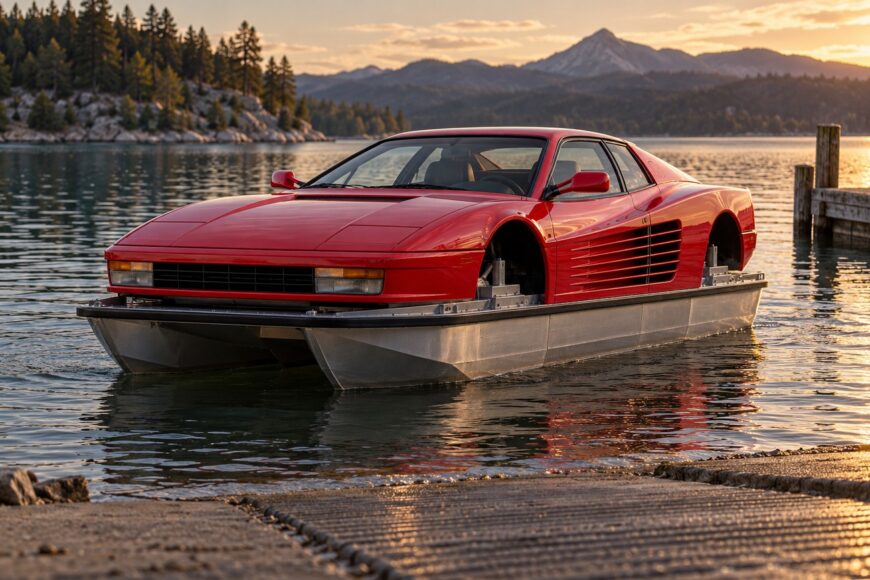
Driving a Ferrari Testarossa down a launch ramp and continuing across the water has obvious appeal. Its wide stance and flat-12 engine make for a striking amphibious concept. Yet a car that displaces enough water to float may still sit dangerously low, roll when someone moves across the cabin, or lose buoyancy after a leak.
This is an engineering feasibility assessment, not a report on a proven conversion. The supplied research does not establish a documented, fully tested amphibious Testarossa with operating data. The useful question is what a conversion would have to change—and whether the result could remain recognizably roadworthy and usable.
- Can a Testarossa float? The engineering verdict
- What 1.7 tonnes means for buoyancy and stability
- Why the stock body cannot serve as a watertight hull
- Propulsion, cooling, and exhaust: making the flat-12 marine-ready
- The hidden cost of water: maintenance and originality
- From feasibility study to controlled trials and legal use
- Frequently asked questions
- What should happen to the brakes after water use?
- What color does Ferrari not allow?
- Which car is called poor man’s Ferrari?
- Why was V12 banned in F1?
Can a Testarossa float? The engineering verdict
Yes, a purpose-built buoyant structure could support a Testarossa. A floating craft must displace water weighing at least as much as its complete operating mass, including people and conversion equipment. Achieving that condition is physically possible; fitting the required structure around a low sports car is the difficult part.
Sealing the stock body would not, by itself, create a safe amphibian. Doors, ventilation paths, and mechanical openings need watertight treatment, while the craft needs reserve buoyancy and enough freeboard to cope with movement and waves. Its stability must also be assessed with passengers aboard and after a plausible leak.
The flat-12 layout does not create buoyancy. Engine placement affects balance and trim, but the engine’s weight still has to be supported by displaced water. To move and steer effectively, the conversion would also need a marine drive and controls suited to its hull.
That makes the verdict a qualified yes on flotation and an unproven case for practical amphibious use. With no established operating data for a fully tested conversion, claims about water speed, handling, or reliability would be speculation.
What 1.7 tonnes means for buoyancy and stability
Reported Testarossa mass is approximately 1,506–1,508 kg dry versus approximately 1,708 kg curb; the figures describe different measurement conditions. For a first freshwater calculation, 1.7 tonnes requires approximately 1.7 m³ of displaced water. That is a starting minimum, before passengers, fuel differences, or conversion equipment are added—not a safe design target.
Every added kilogram calls for more displacement at a given water density. A watertight hull, flotation, propulsion hardware, and protective systems would therefore increase the submerged volume required. The finished, loaded vehicle must be evaluated as a whole rather than against the dry weight of the original car.
The body is approximately 4,485 mm long and 1,976 mm wide, with a 2,550 mm wheelbase. Those dimensions describe the space the car occupies, not its usable watertight displacement. What matters is the external volume of the sealed structure below the waterline; an engine enclosed within that hull contributes weight, while its internal bulk does not subtract from the hull’s external displacement.
Once the craft floats, its waterline becomes the next concern. A low body can leave little freeboard, while added equipment near the rear may alter trim and bring openings closer to the water. Pontoon placement needs a stability assessment as well as a buoyancy calculation: a passenger shifting position or water entering one compartment can change the result abruptly.
Reserve buoyancy and behavior under partial flooding require separate checks. Distributed sealed volumes or properly specified flotation can reduce reliance on a single dry cabin, but neither guarantees an upright, controllable craft. No credible pontoon size or passenger limit follows from the curb-mass figure alone.
Why the stock body cannot serve as a watertight hull
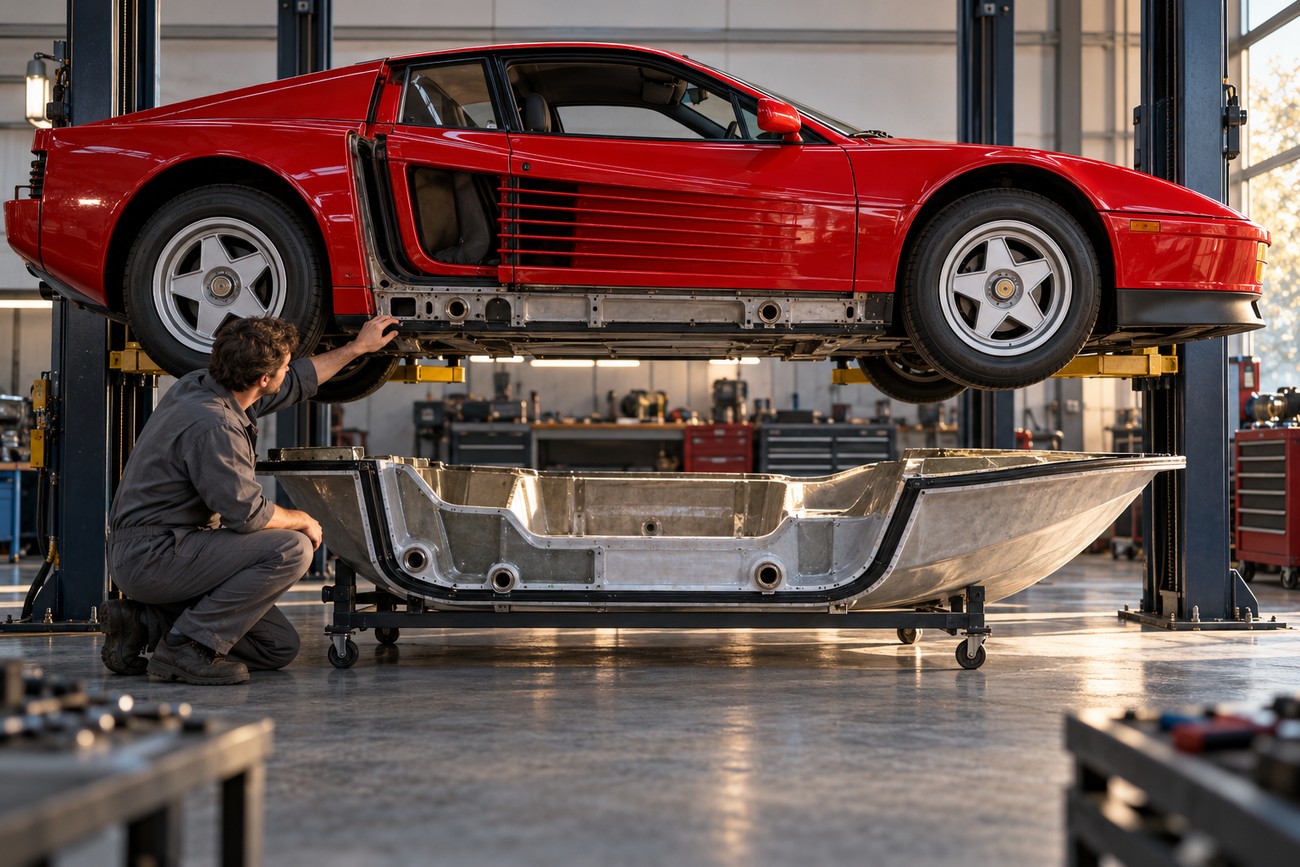
The Testarossa’s wide side intakes create an immediate conflict. They serve the road car’s airflow needs, yet openings near the waterline are potential flooding paths. Closing them would require another way to supply air and remove heat.
Sealing the floor leaves doors, ventilation channels, wiring entries, and any new steering or drive-shaft penetrations to address. Water can also collect in cavities that were never designed as marine compartments. A conversion would need defined watertight boundaries rather than an assumption that the passenger cabin will remain dry.
Static leak checks can miss joints that open under shaft vibration, chassis flex, or repeated door operation. Penetrations and seals need inspection under representative movement, not only while the vehicle sits still.
Those boundaries must tolerate wave impacts, vibration, chassis movement, and aging sealant. Bulkheads can limit how far a leak spreads; distributed, water-resistant flotation can help preserve buoyancy if a compartment floods. Foam alone does not establish stability, and its placement and long-term water resistance would need verification.
Propulsion, cooling, and exhaust: making the flat-12 marine-ready
The Testarossa has a 4.943-liter flat-12; Ferrari quotes 390 hp for the European version and 380 hp for the U. S. version. Those figures describe engine output, not thrust at the water. Stock wheels and the road transmission do not constitute a purpose-built marine drive.
A propeller, waterjet, or other water drive would need a suitable installation, reduction gearing, controls, and a protected route through the watertight structure. Water speed would depend on hull resistance, drive efficiency, and gearing as well as engine power. The exposed wheels, suspension, and underbody would add drag unless the design accounts for them.
Cooling poses a separate packaging problem. Sealing the Testarossa’s wide side intakes conflicts with the airflow its road systems expect, while simply admitting water through them risks flooding. Any revised arrangement would have to manage engine air, heat rejection, and fuel-vapor ventilation without compromising watertight boundaries.
The intake and exhaust also need protection against water entering the engine. Exhaust routing may require marine-appropriate anti-backflow measures, while any water-based cooling circuit needs corrosion protection and a maintenance plan. Freshwater use does not eliminate those obligations, and saltwater makes corrosion control more demanding.
Headline horsepower cannot resolve these linked choices. A powerful engine driving an inefficient propulsor behind a high-drag car body may produce disappointing water performance, even if the vehicle floats securely.
The hidden cost of water: maintenance and originality
Testarossa maintenance already involves difficult engine access, and some service work requires engine removal. A surrounding hull, bulkheads, and marine drive could obstruct that access further. A design that cannot be opened and resealed reliably would turn routine inspection into a major job.
Immersion adds exposure to corrosion, electrical faults, fuel-system problems, and deteriorated seals in an aging car. Water trapped around connectors, brakes, or body cavities may keep causing damage after the vehicle is back on land. Preventing that damage calls for inspection and drying access, not merely a watertight coating.
A visually discreet conversion conflicts with the space needed for flotation, structure, and propulsion. Preserving the familiar body proportions restricts where those systems can go; fitting them securely may require conspicuous changes. Either choice complicates maintenance and compromises the original design.
Major structural changes are also likely to reduce collector originality. Engineering, fabrication, testing, and upkeep could cost more than the car’s value, although no responsible estimate follows without a defined design and vehicle condition.
From feasibility study to controlled trials and legal use
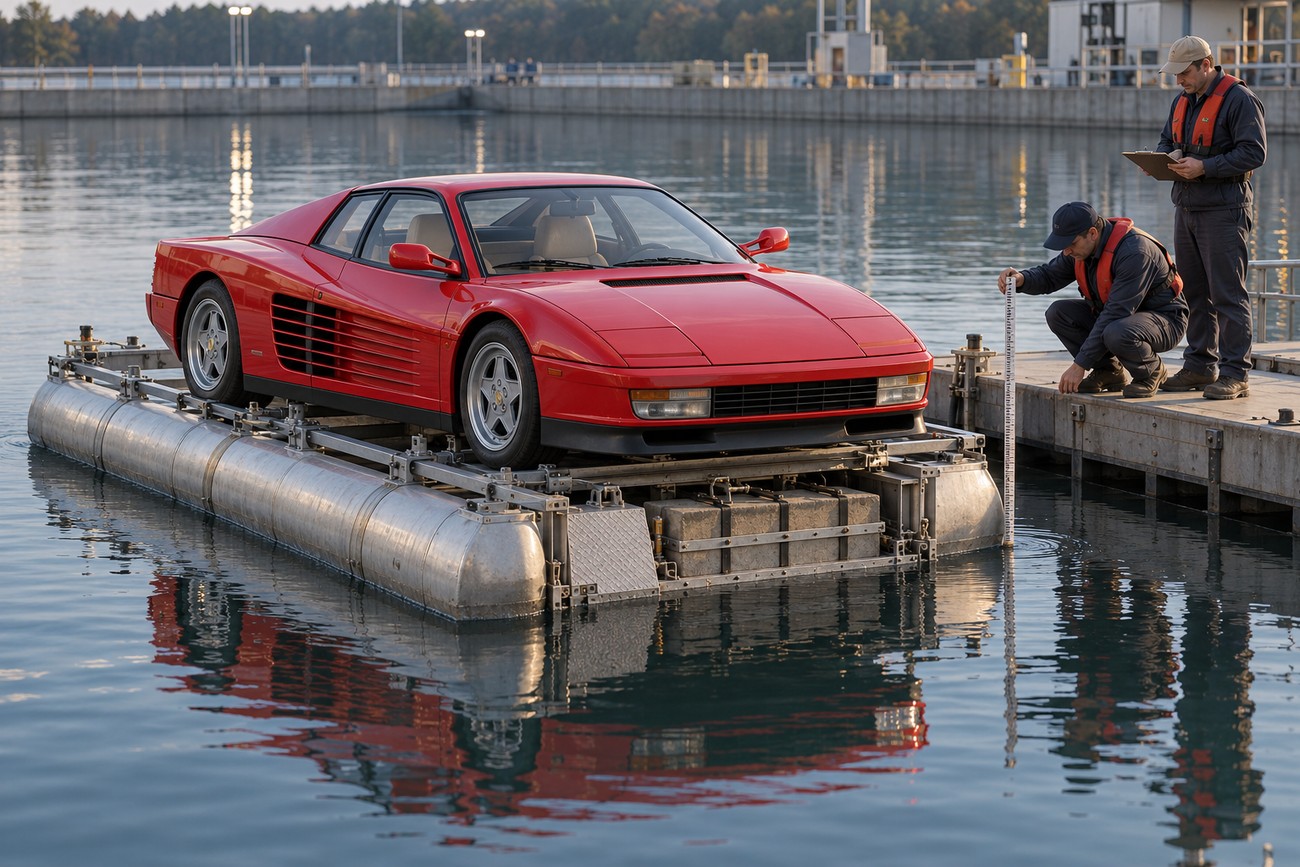
The decision should begin with a measured operating mass and a proposed watertight structure. At 1.7 tonnes, approximately 1.7 m³ of freshwater displacement is only the starting minimum, before additional loads. Hull calculations must then address reserve buoyancy, freeboard, trim, stability, and partial flooding.
Next comes inspection of the actual structure: openings, compartments, penetrations, access panels, and intended load paths. A calculation based on perfectly sealed spaces is of limited use if doors flex or a shaft seal leaks under operation. Designers would need a way to inspect and repair those areas throughout the vehicle’s life.
Trials should progress from restrained checks to shallow-water tests before any open-water operation. Ballast can represent planned loads, while an emergency shutdown and a support vessel provide safeguards during testing. None of these measures proves the finished craft safe; test results should feed back into the design.
Road-vehicle and small-craft requirements vary by jurisdiction and must be checked separately. Before building or launching, verify the applicable rules for registration, operator credentials, lights, safety equipment, launch access, and insurance. Road legality should never be assumed to confer permission to operate on water.
Frequently asked questions
Several practical questions sit outside the flotation calculation. Water use affects components that still have to work on the drive home, while launch and operating permissions depend on local rules. The following points should be checked for the particular vehicle and location.
What should happen to the brakes after water use?
Inspect and test the brakes before returning to the road. Check for trapped water, contaminated components, developing corrosion, and reduced braking performance; dry and service parts as needed rather than relying on a brief drive to clear them. If braking feels uneven or impaired, the car should not be driven until the cause is resolved.
What color does Ferrari not allow?
Pink is commonly cited as a color Ferrari does not offer through its factory personalization program. That is different from a universal ban on privately owned cars: an owner may repaint a Ferrari, subject to any applicable local rules. Color policy also has no bearing on whether an amphibious conversion is safe or permitted.
Which car is called poor man’s Ferrari?
The Toyota MR2 is among the cars given that informal nickname because of its mid-engine layout and sports-car shape. The label is subjective and has been applied to other cars, so it identifies no official model or technical relationship with Ferrari.
Why was V12 banned in F1?
Formula 1 did not ban V12 engines because the configuration itself was inherently unsafe. Regulations eventually required V10 engines for a period, excluding V12s; later rules changed the permitted engine format again. Those racing rules do not apply to the Testarossa’s road-going flat-12 or determine the feasibility of a marine conversion.







