

A 1,000-hp hybrid Ferrari with all-wheel drive has the ingredients for a spectacular gravel demonstration. The SF90 Stradale can send electric drive to the front axle, giving it a theoretical traction advantage over a conventional rear-wheel-drive Ferrari as the surface loosens.
That advantage applies mainly to getting power down. A rally stage also demands clearance for ruts and embedded stones, tires that can survive sharp gravel, suspension travel, predictable low-grip control, and components that tolerate repeated impacts. The sensible distinction is between a controlled appearance on smooth gravel and a timed stage driven at competitive pace.
- Verdict first: hybrid hero on smooth gravel, not a rally car
- What hybrid AWD gives you—and what it cannot create
- Tires, ride height, and suspension set the real pace
- Why the drive modes may feel awkward on loose ground
- The expensive risks hidden beneath a spray of stones
- A sensible boundary: controlled appearance versus timed stage
- Frequently asked questions
- What should you do if an underbody strike might have damaged the hybrid system?
Verdict first: hybrid hero on smooth gravel, not a rally car
The conditional verdict is straightforward: the SF90 Stradale could make an impressive, carefully managed run on a smooth, inspected gravel surface. Its hybrid AWD has genuine mechanical potential, and the car’s power delivery would make even moderate acceleration visually dramatic. That would demonstrate its drivetrain rather than prove rally suitability.
A rough stage changes the equation. The supplied brief estimates ground clearance at approximately 118–125 mm, depending on specification, although the individual car should be checked before treating that range as a definitive factory measurement. Ruts, exposed stones, compression zones, and loose rock can reach parts of the car designed for paved-road and track use.
Ferrari does not specify a dedicated gravel or rally drive mode for the SF90 Stradale. Its control systems therefore have no published stage-specific calibration to reconcile throttle response, wheel slip, stability intervention, and regenerative braking on loose ground. The car may still find traction, but traction alone does not make its responses predictable or its structure durable in rally conditions.
The strongest case for the SF90 is a low-speed or moderate-speed promotional appearance on a prepared surface, with the route inspected and the car treated as an expensive road vehicle. A rutted, jump-filled stage with sustained hard driving exposes the limits of the tires, suspension, cooling protection, underbody, and repair budget much sooner than it showcases the hybrid system.
What hybrid AWD gives you—and what it cannot create

The SF90 Stradale uses a 4.0-liter twin-turbo V8 producing approximately 780 hp, supported by three electric motors contributing approximately 220 hp combined. Ferrari quotes 1,000 hp for the complete system. Two electric motors drive the front axle, while the V8 and a third electric motor drive the rear axle.
On loose ground, driven front wheels can help the car accelerate where a rear-drive supercar would more readily spin its rear tires. Electric motors can also respond quickly to throttle commands, giving the hardware a theoretical advantage during a clean launch or a long, flowing corner exit.
The tires remain the point of contact with the surface. A motor can deliver torque to a driven wheel, but it cannot create friction between a road-oriented tread and loose gravel. Steering and braking consume part of the available grip, so adding power while the car is already asking the tires to change direction can still produce understeer, wheelspin, or a stability intervention.
That distinction matters because the AWD layout offers potential traction benefits, not a guarantee of grip or predictable handling on gravel. The hardware alone does not establish how the SF90 distributes torque in every low-grip situation, nor does it provide a measured gravel-stage result. Its advantage is real in principle, while its rally behavior remains dependent on tires, calibration, surface, and driver inputs.
Tires, ride height, and suspension set the real pace
The supplied brief names Pirelli P Zero and Michelin Pilot Sport Cup 2 as road- or track-oriented tire examples, although actual fitment varies by car. Their compounds and tread patterns are intended for paved-road or circuit performance. On loose gravel, they can struggle to clear material from the contact patch and may suffer cuts from sharp stones.
Low-profile construction adds another limitation. A short sidewall gives precise steering response on asphalt, but it provides less compliance when a wheel meets a rock or drops into a rut. A more suitable tire would require correct fitment, load and speed approval, wheel-clearance checks, and careful consideration of the car’s control systems; changing tires alone would not convert the SF90 into a rally car.
Ride height is equally important. With the supplied estimate of approximately 118–125 mm, depending on specification, the SF90 has little margin over a rough surface compared with a purpose-built gravel car. A rut can damage a splitter or underbody panel without a dramatic jump, while an embedded rock can transmit a sharp load directly into a wheel, tire, or suspension component.
A lightly dusted paved road is a different environment from loose gravel. The former may reduce braking and cornering grip while leaving the surface relatively smooth; the latter constantly moves beneath the tires and sends stones into the arches, cooling openings, and bodywork. The SF90’s asphalt-focused suspension and tire choices set the practical pace long before its power output becomes the limiting factor.
Why the drive modes may feel awkward on loose ground
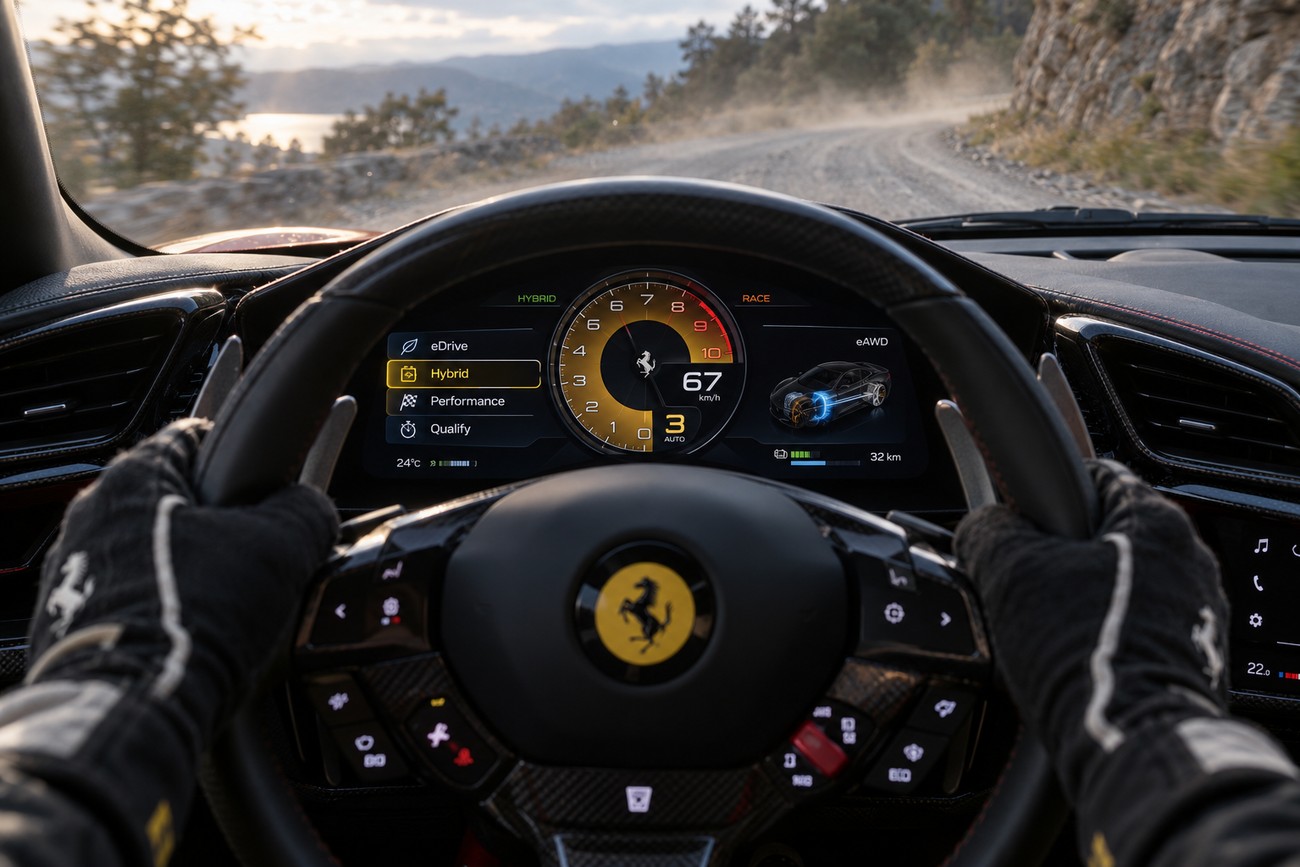
The SF90 Stradale’s named powertrain modes are eDrive, Hybrid, Performance, and Qualify. They change the priorities assigned to electric operation, combustion-engine availability, battery use, and response. Those changes can be noticeable on a low-grip surface because the driver is managing a narrow band of available traction.
Ferrari does not specify a dedicated gravel or rally drive mode for the SF90 Stradale. The car’s traction and stability systems therefore operate within a road and performance framework rather than a published loose-surface calibration. On gravel, an intervention that feels logical on asphalt may arrive abruptly from the driver’s perspective, especially during a throttle change or a transition from braking to acceleration.
Reports that Hybrid or Performance can feel smoother than Qualify on slippery surfaces should be treated as anecdotal preferences, not verified gravel setup advice. A softer-feeling response may make torque easier to meter, but it does not alter the clearance, tires, suspension travel, or impact vulnerability. Qualify’s sharper response can be difficult to exploit when the surface changes continuously.
Switching off safety systems should not be treated as a universal cure. Removing intervention may reveal more natural slip, yet it also removes a layer of protection while the driver is dealing with unfamiliar grip and a high-energy powertrain. Any controlled demonstration should be approached with the systems configured deliberately, within a safe environment, rather than using an electronic setting to compensate for hardware designed around asphalt.
The expensive risks hidden beneath a spray of stones
Gravel exposes the SF90 to a different pattern of wear. Stone strikes can mark the splitter, sills, rear diffuser, underbody panels, and wheel-arch liners, while dust can accumulate around cooling openings. Sharp debris can also cut the tires or cause damage that is difficult to identify from a quick walk-around.
The hybrid system raises the consequences of an underbody impact. High-voltage components and the battery are mounted low to support the car’s center of gravity, so a strike in that area deserves more caution than a cosmetic scrape. This does not establish a documented pattern of high-voltage failures on gravel, but it does mean that suspected impact damage requires qualified inspection rather than casual probing or DIY handling.
A hard underbody strike should end the run until visible damage, tire condition, and cooling openings have been checked; any suspicion of high-voltage damage belongs with qualified personnel.
Cooling deserves attention on slow, dusty runs. A cloud of debris can reduce airflow quality or restrict openings, while low speed reduces the natural cooling available during a hard sequence of acceleration and braking. Heat in the battery and power electronics is therefore a monitoring concern, even though the supplied information does not establish a specific SF90 rally-stage overheating defect.
Repeated vibration creates a separate burden. The car’s carbon and composite aerodynamic parts, wiring, cooling hardware, and electric-drive assemblies were not developed around regular rally-stage impacts in the way a purpose-built gravel car is. A service department may also have limited experience with a hybrid supercar subjected to sustained gravel loads, making post-event assessment more involved.
A sensible boundary: controlled appearance versus timed stage
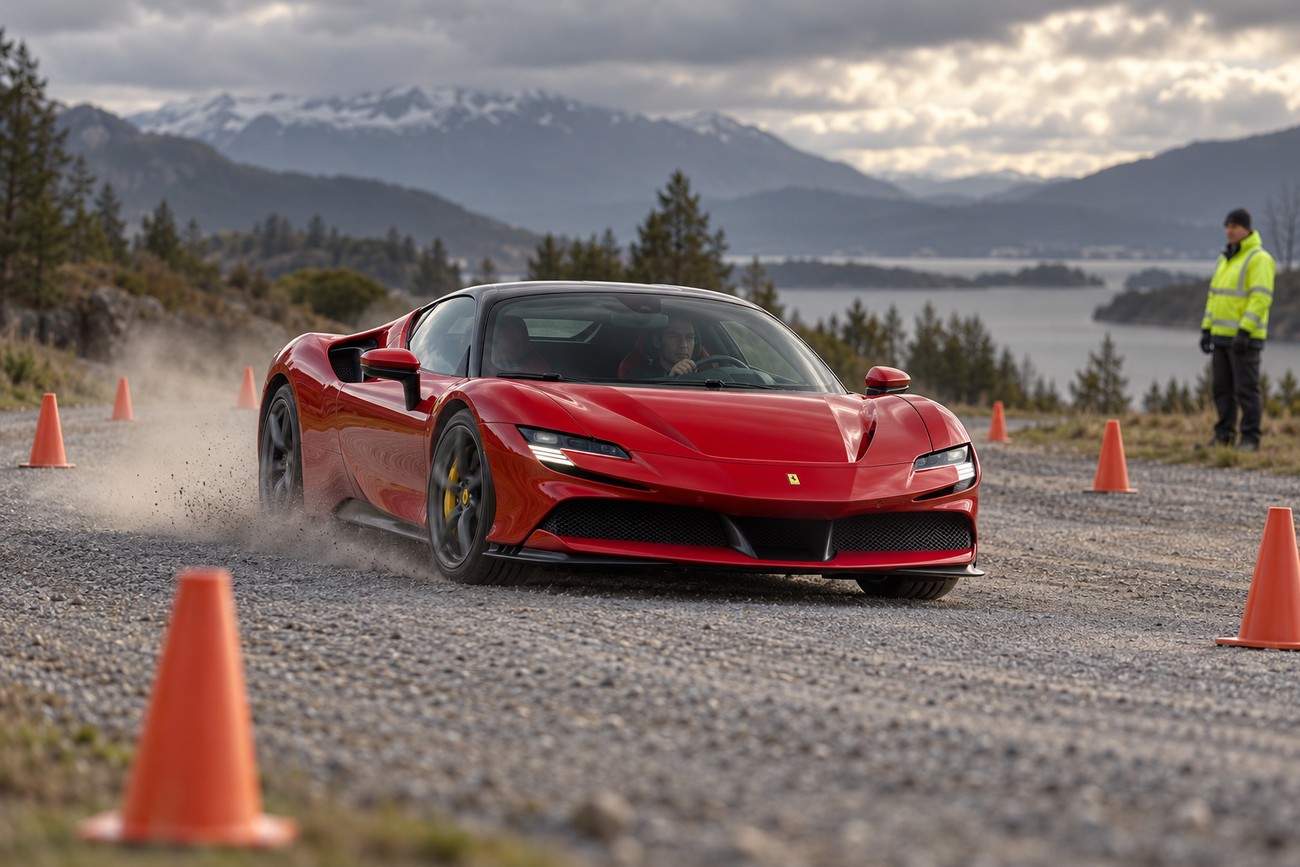
A controlled appearance should use a smooth, inspected surface with no significant ruts, jumps, or fields of exposed rock. The pace should remain low enough for the driver to respond to changing grip without relying on late braking or aggressive rotation. This lets the AWD system contribute to the spectacle while reducing the chance that the car’s road-focused hardware becomes the main story.
A timed stage is a fundamentally different proposition. Sustained competitive running adds repeated compression, braking loads, stone strikes, heat cycles, and rapid changes in grip. The AWD layout offers potential traction benefits, not a guarantee of grip or predictable handling on gravel, and Ferrari does not specify a dedicated gravel or rally drive mode for the SF90 Stradale.
Before any permitted low-speed demonstration, a responsible inspection should cover:
- the surface, including ruts, embedded rocks, loose-stone depth, and escape areas;
- tire type, condition, sidewall damage, and whether any alternative fitment is properly approved;
- visible clearance and the condition of the splitter, underbody, diffuser, and wheel-arch liners;
- radiator, intercooler, and other cooling openings for blockage or existing damage;
- a clear plan to stop after a hard impact, warning message, unusual smell, fluid leak, or change in handling.
Those checks reduce uncertainty; they do not remove the basic limitations of a low, heavy, asphalt-oriented hybrid supercar. The SF90 can be a memorable gravel guest when the route is prepared and the pace is restrained. A rough rally stage with jumps and competitive intent belongs to a car engineered, protected, and calibrated for that job.
Frequently asked questions
What should you do if an underbody strike might have damaged the hybrid system?
Stop safely, shut the car down according to its normal procedure, and keep people away from any visibly damaged high-voltage components, exposed wiring, smoke, fluid leakage, or unusual heat. Do not touch orange high-voltage cables, remove panels, or attempt to continue driving simply because the car still starts.
Arrange recovery and a qualified inspection covering the underbody, battery area, electric-drive hardware, wiring, cooling system, wheels, and tires. Event eligibility, insurance reporting, and repair authorization are separate decisions from whether the car appears capable of moving under its own power.







