
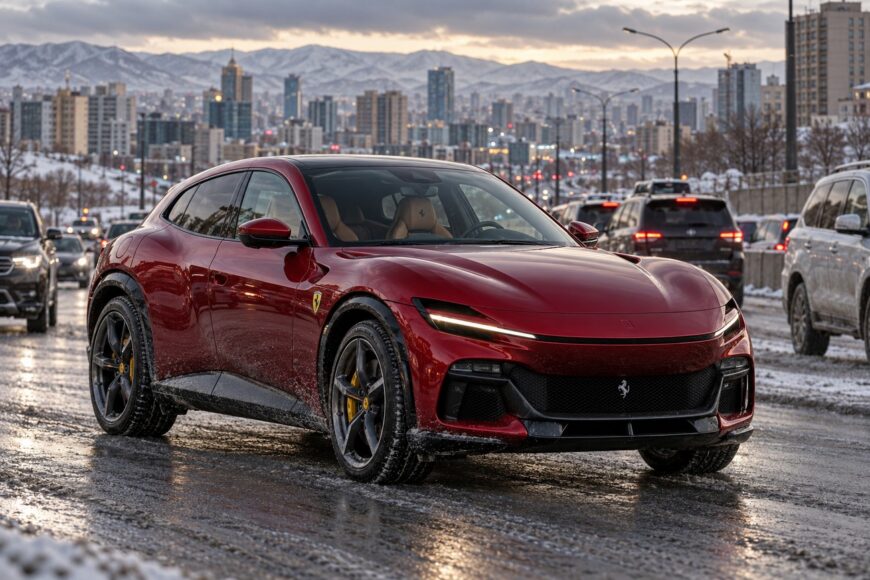
A Ferrari Purosangue on a Ulaanbaatar street would be an arresting sight: the Prancing Horse moving through snow and traffic, with the steppe beyond the city. Its presence could suggest a luxury transfer, an event vehicle, or simply a privately owned car passing through.
A sighting alone does not establish a working taxi service. Without an identifiable operator, a current booking channel, appropriate authorization, and commercial insurance, the idea of a bookable Purosangue taxi in Ulaanbaatar remains unverified. The Ferrari appeal is clear; the harder test is whether the vehicle can deliver a reliable paid ride through a severe winter and demanding streets.
- Is there actually a Purosangue taxi in Ulaanbaatar?
- A V12 Ferrari built for four seats, not a full taxi load
- What Ulaanbaatar’s winter changes
- The passenger experience beyond the photograph
- Why ordinary taxi fares would struggle to cover it
- The harder question: permission and dependable service
- Frequently asked questions
- What should I confirm before paying for an advertised Ferrari transfer?
- Why does Ferrari use a prancing horse on its badge?
- How much does a Ferrari horse cost?
- What car has a prancing horse logo?
Is there actually a Purosangue taxi in Ulaanbaatar?
An image, video, taxi label, or social-media post can show that a Ferrari was present in Ulaanbaatar. It cannot confirm that the car accepts passengers for payment. An operating service would need a traceable operator, a current way to book, and clear terms for pickup, payment, cancellation, and vehicle availability.
The legal and commercial side matters as much as the badge. Anyone considering a paid ride should check the applicable local passenger-transport requirements and commercial insurance rather than assuming that private ownership permits taxi work. The vehicle may be correctly registered for private use while remaining unsuitable for commercial passenger service.
Confirmation of a dependable ongoing service also requires more than a single successful booking. A credible service should be able to identify the exact vehicle, state who supplies the ride, and explain what happens if weather, a mechanical fault, or a delayed transfer makes the advertised car unavailable. Until those details can be independently checked, the Purosangue taxi premise should be described as unverified, rather than declared real or fake.
A V12 Ferrari built for four seats, not a full taxi load
The Purosangue is a four-door, four-seat, road-focused vehicle with a 6.5-liter V12. Its stated 0–100 km/h time is 3.3 seconds, which establishes the character of the car: this is a high-performance Ferrari designed to make rapid progress on suitable roads. Those figures have little practical value in city transport, where traffic, ice, pedestrians, and speed limits determine the journey.
Passenger capacity is more restrictive than the body shape may suggest. With a driver aboard, there is room for at most three passengers. That can work for a small executive transfer, while a larger family group or a passenger carrying bulky luggage would need a different vehicle.
The rear doors improve access compared with a two-seat sports car, yet they do not turn the cabin into a people mover. Rear-seat legroom, entry comfort, child-seat arrangements, and luggage space should be confirmed for the specific booking. A four-seat layout also means that the operator cannot maximize each trip in the way a conventional taxi or larger SUV can.
The dry weight is approximately 2,033 kg, and dry weight is not the same as an in-service taxi weight. Fuel, passengers, luggage, winter equipment, and road dirt all affect the real operating load. That mass helps explain why tires, brakes, suspension components, and fuel use deserve close attention in commercial service.
What Ulaanbaatar’s winter changes
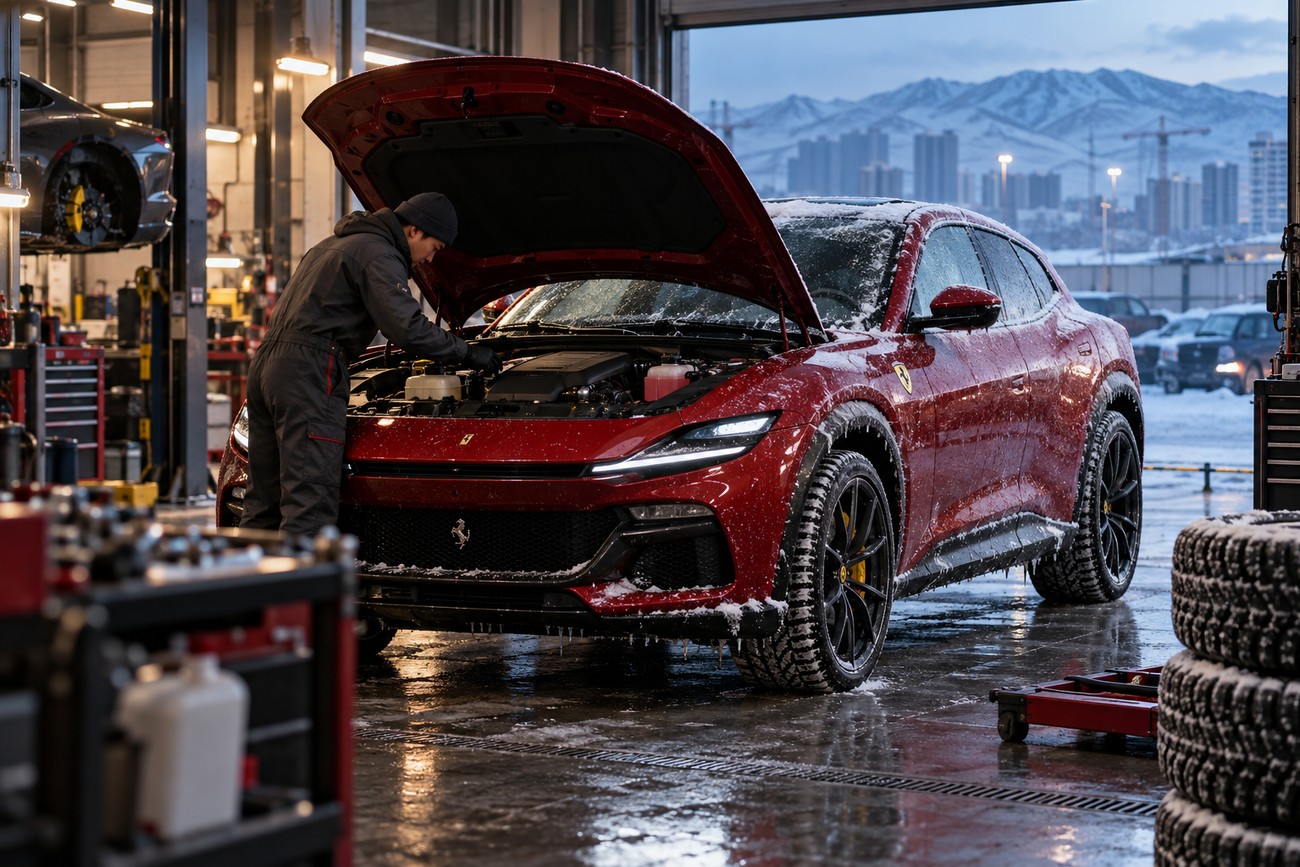
Severe cold shifts the priority from headline performance to basic operating readiness. Battery condition, fluid condition, visibility, and a suitable winter tire setup become central to whether the car can leave, stop, and complete a booking safely. Cold starts can also mean a longer period before the engine, cabin, and glass reach a useful operating condition, depending on the vehicle’s condition and the weather.
Tires carry much of the real winter responsibility. The correct winter design, load rating, speed rating, and condition need to match the car and the operating environment. Low-profile tires can be expensive and vulnerable on potholes, sharp road edges, ruts, and debris; a single impact may create damage that is inconvenient for a private owner and commercially disruptive for a taxi operator.
The Purosangue has adjustable active suspension, but that does not make it an unrestricted off-road vehicle. It remains a road-focused Ferrari with limits imposed by clearance, wheel and tire vulnerability, braking conditions, and the geometry of damaged roads. Traction can help the car move; it cannot remove the risk of an underbody strike, a tire failure, or an icy stopping distance.
Route planning therefore matters. A vehicle used for premium transfers would need to avoid poorly surfaced alleys, construction zones, deep ruts, and uncertain access points where possible. Winter grime, salt, and slush can also undermine the visual appeal that customers expect from a Ferrari, while tire noise, road impacts, fogging, and slow cabin warm-up may make the experience less theatrical than the photograph suggests.
The passenger experience beyond the photograph
Arriving in a Ferrari can be the purpose of the journey, especially for an event, celebration, photo session, or pre-arranged executive transfer. The passenger may value the car’s rarity, the V12 soundtrack, and the feeling of being collected in something far outside the normal taxi fleet. That value depends on a smooth, well-managed service rather than acceleration figures.
A punctual transfer still requires ordinary transport discipline. The operator must know the pickup location, allow for winter traffic, choose a route that the car can use comfortably, and communicate if weather or road conditions change. Smooth driving is particularly important because passengers may be dressed for an event, carrying luggage, or unfamiliar with the vehicle’s firm responses over damaged surfaces.
Bad weather can expose practical compromises. A dirty exterior, snow around the doors, winter-tire noise, and attention from pedestrians or other drivers may be acceptable for an enthusiast but inconvenient for a passenger trying to reach a meeting. The car’s visibility can also create delays when people stop to photograph it or ask questions.
These conditions favor a pre-booked premium transfer or event service over unpredictable street hails. A scheduled ride gives the operator time to inspect the vehicle, select a workable route, confirm passenger and luggage needs, and set expectations. It also gives the customer a chance to decide whether the experience is worth accepting the four-seat cabin and winter operating compromises.
Why ordinary taxi fares would struggle to cover it
The business case starts with the cost of every available passenger seat. A driver leaves at most three passenger places, and some trips may carry only one or two people. If the car spends time waiting between bookings, its fixed costs continue while its limited seating capacity produces little additional revenue.
Fuel is only one part of the calculation. High-performance tires, brake components, suspension parts, specialist diagnostics, original replacement parts, insurance, cleaning, and recovery all affect the cost of a working kilometer. Winter use adds exposure to potholes, road debris, salt, cold-start demands, and accidental damage.
Maintenance downtime is especially important. A private owner may tolerate waiting for a part or arranging a specialist appointment; a passenger service has to cancel or replace bookings. Even a repairable fault can keep the car out of service if the required diagnostic capability, component, or qualified repair facility is not immediately available.
That makes conventional taxi pricing a poor assumption. A scheduled premium transfer can charge for the vehicle’s limited capacity, preparation, risk, and exclusivity. Trying to compete with ordinary taxi rates would leave little room for the costs of keeping a V12 Ferrari safe, clean, insured, and available through winter.
The harder question: permission and dependable service
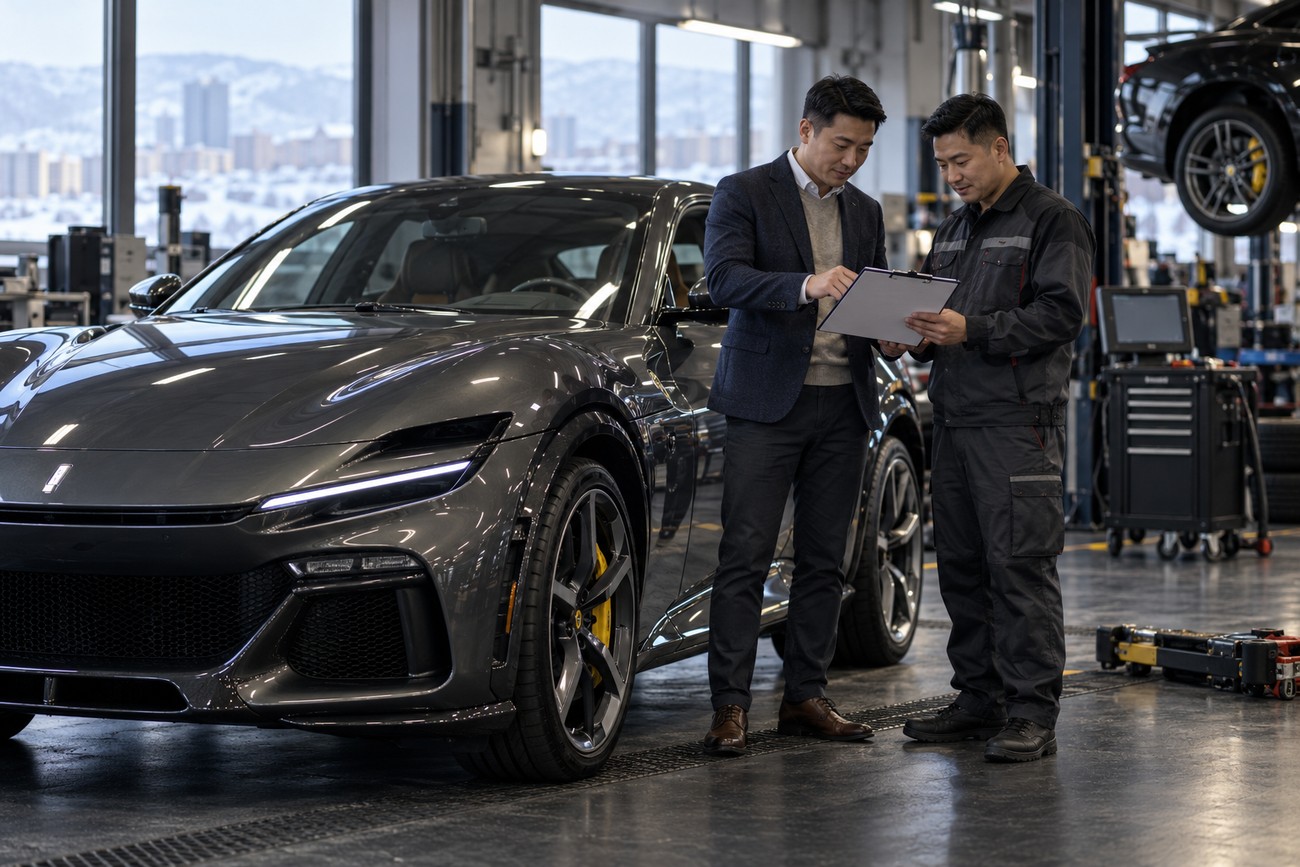
Owning a Purosangue does not automatically authorize paid passenger transport. A prospective operator should verify current local rules, commercial insurance requirements, any applicable licensing or marking provisions, and the way fares must be disclosed. Those obligations can change, so they need confirmation from the relevant local authorities and insurers before advertising rides.
Operational planning should continue beyond paperwork. The service needs access to suitable diagnostics, technicians familiar with the vehicle, original parts, approved tire replacements, and a recovery provider able to handle a heavy, low-volume performance vehicle. A roadside solution designed for an ordinary sedan may be unsuitable or damaging.
A dependable service also needs a replacement policy. If the Ferrari becomes unavailable, the operator should state whether the customer receives a refund, another premium vehicle, or a rescheduled trip. This is particularly important for weddings, airport connections, and events, where the timing matters as much as the car.
The most plausible model is therefore a carefully scheduled premium transfer or event service, rather than mass-market taxi operation. That is an operating assessment, not confirmation that such a service currently exists in Ulaanbaatar. Any advertisement should be judged by evidence of authorization, insurance, vehicle availability, and a credible plan for winter downtime.
Frequently asked questions
Before booking, the key distinction is between seeing a Ferrari and confirming an available, authorized transfer. The questions below cover what to check before paying and what the Prancing Horse badge actually tells you. They also clarify why the emblem itself has no standard ride price.
What should I confirm before paying for an advertised Ferrari transfer?
Confirm the exact vehicle, the operator’s identity, the pickup time and location, the number of passengers, and the luggage arrangement. Ask whether the advertised Purosangue is guaranteed or may be replaced, and request a current booking confirmation rather than relying on an old photograph or social-media post.
Read the cancellation and refund terms before paying. It is also reasonable to ask for evidence that the ride can be supplied commercially, including applicable authorization and insurance. A sighting proves that a Ferrari was present; it does not prove that a bookable taxi service exists.
Why does Ferrari use a prancing horse on its badge?
The Ferrari badge’s prancing horse is associated with Italian World War I pilot Francesco Baracca. Ferrari’s historical account says Baracca used the horse on his aircraft, and that his family later suggested the symbol to Enzo Ferrari. Ferrari adopted it with a yellow background associated with Modena, the company’s home city.
The horse is therefore a brand emblem with an aviation and local connection, rather than a reference to the Purosangue’s SUV shape. Its appearance on a car identifies Ferrari; it says nothing by itself about taxi licensing, commercial insurance, or the vehicle’s winter readiness.
How much does a Ferrari horse cost?
The Prancing Horse emblem is not a separate transport product with a standard public fare. Its value is included in the Ferrari vehicle and brand, while the price of a transfer depends on the operator, route, duration, terms, and vehicle availability.
For an advertised ride, ask for a complete quote before payment. The quote should state what is included, how long the vehicle is reserved, the passenger limit, and what happens if the Purosangue cannot operate on the scheduled date.
What car has a prancing horse logo?
Ferrari road cars carry the Prancing Horse logo. The Purosangue is one of them, alongside Ferrari’s sports cars and other road models. The emblem identifies the marque, while the Purosangue itself is a four-door, four-seat, road-focused vehicle with a 6.5-liter V12.
A Ferrari badge does not mean that every car is suitable for the same use. For a Ulaanbaatar transfer, the relevant questions remain the particular vehicle, its tires and condition, the route, the operator’s authorization, and the service plan if winter conditions cause a delay.







