
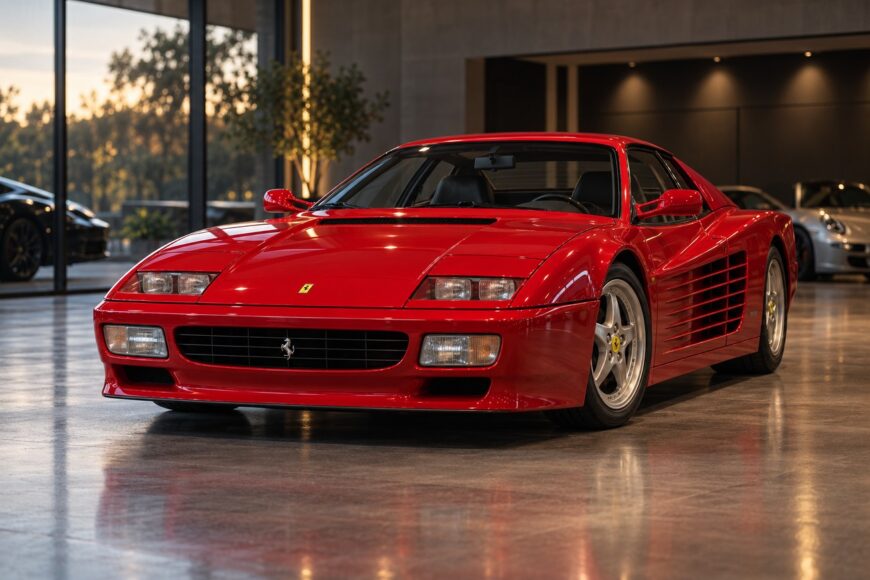
The Ferrari F512 M has a compelling place in the Testarossa story: it is the final evolution of the line. That status also raises the cost of buying the wrong example. A car can look carefully preserved while hiding deferred servicing, aging hoses, or hard-to-source parts; low mileage alone settles none of those concerns.
Produced from 1994 to 1996, the F512 M brought more power and a distinct new appearance to the 512 TR’s underlying design. Its familiar proportions and manual, rear-wheel-drive layout remain central to the appeal. For a prospective owner, the difference between a rewarding final edition and an expensive project lies as much in documented care as in the specifications.
- The final chapter of the Testarossa
- A new face on a familiar chassis
- What changed beneath the bodywork
- Ferrari F512 M specifications: figures and caveats
- How the final Testarossa feels to drive
- Buying one: where rarity becomes a liability
- Frequently asked questions
- How much is a Ferrari F512 M worth?
- How many Ferrari F512 Ms were made?
- What does the M in F512 M stand for?
The final chapter of the Testarossa
The F512 M followed the original Testarossa and the 512 TR, completing a sequence that began with Ferrari’s broad, flat-12 grand tourer. Ferrari calls the 1994–1996 car the final evolution of the Testarossa family. That description matters: the M developed an established design rather than introducing an entirely new platform.
Its place at the end of the line gives it an identity beyond its mechanical changes. Buyers seeking a late Testarossa encounter a car with a substantially revised appearance and the strongest quoted engine output of the three, while retaining the family’s recognizable layout. The result appeals to collectors who value a clear model lineage as well as a particular shape.
Limited production adds interest, but rarity has practical consequences. There are fewer cars against which to judge originality and fewer replacement trim or body components to choose from when something needs repair. A well-documented example therefore offers more than reassurance about past maintenance: it provides a reference for what remains original.
A new face on a familiar chassis
The F512 M’s revised front and rear lighting, bumpers, and wheels make it readily distinguishable from a 512 TR. Those changes give the last version a different visual character without erasing the wide, low proportions that identify the family. They also make correct replacement parts especially relevant after accident damage or an earlier restoration.
Under that revised body, the 2,550 mm wheelbase was retained from its predecessors. The steel tubular chassis remained closely related in construction, so the fresh appearance should not be read as evidence of a clean-sheet car. For an owner, that continuity makes specialist knowledge of the wider Testarossa family useful during inspection and servicing.
Visual changes deserve closer scrutiny on a rare model than they might on a more common used car. Wheels, lighting, paintwork, and bumper fit can reveal earlier repairs or substitutions, although none proves a problem on its own. Compare what is fitted with the car’s records before treating an attractive presentation as proof of originality.
What changed beneath the bodywork
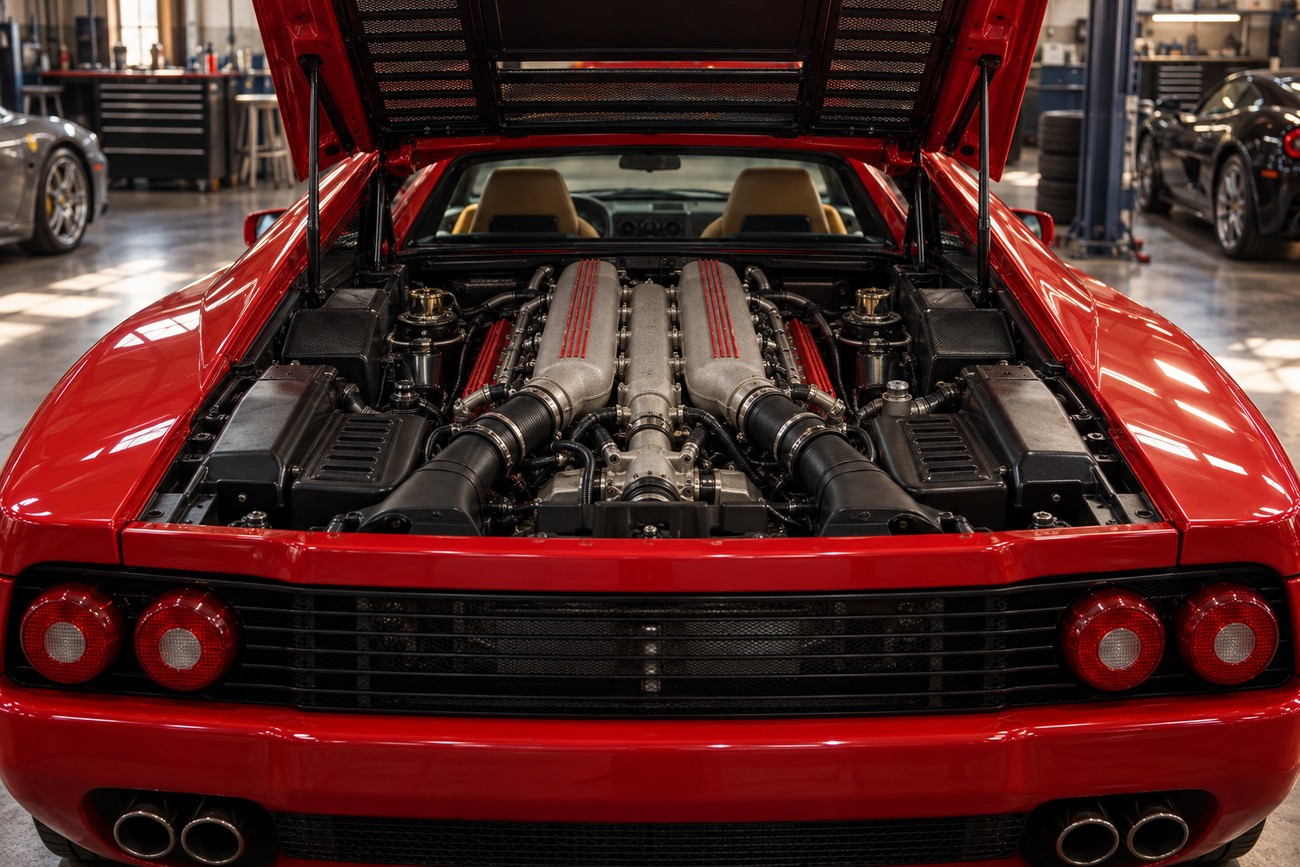
The F512 M uses the naturally aspirated, longitudinally mounted Tipo F113 G flat-12. It displaces 4,943 cc, with an 82 × 78 mm bore and stroke, and has four valves per cylinder. Output rose over the 512 TR to 440 PS at 6,750 rpm, with 500 Nm of torque at 5,500 rpm.
That 440 PS figure is metric horsepower, equivalent to approximately 434 mechanical hp. Describing the car as having 440 hp without identifying the unit creates a small but avoidable specification error. The flat-12 description likewise identifies the cylinder layout; it should not be taken to mean that its construction or firing arrangement matches every racing engine described as a “boxer.”
A dry sump, five-speed manual transmission, and rear-wheel drive preserve the mechanical character buyers expect of the line. The dry-sump system belongs in any serious condition assessment, alongside the engine’s cooling, ignition, and fuel systems. A smooth idle is encouraging, but it says little about how all those systems behave under load or after a sustained run.
Ferrari F512 M specifications: figures and caveats
These figures use different sources and measurement bases. Read the qualification alongside each number, especially for weight and performance.
| Specification | Figure | Qualification |
|---|---|---|
| Engine | 4,943 cc Tipo F113 G flat-12 | Naturally aspirated; longitudinally mounted |
| Output | 440 PS at 6,750 rpm | Approximately 434 mechanical hp |
| Torque | 500 Nm at 5,500 rpm | Engine specification |
| Weight | Approximately 1,470 kg dry; approximately 1,631 kg kerb | Different measurement bases; not directly comparable |
| Top speed | Approximately 315 km/h | Commonly quoted; not confirmed on the cited Ferrari model page |
| 0–100 km/h | Approximately 4.7 seconds | Commonly quoted; not confirmed on the cited Ferrari model page |
How the final Testarossa feels to drive
The engine’s output, five-speed manual gearbox, and rear-wheel drive describe a car that asks its driver to take an active part. They do not, by themselves, predict the feel of a particular example. Clutch condition, gearshift adjustment, tires, and suspension condition can all change the impression before any comparison with a published performance figure becomes meaningful.
Owners report that substantial clutch effort, long gearing, and a stiff shift can make slow urban journeys tiring. Those traits are worth assessing on a proper drive rather than dismissing as period character or assuming they indicate a fault. A specialist can help separate normal effort from a car that needs adjustment or repair.
The low front overhang and long body also demand attention around curbs, steep ramps, and uneven roads. This is a practical limitation for someone planning regular use, regardless of how well the car performs on an open road. The final Testarossa evolution offers a distinctive analog driving experience, but its layout and age do not make it a modern daily driver.
Buying one: where rarity becomes a liability
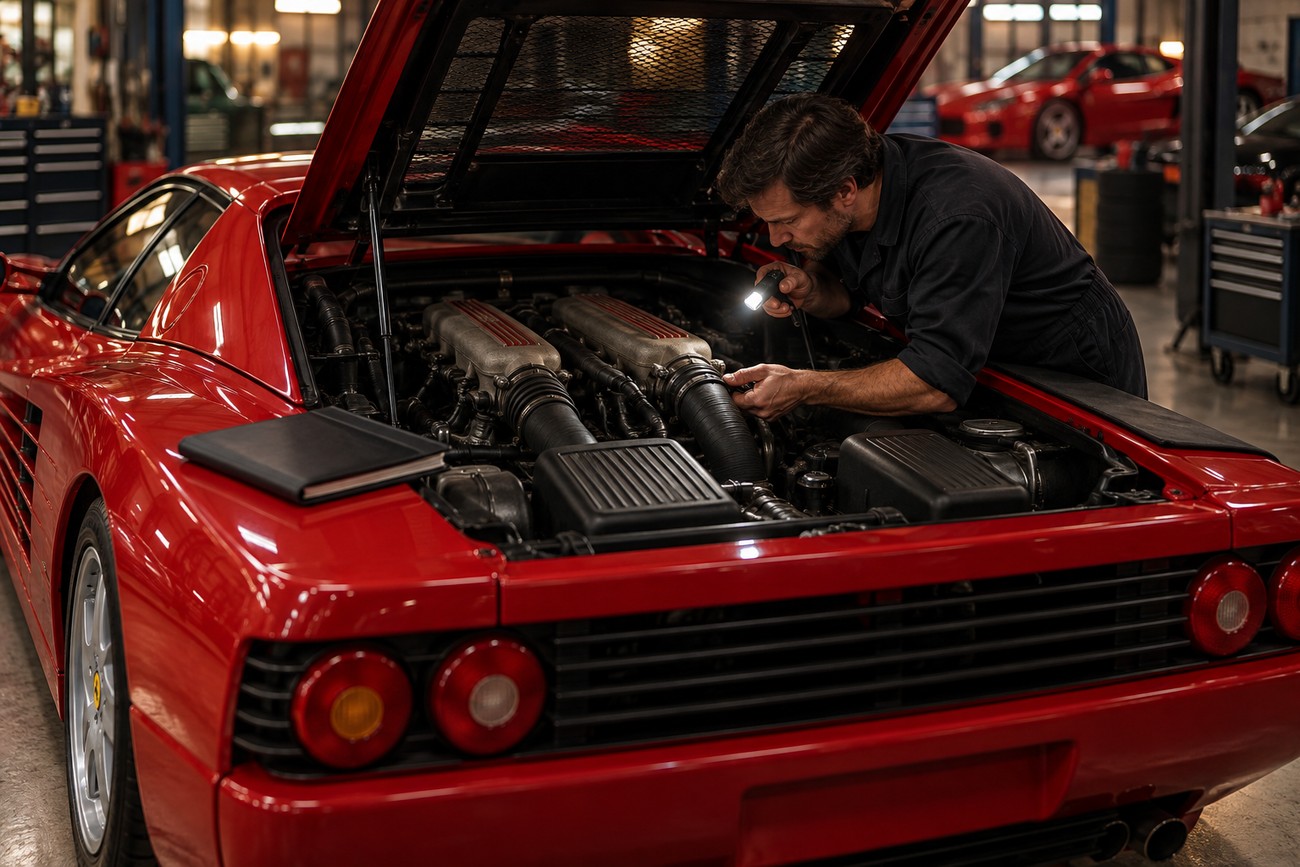
Start with service invoices and a history that identifies the work done, rather than a folder that merely shows visits to a workshop. Check for evidence of regular major work and ask a specialist familiar with the Testarossa family to inspect the car before purchase. Engine access and specialist labor can make even planned servicing expensive, so gaps in the record have financial weight.
Age-sensitive items deserve their own inspection. Fuel and vacuum hoses, seals, and other rubber components can deteriorate while a car covers little distance; cooling and fuel systems need checks beyond a brief start-up. The dry-sump system, ignition, and evidence of leaks also warrant specialist attention.
Electrical faults may be intermittent, making instruments, relays, and connections important to test rather than simply glance at. Then establish the originality and condition of the bodywork, cabin, wheels, and exhaust against records where possible. On a limited-production car, reversing an undocumented change may depend on finding a scarce correct part.
Before ordering replacements, confirm compatibility by VIN and destination market; cars sharing the F512 M name need not have identical specifications in every market. Allow for baseline servicing after purchase, even if the car has been stored carefully or used sparingly. That allowance gives you room to address fluids, rubber, and other time-sensitive items before relying on the car.
Frequently asked questions
The F512 M’s rarity makes precise claims attractive, but numbers and names need context. For valuation, production totals, and the model designation, use evidence that can be checked rather than a confident figure repeated without a source.
How much is a Ferrari F512 M worth?
A defensible valuation starts with recent comparable sales in the relevant market, then adjusts for provenance, originality, condition, and documented work. An asking price alone does not show what a similar car sold for, and a cheaper example may need substantial servicing or scarce original parts. Compare the records and inspection findings as closely as the advertised mileage.
How many Ferrari F512 Ms were made?
Production is reported as either 500 or 501 cars; 501 is frequently cited, but the cited Ferrari model page confirms neither total. If an exact count matters to a purchase, publication, or registration record, seek a traceable source for the figure rather than treating its repetition as confirmation.
What does the M in F512 M stand for?
The M stands for Modificata, meaning “modified.” It suits a car with revised styling and increased power that remains an evolution of the 512 TR. The designation should not be read as evidence of an entirely new chassis or a clean-sheet replacement for the Testarossa family.







