
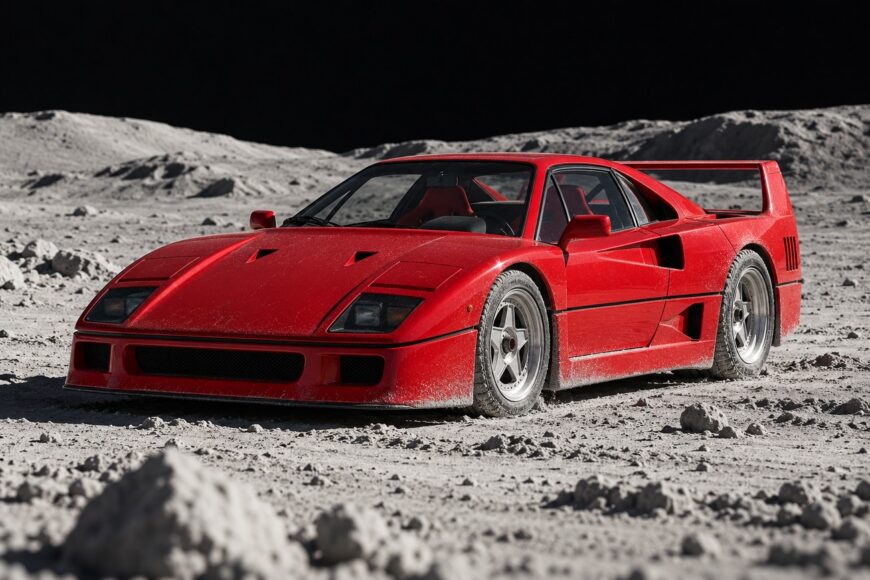
A Ferrari F40 crossing pale lunar regolith makes a striking image: a low nose, a broad rear wing, and dust trailing behind a twin-turbo legend. The engineering picture is less forgiving. This lightweight road car was built for atmospheric air, air-assisted cooling, and pavement, while the Moon offers practically no surface atmospheric pressure and exposes machinery to abrasive dust.
The real Ferrari F40 is documented. No official Ferrari documentation confirming an “F40 Moon Race” project was found, so a render or evocative name should be treated as a concept rather than a factory variant. The useful test is whether the F40’s defining systems could function in the lunar environment.
- What Is Real About the Ferrari F40 Moon Race?
- Why the F40’s Twin-Turbo V8 Cannot Simply Run on the Moon
- Low Gravity Does Not Turn an F40 Into a Faster Race Car
- Regolith, Seals, and Thermal Cycling: The Hidden Failure Points
- Earth-Born F40 vs. Lunar Operating Reality
- What a Real Lunar F40 Conversion Would Actually Need
- The Verdict: Iconic F40, Unworkable Moon Car Without a New Vehicle
- Frequently asked questions
- What is the rarest Ferrari F40 color?
- What car is a poor man’s Ferrari?
- How much is a Ferrari F40 worth today?
- How many F40s are left?
What Is Real About the Ferrari F40 Moon Race?
The Ferrari F40 is a road-going, mid-engine, rear-wheel-drive sports car. Its 2.936-liter twin-turbocharged V8 has a claimed output of 478 hp, and the production car has a mass of approximately 1,100 kg. Those figures describe an Earth vehicle, where its engine can draw in air and its tires can press against a paved road.
Ferrari’s documented construction includes composite body panels, a steel spaceframe, and independent double-wishbone suspension. Those details help explain the F40’s appeal as a lunar visual concept: it already looks spare, purposeful, and mechanically exposed. They do not establish that its materials or suspension were qualified for vacuum, regolith, or lunar temperature cycles.
“F40 Moon Race” is therefore a label to handle carefully. An image can show how a lunar F40 might look, but it cannot demonstrate a working powertrain, validated seals, or a Ferrari-backed project. Separating the documented car from the speculative conversion makes the engineering problems easier to assess.
Why the F40’s Twin-Turbo V8 Cannot Simply Run on the Moon
The F40 engine is designed to operate with atmospheric air. The Moon has practically no atmospheric pressure at the surface, leaving a conventional intake without the air supply needed for ordinary fuel combustion. Opening the throttle would not solve a missing reactant.
A turbocharger compresses an existing gas flow; it does not create oxygen. A combustion-powered lunar vehicle would need a stored oxidizer and a system designed to meter it alongside fuel. That changes the intake, combustion controls, storage, and safety requirements far beyond a turbocharger adjustment.
Heat creates a separate obstacle. On Earth, moving air helps carry heat away from the engine and brakes. In vacuum, heat must be rejected primarily through radiation rather than ordinary convection, requiring a thermal system sized and positioned for that job.
Lubrication and material compatibility would also need review. Oils, seals, and other components selected for road use cannot be assumed to retain their properties through vacuum exposure and severe temperature cycling. By the time oxidizer storage, thermal control, and compatible moving parts were integrated, the result would be a substantially new propulsion system inside—or behind—an F40-inspired shape.
Low Gravity Does Not Turn an F40 Into a Faster Race Car
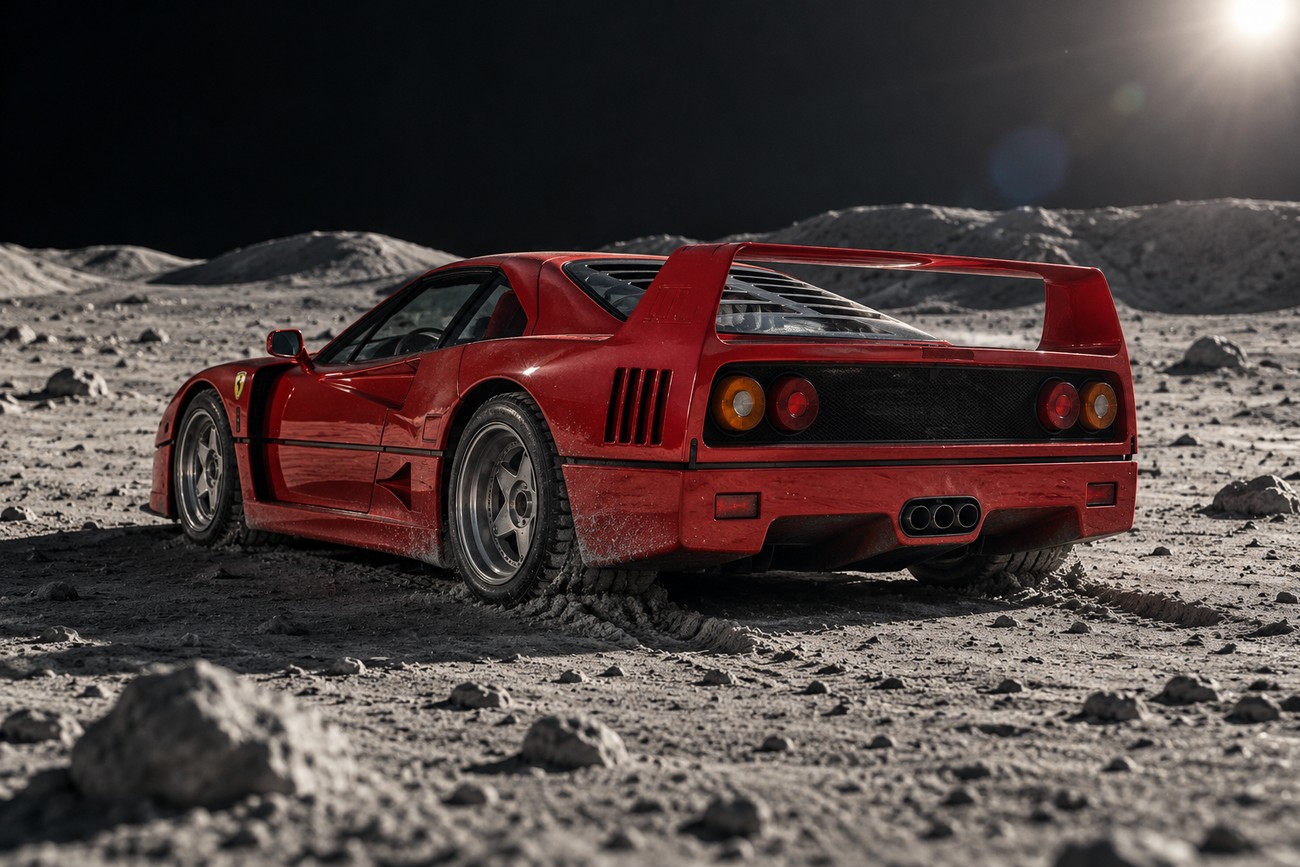
Lunar surface gravity is approximately 1.62 m/s², or about one-sixth of Earth gravity. The F40 would weigh much less there, but its inertial mass would remain approximately 1,100 kg. Its engine or brakes would still have to accelerate or slow that mass.
A tire’s available driving and braking force depends partly on how firmly the surface presses back against it. Lower normal force reduces available tire traction and braking force, while inertial mass remains unchanged. More power would be of little use if the driven wheels could not transfer it to the ground.
The F40’s aerodynamic bodywork loses most of its downforce function without a dense atmosphere. Vacuum removes air resistance, but it also removes the airflow that helps press a fast road car onto its tires. Earth acceleration, braking, cornering, and top-speed figures cannot simply be carried over to a lunar course.
Rough ground compounds the problem. Reduced gravity can let a wheel leave the surface more easily after a bump, interrupting both propulsion and steering. Suspension designed around road loads offers no guarantee that the car would settle predictably onto uneven regolith.
Regolith, Seals, and Thermal Cycling: The Hidden Failure Points
Typical lunar regolith particles are approximately 40–800 micrometers in size. Abrasive dust at moving interfaces threatens bearings, brakes, joints, and seals; any exposed intake machinery would need protection as well. Road-car dust boots and seals were not designed as a lunar contamination-control system.
Temperature protection cannot be reduced to a single heat shield. Lunar surface temperatures can range approximately from 93 K at night to 396 K in sunlit equatorial conditions, while permanently shadowed polar regions can reach approximately 43 K. Components would face different conditions depending on location, exposure, and operating time.
The ground below the surface adds another design wrinkle. At depths of 10–20 cm, regolith bulk density is approximately 1,500–1,800 kg/m³ with 35–45% porosity. Regolith’s insulating behavior means a surface-temperature reading alone cannot describe the conditions around a partly buried wheel or component.
Vacuum and temperature cycling can affect lubricants, rubber, adhesives, and composite materials. A credible design would test those materials and protect their interfaces, rather than assume that the F40’s road-proven parts would remain dependable after exposure.
Earth-Born F40 vs. Lunar Operating Reality
The comparison shows why replacing the tires alone would leave the central failures untouched.
| Earth design assumption | Lunar condition | Engineering consequence |
|---|---|---|
| The V8 draws atmospheric intake air. | The surface has practically no atmospheric pressure. | Combustion requires a stored oxidizer and major propulsion redesign. |
| Air assists engine and brake cooling. | Ordinary convection is unavailable in vacuum. | Heat rejection needs a system designed primarily around radiation. |
| Aerodynamic bodywork works in moving air. | There is no dense atmosphere. | Most aerodynamic downforce is lost. |
| Road tires and suspension operate under Earth gravity. | Gravity is approximately 1.62 m/s², while inertial mass is unchanged. | Reduced normal force limits traction and braking; rough ground challenges wheel contact. |
| Road seals protect moving parts from terrestrial contamination. | Abrasive regolith reaches exposed interfaces. | Seals, filtration, and protected joints need redesign. |
| Materials operate within road-car environmental limits. | Vacuum and severe temperature cycling affect exposed components. | Lubricants, rubber, adhesives, and composites need qualification. |
What a Real Lunar F40 Conversion Would Actually Need
A credible vehicle could retain F40 styling or some chassis heritage, but its systems architecture would start with a power-source decision. Keeping combustion means carrying an oxidizer and redesigning the propulsion system around it. An alternative energy source could avoid atmospheric intake, though it would introduce its own storage and power-management demands.
Next comes thermal control. Radiators designed to reject heat by radiation would need paths for heat from the powertrain, electronics, and brakes. Packaging them around familiar F40 bodywork would be an engineering constraint, rather than a cosmetic detail.
Regolith control would require redesigned seals, filtration, and protected moving interfaces. Wheels and suspension would have to address low gravity, rough terrain, and abrasive particles together. Lunar tires and reinforced suspension alone would leave the power, cooling, and contamination problems unresolved.
An operational vehicle would also need navigation, communications, radiation protection, and energy management. If humans were to ride in a pressurized environment, that environment would need its own design; an exposed F40 cabin is not one. Each added system moves the project further from a road-car conversion and closer to a purpose-built lunar vehicle.
The Verdict: Iconic F40, Unworkable Moon Car Without a New Vehicle
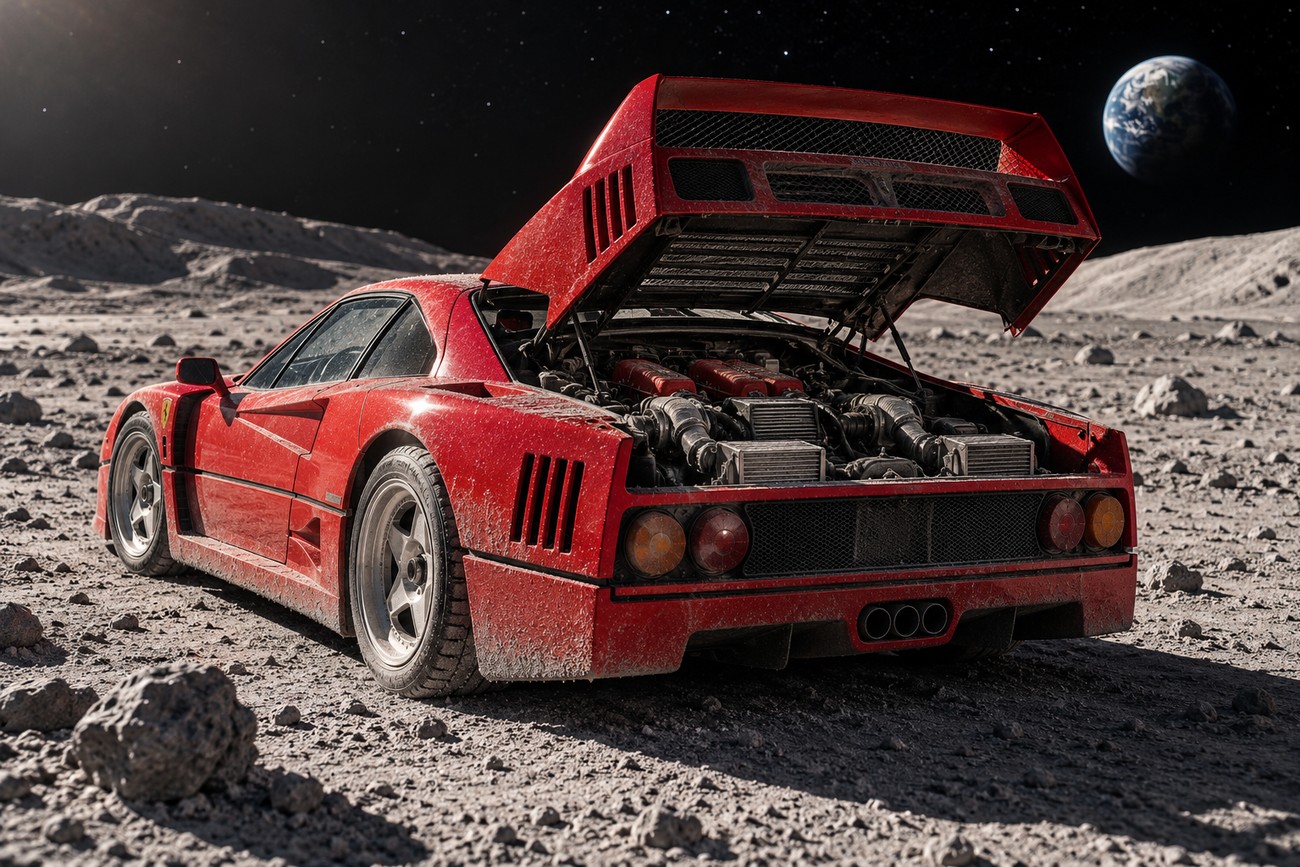
The F40 is a compelling visual and cultural starting point for a lunar concept. The stock car, however, cannot operate normally in the lunar vacuum. Its twin-turbo V8 lacks atmospheric oxygen, and its road-car cooling and protection systems do not address the environment.
The decisive blockers are heat rejection, regolith intrusion, and reduced traction as well as propulsion. Low gravity reduces weight without reducing inertial mass, so it offers no automatic racing advantage. A wing-shaped silhouette cannot restore downforce where there is scarcely any air.
The real Ferrari F40 remains documented; an official “F40 Moon Race” project remains unconfirmed by the available Ferrari documentation. A functioning version would be a new lunar vehicle wearing a recognizable design, with success measured by whether its propulsion, radiators, seals, wheels, and controls survive the course.
Frequently asked questions
These common F40 questions concern the road car, rather than evidence for a lunar edition. Color, value, and survival claims all depend on careful definitions and documentation.
What is the rarest Ferrari F40 color?
There is no reliable single “rarest F40 color” answer without defining whether the question concerns original factory paint or later repaints. Red is closely associated with the production F40; an unusual color seen in a photo does not establish how the car left the factory. Chassis-specific documentation is the useful evidence when judging a particular example.
What car is a poor man’s Ferrari?
“Poor man’s Ferrari” is an informal comparison, not an official car category or a specific model. People may use it for a more accessible sports car with mid-engine proportions or Italian styling, but the phrase says little about its construction or performance. It should not be used to identify an F40 variant, lunar or otherwise.
How much is a Ferrari F40 worth today?
An F40’s current value depends on the individual car’s provenance, condition, originality, service history, and the market in which it is sold; a single unsupported figure would be misleading. A credible estimate calls for recent comparable transactions and an inspection of the specific car. A lunar-themed render does not, by itself, establish a separate factory model or its value.
How many F40s are left?
There is no dependable current survivor count in the information available here. A total would need to distinguish documented surviving cars from cars that are merely registered, publicly photographed, or offered for sale; some may be stored or undergoing restoration. An apparent count of visible cars is therefore not a verified count of all remaining F40s.







