
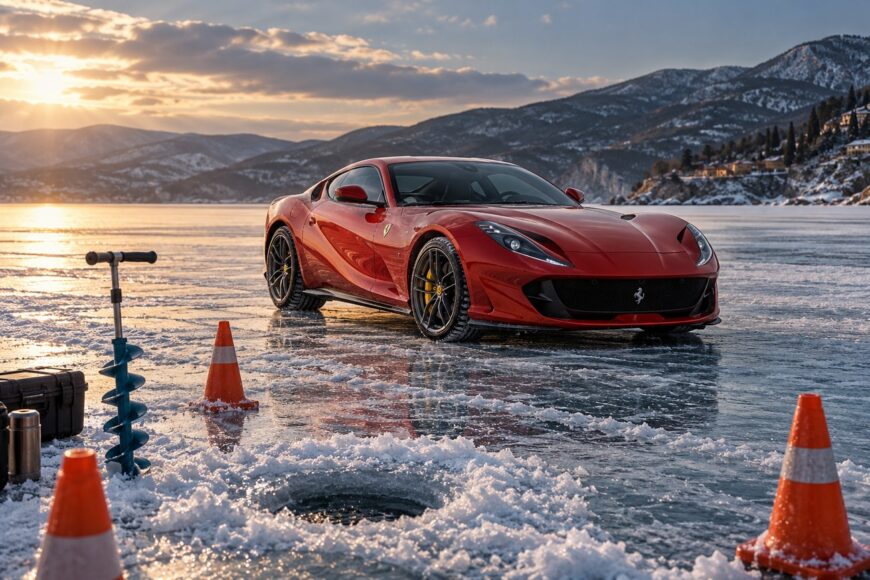
The Ferrari 812 Superfast has approximately 789 mechanical hp, yet on untreated ice, its rear tires may struggle to transmit even a small fraction of that power. The image of a V12 coupe against a frozen lake is arresting. The less visible question is whether the surface beneath it could safely carry the car, let alone a crew and its equipment.
Lake Abrau, near the Black Sea coast, supplies a striking setting for that image. The supplied facts, however, do not establish that a particular 812 Superfast drove there, or document a driver, date, ice survey, or filming setup. Treating the scene as a proposed shoot rather than a verified drive makes the real requirements clearer: assessed ice, lawful access, suitable equipment, and a plan for what happens if conditions change.
- A V12 spectacle, not proof of a lake run
- Lake Abrau is not the Black Sea—and ice needs evidence
- What a heavy GT asks of natural ice
- Why 789 hp cannot buy traction
- What an organized ice shoot keeps out of frame
- The decision before any wheels reach the lake
- Frequently asked questions
- What should an owner ask an insurer before an ice shoot?
- What should be inspected after a winter filming session?
- How much is a Ferrari 812 Superfast worth?
A V12 spectacle, not proof of a lake run
The 812 Superfast’s naturally aspirated 6.5-liter V12 produces 800 CV, approximately 789 mechanical hp, at around 8,500 rpm. Its long hood, rear-wheel-drive layout, and high-revving engine make an unusual pairing with a white, apparently empty lake. The visual tension comes from putting a road-focused grand tourer in a place where power offers little advantage.
It is also a substantial car. Quoted mass is roughly 1,630–1,750 kg, depending on specification and measurement basis; that range is not a measurement of any particular 812. Its weight matters to an ice assessment, while rear-wheel drive matters to how readily the driven tires can lose traction.
A photograph can establish that a car was present at a location only if its origin is reliable. It cannot, by itself, establish that the car drove across the lake, how far it traveled, or what precautions were taken outside the frame. No specific Lake Abrau driving event is verified by the supplied facts, so a speed, drift, driver, or eyewitness impression would be conjecture.
The V12 remains the story’s vivid mechanical centerpiece. Hearing it under load on a verified, managed course would describe a driving event; picturing it above Lake Abrau describes a possibility. That distinction matters when an appealing image could otherwise be mistaken for evidence that the route was safe.
Lake Abrau is not the Black Sea—and ice needs evidence
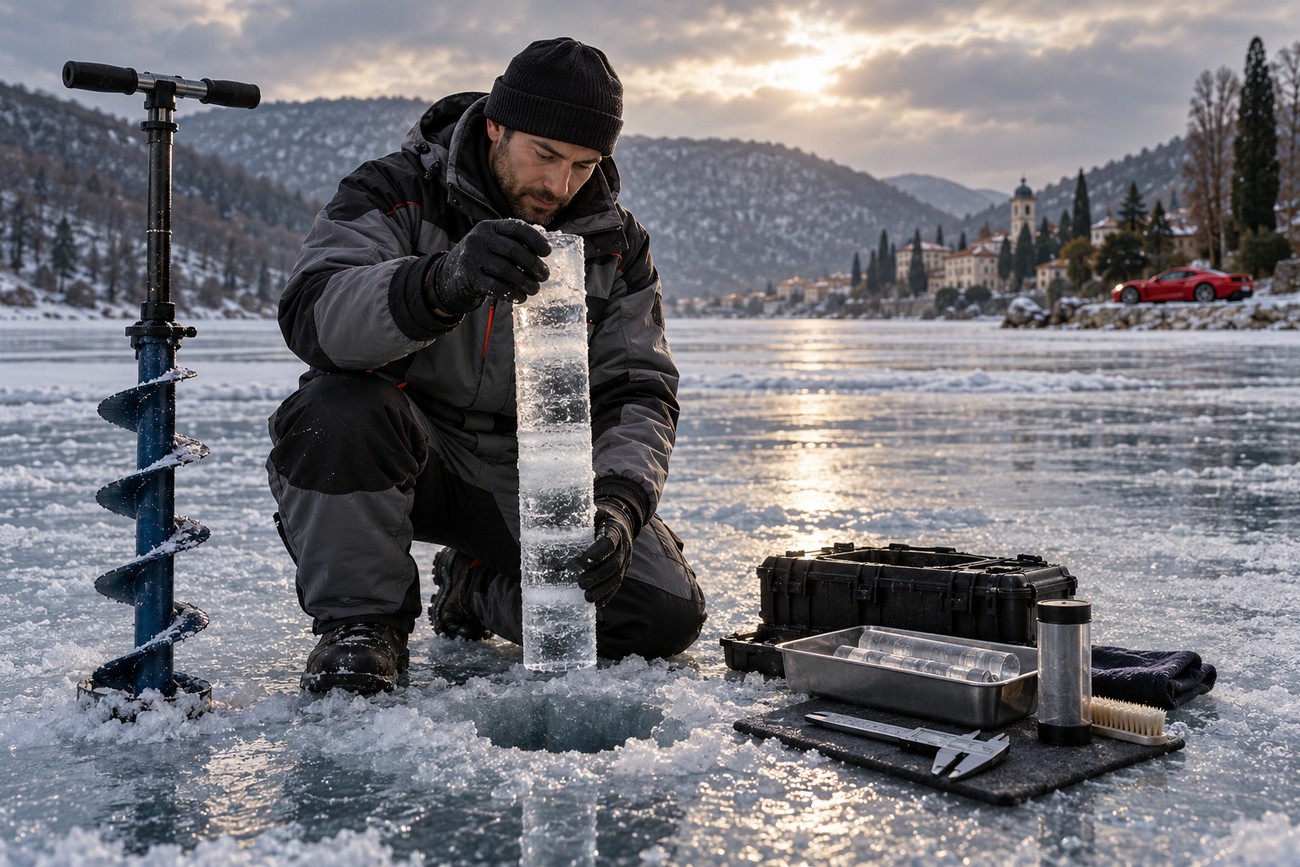
Lake Abrau is an inland lake near the Black Sea coast. “Black Sea ice” works as a geographical shorthand for the setting, not as a claim that the 812 would be driving on frozen seawater. The difference matters because the relevant questions concern a particular lake surface at a particular time, rather than a region’s winter appearance.
Natural-lake ice has no automatically certified capacity for a vehicle. A pedestrian crossing, footprints, or an unbroken expanse visible from shore tells little about the route a heavy car would take. Ice can vary across short distances, especially around cracks, weak layers, and places where water moves beneath it.
Recent weather adds another uncertainty. A thaw can weaken or layer ice even when the surface still looks wintry; renewed cold does not necessarily restore a uniform sheet. A site-specific assessment would need to address those local differences and the intended vehicle load, rather than rely on a photograph or a single reassuring observation.
Nothing in the supplied information establishes current conditions at Lake Abrau or whether vehicle access is permitted. Those are separate matters to verify locally before planning any activity. A frozen-looking shoreline is a setting for an image, not evidence of a usable route onto the lake.
What a heavy GT asks of natural ice
The 812 Superfast’s quoted mass of roughly 1,630–1,750 kg, depending on specification and measurement basis, is only a starting point for load planning. A parked car places a different load on ice than one that moves, brakes, or crosses a weak spot. The assessment must concern the planned route and activity, not simply whether a sheet of ice can hold a stationary object.
Around 30–40 cm of sound, uniform ice is sometimes used as an illustrative reference for vehicle loads. It is not clearance for this Ferrari, this lake, or any chosen day. Thickness alone misses the condition of the ice between measurement points and the effects of cracks, weak layers, or moving water.
The familiar argument that ice held people or another vehicle is unreliable. Their loads, paths, spacing, and movements may have differed, while a later pass can encounter a local defect that neither crossed. An apparently successful crossing cannot certify the next one, particularly after a change in weather.
Filming can further concentrate load where the camera points: a second vehicle stops nearby, equipment is unloaded, and people gather around the subject car. Those additions belong in the same site-specific plan as the Ferrari. Keeping track of total activity on each part of the ice is more useful than focusing on the coupe’s weight alone.
Why 789 hp cannot buy traction
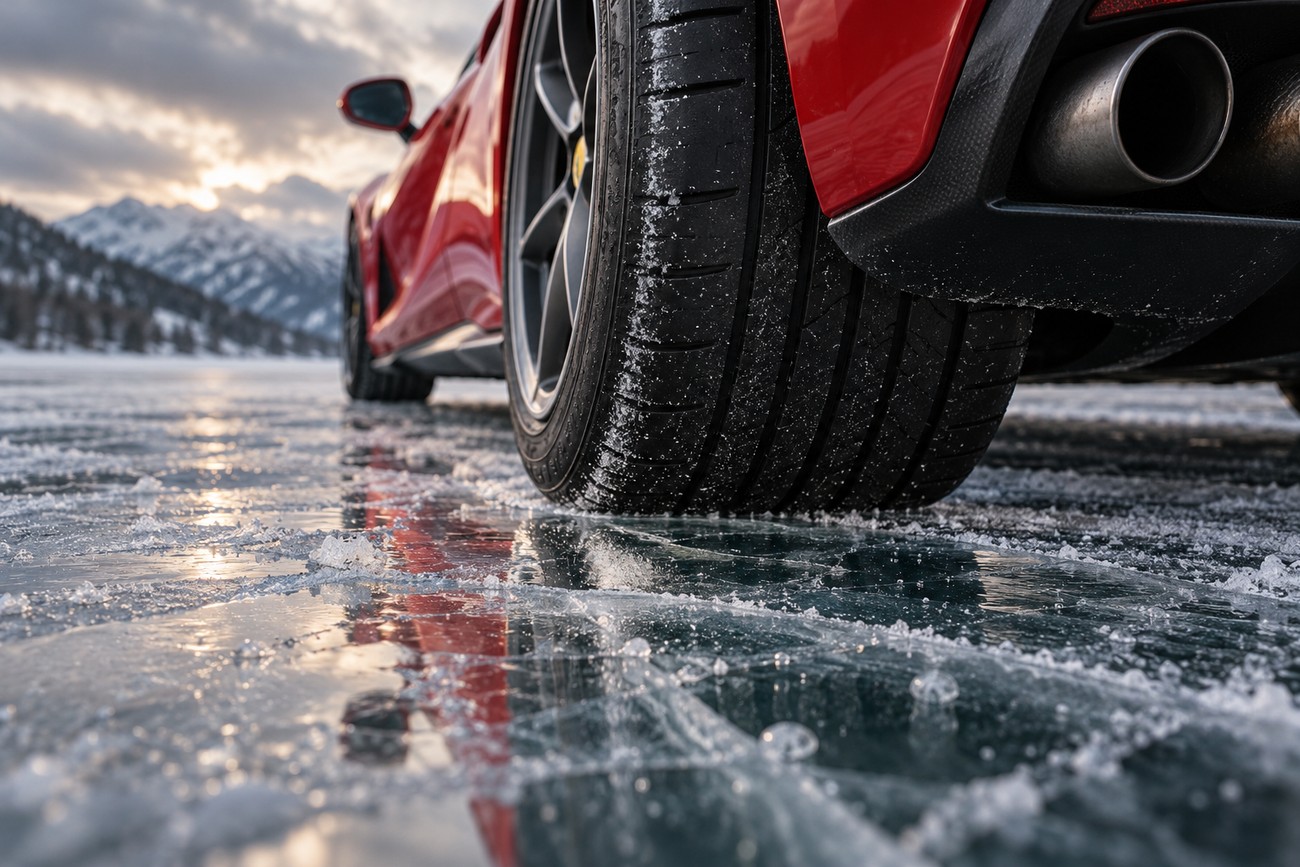
The V12’s 800 CV, approximately 789 mechanical hp, is calibrated for a car that can put power through its tires. The 812 normally wears high-performance summer tires, which are not intended for ice or freezing conditions. On untreated ice, their contact patches may offer too little grip for predictable acceleration, steering, or braking.
Ferrari’s CST, F1-Trac, and E-Diff 3 can manage available traction; they cannot create grip that the tires and surface do not provide. A flashing intervention light means a system is responding to lost traction, not that it has found a safe margin. ABS likewise cannot promise a short or consistent stop on a surface with little friction.
Small, smooth throttle and steering inputs reduce abrupt demands on the tires, while low speed leaves more room to respond. These are limits on risk, not instructions that make an unassessed natural lake safe. A dramatic, repeatable drift calls for preparation and a suitable venue; it should not be expected from a powerful rear-wheel-drive car on ordinary summer tires.
Surface conditions can change the result within the same shot. Polished ice or a film of water may reduce usable grip, and a car can slide farther than its driver expects without any high-speed maneuver. The appropriate response to uncertain grip is to reconsider the location and equipment, rather than ask the electronics or the V12 to resolve it.
What an organized ice shoot keeps out of frame
An assessed, managed ice venue is materially different from an improvised shoot on a natural lake. Depending on local rules and the event, an organized operation may check the ice and route, plan loads, limit speeds, provide suitable tires, and arrange personnel and rescue capability. Those measures require documentation and judgment; their presence cannot be inferred from polished footage.
The camera car, support vehicles, generators, and other equipment are part of the load problem. A production plan must account for where they move and stop, as well as where the Ferrari travels. The clearest-looking patch for a shot is not necessarily the place assessed for several vehicles and a crew.
A route assessed for the subject car can become a different loading case when a support vehicle parks beside heavy camera equipment on the same patch of ice. Equipment placement needs its own plan, not just a line on a driving map.
Likewise, a controlled drift on screen says little about the owner’s ability or the car’s usual setup. Prepared ice, specialist tires, and a professional driver are possible explanations in a production, but none should be asserted about an unidentified Lake Abrau image. Asking who drove, what surface was used, and what support was present is more informative than treating the finished shot as a demonstration.
The decision before any wheels reach the lake
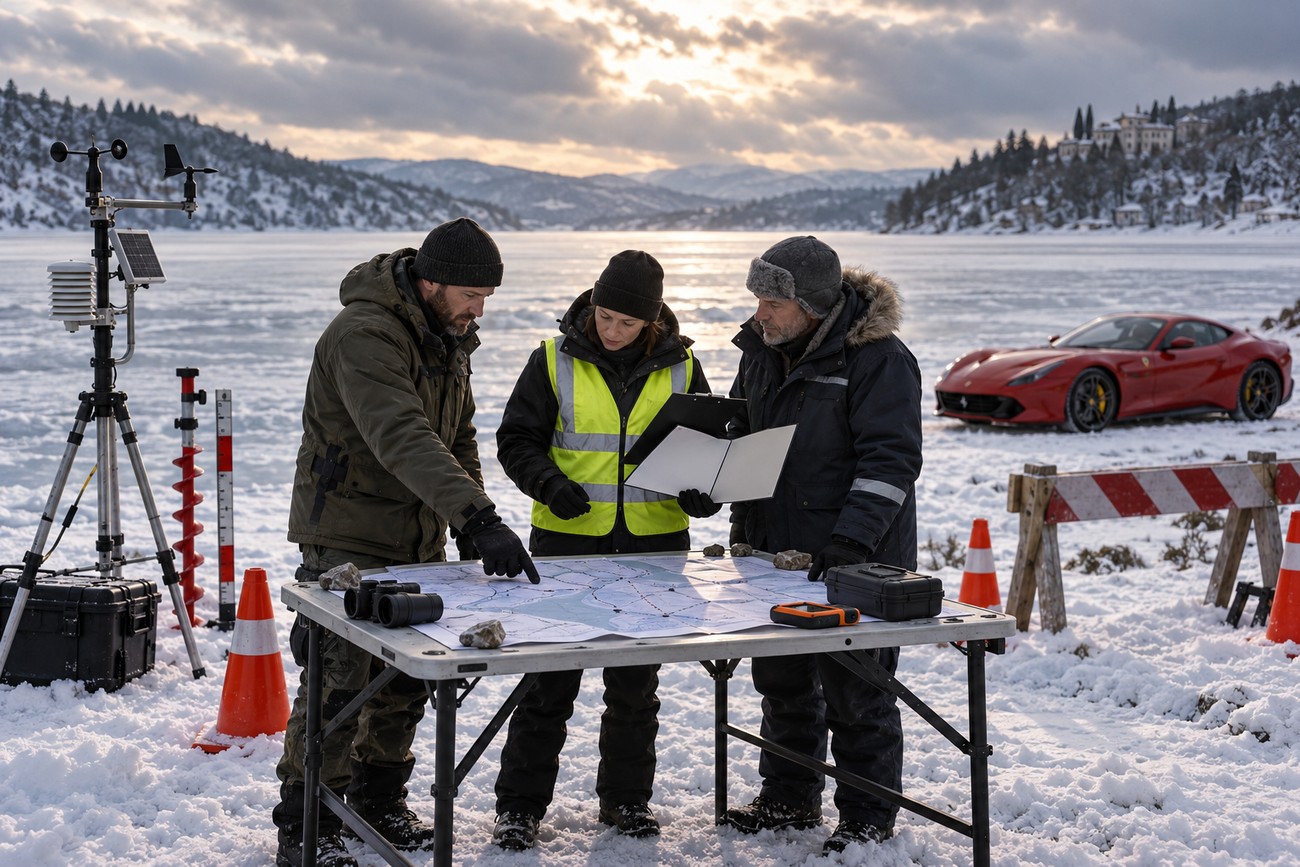
Legal access comes first. Local rules may restrict vehicles on a lake or impose environmental conditions, and permission to stand or film near shore does not necessarily allow driving onto the ice. A production needs to confirm the applicable permissions with the relevant local authorities rather than assume that an open surface is an open road.
Next comes a site-specific assessment by appropriately qualified people, covering the intended route, current ice condition, loads, and weather. Natural-lake ice has no automatically certified capacity for the 812. The assessment also has to support a practical emergency and recovery plan, including who responds and whether rescuers can work without adding to the hazard.
Insurance is a separate written check. Ordinary road cover may exclude natural-lake, off-road, or event use; an event’s promise of protection does not establish what an owner’s policy pays. The applicable policy wording and any event-specific cover should address both vehicle damage and recovery before anyone relies on them.
Each check answers a different question: permission does not establish ice strength, an ice assessment does not supply rescue capability, and a camera crew’s precautions do not establish insurance cover. If any essential permission, assessment, or emergency provision is missing, the sound alternative is to keep the car off the lake. The V12 can still be photographed from solid ground without turning an unverified surface into a driving route.
Frequently asked questions
Three practical questions remain after the location and driving plan have been considered. They concern the written scope of cover, the car’s condition after exposure to winter moisture, and how to judge its value without relying on an unsupported price. Each deserves an answer specific to the vehicle and circumstances.
What should an owner ask an insurer before an ice shoot?
Ask in writing whether a natural lake is an excluded location, whether filming or event participation changes cover, and whether recovery costs are included if the car becomes stranded or damaged. Give the insurer the proposed location and activity, and request confirmation under the actual policy or any event-specific cover; promotional wording alone is not an answer.
What should be inspected after a winter filming session?
Have the brakes, underbody, suspension, and exhaust checked for trapped moisture, debris, and contamination, particularly if the car encountered slush or treated access roads. Prompt inspection can catch residue or a developing fault, although a session near ice does not mean corrosion has occurred.
How much is a Ferrari 812 Superfast worth?
Its asking price depends on model year, mileage, condition, specification, and local market. Use dated listings for comparable cars, then consider service history and any evidence of winter-use damage; no reliable current sale-price range for a particular 812 is established here.







